
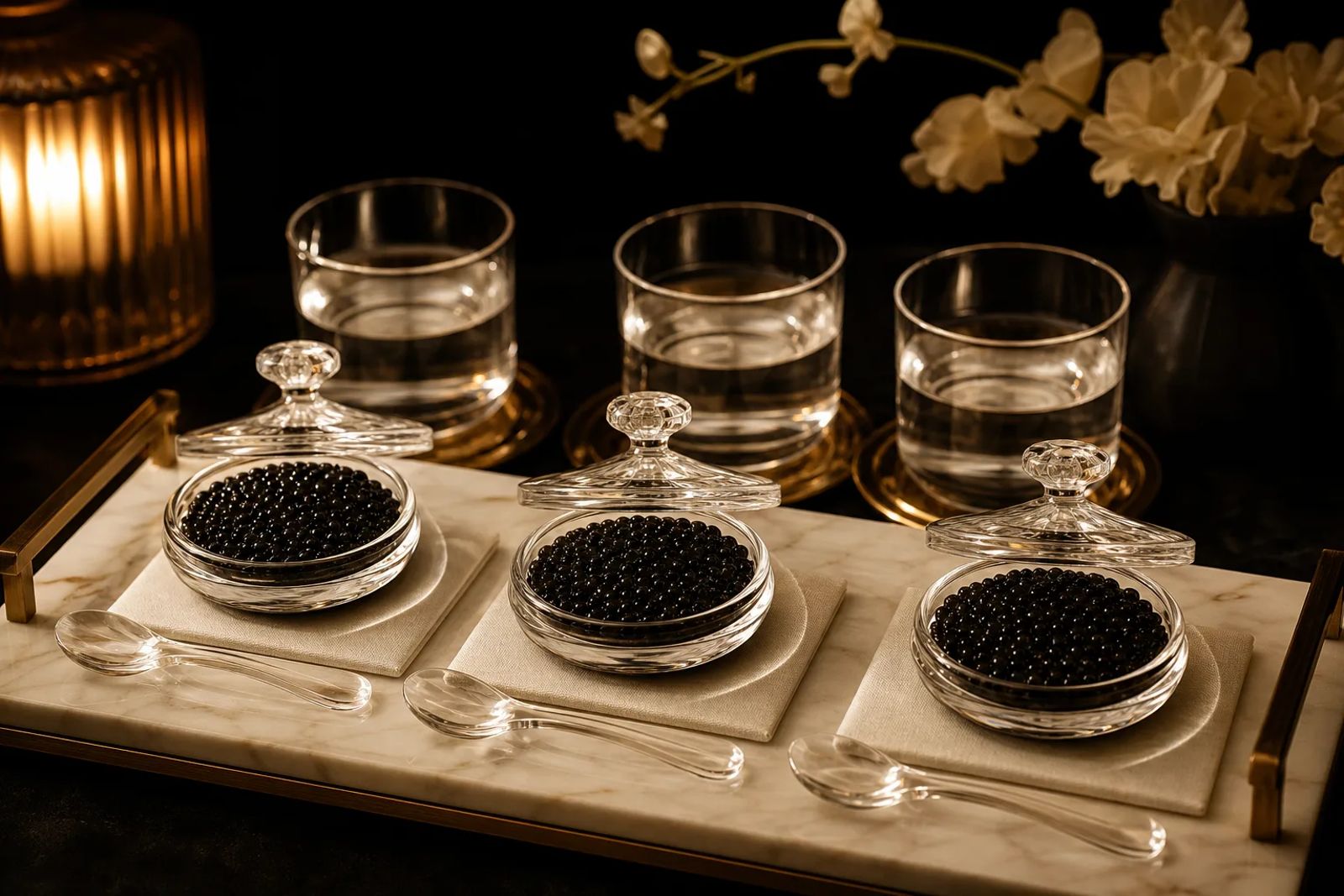
Eight assessors, two commercial caviars, approximately 5 g in each covered glass. In a 2025 study, Rodrigues da Silva and colleagues turned caviar's aroma into a set of defined, measurable observations. Fatty, grassy, fishy: each sensation had its own place on the scale.
That precision is the heart of professional caviar tasting. Coded or blind samples are compared under controlled conditions, with appearance, aroma, texture, flavour and finish recorded against agreed definitions. Trade tasters use the results to select or accept lots. Research panels follow a specified experimental method to measure attributes or establish whether samples differ.
- Separate attribute intensity from liking and purchasing decisions.
- Set the method and acceptance criteria before revealing sample identities.
- Keep individual scores, not just the panel average.
Trade tasting and research answer different questions
Does this lot fit the specification and its intended use? That is the buyer's question. Browne Trading says its caviar director grades its caviar in house for colour, firmness and taste to maintain consistency. The company's account does not establish that all buyers use the same scorecard.
Research asks something narrower: what changes during storage, how intense is an aroma, or can assessors distinguish two treatments? A descriptive score measures a named sensation. A liking score measures acceptance. Neither automatically becomes a commercial grade. The wider distinction belongs in caviar grading and quality.
Which ISO standards apply?
ISO provides sensory methods, not a caviar grading scheme. The relevant current published editions, checked in November 2026, are:
- ISO 8586:2023: selection and training of sensory assessors.
- ISO 8589:2007, with Amendment 1:2014: test room design.
- ISO 13299:2016: establishing a sensory profile.
- ISO 5492:2008, with Amendment 1:2016: sensory vocabulary.
ISO confirmed ISO 8589, ISO 13299 and ISO 4120 in 2026; ISO 5492 is listed as confirmed. Confirmation keeps an existing edition current. It does not create a new edition bearing that year's date.
Select and train the panel
Sensory competence must be demonstrated. A job title, years in hospitality or enthusiasm for caviar cannot establish it alone. ISO 8586 addresses both trained and expert sensory assessors and provides a framework for selecting and training a caviar panel.
Train assessors on the vocabulary and references the programme will actually use. Agree what firmness means, distinguish aroma from taste, and decide when to assess the finish. Have assessors score independently before discussing differences. Then repeat coded samples to check whether each person can reproduce their judgements.
A small technical panel's preferences should not be presented as representative of customers. If customer liking is the question, commission a consumer acceptance study separately from the trained panel's descriptive work.
Control the professional caviar tasting session
Write the protocol before opening the samples. The practical framework below draws on the cited methods; it is neither an ISO certification checklist nor a universal industry procedure.
| Step | What to control | Source |
|---|---|---|
| Prepare the room | Separate preparation and assessment; keep surroundings quiet, odour-free and consistently lit. | ISO 8589 |
| Blind the samples | Use random three-digit codes and identical vessels; keep the identity key outside the panel. | Rodrigues da Silva et al., 2025 |
| Standardise presentation | Match portion size, spoon material, temperature and time after opening. | Editorial protocol; Petrossian serving guidance |
| Reset the palate | Provide plain water; keep any cleanser and the interval between samples consistent. | Editorial protocol |
| Record independently | Collect scores before discussion; retain replicate results separately. | ISO 13299; editorial protocol |
For trade tasting, Petrossian's dedicated temperature guidance recommends serving at 8 to 9°C (46 to 48°F). This is serving advice, not a research standard or storage instruction. Keep reserve samples under the producer's validated refrigerated conditions and bring out only the portions needed.
Use identical clean glass spoons, or another consistent, neutral utensil such as mother-of-pearl. Petrossian advises against silver, not steel. For comparison, the essential discipline is to keep the utensil unchanged across samples. Taste the caviar alone during the analytical stage: accompaniments introduce extra variables.
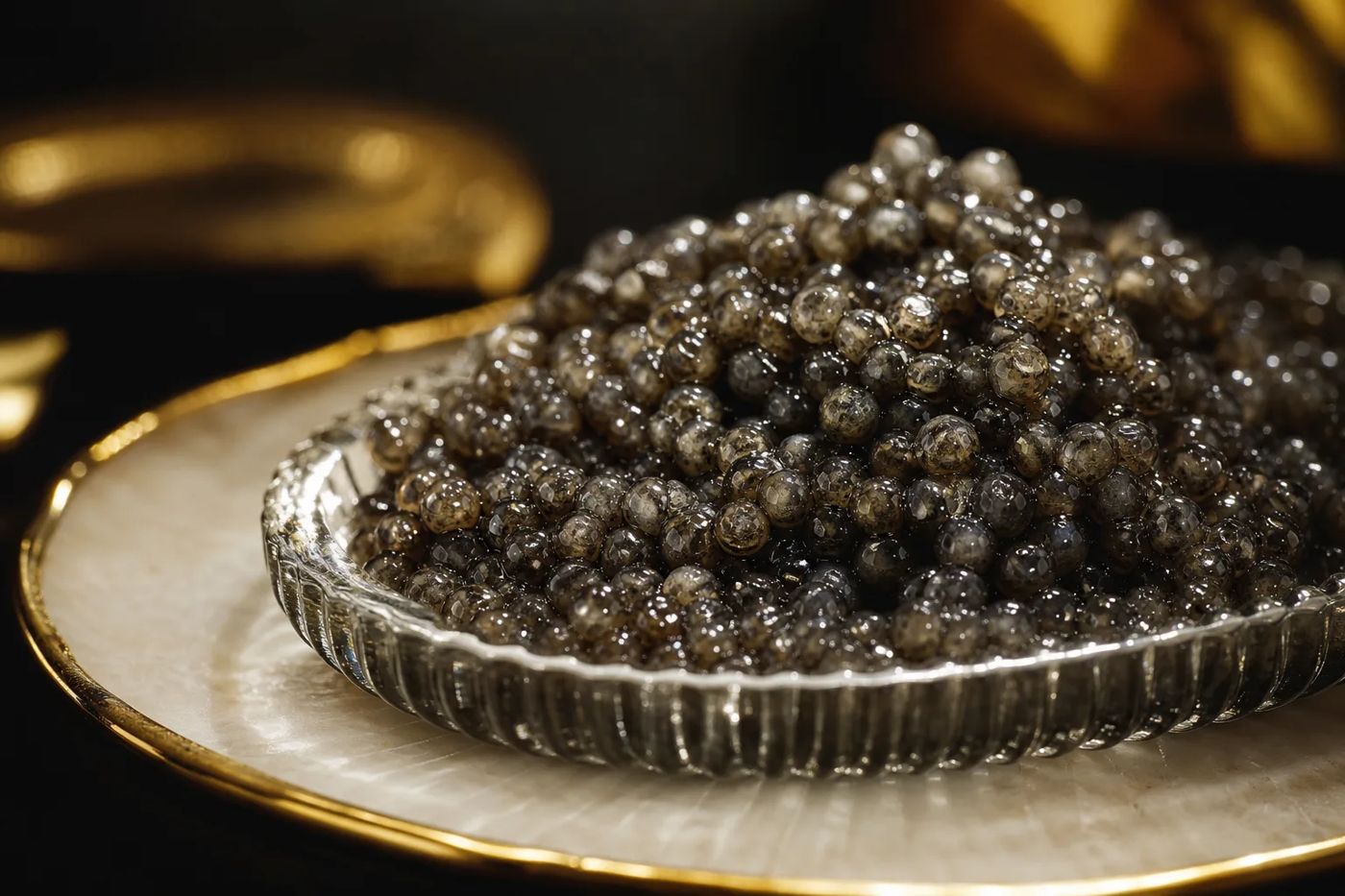
Firmness before a bead ruptures is not the same sensation as the mouthfeel afterwards.
Rotate or balance presentation order across assessors instead of giving everyone the same sequence. This recommended protocol is intended to reduce order effects and carryover, where one sample influences perception of the next. Record the sequence so that an apparent sample difference can be checked against its position in the tasting.
What published studies actually scored
The 2025 aroma study by Rodrigues da Silva and colleagues introduced above shows how a defined sensory scale works in practice. Its covered glasses carried random three-digit codes. Assessors developed descriptors, then rated their intensities using reference odours. The scale ran from 0, no perception, to 10, strong perception.
Attributes included fatty, green or grassy, wheat, fishy, and seawater or algae-like. These words describe that panel's aroma profile, rather than compulsory defects or a complete tasting scorecard. The reported room temperature was 21°C (70°F); it should not be mistaken for a measured caviar serving temperature.
A separate 2024 refrigeration study, Multi-omics combined approach to analyze the mechanism of flavor evolution in sturgeon caviar, used 15 trained assessors. Over six weeks, they scored glossiness, fullness, odour, umami and spring on a five-point scale. Its endpoints were 1, not at all, and 5, overwhelmingly.
The studies used different tools because they asked different questions. Neither scale is an international caviar quality grade. Turning either into a score out of 100 would require a separately defined and justified scoring system.

Build the attribute list before the scorecard
Firmness before a bead ruptures is not the same sensation as the mouthfeel afterwards. Record them separately. The same discipline applies across a full trade assessment: organise observations under appearance, aroma, texture, flavour and finish, keeping colour and bead integrity distinct from aroma intensity.
Define finish precisely. Will assessors record how long it persists, the character of the aftertaste, or both? A clear question produces a more useful answer than an unexplained number.
Use this grouping as a working structure, not a universal published scale. Choose descriptors relevant to the samples and write down the endpoints. A saltiness rating tells you how salty a sample seems, not whether that saltiness is desirable. Keep defect observations and overall suitability in separate fields.
Descriptive analysis and difference tests
Descriptive analysis explains what a sample is like and how intense its attributes are. ISO 13299 guides the construction of that profile, supporting product specifications, reference comparisons and shelf-life work. For a buyer asking what changed and why, it offers more than an unexplained total.
A difference test asks a simpler question: are the samples perceptibly different? In the triangle test, covered by ISO 4120:2021, assessors receive three coded samples, two alike and one different. They must select the odd sample.
The result needs statistical interpretation. It does not identify the better product, the attribute responsible or the size of the difference.
ISO cautions that triangle testing has limited usefulness with strong carryover or lingering flavours and requires homogeneous products. Before commissioning it for caviar, assess whether variation between individual beads and persistence in the mouth make the proposed test suitable.
Record results that support a decision
A tasting record should make the decision traceable. Use the printable tasting sheet, adding a technical annex for research. Keep the sample code, assessor identifier, date, lot reference, portion weight, actual serving temperature, opening time, presentation order, scale definitions, individual ratings and free-text observations. Store the identity key separately until scoring is complete.
For procurement, agree acceptance limits and the response to a failed attribute before seeing the results. Compare incoming lots with the agreed reference. Investigate repeated deviations rather than letting a favourable overall impression cancel them out. Browne Trading's stated aim of consistency illustrates the commercial purpose; the decision procedure here is a recommended approach.
For research, retain replicate data. Report panel size, training, experimental design, variability and the statistical method alongside the means.Those details make the record useful beyond the tasting room.
Read the limits of a score
An average can conceal disagreement. Inspect individual ratings and repeatability before treating small numerical differences as meaningful.
Context matters, too. The appearance or texture associated with one species or processing style should not become a target for every caviar.
When reporting a result, state what the score measures and the conditions under which it was obtained. A useful professional verdict identifies the lot's sensory profile, its fit with the intended specification and any reason for reassessment. It gives the reader a reasoned decision, not an unsupported league table.
Sources
-
International Organization for Standardization. ISO 8586:2023, Sensory analysis: Selection and training of sensory assessors. Second edition, April 2023. Official catalogue abstract and publication record. Official source.
-
International Organization for Standardization. ISO 8589:2007, Sensory analysis: General guidance for the design of test rooms. Second edition, December 2007; confirmed 2026. Official catalogue abstract and publication record. Official source.
-
International Organization for Standardization. ISO 8589:2007/Amd 1:2014, Sensory analysis: General guidance for the design of test rooms: Amendment 1. 2014. Official amendment record. Official source.
-
International Organization for Standardization. ISO 13299:2016, Sensory analysis: Methodology: General guidance for establishing a sensory profile. Second edition, March 2016; confirmed September 2026. Official catalogue abstract and publication record. Official source.
-
International Organization for Standardization. ISO 5492:2008, Sensory analysis: Vocabulary. Second edition, October 2008; confirmed 2024. Official catalogue abstract and publication record. Official source.
-
International Organization for Standardization. ISO 5492:2008/Amd 1:2016, Sensory analysis: Vocabulary: Amendment 1. 2016. Official amendment record. Official source.
-
International Organization for Standardization. ISO 4120:2021, Sensory analysis: Methodology: Triangle test. Third edition, March 2021; confirmed 2026. Official catalogue abstract and publication record. Official source.
-
Rodrigues da Silva, M., and colleagues; Friedrich-Alexander-Universität Erlangen-Nürnberg and collaborating institutions. Aroma profiling and volatile fingerprinting of commercial caviar (Acipenser baerii and Acipenser gueldenstaedtii). LWT, volume 230, article 118261, 2025. Author manuscript held by Fraunhofer. Research paper.
-
National Center for Biotechnology Information, PubMed Central. Multi-omics combined approach to analyze the mechanism of flavor evolution in sturgeon caviar (Acipenser gueldenstaedtii) during refrigeration storage. Original research article, 2024, section 2.9, “Sensory analysis”. Research paper.
-
Browne Trading Company. Our Caviar Partners. Undated company account, retrieved November 2026. Used only for its attributed description of in-house grading and consistency. Company source.
-
Petrossian. À quelle température servir le caviar ? Undated company guidance, retrieved November 2026. Used for its stated serving temperature only, not its storage advice. Company source.
The piece was researched through official ISO publication records, primary caviar sensory research and explicitly attributed company accounts, with editorial recommendations distinguished from published procedures.
Last checked: November 2026