
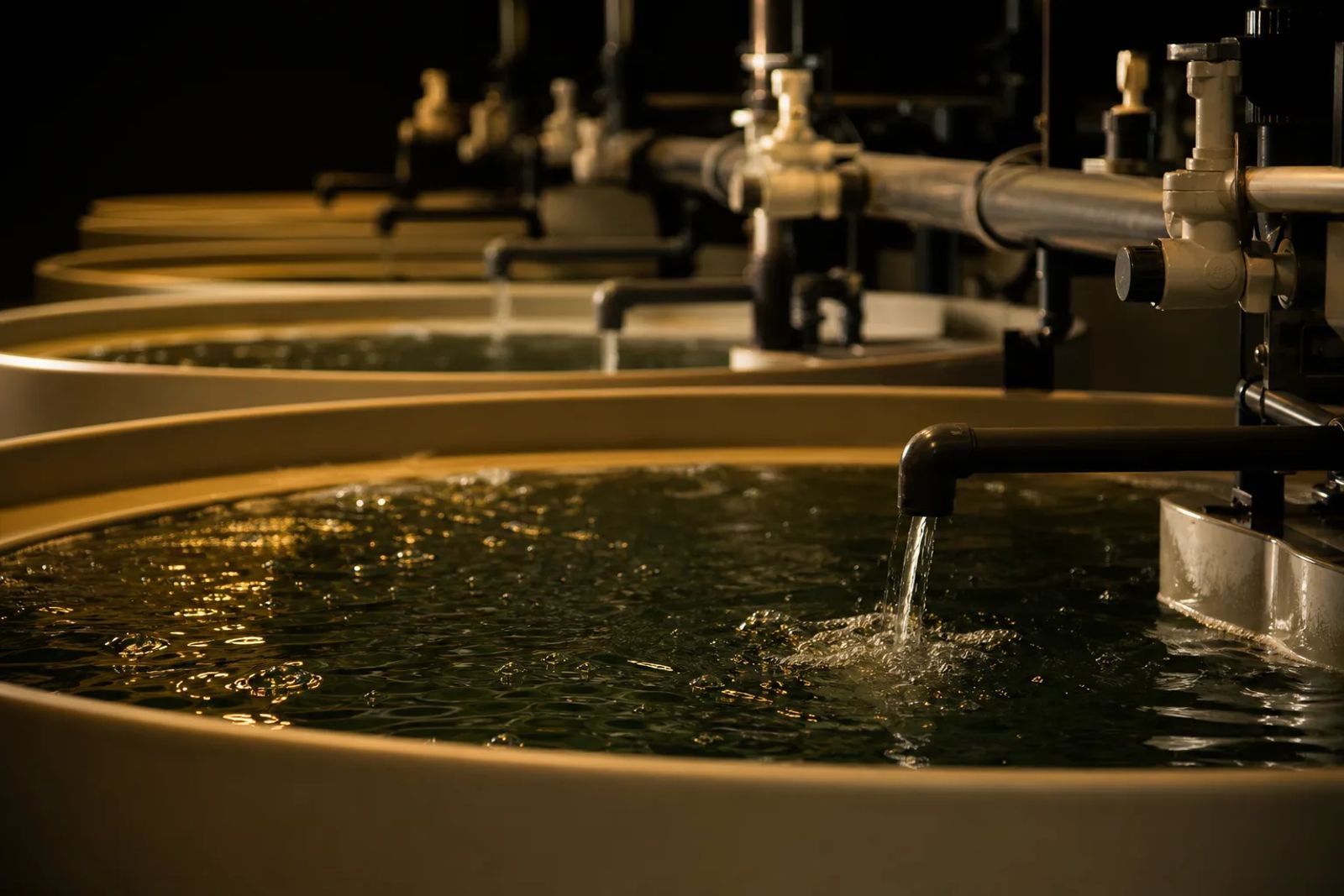
In 2018, China produced 135 tonnes of caviar, according to FAO GLOBEFISH. For a delicacy whose older international trade centred on wild sturgeon from the Caspian Sea, that figure captures a remarkable shift. Today, salted sturgeon eggs come mainly from aquaculture, with China and several European countries supplying international markets.
EUMOFA’s May 2021 report estimated global caviar production at 380 tonnes for 2018. That is a historical benchmark rather than a measure of current output; newer estimates use different methods.
- Raising the fish, processing their roe and selling caviar under a brand are distinct activities, even when one business does all three.
- An importing country can also be a producer, a repacking centre or a route to another market.
- Sturgeon farming tonnage measures fish. Caviar is the much smaller quantity obtained from mature females.
From the Caspian Sea to the farm
The older international caviar trade revolved around wild Caspian sturgeon, particularly supplies associated with Russia and Iran. Heavy fishing pressure depleted those populations. Aquaculture grew into the main source of commercial caviar.
The transformation reached far beyond the map. A seasonal wild catch gave way to the long business of breeding fish, rearing successive generations and keeping females until their eggs were ready for processing. Hatcheries, fish husbandry and food processing became connected parts of the same enterprise.
Farming also loosened the link between a species and its native waters. A sturgeon native to one river system could be raised in another country. The shift from wild to farmed tells that history; its commercial legacy is a supply chain stretching across many countries.
Where caviar is produced
China farms the fish, produces the roe and exports the caviar. Its position is built on production, not simply on repacking another country’s output. EUMOFA’s February 2023 study of sturgeon products identifies it as the leading caviar producer.
Within the EU, Italy, France, Poland and Germany were the largest caviar producers in 2018, according to EUMOFA’s 2021 report. These are the EU leaders, rather than a worldwide ranking, and their industries combine production, processing and trade. Russia and Iran also farm sturgeon: their famous association with wild caviar tells only part of their present production story.
| Country | Volume | Unit | Year | Source |
|---|---|---|---|---|
| China | 135 | tonnes, caviar weight | 2018 | FAO GLOBEFISH, 2019 |
| China | 104,280 | tonnes, whole-fish live weight | 2020 | FAO via EUMOFA, 2023 |
These Chinese figures measure different things: finished caviar and whole fish. Keep them separate, rather than adding them together. The table offers a production snapshot; the producing-country guide covers the wider geography.
The fish behind the caviar
Siberian sturgeon, Russian sturgeon, white sturgeon, beluga, kaluga and Amur sturgeon all feature in farming and trade records. Sterlet, starry sturgeon and Adriatic sturgeon also appear in documented production or exports. The list shows the industry’s biological range; inclusion should not be mistaken for an equal share of global output.
Hybrids account for another substantial part of production. FAO’s 2019 account describes widespread hybrid farming in China, including a cross between a male Amur sturgeon, Acipenser schrenckii, and a female kaluga, Huso dauricus. That fish is a cross between two species, rather than a separate wild species.
A shelf full of brands can conceal a much smaller number of supplying farms.
The essential distinction is between the fish in the water and the name on the container. Species and parentage identify the fish biologically. A brand identifies the business presenting its roe. To establish where the fish were farmed, look beyond both familiar trade names and the nationality of the company selling the caviar.
Where caviar goes, and where it is eaten
A shipment’s destination is not always where its contents reach the spoon. The United States, Japan and the UK received 64% of extra-EU caviar export volume in 2020, according to EUMOFA’s analysis of Eurostat data. They were major destinations for EU shipments. Those figures describe that trade, rather than a global ranking of caviar consumption.
For 2018, EUMOFA estimated EU apparent consumption at 121 to 126 tonnes, with France, Germany and Spain its largest consumer markets. “Apparent consumption” is an accounting measure: production plus imports minus exports. It does not come from surveying what diners ate.
France or Germany can import caviar for local sale, processing or onward distribution. A producing country can also import species it does not supply itself. Import figures therefore reveal trading relationships as well as demand.
From farm to restaurant and retailer
Three questions make a caviar supply chain easier to follow: who raised the fish, who prepared the roe and who packed this container?
The farm raises the fish and may operate a hatchery to produce the next generation. The processor prepares, salts and packs the harvested roe, turning eggs into caviar. A repacker opens an existing container and transfers the caviar into new primary containers: the packaging directly in contact with the food.
Distributors organise supplies for other businesses. Retailers sell to the final customer, while food service covers restaurants, hotels and catering. One enterprise may handle several stages, or successive businesses may take responsibility along the way. A brand can sit above either arrangement.
That is why a familiar house name need not identify a farm.
Scale, concentration and ownership
A shelf full of brands can conceal a much smaller number of supplying farms. The industry includes integrated businesses that rear fish and process roe, alongside specialist farms, repackers and trading houses. Integration can give a business control over several stages; brand counts alone reveal little about how many independent farms supply them.
The source behind a market headline matters just as much. A June 2026 company prospectus reports a commissioned CIC estimate of 808.4 tonnes of global caviar sales volume in 2025. This is company-commissioned market research measuring sales, rather than a new FAO production total. It cannot simply replace the earlier EUMOFA benchmark.
To understand ownership, follow legal entities, filings and documented relationships between farms and brands. Producers and companies follows that evidence. Production estimates describe scale; establishing corporate control requires a different trail.
What shapes value and quality
Caviar begins with the female fish’s biological timetable. Her species, age, condition and stage of egg development influence when roe can be harvested and what the farm can produce. Long rearing periods give breeding decisions a long reach: choices about stock shape supply well before a container reaches a customer.
Water management and feeding support fish throughout growth and maturation. They are central to husbandry, and their effects sit alongside those of the individual animal and the farming system. A species name is useful information, but it cannot tell the whole story of production quality.
After harvest, handling, salting, maturation and temperature management shape the finished caviar and its consistency. Traceability serves a separate purpose, providing an accountable record of species, origin and processing. Food safety depends on appropriate controls throughout production and distribution, rather than on an attractive appearance or traceability records alone.
The rules behind the trade
CITES supplies the international wildlife-trade framework for sturgeons and paddlefish. National or regional law puts that framework into effect, so domestic requirements differ. Its caviar labelling system supports traceability; the label itself does not verify a container’s contents.
Food law separately governs safety and consumer information. The EU has its own regime. Great Britain uses domestic and assimilated legislation, while EU food law continues to apply in Northern Ireland. US requirements include FDA seafood controls and wildlife rules under 50 CFR 23.71.
China, Russia, Iran and Kazakhstan have their own implementing systems. Neither historical Caspian origin nor farmed status alone grants permission to export or import. The industry hub places these regulatory requirements in the wider context of the caviar trade.
Reading the numbers clearly
Keep four things attached to every industry figure: the product, the unit, the year and the reporting method. Fish production, caviar production, sales and cross-border shipments measure different activities. A country with a strong sturgeon meat industry need not have a comparably strong caviar industry. EUMOFA highlights Armenia, whose caviar exports are far lower than its sturgeon farming output would suggest.
Trade figures need careful reading too. Importer and exporter reports can disagree. Re-exports can count the same caviar as it crosses successive borders, and customs groupings need checking for other roe. Domestic sales and changes in stored stock further affect how trade relates to consumption.
Those distinctions make comparisons more useful, not less. Before ranking countries, adding trade flows or interpreting a growth claim, establish exactly what each figure counts. Reading production statistics explains how to make those comparisons on a sound basis.
Sources
-
EUMOFA. The caviar market, May 2021. Report
-
EUMOFA. Sturgeon meat and other by-products of caviar. February 2023. Report
-
Food and Agriculture Organization of the United Nations, GLOBEFISH. Chinese sturgeon and caviar industry. 30 September 2019. Article.
-
EUMOFA. COVID-19 impacts on farmed species: focus on turbot and caviar. 2022 edition. Report
-
Chebanov, M. S. and Galich, E. V., FAO. Sturgeon hatchery manual. FAO Fisheries and Aquaculture Technical Paper 558, reprinted 2013. Manual.
-
Hangzhou Qiandaohu Xunlong Sci-tech Co., Ltd. Global offering prospectus. 22 June 2026, “Industry overview”. Market estimates attributed to commissioned CIC research. Prospectus.
-
Water. Economic analysis of sturgeon farming and caviar production: a case study of an Italian fish farm. Volume 16, article 2618, 15 September 2024. Research article.
-
European Commission. EU Wildlife Trade Reference Guide, Annex XIV, online edition. Caviar labelling guidance.
-
United States Food and Drug Administration. Aquacultured seafood. Content current as of 19 September 2023. Authority guidance.
-
Food Standards Agency. General food law. Online guidance, originally published 23 January 2018, current text retrieved November 2026. Authority guidance.
-
United States Code of Federal Regulations. 50 CFR 23.71: How can I trade internationally in sturgeon caviar? Online text reproduced by Cornell Legal Information Institute. Regulatory text.
-
CITES Secretariat. Resolutions of the Conference of the Parties in effect after the 20th meeting. Online index, including Resolution Conf. 12.7 (Rev. CoP17). Resolutions index
Researched from the dated sources listed above.
Last checked: November 2026