
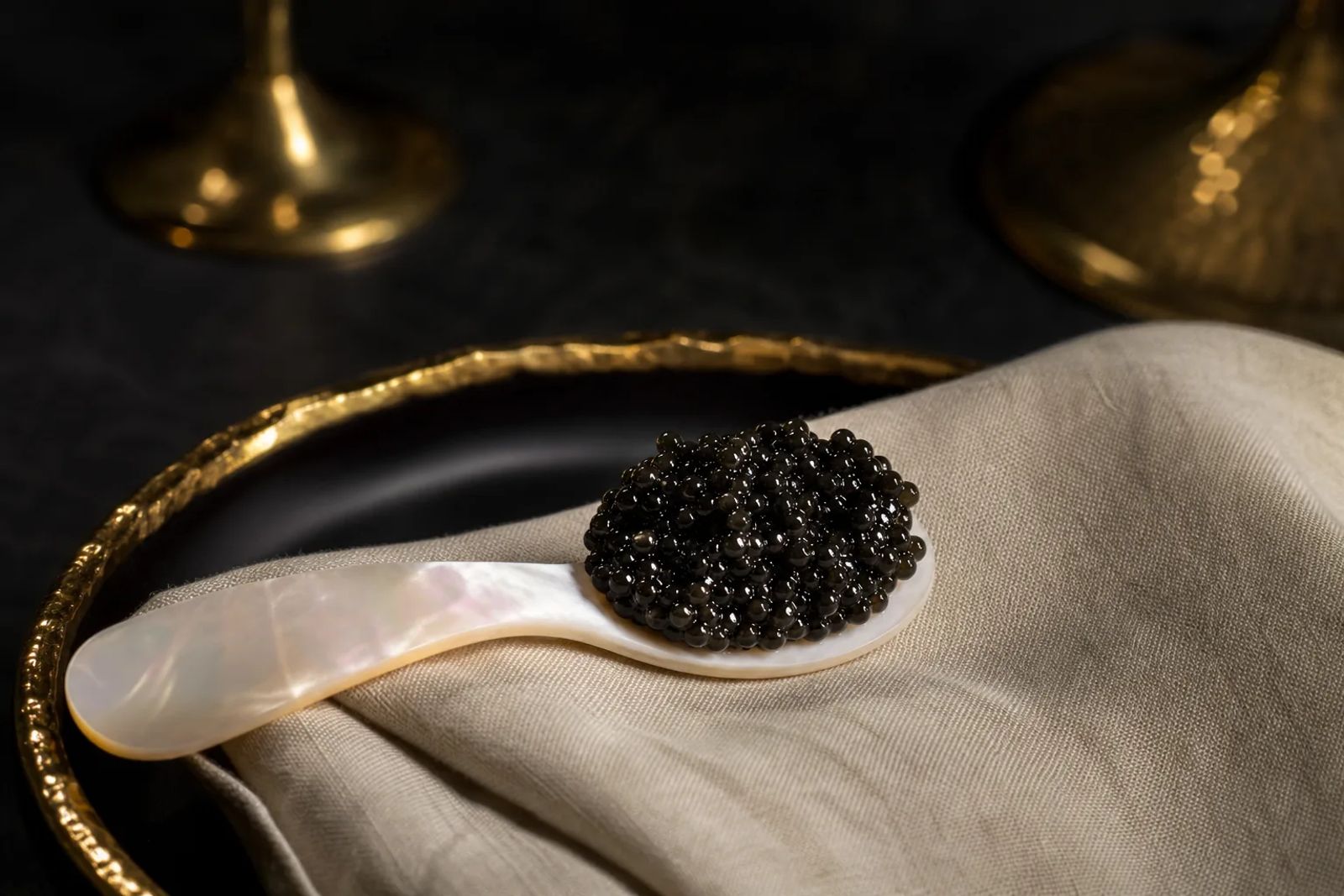
Choose a small amount of well-labelled, farmed sturgeon caviar, such as Siberian sturgeon or Ossetra, and serve it simply. Firm beads, hazelnut and a lingering finish: that is how one producer describes its Ossetra 2. A little on a clean mother-of-pearl spoon gives you a moment to notice what happens.
An identifiable fish, a clear origin and a manageable quantity give you a useful first reference without burying the pleasure in choice.
- Choose the experience you want: gentle salinity, a classic tasting reference or a more noticeable bead.
- Ask which species sits behind menu words such as Royal or Imperial.
- A guided tasting lets you compare without committing to several tins.
Choose your first caviar by experience
Start with curiosity, not a catalogue of fish. Decide what appeals to you, then ask a knowledgeable supplier or server for a batch that fits. The flavour descriptions below are producer and retailer product notes, not universal species profiles.
For a straightforward starting point
Siberian sturgeon, Acipenser baerii, makes a sensible first choice: it is farmed in several countries and can be clearly identified on the label. Ossetra is another useful starting point when the seller can name the species or hybrid behind it. Explore Siberian sturgeon caviar for more about the fish.
Siberian does not automatically mean mild. One producer describes its caviar as mild with a hazelnut aftertaste 1; another describes oyster and seaweed characters 2. Ask about the batch, not just the name.
For a mild, approachable style
Ask about white sturgeon, Acipenser transmontanus, and say that you want gentle salinity rather than a strong marine finish. One producer describes its white sturgeon caviar through fruit, gentle marine salinity and a clean finish 2. That style is worth considering if you feel hesitant about your first taste.
If you already enjoy oysters or other strongly marine foods, tell the server. Your own appetite gives them more useful information than a request for whatever beginners are supposed to like.
For a classic tasting reference
Ossetra identified as Russian sturgeon, Acipenser gueldenstaedtii, pairs a familiar caviar name with a clearly stated species. One producer describes hazelnut, firm beads and a lingering finish in its Ossetra 2. Those are useful things to look for: flavour, texture and what stays with you afterwards.
There is no need to begin with the historic trio of Beluga, Ossetra and Sevruga. Leave the classic three compared until you have a first taste to connect with the distinctions.
For a more noticeable bead
If texture intrigues you most, ask about a Kaluga hybrid. One retailer describes its example as having large beads, a soft, sustained finish and subtle brine 3.
For a first purchase or tasting, identifying the fish is worth more than another decorative adjective.
One documented cross pairs a male Amur sturgeon, Acipenser schrenckii, with a female Kaluga, Huso dauricus, using the scientific names recognised by CITES. Other hybrids also appear on menus. Ask for both parents: hybrid describes parentage, not a flavour or quality grade.
For a gentler introduction to roe
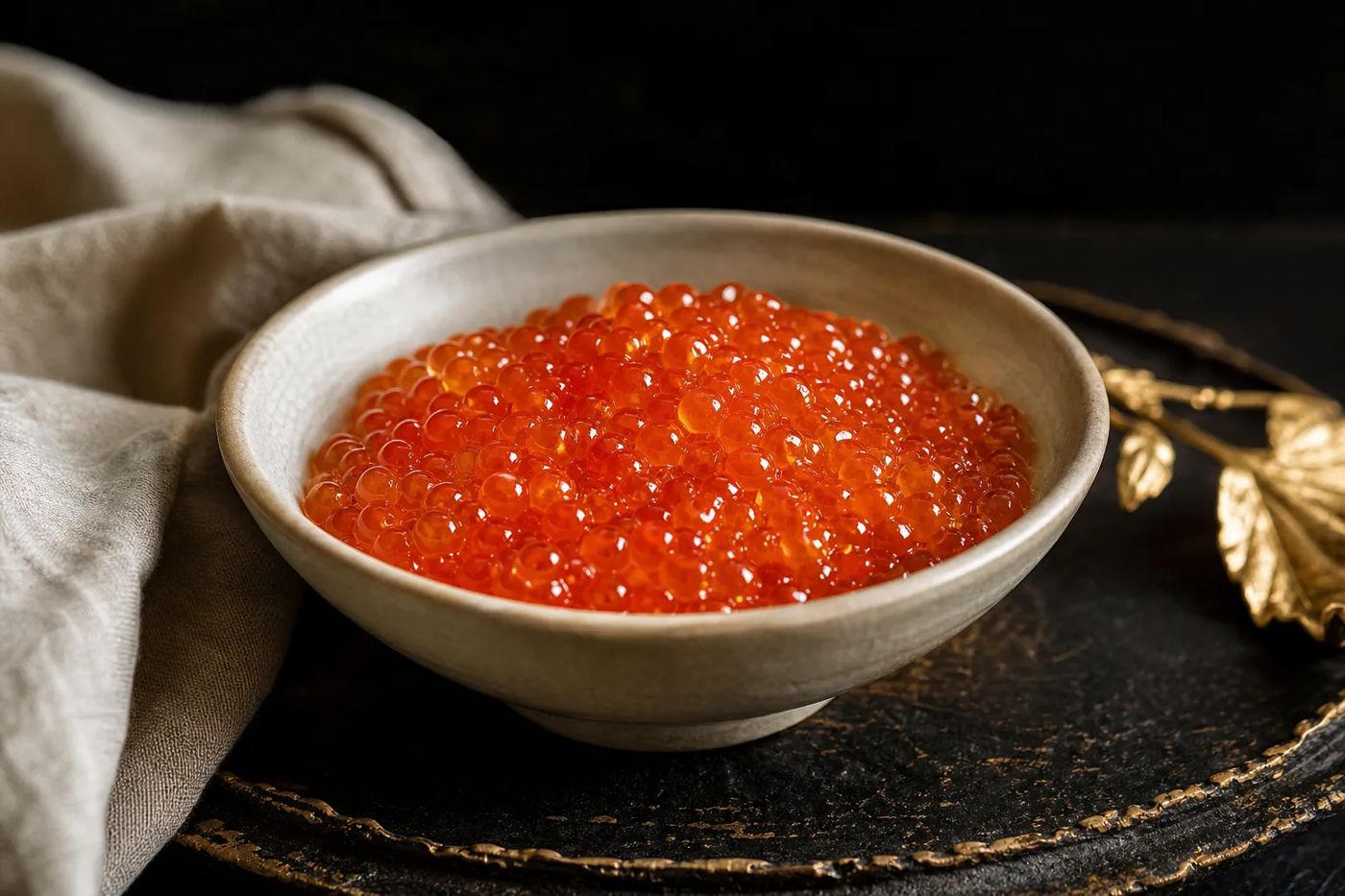
Salmon or trout roe, meaning fish eggs, may feel more approachable if those fish are already familiar. One retailer describes its trout roe as light and juicy, and its salmon roe as briny with a pronounced pop 3.
Enjoy them as an introduction to roe in their own right, rather than as a rehearsal that predicts sturgeon caviar. In the United States, FDA guidance recommends that roe from other fish sold as caviar carries the fish name, such as salmon caviar. This guidance is not a worldwide naming law.
Look past the name on the front
Royal, Imperial, Golden and Reserve tell you less than the name of the fish. They are trade descriptions, not species names or a universal grading system. Ossetra and Oscietra are trade spellings, too, so look beyond the front label and identify the fish.
Take particular care with phrases such as Kaluga Beluga. Beluga means the species CITES lists as Huso huso. The combined phrase alone does not tell you whether the contents are beluga, pure Kaluga or a particular hybrid.
Once you have narrowed the choice, matching species to taste offers a fuller comparison. For a first purchase or tasting, identifying the fish is worth more than another decorative adjective.
Try a tasting or choose a small tin
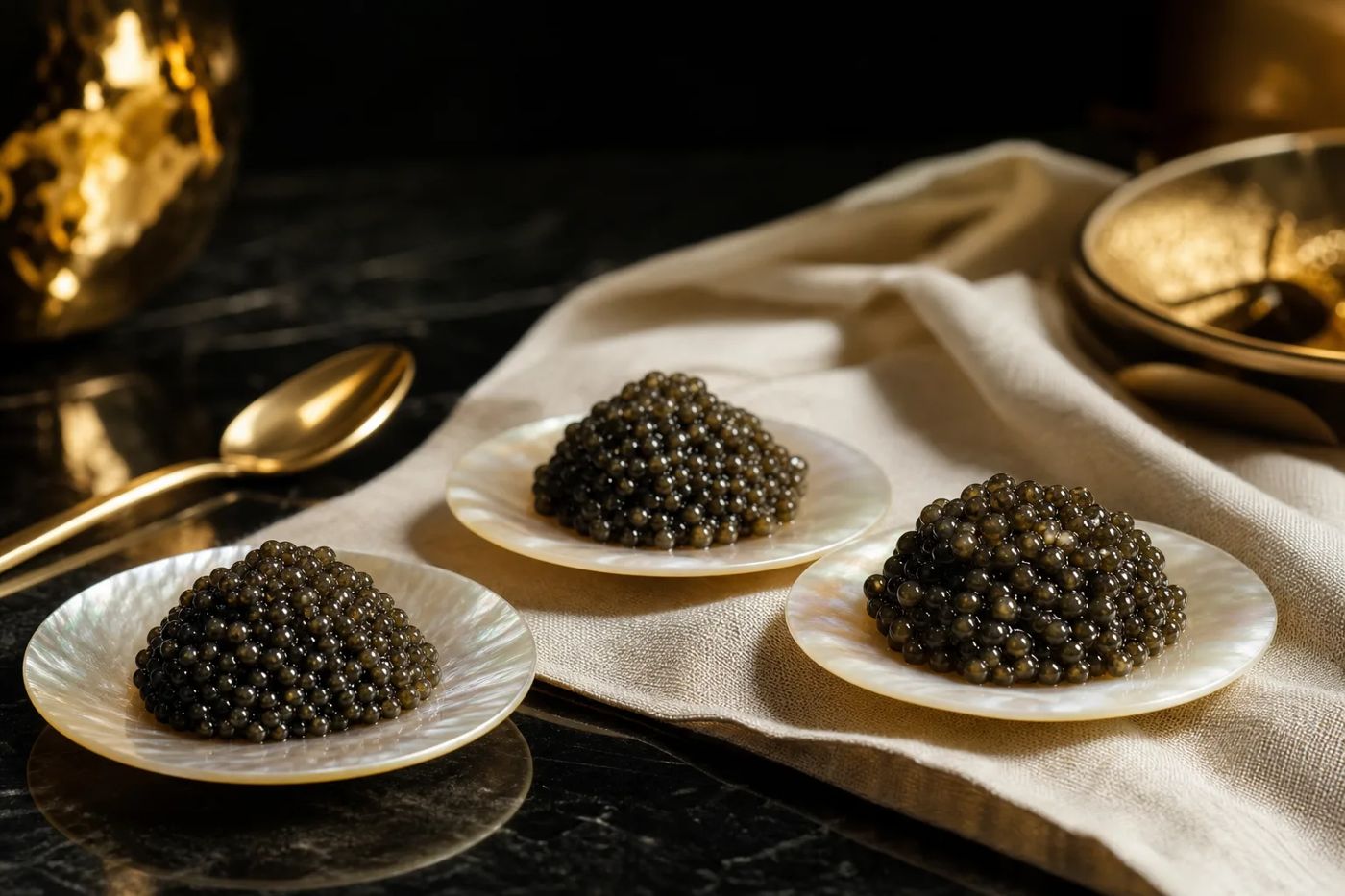
Plan on 15 g per person, about half an ounce, for a first tasting. This site's suggested standard serving is a practical starting point rather than a regulatory serving size. A 30 g tin, about 1 oz, gives two people that amount each.
Adjust the quantity to the occasion. For a meal or a larger gathering, use portions by occasion instead of multiplying a garnish into a full serving.
Before ordering several tins, ask a restaurant offering caviar service or an organised tasting whether you can compare small samples. Check what is included. Ideally, each fish should be named, each roe tasted on its own, and someone should be ready to explain the differences without steering you towards a prestige label.
A comparison helps you discover what matters most to you: salinity, texture or the finish, meaning the flavour that remains after swallowing. For a quiet tasting at home, one small tin keeps the experience focused and pleasurable, rather than turning it into an examination.
Your first tasting checklist
-
Confirm the fish and origin. Ask for the species, both parents for a hybrid, and the country where the roe originated. A company's address or the place of repacking may be different from that origin. If ordering remotely, request a photograph of the actual label so you can check the details before choosing.
-
Check the CITES label. CITES is the international wildlife trade convention. Look for the declared species code, source code and country of origin. The species code identifies the declared fish or hybrid; the source code describes its declared origin category. The label provides traceability rather than verification of the contents, and domestic requirements depend on the jurisdiction. Some travellers may carry up to 125 g of qualifying caviar as personal effects, subject to conditions. See how to read a caviar label for the full explanation.
-
Check the date and cold chain. Choose a use-by date that covers your tasting. Ask how the supplier keeps the product chilled through delivery, then follow the producer's validated storage and after-opening instructions. The cold chain means maintaining the required temperature throughout transport and storage.
-
Plan the quantity and accompaniments. Use the tasting quantity above as your starting point. If you want accompaniments, have plain blinis, small pancakes, and crème fraîche ready. Keep the cream light so it does not cover the caviar.
A pleasant smell or reassuring appearance cannot override handling instructions or a use-by date. The UK's Food Standards Agency advises that the sniff test cannot establish the safety of foods carrying a use-by date. If delivery conditions are doubtful, contact the supplier before tasting.
Serve simply and notice what you enjoy
Use a clean mother-of-pearl or glass spoon and taste a little caviar unaccompanied first. When comparing two samples, taste both this way before adding a garnish to either. Notice whether the beads feel firm or soft, how the salt arrives and whether another flavour remains afterwards. There is no need to recognise somebody else's tasting vocabulary. Your own words are enough.
For the next bite, add a little crème fraîche to a plain blini and place a small amount of caviar on top. Keep strong garnishes, lemon and raw onion aside during this first comparison. You can then judge what the roe contributes before bringing in more flavours.
Do not use heavily dyed lumpfish roe to decide whether you like sturgeon caviar. It is a different fish product, and liking or disliking it answers a different question. Neither its colour nor its name makes it a substitute for tasting the caviar that caught your interest.
For a comparison, write down a few ordinary words, such as firmer, saltier or longer finish, and choose the one you want another spoonful of. That is a useful first conclusion.
Where to go next
- How to Eat Caviar: Tasting It Properly: follow a fuller tasting method.
- Caviar for Beginners: find the next explanation when another question comes up.
Sources
-
Azienda Agricola Pisani Dossi s.s. Pisani Dossi Farm, undated web edition, retrieved November 2026. Producer descriptions of its Siberian caviar and an Ossetra-labelled hybrid, used as attributed product statements only.
https://pisanidossi.com/en/azienda-agricola-pisani-dossi-english/ -
Calvisius. Undated producer descriptions of white sturgeon, Ossetra and Siberian products, including their texture and finish, retrieved November 2026;
-
Just Caviar. Species guide: Osetra, Kaluga, Beluga, and the rest, undated web edition, checked November 2026. Retailer descriptions of its Kaluga hybrid, salmon roe and trout roe;
https://justcaviar.us/pages/species-guide -
CITES Secretariat. Resolutions of the Conference of the Parties in effect after the 20th meeting, current index retrieved November 2026. The index lists Resolution Conf. 12.7 as Rev. CoP17.
https://cites.org/eng/res/index.php -
European Commission. EU Wildlife Trade Reference Guide, Annex XIV: Caviar labelling, undated online edition, retrieved November 2026. Explains label fields, origin and repacking, and the EU's implementation of the system.
https://environmental-data.ec.europa.eu/cites/reference-guide/chapters/annexes_xiv.html -
US Fish and Wildlife Service. 50 CFR 23.71: How can I trade internationally in sturgeon caviar?, annual CFR edition revised 1 October 2025. Paragraphs (b)(2) and (b)(3) distinguish species, source, origin and processing or repacking fields.
https://www.govinfo.gov/content/pkg/CFR-2025-title50-vol9/pdf/CFR-2025-title50-vol9-part23.pdf -
US Food and Drug Administration. CPG Sec. 540.150: Caviar, Use of Term, Labeling, October 1989, current guidance page retrieved November 2026. Nonbinding US guidance on naming salted sturgeon roe and other fish roe.
https://www.fda.gov/regulatory-information/search-fda-guidance-documents/cpg-sec-540150-caviar-use-term-labeling -
Food Standards Agency. Home food fact checker, current GOV.UK web edition, retrieved November 2026. Explains why smell cannot establish the safety of food carrying a use-by date.
https://www.gov.uk/government/publications/home-food-fact-checker/home-food-fact-checker -
Food and Agriculture Organization of the United Nations. Sturgeons (Acipenseriformes), undated report chapter, retrieved November 2026. Background on sturgeon species, caviar names and aquaculture; not used for contemporary production totals.
https://www.fao.org/4/y5261e/y5261e06.htm -
Richard Corrigan, Great British Chefs.** Ossetra caviar with blinis and sour cream, published 2015, checked November 2026. The chef's method serves caviar over ice with blinis and sour cream separately.
https://www.greatbritishchefs.com/recipes/blini-recipe
Researched from the dated sources listed above. No first-hand tasting was undertaken.
Last checked: November 2026