
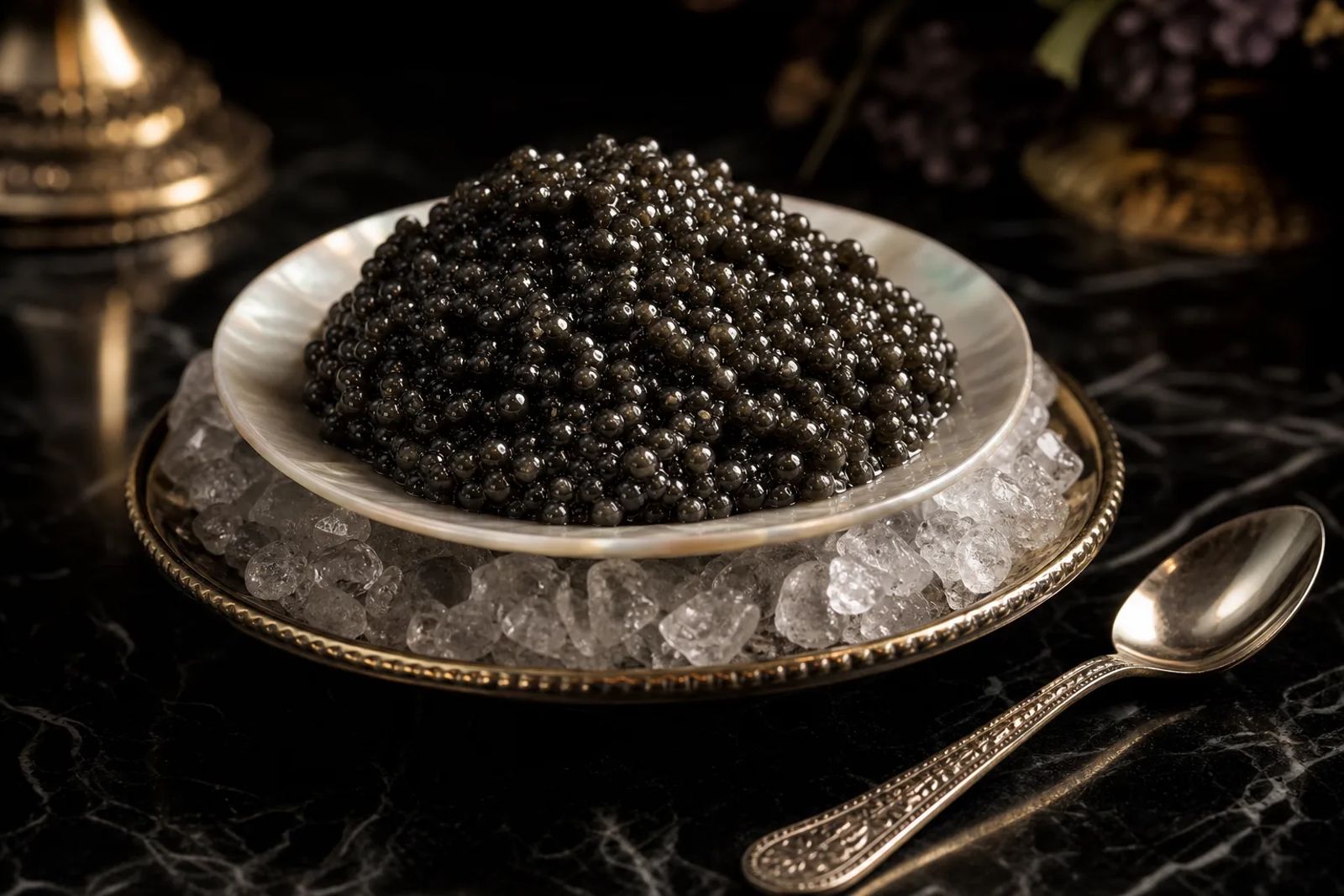
A beluga can live for more than a century: the IUCN records one reaching 118 years. This immense, slow-maturing sturgeon produces the salted roe, meaning fish eggs, known as beluga caviar. The species is Huso huso, whatever the eggs’ size, colour or name on the tin. Kaluga and beluga hybrids are different fish. Today, documented farmed production sits alongside heavily restricted wild trade and a separate set of US rules. 3,16,22,26
Beluga at a glance
| Field | Details |
|---|---|
| Names | Beluga; giant sturgeon; beluga caviar. 1,2 |
| Scientific name and synonyms | Huso huso under CITES; Acipenser huso in the October 2025 IUCN Sturgeon Specialist Group classification. 3,26 |
| CITES | Appendix II, effective 1 April 1998; species code HUS. 3,12 |
| IUCN | Critically Endangered; confirmed in the July 2022 update. 5 |
| Native range | Caspian, Black, Azov and Adriatic seas and their tributaries; Adriatic occurrence is historical. 1,26 |
| First farm harvest | Not documented; maturity and harvest age are different measures. 26 |
| Egg diameter | 3.6 to 4.3 mm for documented Volga beluga eggs, rather than finished salted caviar. 1,26 |
| Roe colour | Light to dark grey; colour and diameter alone cannot identify the species. 2,21 |
| Documented farming | Belgium, Italy and China; older records document Spain and Florida, United States. 8,9,10,11,18 |
| Wild trade | Appendix II controls apply; destination restrictions appear below. Checked November 2026. 3,13,16 |
One species, not a style
Beluga is a fish, not a description of large, pale eggs. Codex’s Standard for Sturgeon Caviar identifies it with Huso huso. Calling another species “beluga” blurs that identity; “Kaluga Beluga” is potentially misleading trade language, not a second scientific name. The broader sturgeon species guide introduces the other fish behind familiar caviar names. 3,22
The scientific naming debate is separate from the legal label. In October 2025, the IUCN Sturgeon Specialist Group and World Sturgeon Conservation Society declined to support Brownstein and Near’s proposed revision, while proposing Acipenser huso as beluga’s scientific name. CITES still uses Huso huso, the name followed here and the one that should not be silently changed on a legal label. 3,4,6
A giant that takes its time
Beluga is among the largest sturgeons: a heavy-bodied predator that moves between coastal waters and rivers to reproduce. Its native range describes its natural geography, not the origin of farmed roe. A fish reared outside those basins remains Huso huso; where its roe was produced is a separate question. 1,19
The wait for maturity is measured in years, sometimes decades. FAO gives wild female maturity at 16 to 18 years, or 14 to 16 years in the Azov population. Males mature at 12 to 14 years, or 10 to 12 in Azov. EUMOFA gives a later wild maturity range of 19 to 22 years. Against that slow pace, the IUCN’s record of a beluga reaching 118 years becomes especially striking. 1,7,26
Farming does not supply a single timetable. FAO reports females maturing at 9 to 12 years under optimal rearing with controlled water temperatures; EUMOFA gives 16 to 18 years in captivity. Kaluga Queen describes its own beluga females as averaging 20 years at maturity. Each figure belongs to its particular record, rather than a standard production schedule. 1,7,8
Grey beads, buttery aromas
Plump roe, elastic membranes and a pronounced buttery aroma: that is Kaluga Queen’s description of beluga in its 2026 prospectus. Caviar Giaveri describes its own beluga as delicate and buttery. These are producers’ accounts, not caviar.uk’s own tasting results or a promise that every batch tastes alike. 8,23
The familiar colour marks describe shades of grey. In historical FAO and US Customs descriptions, 000 denotes light grey, 00 medium grey and 0 dark grey. They are trade conventions, not statutory quality grades or flavour guarantees. Producers set their own grading, so a longer string of zeroes is no independent assessment of quality. 2,20,22
To explore a batch’s character, look beyond the name when tasting. Notice whether the beads remain intact, how readily their membranes give way, how salt balances the roe, and what remains in the finish. These observations help compare batches. They neither identify the species nor establish that beluga must outperform another sturgeon’s caviar.
From Caspian trade to conservation crisis
Beluga’s Caspian reputation grew from a real fishery and export trade. Its decline was equally real. FAO’s historical review describes falling catches alongside overfishing, poaching, pollution and the loss of spawning habitat. IUCN’s 2022 reassessment confirms that beluga remains Critically Endangered; farmed populations do not establish recovery in the wild. 2,5
Three dates frame the modern story:
- 1998: Appendix II listing took effect on 1 April, bringing previously unlisted sturgeons, including beluga, under CITES international trade controls. 12
- 2005: The United States suspended beluga imports from the Caspian and Black Sea basins. 17
- 2022: IUCN’s July update again identified beluga as Critically Endangered. 5
Where farmed beluga is documented
Belgium, Italy and China have current documentation of beluga farming. The European Commission describes Huso huso at Royal Belgian Caviar’s operation, while Caviar Giaveri lists the species among fish raised at its northern Italian farms. Kaluga Queen’s prospectus lists beluga stock separately for 2023 to 2025, distinct from its Kaluga and hybrid stock. 8,9,10
Producers set their own grading, so a longer string of zeroes is no independent assessment of quality.
Spain supplies an older documented example. In April 2021, Alimarket reported Caviar Riofrío’s first Spanish beluga production. That establishes production at the time, rather than uninterrupted availability today. For any particular roe, follow the production record: neither a brand’s headquarters nor a European repacking address establishes where it was produced. 11,19
Wild trade and the main destination rules
The 2026 CITES quota records show zero wild beluga caviar export quotas for the Caspian Sea and the north-west Black Sea and Lower Danube stocks. Appendix II itself is a controlled-trade listing, rather than an automatic worldwide ban on every specimen. Farmed caviar requires its own lawful documentation; a historic reputation for wild origin cannot replace it. 3,13
EU
In the EU, Regulations (EC) No 338/97 and No 865/2006 govern wildlife trade. Commercial EU imports require wildlife permits, prescribed caviar labels and compliance with separate food import approvals for the exporting country and establishment. Applications for shared-stock wild caviar must be refused where the required established quotas are absent. 14,24
UK
For the UK, APHA issues CITES permits, while EU rules still apply in Northern Ireland. Moves into or out of Great Britain, including to the EU or Northern Ireland, require permits; personal luggage is capped at 125 g. Treat domestic sale and personal import as separate legal questions. 15
US
In the US, beluga is threatened under the Endangered Species Act, with trade governed by 50 CFR 17.44(y). The 2005 Caspian and Black Sea suspensions also cover personal effects. Qualifying aquaculture facilities outside the littoral states can receive case-specific exemptions. 16,17
The published 2017 exemption for Sturgeon AquaFarms in Bascom, Florida, explicitly covers meat only, not caviar or live fish. The cited sources do not document current pure-beluga production or caviar authorisation there, so that exemption cannot serve as blanket clearance. For the fuller picture, see the US beluga ban explained and caviar law for other markets. 18,25
How to recognise genuine beluga on a label
Start with the species declaration, then follow origin and traceability. For international trade, the CITES label is the starting point. Domestic requirements vary: EU rules also require these labels on containers sold domestically, while US 50 CFR 23.71 sets labelling requirements for imports, exports and reexports. In every case, the code should match the supplier’s description. 3,14,19
- Find HUS. This is the CITES code for Huso huso. DAU denotes Kaluga, Huso dauricus, not beluga. A description such as Kaluga “beluga” needs clarification, rather than acceptance as a synonym. 3
- Check for a hybrid cross. Annex 2 of Resolution Conf. 12.7 (Rev. CoP17) puts the male parent’s code first on CITES labels. RUTxHUS means a male sterlet, Acipenser ruthenus, crossed with a female beluga, Huso huso. That is a hybrid, not pure beluga; the Bester caviar guide explains the cross. 3,19
- Separate origin from repacking. The country of origin is distinct from the repacking plant’s country and identification. Read those fields rather than relying on a familiar national brand name. The front label and traceability record should agree. 19
- Read the whole declaration. Species, source code, country of origin, year, plant and lot information work together. The source code records the specimen’s documented origin category, which is separate from its country of origin. The CITES code guide explains these fields and the differences between first-packed and repacked caviar. A repacking year is not automatically the harvest year. 19
A CITES label provides traceability information, not proof of its contents. Hu and colleagues’ 2023 study examined 21 batches of Chinese-market caviar using mitochondrial COI and D-loop DNA markers and found species mislabelling. Those mitochondrial tests identify maternal ancestry, so they cannot alone establish that both parents were pure beluga. 21
Where to go next
The fish behind the name and the character of its roe are two different questions. Take both into a closer comparison, first with Kaluga, then with the classic trio.
- Beluga vs Kaluga: a focused comparison of two distinct species and their caviar.
- Beluga, Ossetra and Sevruga: The Classic Three Compared: meet the traditional trio, with each trade name kept distinct.
Sources
- FAO. Chebanov, M. S. and Galich, E. V., Sturgeon Hatchery Manual, Fisheries and Aquaculture Technical Paper 558, 2013 reprint. Document. (fao.org)
- FAO. Sturgeons (Acipenseriformes), undated historical report section, incorporating references through 2003. Report. (fao.org)
- CITES. Conservation of and trade in sturgeons and paddlefish, Resolution Conf. 12.7 (Rev. CoP17), 2016, Annexes 1 to 3; government-hosted copy. Resolution. (downloads.regulations.gov)
- CITES. Resolutions of the Conference of the Parties in effect after the 20th meeting, online index, checked November 2026. Index.
- IUCN. Migratory monarch butterfly now Endangered: IUCN Red List, press release containing the global sturgeon reassessment, 21 July 2022. Release. (iucn.org)
- World Sturgeon Conservation Society. Bronzi, P., IUCN SSG summary report, 13 November 2025, reporting the meeting of 22 October 2025. Report. (wscs.info)
- European Commission, EUMOFA. Sturgeon meat and other by-products of caviar: production, trade and consumption in and outside the EU, February 2023. Report. (eumofa.eu)
- Hangzhou Qiandaohu Xunlong Sci-tech Co., Ltd. Global Offering Prospectus, 22 June 2026. Company evidence, including product descriptions and stock records. Prospectus. (www1.hkexnews.hk)
- European Commission, EU Aquaculture campaign. The success of caviar from Belgium, undated, current online version retrieved November 2026. Article. (eu-aquaculture.campaign.europa.eu)
- Caviar Giaveri. Sturgeon farm, undated, current online version retrieved November 2026. Company evidence. Farm description. (caviargiaveri.com)
- Alimarket. Caviar Riofrío invierte para consolidar la producción del esturión Beluga, 20 April 2021. Trade reporting, including attributed company statements. Article. (alimarket.es)
- US Fish and Wildlife Service. Endangered and Threatened Wildlife and Plants; Threatened Status for the Beluga Sturgeon, final rule, Federal Register 69, 21 April 2004, beginning at page 21425. Rule. (govinfo.gov)
- CITES. Export quotas, 2026 records for Huso huso, published 7 April 2026 and revised 12 June 2026; retrieved through indexed official records. Quota register.
- European Commission. EU Wildlife Trade Reference Guide, Annex XIV, current online edition retrieved November 2026. Caviar provisions. (environmental-data.ec.europa.eu)
- APHA and Defra. Check if you need a CITES permit to import or export endangered species, updated 23 June 2026. Guidance. (gov.uk)
- US Electronic Code of Federal Regulations. 50 CFR 17.44, paragraph (y), current text retrieved November 2026. Regulation. (ecfr.gov)
- US Fish and Wildlife Service. Service Suspends Trade in Threatened Beluga Sturgeon, 28 October 2005. Announcement. (fws.gov)
- US Fish and Wildlife Service. Threatened Species; Exemption From Threatened Species Permits for a Qualifying Beluga Sturgeon Aquaculture Facility, Federal Register 82, page 28875, 26 June 2017. Notice. (govinfo.gov)
- US Electronic Code of Federal Regulations. 50 CFR 23.71: How can I trade internationally in sturgeon caviar?, current text retrieved November 2026. Regulation. (ecfr.gov)
- US Customs and Border Protection. Caviar, Informed Compliance Publication, revised March 2008, particularly page 9; retrieved from a third-party-hosted copy. Publication. (baybrokerageus.com)
- Hu, Q. and colleagues. Species Identification of Caviar Based on Multiple DNA Barcoding, Molecules 28(13), 5046, 2023. Study. (pmc.ncbi.nlm.nih.gov)
- Codex Alimentarius, FAO and WHO. Standard for Sturgeon Caviar, CXS 291-2010, amended and reformatted in 2026. Standard. (fao.org)
- Caviar Giaveri. Beluga 000, undated producer tasting description;
- European Commission. EU Wildlife Trade Reference Guide, section 3.3, current online edition retrieved November 2026. Import-permit requirements. (environmental-data.ec.europa.eu)
- Sturgeon AquaFarms. Home, undated, current website retrieved November 2026. Company evidence, not confirmation of a caviar exemption. Website. (sturgeonaqua.com)
- caviar.uk. Verified fact sheets, Sheet 1: Beluga (Huso huso), built 4 November 2026, supplied by the editor.
This article was researched against the supplied species sheet, official conservation and trade records, published research and explicitly attributed producer descriptions.
Last checked: November 2026