
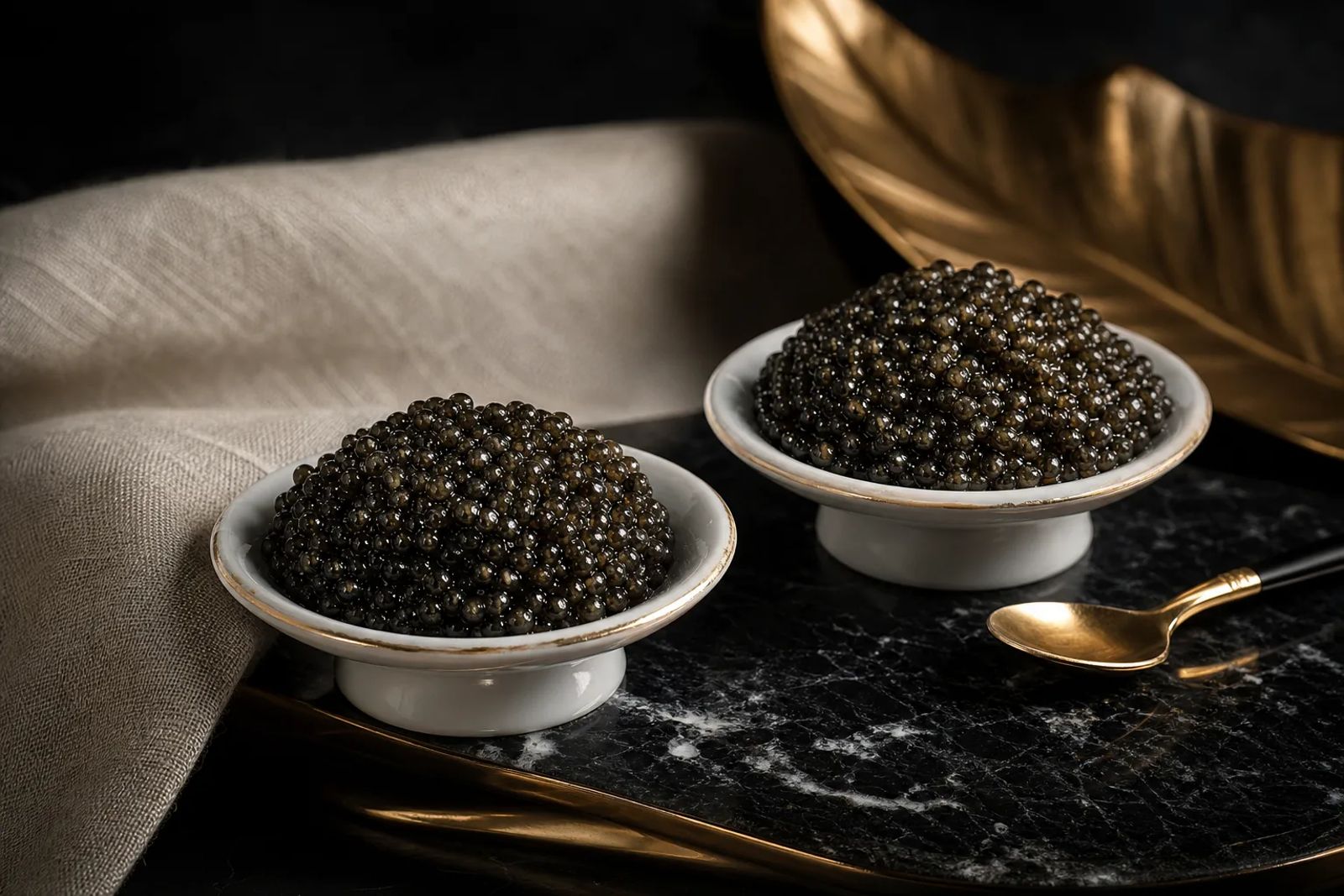
Pearl-grey eggs, elastic membranes, a pronounced butter-like aroma: that is how Kaluga Queen describes its beluga. Its pure Kaluga offers a different picture, with brownish-grey or yellowish-brown roe, milky notes and a lingering finish. Behind those descriptions are two distinct sturgeons, and a naming complication worth understanding before the tin is opened.
CITES places both fish in the genus Huso: beluga is Huso huso, Kaluga is Huso dauricus. Beluga belongs to the Caspian, Black Sea and Azov basin tradition; Kaluga comes from the Amur basin. Yet caviar carrying “Kaluga” in its name may come from a Kaluga and Amur sturgeon hybrid instead.
- A brand name tells you neither the species nor where the roe originated.
- Check the species code and hybrid parentage before judging by colour.
- Give processing and handling as much attention as the fish name.
Beluga vs Kaluga: the measurable differences
The clearest differences begin with the fish, not the prestige of the name. These are species distinctions, not quality grades. The egg measurement describes mature beluga eggs, rather than a guaranteed size for every finished bead.
| Criterion | Beluga | Kaluga |
|---|---|---|
| CITES species | Huso huso | Huso dauricus |
| CITES species code | HUS | DAU |
| CITES listing | Appendix II | Appendix II |
| Native range | Black, Azov, Caspian and Adriatic seas and associated rivers | Amur basin |
| IUCN category, 2022 update | Critically Endangered | Critically Endangered |
| Egg diameter | 3.6 to 4.3 mm, Volga beluga | Not documented |
| Roe colour | Light to dark grey | General species range not documented |
Both conservation categories concern wild populations, not the quality of farmed caviar. Both species need conservation attention. Farming alone does not establish a producer’s environmental performance, and neither species name supports a general sustainability claim.
Different waters, disputed genus names
Beluga’s historical waters reach beyond the familiar Caspian, Black and Azov seas to the Adriatic. History and surviving stocks are different maps, however: in 2004, the US Fish and Wildlife Service described its range as limited to the Caspian and Black Sea basins.
The distinction between the fish is clearer than agreement over their genus names. At their meeting on 22 October 2025, the IUCN Sturgeon Specialist Group and World Sturgeon Conservation Society rejected the Brownstein and Near and the Kottelat and Freyhof revisions, while proposing to dissolve Huso. Eschmeyer’s Catalog recognises Acipenser dauricus and Acipenser huso; CITES retains the Huso combinations.
Recent literature also uses Sinosturio dauricus. These alternative generic combinations do not make Kaluga beluga, or make their caviars interchangeable.
Fish size, maturity and first harvest
Both fish grow very large. Record size tells you little about the caviar in a tin; maturity is the more useful question.
FAO gives wild female beluga maturity at 16 to 18 years, or 14 to 16 years for the Azov population. Its hatchery manual reports first female maturity at 9 to 12 years under optimal, thermoregulated farming conditions. EUMOFA, meanwhile, reports 16 to 18 years in captivity. Those differing figures cannot supply a single timetable for every farm.
A comparable wild female maturity range for Kaluga is not documented. The faster maturation of a Kaluga hybrid cannot fill that gap for the pure species.
A European brand address or repacking location does not make the roe European.
Nor does first sexual maturity necessarily mean first commercial harvest. A general first harvest range is not documented. Kaluga Queen gives an average maturity age of 20 years for its beluga; that is a maturity figure for its fish, not a universal harvest age.
Bead size, colour, flavour and texture
Beluga’s documented egg diameter is 3.6 to 4.3 mm for Volga fish. FAO describes its caviar as light to dark grey. Without an equivalent general bead range for Kaluga, there is no sound basis for saying that either species always produces larger beads.
For a more sensory picture, Kaluga Queen describes its beluga as pearl-grey or metallic-grey, with plump eggs, elastic membranes and a pronounced butter-like aroma. Its pure Kaluga description gives brownish-grey or yellowish-brown roe, milky notes and a lingering finish.
These descriptions belong to one producer, rather than a blind comparison across farms. Use them to sharpen the questions about a particular batch. How firm are the beads? How readily do they release their contents? How prominent is the salt? Those details make a tasting more revealing than a name alone.
Why “Kaluga Beluga” causes confusion
Beluga means the CITES species Huso huso. It is not a bead size. Names such as “Kaluga Beluga” and “river beluga” borrow the association without precisely identifying the fish. Check the scientific name before assuming that either contains beluga.
Pure Kaluga and Kaluga hybrids are different products, too. One documented commercial cross pairs a female Kaluga, Huso dauricus, with a male Amur sturgeon, Acipenser schrenckii. There is no beluga parent in that cross. Calling it simply Kaluga omits information that matters to anyone seeking the pure species.
How much caviar sold as Kaluga is hybrid remains undocumented by a representative global survey. A producer’s hybrid output cannot establish that worldwide share. For a closer look at the parentage, see Kaluga hybrid caviar.
Read the species code before the sales name
Start with HUS for beluga and DAU for Kaluga. Hybrid labels need a little more attention: the convention puts the male parent’s species code first, followed by x and the female parent’s code. SCHxDAU therefore identifies a male Amur sturgeon crossed with a female Kaluga. Farming descriptions may name the female first, so prose and label order can differ.
Next, separate the country of origin from the repacker’s country and plant details. The CITES label declares traceability; it does not independently verify the contents. Mitochondrial DNA alone identifies the maternal line and cannot exclude a hybrid. See spotting hybrids sold as pure species for the testing distinction.
The naming rules also matter. EU consumer information must not mislead about identity or composition under Regulation (EU) No 1169/2011, Article 7. Great Britain applies its assimilated, amended version; Northern Ireland continues to apply the EU regulation.
In the US, FDA guidance CPG 540.150 says unqualified caviar refers to salted sturgeon roe, and that other roe should carry the fish name in the same type size. That guidance is not binding. Consumer naming, customs classification and wildlife trade labelling remain distinct matters.
Where the fish are farmed
Beluga farming is documented in Belgium, Italy and China. Spanish production was reported in 2021, and a 2017 federal notice documents US aquaculture. The US record establishes historical stock, rather than confirmed current production of pure beluga. For pure Kaluga, China is documented in the shared overview and Kaluga Queen’s stock disclosures.
These examples are not a complete farm census. To establish a batch’s origin, ask where the fish supplying it were raised. A European brand address or repacking location does not make the roe European.
The US beluga restriction does not rename Kaluga
The US suspensions imposed in 2005 affected imports of beluga caviar from the Caspian and Black Sea basins. The beluga special rule, 50 CFR 17.44(y), imposes restrictions with conditions and exceptions, including provisions for qualifying products from littoral states and individual aquaculture facilities outside those states.
The 2017 Florida exemption covered meat only, not caviar. It therefore cannot establish the legality of a current caviar offering.
Pure Kaluga is not Huso huso and falls outside that beluga rule, although other applicable requirements remain. The US beluga caviar ban guide explains the relevant restrictions.
Comparing species and processing
A useful comparison keeps beluga, pure Kaluga and identified hybrids separate. Establish the scientific name, species code, origin, ingredients and processing records first. Trade names and appearance cannot do that work.
Then look at how the roe reached the tin. Age matters because the fish must reach the appropriate stage of egg development, but an older fish does not automatically yield a better batch. Water and feed influence flavour. Careful handling protects the eggs. Salting and maturation, the period when salted roe develops and equilibrates, shape the result too.
For each batch, record bead firmness, salt content and whether the roe was pasteurised or frozen. Compare similar processing styles and keep accompaniments minimal. That gives the eggs room to show their character, while keeping the comparison grounded in documented handling and processing rather than prestige names.
Where to go next
- Beluga Caviar (Huso huso): the fish’s biology and the evidence behind beluga production.
- Caviar Comparisons: more species comparisons grounded in identity, processing and documented differences.
Sources
-
FAO. Chebanov, M. S. and Galich, E. V. Sturgeon Hatchery Manual. Fisheries and Aquaculture Technical Paper 558, 2013 reprint. Sections 1.2.1.1 and 1.2.1.3; Tables 56 and 57. Document.
-
FAO. Sturgeons (Acipenseriformes). Undated report chapter, approximately 2004. Beluga caviar colour description. Chapter.
-
CITES. Resolutions of the Conference of the Parties in effect after the 20th meeting. Current index, checked November 2026, listing Resolution Conf. 12.7 (Rev. CoP17). Index.
-
CITES. Conservation of and trade in sturgeons and paddlefish. Resolution Conf. 12.7 (Rev. CoP17), official CITES text checked after CoP20. Annex 1, labelling guidelines; Annex 2, species codes. Document.
-
US Government Publishing Office and USFWS. 50 CFR 23.71: How can I trade internationally in sturgeon caviar? Current electronic text, checked November 2026. Regulation.
-
North American Sturgeon and Paddlefish Society. IUCN Assessment 2022. Published 1 August 2022, reproducing the 2022 species categories. Assessment summary.
-
World Sturgeon Conservation Society. Bronzi, P. IUCN SSG summary report. Published 13 November 2025, reporting the meeting of 22 October 2025. Report.
-
California Academy of Sciences. Eschmeyer’s Catalog of Fishes: dauricus, Acipenser. Current online entry, checked November 2026. Species entry.
-
Hangzhou Qiandaohu Xunlong Sci-tech Co., Ltd. Global Offering Prospectus. 22 June 2026. Glossary; business descriptions of beluga and Kaluga caviar; live-stock table by species. Company statements, not independent tasting evidence. Prospectus.
-
European Commission. The success of caviar from Belgium. EU Aquaculture campaign, undated online story. Story.
-
Caviar Giaveri. Sturgeon farm. Undated company page, checked November 2026. Farm description.
-
Alimarket. Caviar Riofrío invierte para consolidar la producción del esturión Beluga. 20 April 2021. Historical trade reporting. Article.
-
USFWS. Threatened Species; Exemption From Threatened Species Permits for a Qualifying Beluga Sturgeon Aquaculture Facility. Federal Register 82, page 28875, 26 June 2017. Notice.
-
US Government Publishing Office and USFWS. 50 CFR 17.44: Species-specific rules, fishes. Paragraph (y), current electronic text checked November 2026. Regulation.
-
USFWS. Service Suspends Trade in Threatened Beluga Sturgeon. 28 October 2005. Covers the Black Sea suspension and preceding Caspian action. Announcement.
-
UK legislation. Regulation (EU) No 1169/2011, Article 7: Fair information practices. Assimilated, amended text, checked November 2026. Article.
-
UK Government. Packaging and labelling. Current guidance, checked November 2026, distinguishing Great Britain and Northern Ireland. Guidance.
-
University of Florida, IFAS Extension. Technically Speaking, What Is Sturgeon Caviar? FA194, online edition checked November 2026. Maturation, feed and water influences. Publication.
-
Codex Alimentarius Commission. Report of the Thirty-fourth Session of the Codex Committee on Fish and Fishery Products. REP16/FFP, 2016, Appendix V. Technical guidance on handling, salting, cooling and maturation, used as processing evidence, not as binding law. Report.
-
Molecules. Species Identification of Caviar Based on Multiple DNA Barcoding. Volume 28, article 5046, 2023. Methodological limitation of mitochondrial identification. Paper.
-
US Fish and Wildlife Service. Final rule on threatened status for beluga sturgeon. Federal Register, volume 69, page 21425, 2004.
-
European Commission, EUMOFA. Sturgeon meat and other by-products of caviar. February 2023, Table 3.
-
US Food and Drug Administration. Caviar, Use of Term, Labeling. Compliance Policy Guide section 540.150, October 1989.
Researched from the dated sources listed above.
Last checked: November 2026