
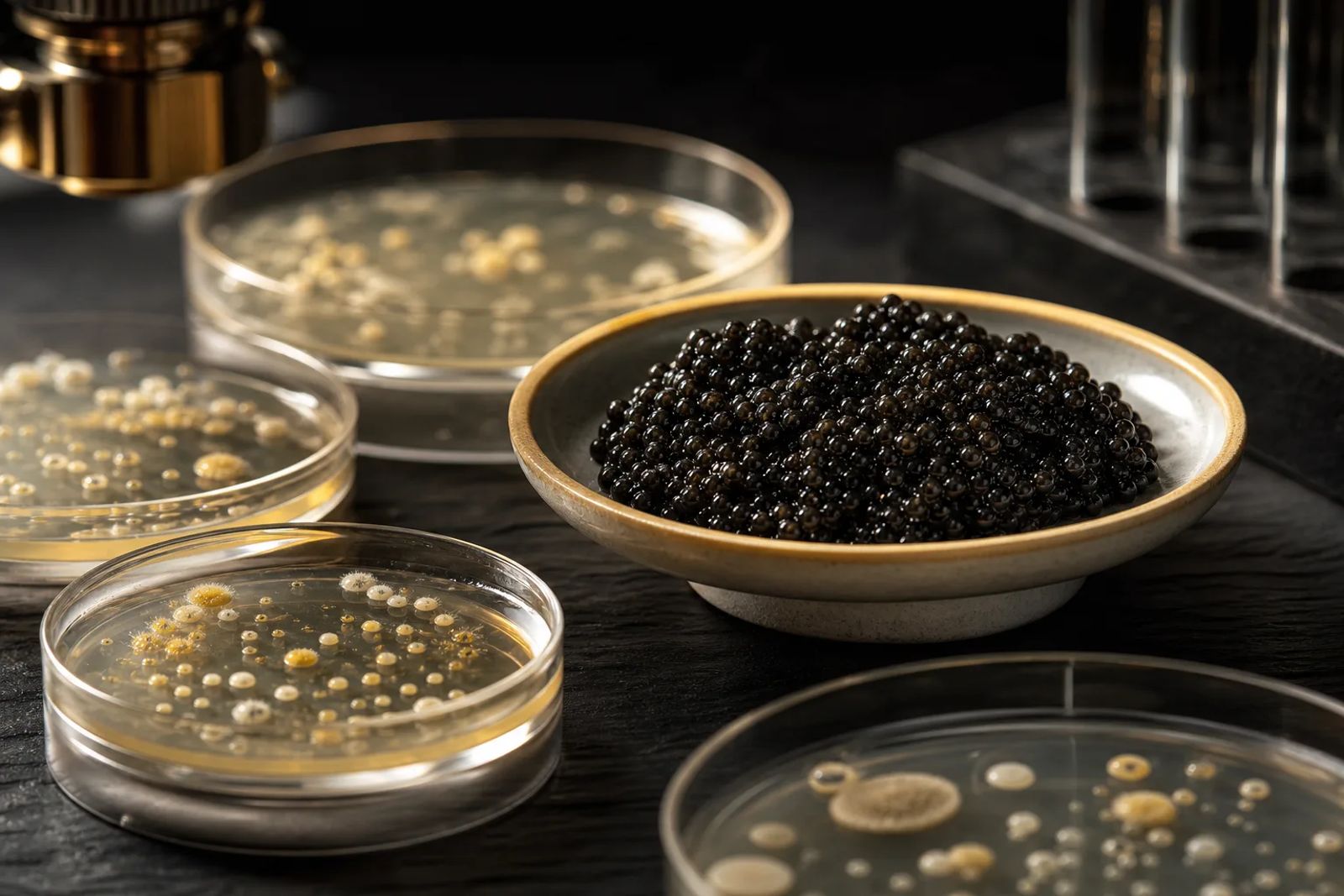
A sealed tin of caviar is not a sterile tin: organisms introduced with raw roe or during processing may survive or multiply in the finished product. Both matter for safety. Salted, refrigerated caviar depends on validated processing, scrupulous hygiene, temperature control and a justified shelf life.
Caviar microbiology in published studies
This article concerns sturgeon roe; the mixed-roe survey below is identified separately. The broader context sits in caviar science.
Altug and Bayrak's 2003 survey examined 68 caviar samples from Russia and Iran using culture-based enumeration and pathogen isolation. Standard plate counts ranged from 1,000 to 2,600,000 colony-forming units per gram (CFU/g), and yeasts were recovered. One sample contained Staphylococcus aureus. Salmonella, Clostridium perfringens and moulds were not isolated.
Oeleker and colleagues' 2013 retail study cast a wider net: 50 products made from freshwater and marine fish roe, not exclusively sturgeon. Culture-based examination found lactic acid bacteria in 20% of samples, yeasts in 10% and mould in one sample. One product contained pseudomonads and coagulase-positive staphylococci. These groups can contribute to deterioration or indicate contamination.
Lopez and colleagues' 2021 experiment followed white sturgeon caviar through 14 months at −2 °C. It compared three salt or preservative treatments in 500 g and 1,800 g tins, assessing plate counts alongside pH, water activity and volatile compounds. The producer supplied, funded and co-wrote the study. Its scope was formulation and storage, rather than a pathogen challenge establishing safe storage for every commercial product over that period.
Together, these studies describe their tested samples, not contamination prevalence in today's market or a single characteristic caviar microbiome. An aerobic colony count measures organisms that grow under the chosen laboratory conditions; it cannot identify everything present or replace targeted pathogen testing.
Where contamination enters
Contamination can enter with the fish and its aquatic environment, then enter or spread during handling. Egg separation, washing, draining, salting and filling all create opportunities. Codex CXC 52-2003 therefore treats caviar production as a sequence of controls over raw materials, water, ingredients, equipment and handling, rather than placing trust in the final sealed container.
During extraction, fish surfaces and intestinal contents are potential sources. Water can introduce contamination or carry it between batches. Sieves, bowls, utensils and filling equipment can transfer organisms if cleaning is ineffective. Hands, clothing and movement between raw and finished-product areas create further routes for cross-contamination.
Packaging needs protection before it reaches the filling stage and must remain clean through filling and closure. Repacking opens another window of exposure. A compliant bulk lot still requires hygienic repacking, and the repacker remains responsible for the finished product.
Hazards and their controls
Spoilage and illness are different problems, and hazard analysis must separate them. A survey finding identifies an organism in a sample; it does not establish an outbreak or make that organism a routine hazard in every production system.
| Organism | Why it matters | Main control | Source |
|---|---|---|---|
| Listeria monocytogenes | Ready-to-eat contamination; can grow under refrigeration | Environmental hygiene, validated shelf life, temperature control | Codex CXG 61-2007; FDA, chapter 18 |
| Non-proteolytic Clostridium botulinum | Toxin formation in reduced-oxygen fish products | Validated formulation, refrigeration, packaging controls | FDA, chapter 13 |
| Staphylococcus aureus | Handling contamination; possible toxin formation | Personnel hygiene; controlled processing time and temperature | Altug and Bayrak; FDA, chapter 12 |
| Salmonella spp. | Pathogen covered by seafood hazard assessment | Raw-material, water and sanitation controls | FDA, chapters 4 and 12 |
| Pseudomonads, lactic acid bacteria, yeasts and moulds | Reported spoilage-associated flora | Hygiene; validated preservation system | Oeleker and colleagues |
Managing the process
Adding salt is a step, not a complete safety system. Hazard analysis and critical control points (HACCP) identifies significant hazards and sets effective controls, monitoring, corrective action and verification. For caviar, the test is whether the whole process controls each relevant hazard under the actual conditions of storage and distribution.
Formulation. Salt lowers water activity: the water available for microbial growth. But total salt percentage and water-phase salt measure different things. FDA's botulism guidance uses product-specific combinations of barriers, so a salt percentage borrowed from another roe product cannot validate a process. How salt preserves caviar explains the mechanism.
Temperature. Temperature control needs documented limits, calibrated measurement and a clear response when limits are exceeded.
Packaging. Reduced-oxygen packaging is not a microbial kill step. It changes which organisms can grow, making control of non-proteolytic C. botulinum particularly important. The sealed package belongs inside the hazard assessment.
Preservatives. Preservatives add barriers; sanitation remains essential. EU Regulation (EC) No 1333/2008, Annex II, category 09.3, lists boric acid (E284) and sodium tetraborate, borax (E285), for sturgeon eggs only, each at 4,000 mg/kg expressed as boric acid. That authorisation does not extend automatically to every destination market.
Hygiene and verification. An effective hygiene programme keeps raw handling separate from exposed finished roe and verifies cleaning and disinfection. Recurring environmental positives demand investigation of the source, not another round of cleaning alone. Monitoring should cover relevant food-contact surfaces and the routes by which contamination can reach them. Finished-product testing verifies part of this system; it cannot rescue an uncontrolled process or establish the safety of every container.
Microbiological criteria by jurisdiction
Food safety criteria judge microbial safety, not sensory quality. CFU/g expresses a viable count. “Not detected in 25 g” specifies the required result for an analytical portion, rather than declaring every gram of a lot sterile.
For the EU, Great Britain and Northern Ireland, two questions guide the Listeria criteria: does the product support growth, and is the required shelf-life evidence available?
EU: Regulation (EC) No 852/2004 requires hygiene and HACCP-based procedures. Regulation (EC) No 2073/2005 sets the relevant ready-to-eat food criteria.
For foods supporting L. monocytogenes growth, producers may use the 100 CFU/g shelf-life criterion only when evidence acceptable to the competent authority shows that the limit will not be exceeded.
Since 1 July 2026, Regulation (EU) 2024/2895 requires L. monocytogenes not to be detected in 25 g throughout the marketed shelf life of these growth-supporting foods when that demonstration has not been made. Previously, this absence requirement applied only before the food left the producer's immediate control. The amendment extends it through the marketed shelf life.
Great Britain: Assimilated Regulation 2073/2005 retains the earlier distinction for growth-supporting foods. Absence in 25 g is required before the product leaves the producer's immediate control unless the required shelf-life demonstration is available; the 100 CFU/g criterion applies during shelf life. The EU's 2026 amendment must not automatically be applied as GB law.
Finished-product testing verifies part of this system; it cannot rescue an uncontrolled process or establish the safety of every container.
Northern Ireland: The EU amendment applies from 1 July 2026, as confirmed by the FSA. Across these markets, the essential question is whether the particular caviar supports growth. Its name or declared salt content alone cannot settle that classification.
For EU foods demonstrated not to support growth, the Listeria criterion is 100 CFU/g during shelf life. The relevant Annex I plans require five sample units, with none permitted to fail. Growth classification and shelf-life evidence determine which criterion applies.
United States: 21 CFR Part 123 requires seafood hazard analysis, a HACCP plan where a hazard is reasonably likely to occur, and sanitation monitoring. It does not provide an EU-style numerical caviar specification. FDA's 2008 CPG 555.320 proposed different Listeria approaches according to growth potential, but remains labelled draft and not for implementation. Its proposed 100 CFU/g approach is therefore not an established US permission.
Codex: CXG 61-2007, formerly CAC/GL 61-2007, addresses Listeria control. CXC 52-2003 covers fish processing, including caviar. These international reference texts do not automatically become binding national law. The requirements of the market receiving the product remain decisive.
What recalls and alerts demonstrate
A reported hazard and a confirmed finding are different things, as these two salmon roe incidents illustrate.
On 5 May 2023, Hong Kong's Centre for Food Safety warned against a batch of US salmon roe for possible L. monocytogenes and reported a recall. The notice recorded information received through the EU's Rapid Alert System for Food and Feed (RASFF). It concerned salmon roe, not sturgeon caviar, and documented an incident rather than providing a survey denominator.
An FDA-posted company announcement dated 15 August 2019 recalled AWERS grained salmon caviar for a potential botulism hazard after testing indicated inadequate salt. Again, the product was salmon roe rather than sturgeon caviar. The significance lies in the failed preservation barrier: the notice explicitly stated that C. botulinum was not detected and that no illnesses had been reported.
Recall, pathogen detection, toxin detection and confirmed illness are separate findings. Keeping them separate gives an accurate account: a precautionary withdrawal is not a documented outbreak, while a negative pathogen test does not make a defective process acceptable.
For consumers: follow the product's storage and use instructions. Normal smell and appearance cannot establish safety. Read caviar food safety for advice on who should take particular care.
Sources
-
Altug, G. and Bayrak, Y., Istanbul University. Microbiological analysis of caviar from Russia and Iran. Food Microbiology, volume 20, issue 1, pages 83 to 86, 2003. Author-institution record and abstract. Source.
-
Oeleker, K. and colleagues, Freie Universität Berlin and BfR. Organoleptic, physicochemical and microbiological properties of caviar at retail trade. Archiv für Lebensmittelhygiene, volume 64, pages 50 to 54, 2013. Full paper.
-
Lopez, A. and colleagues, University of Milan and Agroittica Lombarda. Evolution of Food Safety Features and Volatile Profile in White Sturgeon Caviar Treated with Different Formulations of Salt and Preservatives during a Long-Term Storage Time. Foods, volume 10, article 850, 2021. Publisher record. The versioned publisher PDF was checked.
-
US Food and Drug Administration. Fish and Fishery Products Hazards and Controls Guidance. Fourth edition, June 2022, particularly chapters 4, 12, 13, 16 and 18. Guidance and chapter downloads.
-
United States, electronic Code of Federal Regulations. 21 CFR Part 123: Fish and Fishery Products. Current electronic text checked November 2026, particularly sections 123.6 and 123.11. Regulation.
-
European Commission. Commission Regulation (EU) 2024/2895 amending Regulation (EC) No 2073/2005 as regards Listeria monocytogenes. Adopted 20 November 2024; applicable from 1 July 2026. Regulation.
-
Food Standards Agency. Managing food safety. Updated 21 August 2026, including the explanation of the Listeria amendment's application in the EU and Northern Ireland. Guidance.
-
UK Health Security Agency. National outbreak of a Listeria monocytogenes CC4 t5.248 cluster associated with cook-chill meals. 2026 incident report, including its explanation of assimilated Regulation 2073/2005. Report.
-
US Food and Drug Administration. CPG Sec 555.320 Listeria monocytogenes. February 2008, draft, not for implementation; status checked November 2026. Draft guidance.
-
FAO and WHO, Codex Alimentarius. Code of Practice for Fish and Fishery Products, CXC 52-2003, amended through 2019; FAO/WHO book edition, 2020, particularly section 20 on sturgeon caviar. Institution-hosted copy.
-
FAO and WHO, Codex Committee on Food Hygiene. Revision of the Guidelines on the Application of General Principles of Food Hygiene to the Control of Listeria monocytogenes in Foods (CXG 61-2007). Electronic working-group record, 2026, recording the revision work's scope and mandate. Official record.
-
European Union. Regulation (EC) No 1333/2008 on food additives. EUR-Lex consolidation dated 28 October 2019, Annex II, category 09.3. Consolidated text.
-
Hong Kong Centre for Food Safety. CFS urges public not to consume batch of prepackaged caviar suspected to be contaminated with Listeria monocytogenes. Official notice, 5 May 2023. Notice.
-
AWERS, Inc., announcement hosted by the US Food and Drug Administration. AWERS, Inc. Recalls Grained Salmon Caviar 95g Because of Possible Health Risk. 15 August 2019; FDA page subsequently marked recall terminated. Recall announcement.
This article was researched through peer-reviewed surveys and storage research, official legislation and guidance, and recorded recall and alert notices.
Last checked: November 2026