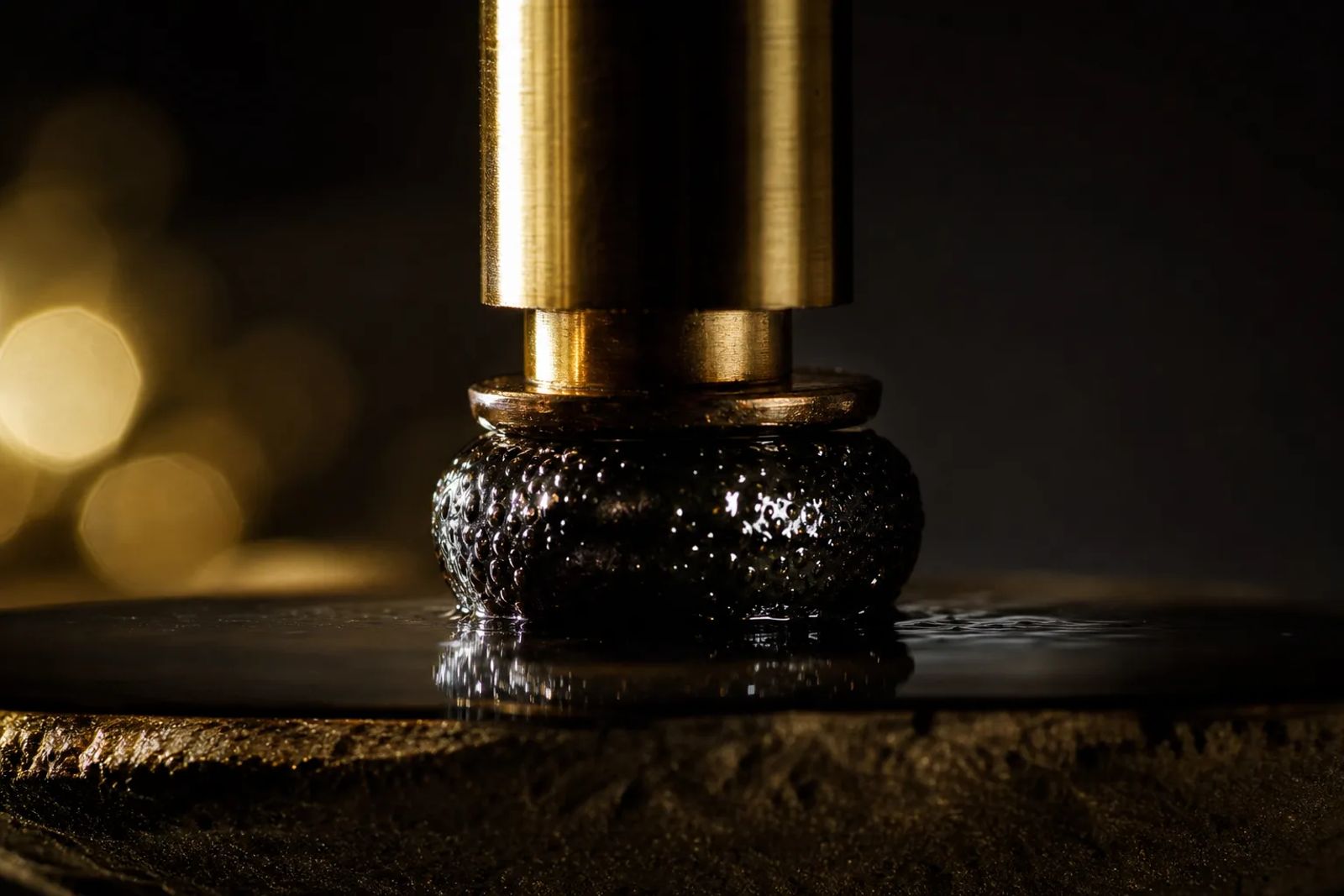
A caviar bead yields under pressure, then breaks, releasing its soft contents as resistance suddenly falls. That brief transition is the pop. Behind it lies more than a thin skin: the egg's layered envelope, developmental stage and supporting tissues all matter, as do salting, processing and storage.
Why caviar pops
Firmness is resistance to compression; pop is the sudden release when the covering breaks. A bead can push back under pressure without delivering a sharp burst. Its flexible covering first deforms, but resistance alone does not tell you how distinctly it will give way.
That distinction matters when reading scientific results. A texture analyser can register rupture without capturing precisely how it feels in the mouth. Firmness and popping are related, but they are not interchangeable measurements. The wider caviar science guide explains how these measurements fit together.
The layers around the egg
A developing egg, or oocyte, has a more elaborate covering than its own cell membrane. It also has a protein-rich envelope and, before ovulation, surrounding ovarian follicular tissues. These comprise the outer thecal cells, a supporting basal lamina and the follicular epithelium, the cell layer beside the envelope. Follicular cells support egg development, and their covering contributes to the texture of traditionally harvested caviar.
In the terminology used to connect modern sterlet microscopy with earlier research, the envelope contains the following structures, moving from the outside towards the egg:
- Adhesive layer: the outer coating that helps spawned eggs attach to a surface.
- Alveolar layer: a porous layer beneath the coating, crossed by small channels.
- Zona radiata externa: the outer fibrous zone, which helps anchor the layers beyond it.
- Epilayer: a thin structural division between the outer and inner zones, with a clearer anatomical position than a separate culinary function.
- Zona radiata interna: the inner fibrous zone, nearest the egg cell and part of its protective covering.
These are microscopic structures, not five separate skins distinguishable with a spoon. Layer names and counts vary between developmental studies: electron microscopy of white sturgeon eggs described four layers under an earlier naming system, while later work divides and names them differently. Follow the developmental sequence in how sturgeon eggs develop.
What salting changes
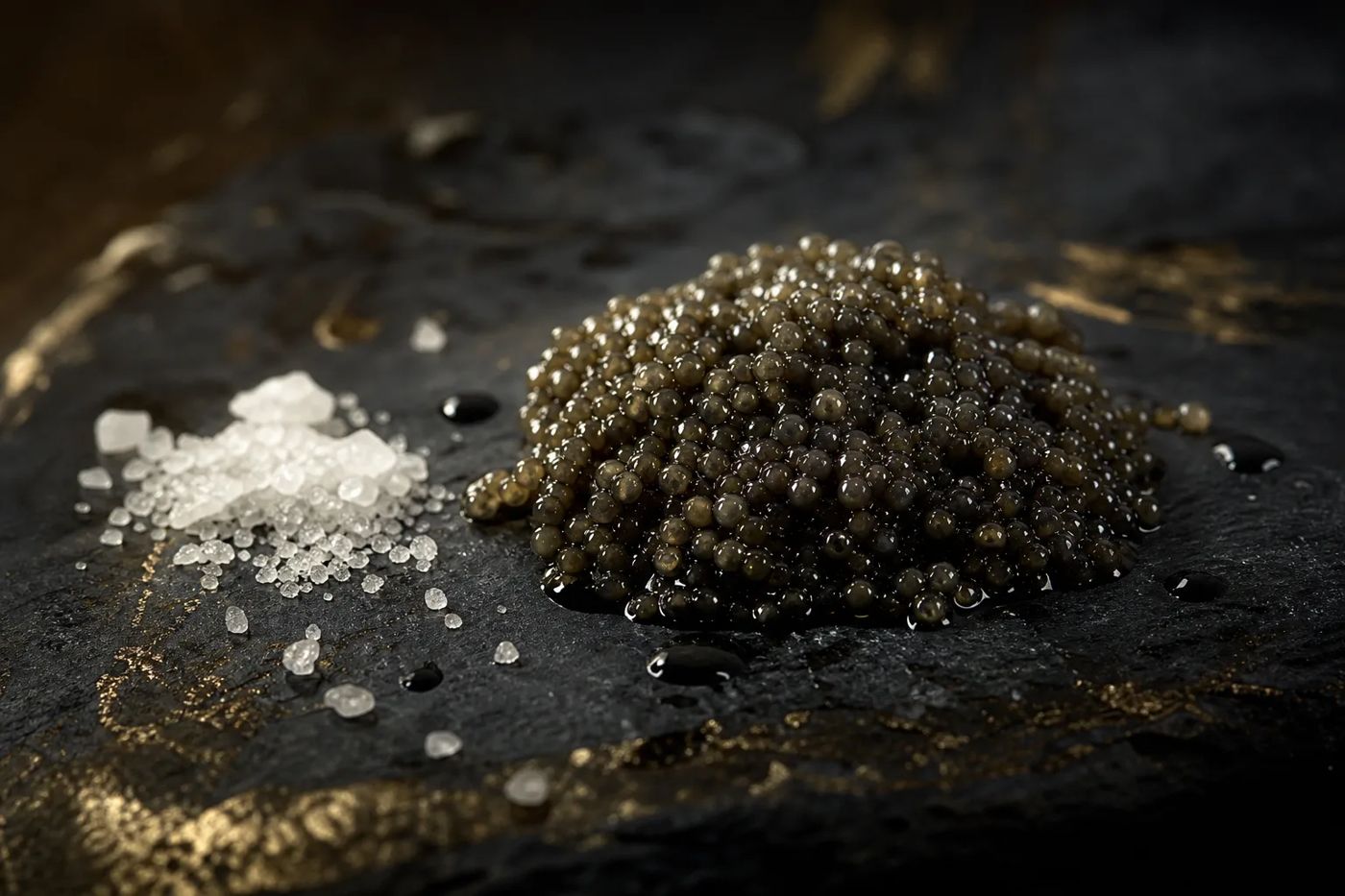
Salt changes the bead by drawing water out. The difference in concentration between the egg and its surrounding liquid drives osmosis; water loss and altered interactions between proteins and water can leave the envelope feeling firmer. Salt is changing the structure, not simply building a thicker shell.
Research on white sturgeon found that adding borax to salt changed water behaviour and egg breaking distance during storage. Curing affects both the covering and the soft contents within it, so adding more salt does not produce a reliably greater pop.
Why ovulated eggs behave differently
Ovulation releases the egg from its follicular covering. Eggs collected by stripping, the removal of released eggs from a live female, therefore reach processing in a different state from non-ovulated ovarian eggs. Contact with water can trigger swelling, adhesion and hardening, changes associated with preparing the egg for development.
Processing can make a perceptible difference. In a 2025 Swedish study of two Siberian sturgeon caviars, the cold-processed product was firmer and more popping in sensory assessment. Groups of its eggs also showed greater instrumental hardness. The study compared mild hot-water treatment with cold-water treatment using pH adjustment, approaches to managing adhesion and stabilising texture. A producer representative was among the study's authors.
Patent application US20090246335A1 describes other approaches, including calcium-based treatments intended to harden ovulated egg envelopes. It records claimed processes rather than independently established performance across products. These are processing methods, not treatments to attempt on caviar at home.
Codex CXS 291-2010 (2024 text) permits ovulated farmed sturgeon eggs under shell treatment and hormone conditions; its register lists a 2026 revision. This is an international reference standard, not automatically national law. The collection methods are explained in no-kill caviar.
Freezing and heat alter the structure
Freezing can damage the egg's covering as water forms ice and redistributes within the product. After thawing, damaged beads may leak or lose their former resistance. Alaska Sea Grant's freezing guidance specifically identifies sturgeon eggs as vulnerable to this damage; find the practical guidance in can you freeze caviar?.
Heat changes proteins, altering their shape and how they associate with one another. Both the envelope and the interior can change as caviar warms. A dielectric heating study describes caviar as a heat labile, high value food. Controlled pasteurisation is a different treatment from stirring beads into a boiling sauce.
These are microscopic structures, not five separate skins distinguishable with a spoon.
To preserve the existing bead texture, take food off the heat before adding caviar, rather than simmering it. That advice follows from caviar's heat sensitivity, though contact with hot food can still change the beads.
How scientists measure firmness
A rupture test captures the moment an egg breaks. An instrument presses an individual bead, recording its resistance and deformation until failure. In one white sturgeon study, researchers tested 30 eggs per sample, measuring consistency and the distance and time to breakage. The results describe behaviour under a defined laboratory load, rather than a universal quality grade.
The Swedish study used a texture analyser fitted with a 36 mm cylindrical probe, compressing at 0.1 mm per second. It tested both single eggs and groups of 25, with five replicate measurements. The group result distinguished the products: how eggs are arranged for testing matters when comparing firmness findings.
The instrument measures the whole bead or group, not the membrane alone. Yolk-rich contents, bead size and packing all contribute to the recorded force. Results obtained with different probes, speeds or sample temperatures should therefore not be treated as directly interchangeable measures of membrane strength.
Does species determine the pop?
Species is only part of what shapes a caviar bead's texture. A comparative study examined eight caviar types from six sturgeon species through texture evaluation, sensory analysis and metabolomics, the measurement of many small chemical compounds. Crunchiness helped distinguish the products, but their processing differed too. The findings cannot isolate species as the cause or supply a species-only ranking from softest to firmest.
For a meaningful comparison, look beyond the species name. Were the eggs collected at comparable developmental stages? Were they cured and tested in the same way? The guide to bead size, colour and firmness explores what that means when choosing caviar. Species helps explain the bead, but its developmental stage and processing also shape the resistance and release you feel in the mouth.
Sources
-
University of Florida, IFAS Extension. Technically Speaking, What Is Sturgeon Caviar? Publication FA194, online edition retrieved November 2026. Used for ovarian tissues, ovulation, water-hardening and their contribution to texture. Publication.
-
Cherr, G. N. and Clark, W. H., Jr., University of California, Davis. Fine Structure of the Envelope and Micropyles in the Eggs of the White Sturgeon, Acipenser transmontanus Richardson. Development, Growth & Differentiation, volume 24, 1982. Publisher record.
-
Żelazowska, M. and Pšenička, M., Jagiellonian University and University of South Bohemia. Secondary growth ovarian follicles of the pigmented sterlet sturgeon Acipenser ruthenus L. 1758 (Acipenseriformes, Chondrostei, Actinopterygii, Osteichthyes): Microscopic study of oocytes, egg envelope and diversification of follicular cells. Micron, volume 186, article 103701, 2024. Institutional full text.
-
Brambilla, M. and colleagues, Sensors. The Influence of the Presence of Borax and NaCl on Water Absorption Pattern during Sturgeon Caviar (Acipenser transmontanus) Storage. Volume 20, issue 24, article 7174, 2020, DOI 10.3390/s20247174. Full-text record.
-
Jönsson, M. and colleagues, Kristianstad University and collaborating organisations. Quality characteristics of Swedish black caviar from live sturgeons (Acipenser baerii): a comparison of hot-water and pH-adjusted cold-water post-harvest processing. International Journal of Food Properties, volume 28, 2025. Institutional full text.
-
United States patent application, reproduced by Justia. Method for processing ovulated eggs of aquatic animals into delicacy foods and ovulated eggs processed using the method. US20090246335A1, published 1 October 2009. Application text.
-
FAO and WHO, Codex Alimentarius Commission. Standard for Sturgeon Caviar. CXS 291-2010, 2024 edition checked; the Codex register shows last modified 2026. Canonical standard file.
-
Kolbe, E. and Kramer, D., Alaska Sea Grant, University of Alaska Fairbanks. Planning for Seafood Freezing. MAB-60, 2007. NOAA repository copy.
-
Elsevier, Journal of Food Engineering. Dielectric properties of salmon (Oncorhynchus keta) and sturgeon (Acipenser transmontanus) caviar at radio frequency (RF) and microwave (MW) pasteurization frequencies. Volume 70, 2005. Publisher record.
-
Rocchetti, G. and colleagues, Food Chemistry. The contribution of sturgeon species and processing conditions on caviar texture, metabolomic profile and sensory traits. Volume 463, article 141516, 2025, DOI 10.1016/j.foodchem.2024.141516, PMID 39369608. Study record.
This piece was researched through developmental microscopy studies, caviar processing experiments, an attributed patent application and official Codex and seafood-freezing publications.
Last checked: November 2026