
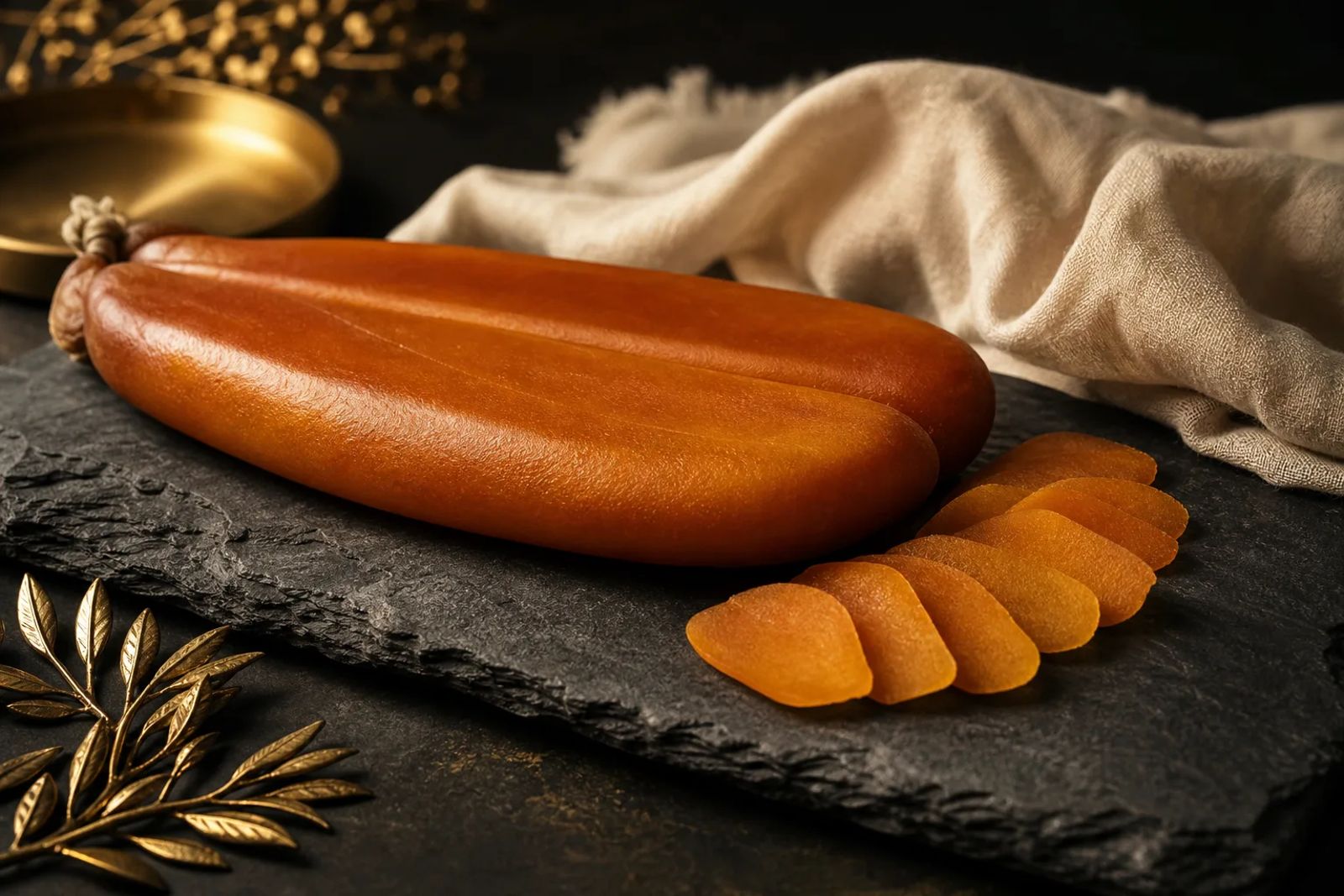
Glossy amber, with concentrated roe flavour and aroma: that is how Japan's agriculture ministry describes Nagasaki Karasumi. Beneath that distinctive finish is the form that unites cured mullet roe: a roe sac, salted and dried whole, with the eggs together rather than separated into loose beads.
Italian bottarga, Greek avgotaraho, Japanese karasumi and Taiwanese wuyuzi share that foundation. Their curing methods, finishes and protected geographical names give each tradition its own character.
Which fish is used?
Flathead grey mullet, Mugil cephalus, is the principal fish behind the products discussed here. Roe from other mullet can also be used. A 2020 study of roe from Sardinia's Cabras lagoon used thinlip grey mullet, named Liza ramada in the paper and now Chelon ramada. The species therefore needs checking on the individual product.
The essential structure is the intact ovarian membrane. This thin covering holds the eggs together through curing, allowing the finished roe to remain a whole piece. For the wider distinction between roe products, start with other fish roe and roe beyond sturgeon.
Four traditions, distinct identities
A regional tradition and a protected name are different things. The table sets them side by side. Register entries were checked in November 2026; “none found” means no registration was found under that name.
| Product | Place | Fish | Cure and finish | Protected name status |
|---|---|---|---|---|
| Bottarga di muggine | Italy | Mullet; species varies by product | Salted, dried; pressing documented | PDO or PGI: none found under this name |
| Avgotaracho Messolongiou | Messolonghi, Greece | Mugil cephalus | Salted, dried, beeswax-coated | PDO: EU registration 2 July 1996; UK registration 31 December 2020 |
| Nagasaki Karasumi | Nagasaki Prefecture, Japan | Mullet | Salt-only seasoning, slow drying, hand shaping | Japanese GI: registered 20 July 2023 |
| Wuyuzi | Taiwan | Mullet | Salted, desalted, pressed, dried | Protected name: none found |
Sardinia is a major Italian centre, with documented production around Cabras and Tortolì. The Italian map extends further: Slow Food records bottarga from Orbetello in Tuscany, while Sardinian processor Blue Marlin describes production in Sicily and Calabria too. Bottarga di tonno belongs to a different branch: it is made from tuna roe.
The complete registered Greek name is Αυγοτάραχο Μεσολογγίου / Avgotaracho Messolongiou. The UK register records both its original EU registration and its protection under the UK scheme. The broader word avgotaraho does not carry the same meaning as that complete protected name.
In Egypt, the related preparation is batarekh. FAO's Mediterranean lagoon review describes collecting ripe female mullet as they migrate towards the sea, then salting and drying the roe. Slow Food also records related bottarga traditions in Tunisia and elsewhere around the Mediterranean. These sources document connected traditions, but do not establish one uniform regional recipe.
How salt and drying transform the roe
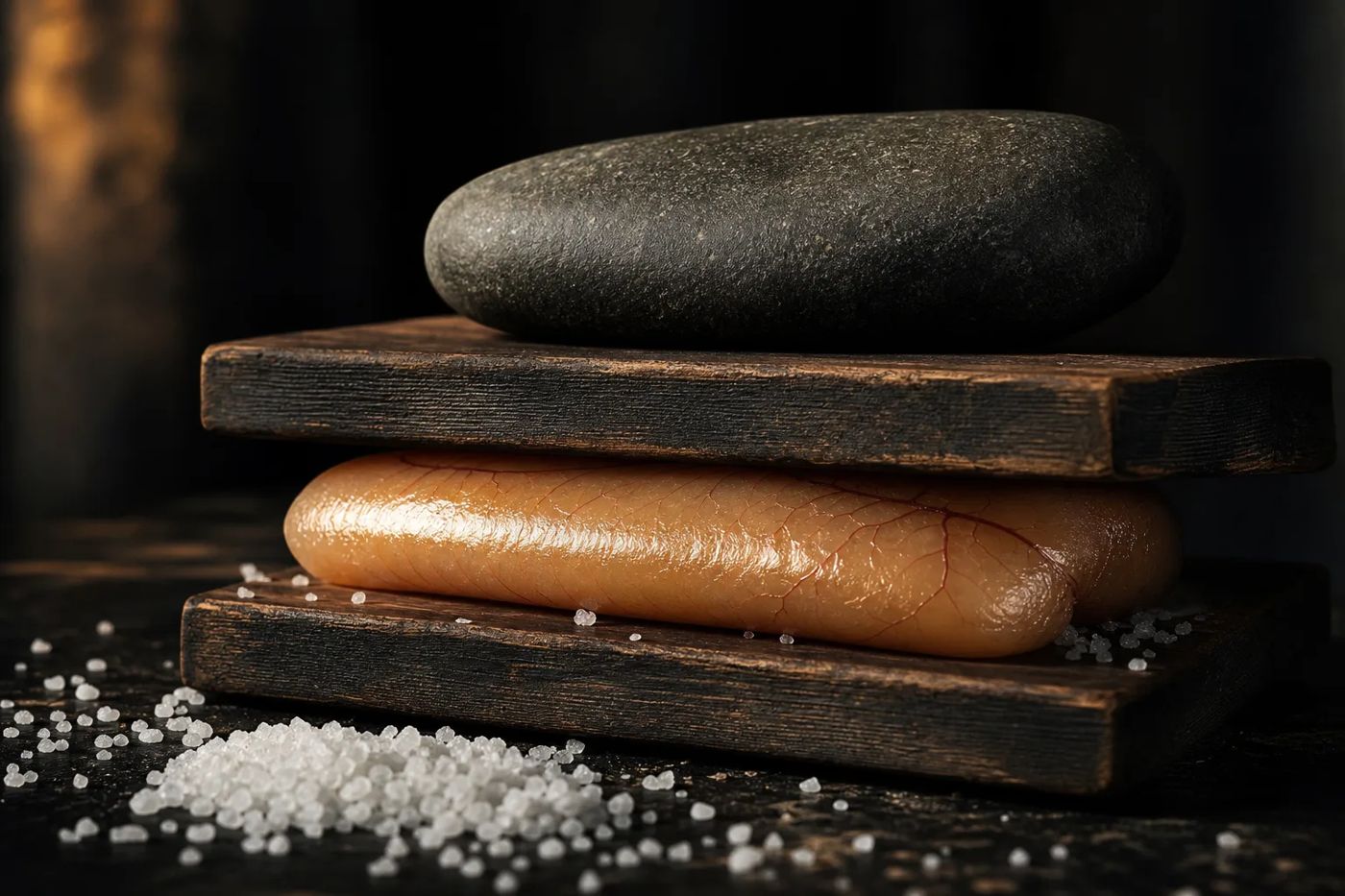
Salt draws water from the cleaned, intact roe sacs. Pressing flattens them and helps remove moisture; drying turns them into dense pieces ready for slicing or grating. The order and intensity of those steps vary between processes.
In the Cabras study, researchers salted the roe, removed surface salt, pressed it between boards and dried it under controlled conditions. Separate research at Tortolì documented drying in ventilated, temperature-controlled chambers. Sun drying has its place in the tradition, but bottarga can also be made without it.
Registered Nagasaki Karasumi follows a defined process. The Japanese GI specification requires flathead grey mullet ovaries, salted with salt or brine, adjusted for excessive salt where necessary, then slowly dried and shaped by hand. Alcohol and oils are excluded as supplementary materials during that processing. Taiwan's Tourism Administration describes wuyuzi production as salting, desalting, pressing, drying and final shaping.
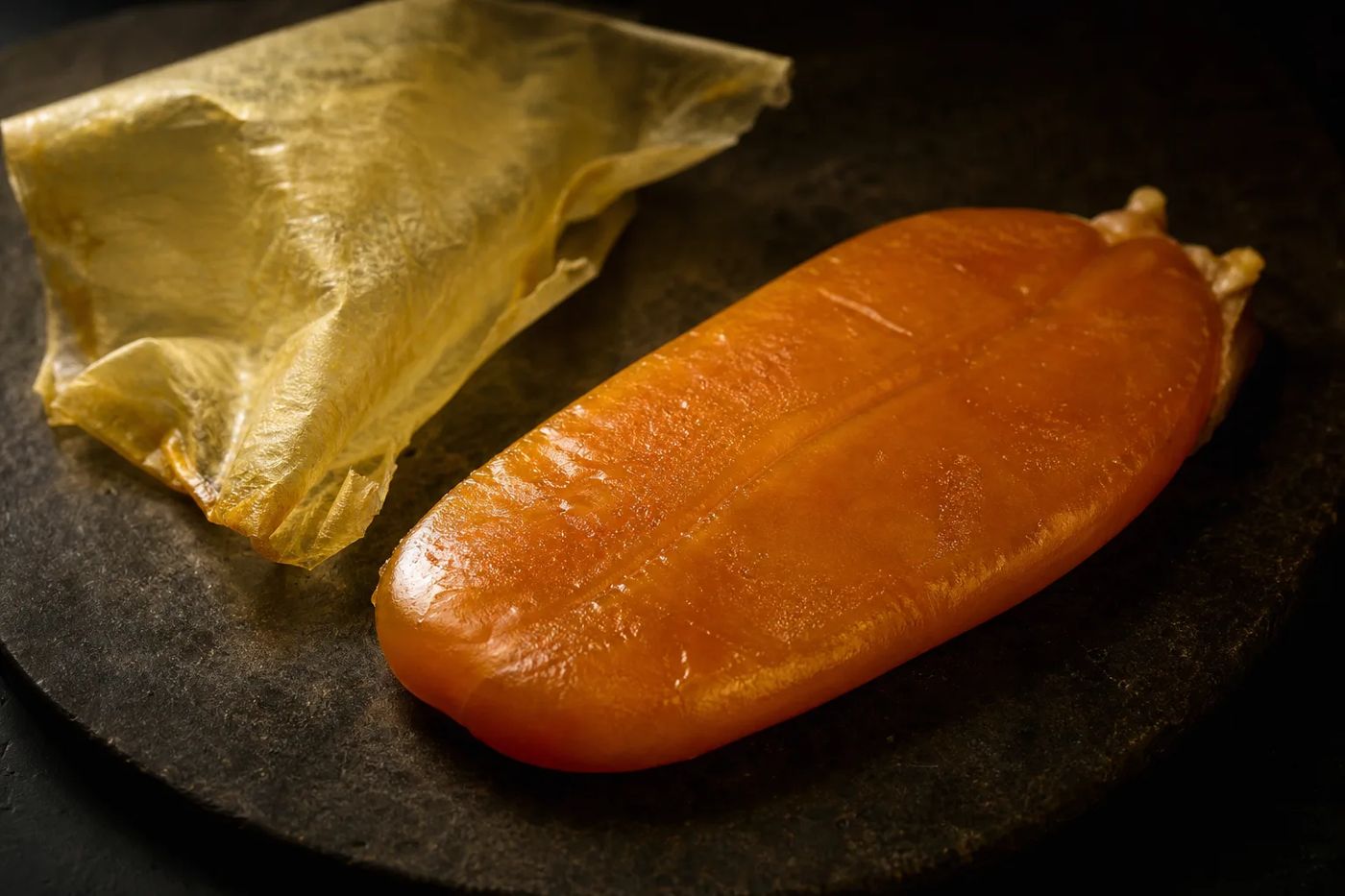
Beeswax is a characteristic Greek finish. Producer Trofelia describes coating avgotaraho as a way to retain moisture. Remove the wax from the portion being prepared; it is a covering, not something to grate into the food.
Where the roe comes from, and where it is cured
The place that cures the roe may be far from the waters that supplied it. The 2018 Tortolì study says little Sardinian bottarga roe is local; most is imported frozen, mainly from the Western Central Atlantic. That describes the supply chain documented in the study, rather than every producer or present-day batch.
Ask two questions: where was the roe harvested, and where was it salted and dried? A processor's address does not fully answer either. The distinction is explored further in origin versus repacking, although curing is a processing operation, not simply a change of wrapping.
Japan makes another useful distinction. Its Fisheries Agency explains that origin labelling for domestically manufactured processed foods covers the ingredient contributing the greatest weight. The Nagasaki GI specification separately requires manufacture within Nagasaki Prefecture. Its published wording does not say that every fish must have been caught there.
For purchases in the EU, Great Britain or Northern Ireland, read the registered name and the product's origin information separately. An Italian style description or Italian business address does not establish where the fish was caught or farmed.
In the US, check the import and labelling requirements for cured mullet roe before importing or selling it.
Texture, flavour and salt
Moisture makes a tangible difference under the knife. The Tortolì research found that hardness and consistency increased as moisture decreased.
Taiwan's Tourism Administration emphasises balanced saltiness, moisture and firmness in wuyuzi. Descriptions like this offer a starting point, but the piece in your kitchen deserves attention on its own terms. There is no single verified hierarchy in which bottarga is always firmer, or karasumi always milder, than comparable products.
Salt deserves a close look at the label. Barra and colleagues' 2008 analysis of commercial whole and ground mullet bottarga reported approximately 7 g of salt per 100 g. At that concentration, a 5 g portion supplies about 0.35 g of salt, calculated from the reported figure.
The 2018 Tortolì study says little Sardinian bottarga roe is local; most is imported frozen, mainly from the Western Central Atlantic.
The label may give a different figure: Attilus, for example, declares 4.4 g of salt per 100 g for its bottarga. Check whether the nutrition panel lists salt or sodium, since the terms are not interchangeable. The package gives a more useful answer than a generic average.
Slice it, grate it, serve it
Let the piece guide the preparation. Finely grate a firm lobe to use as seasoning. If it cuts cleanly, serve it in thin slices. Remove any wax, prepare only the section needed and follow the maker's directions for the membrane.
Thin slices on toasted bread belong to the Martigues tradition described by Slow Food. Taiwan's Tourism Administration describes a different approach: roasting mullet roe and flavouring it with sorghum wine. Mediterranean serving habits are only part of the story.
Grating changes the format; it does not identify a different fish.
Keeping whole and opened pieces
Read the storage instructions before opening. Different products have different requirements, even when they look much alike.
Smeralda's January 2021 technical sheet for whole mullet bottarga specifies protection from light and heat, then refrigeration after opening and consumption within 10 days. Its grated mullet bottarga sheet also requires refrigeration after opening and use within 10 days.
Attilus gives a different set of instructions for its product: unopened storage at a maximum of 24°C (75°F), or refrigerated at 4 to 6°C (39 to 43°F). Once opened, it requires refrigeration and consumption within 48 hours. Follow the instructions for the particular product rather than borrowing a shelf life from another maker or tradition.
Taiwan's voluntary Fisheries Agency guidance for farmed, dried and frozen mullet roe calls for frozen products to remain at -18°C (0°F) or below. It also calls for traceable raw materials and production records. A dried appearance alone does not mean a wuyuzi can be kept at room temperature.
Protect the opened piece as its maker directs, note the opening date and retain the label. If storage directions are missing, ask the producer before keeping it for later. Fresh, salted or dried, fish roe remains a fish allergen.
Sources
-
Corrias and colleagues. Influence of the Technological Process on the Biochemical Composition of Fresh Roe and Bottarga from Liza ramada and Mugil cephalus. Foods, volume 9, article 1408, 2020. Processing study using roe from Cabras lagoon.
-
Caredda and colleagues. Physico-chemical, colorimetric, rheological parameters and chemometric discrimination of the origin of Mugil cephalus' roes during the manufacturing process of Bottarga. Food Research International, volume 108, pages 128 to 135, 2018; publisher abstract and institutional accepted manuscript.
-
Department for Environment, Food & Rural Affairs. Αυγοτάραχο Μεσολογγίου / Avgotaracho Messolongiou. UK protected food names register, published 2021, live entry retrieved November 2026.
-
Ministry of Agriculture, Forestry and Fisheries, Japan. Register of specified agricultural, forestry and fishery products: registration No. 132, Nagasaki Karasumi. Registered 20 July 2023; accompanying English product summary.
-
Tourism Administration, Taiwan. Souvenirs: Mullet Roe. Undated public information page, retrieved November 2026.
-
Slow Food. Slow Food Presidia: Bottarga di Orbetello. 2001 record, retrieved November 2026. Used for the documented Orbetello tradition, not current regulatory conditions.
-
Blue Marlin. History of Bottarga. Undated producer account, retrieved November 2026. Used with attribution for its description of Italian producing areas.
-
Smeralda. Bottarga di tonno macinata: technical sheet. July 2020 revision. Identifies the product as cured yellowfin tuna roe.
-
FAO, General Fisheries Commission for the Mediterranean. Mediterranean coastal lagoons: sustainable management and interactions among aquaculture, capture fisheries and the environment. Studies and Reviews No. 95, 2015; Egyptian lagoon fisheries discussion.
-
Slow Food Foundation for Biodiversity. Martigues Mullet Bottarga. Undated Ark of Taste record, retrieved November 2026.
-
Trofelia. Αυγοτάραχο Μεσολογγίου. Undated producer description, retrieved November 2026. Used with attribution for the beeswax coating and moisture-retention explanation.
-
Fisheries Agency, Japan. Measures for providing information to consumers and protecting intellectual property. Fisheries White Paper, fiscal year 2023 edition, published 2024.
-
Barra and colleagues. Chemical characterization and DNA tracking of Sardinian botargo by Mugil cephalus from different geographical origins. Journal of Agricultural and Food Chemistry, volume 56, pages 10847 to 10852, 2008; retrieved abstract.
-
Attilus. More details: Bottarga. Undated product information, retrieved November 2026. Manufacturer or supplier declarations, not independent compositional analysis or universal storage guidance.
-
Smeralda. Bottarga di muggine baffa intera: technical sheet. January 2021 revision, manufacturer document hosted by its distributor.
-
Smeralda. Bottarga di muggine grattugiata: technical sheet. Revision 6, June 2021.
-
Fisheries Agency, Taiwan. Production planning guidance for primary processing facilities for aquatic agricultural products: drying, frozen mullet roe. April 2024; official document hosted by Taoyuan City Government.
-
Fine & Wild. Italian Bottarga. Undated retailer preparation instructions, retrieved November 2026. Used for practical slicing, grating and wax-removal advice only.
This piece was researched through public registers, government publications, peer-reviewed processing studies and explicitly attributed producer instructions; no tasting or recipe testing was undertaken.
Last checked: November 2026