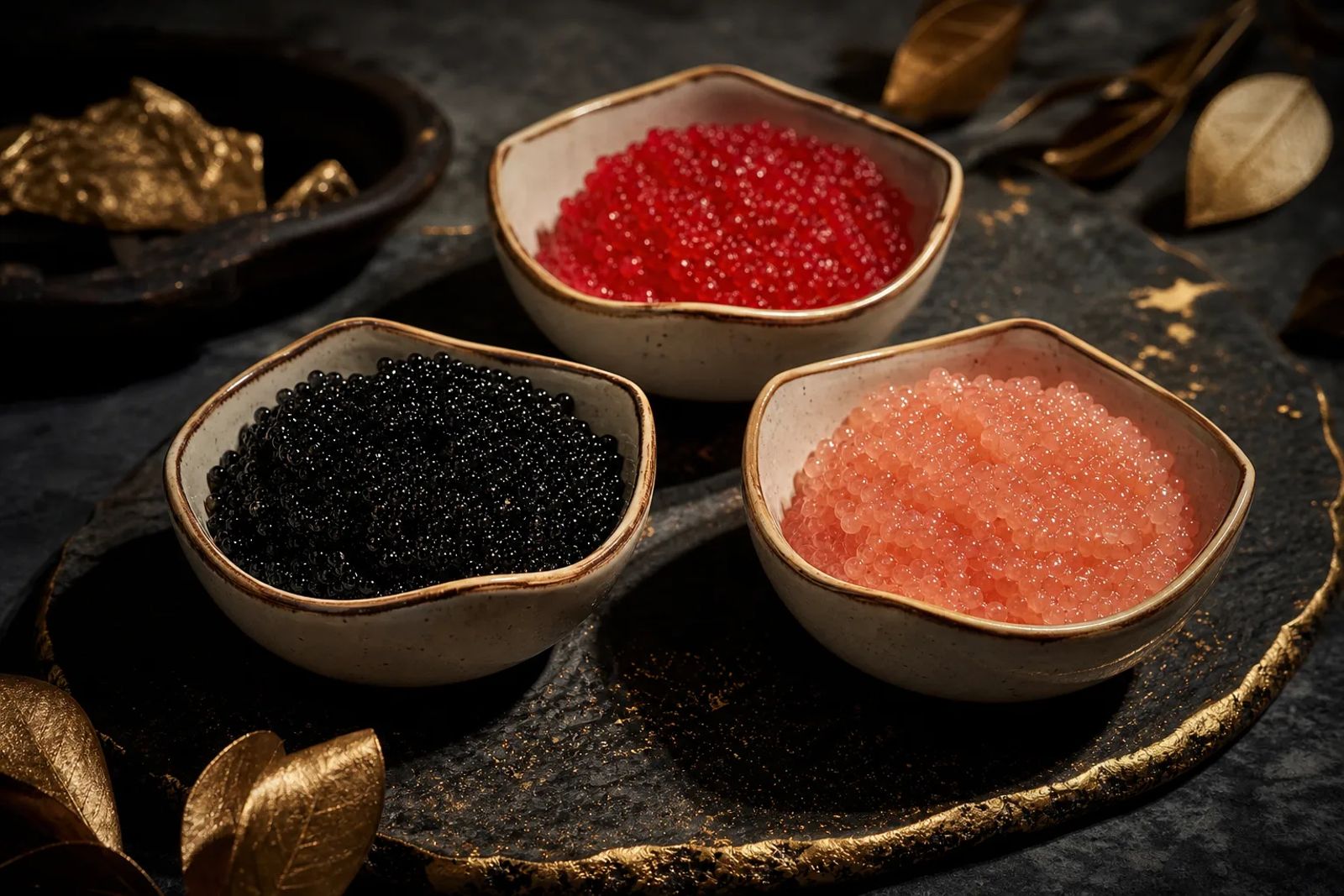
Dusty pink, pale green, nearly white: lumpfish roe has a quieter natural palette than its familiar black and bright red jars suggest. Royal Greenland describes its undyed roe as dusty pink; a Danish technical review records a wider range. Those vivid jar colours usually come from added colour, not different species.
The eggs belong to Cyclopterus lumpus, a North Atlantic fish distinct from sturgeon. Salted and prepared, they are lumpfish roe, not sturgeon caviar.
- Undyed roe is available, in a range of natural colours.
- Some jars need refrigeration before opening. Pasteurisation alone does not make them shelf-stable.
- Check ingredients for colours, preservatives and fish allergens, then follow the jar's storage instructions.
What fish does lumpfish roe come from?
Lumpfish have rounded bodies and a sucking disc underneath, which they use to attach to surfaces. Also called lumpsuckers, they live on both sides of the North Atlantic, including waters around Canada, Greenland, Iceland and Norway. These marine fish belong to the family Cyclopteridae, distinct from the true sturgeons that supply sturgeon caviar. For the wider family of foods, start with other fish roe.
All four countries have documented roe fisheries, though their importance has shifted. Canada's COSEWIC assessment records an earlier prominence followed by sharp declines in landings. Historical producer lists therefore tell a different story from current rankings. Iceland and Greenland have active, separately assessed fisheries documented in 2026.
The commercial roe fishery targets females approaching spawning, commonly using coastal gillnets, which catch fish by entangling them. Iceland's 2026 scientific report describes a female roe fishery much larger than its small male fishery for flesh. Female catches typically amount to 2,000 to 10,000 tonnes annually.
Collecting the roe normally kills the female. The fate of the body varies by fishery. Iceland introduced mandatory landing of bodies in 2012, with exceptions in 2021 and 2022; MSC documented a market for the flesh in China. Canada's 2017 assessment described carcasses being discarded at sea, an account of practice at that time rather than a description of every fisher today.
Lumpfish roe: dyed black, dyed red or natural
Black and red are presentation choices, not grades. Colouring gives jars their consistent appearance, while undyed lumpfish eggs vary considerably. Alongside Royal Greenland's dusty pink roe, the Danish Institute for Fisheries Research's technical review records pink, yellow, pale green and nearly white eggs. “Grey” is too narrow a description for natural lumpfish roe.
Royal Greenland describes brining its roe in Greenland before cleaning it, reducing the salt level, colouring it to specification, then packing and pasteurising it in Germany. This is that producer's process; other brands need not follow the same method.
According to Royal Greenland, colouring does not change its roe's flavour. Recipes can, however, contain different seasonings. For a comparison with eggs whose colours are natural, see natural roe colours. Colour alone cannot identify the fish.
What goes into the jar?
Two black jars can have different ingredient lists, even under the same brand. Elsinore's chilled black roe lists sulphite ammonia caramel (E150d), Brilliant Black BN (E151), sodium benzoate (E211) and potassium sorbate (E202). Its ambient version instead lists E151 and Sunset Yellow FCF (E110). Ora's red roe specification lists paprika extract (E160c), carmines (E120) and E211.
Colours change appearance; preservatives help control deterioration. Salt, acidity regulators and the preservation process also play their part. A recipe without added colour can still contain preservatives.
The table below summarises authorisations, rather than providing a complete formulation checklist. Permission depends on the additive, its conditions of use and the jurisdiction: an E number on a European label does not establish US permission.
| Ingredient type | Purpose | Where permitted | Legal source | Checked |
|---|---|---|---|---|
| Colours including E120, E150d and E151 | Colour | EU and Northern Ireland: permitted in fish roe subject to each colour's conditions | Regulation 1333/2008, Annex II, category 09.3 | November 2026 |
| Colours and preservatives | Colour and preservation | Great Britain: check each additive's FSA register entry | FSA register under assimilated Regulation 1333/2008 | November 2026 |
| E202 and E211 | Preservation | EU and Northern Ireland: check fish roe conditions | Regulation 1333/2008, Annex II, category 09.3 | November 2026 |
| Caramel and carmine | Colour | US: subject to each listing's conditions; carmine must be named specifically | 21 CFR 73.85 and 73.100 | November 2026 |
| Preservatives | Preservation | US: check each preservative's FDA authorisation | FDA food additive regulations | November 2026 |
The retail examples contain 3.5 to 7.0 g salt per 100 g. That is a range across products, not a standard for the species. Calculated from those labels, a 15 g portion provides about 0.53 to 1.05 g salt. When comparing labels, keep salt and sodium separate: they are different measurements.
Texture, flavour and colour bleeding
The small pop is part of the pleasure. Elsinore describes salty roe with a subtle pop; Royal Greenland describes crisp eggs with saltiness, sweetness and umami, the savoury taste. These supplier descriptions offer a guide to their products, rather than a tasting verdict on every jar or a claim of equivalence to sturgeon caviar.
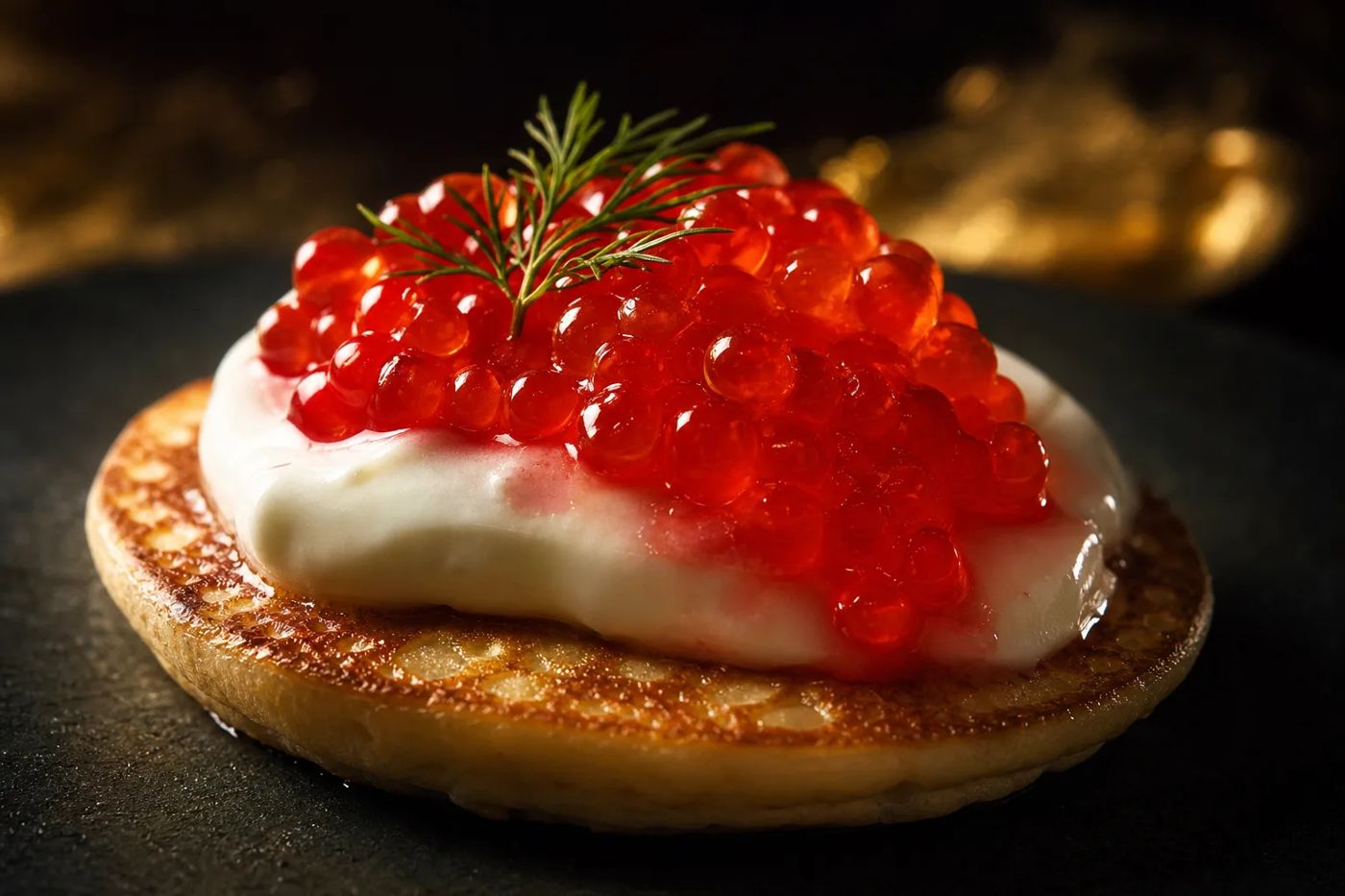
With dyed roe, presentation also depends on where the colour stays. Some releases colour into the food around it, particularly noticeably against a pale sauce or a spoonful of crème fraîche. Pescaviar, a manufacturer of competing alternatives, documents bleeding especially in hot recipes. Its commercial interest is worth bearing in mind, and formulations differ.
For a cleaner finish, keep the roe off the heat. Drain loose packing liquid and add it just before serving, rather than stirring it through a dish in advance. These steps reduce the risk of bleeding without guaranteeing colourfastness. If presentation matters, test a little roe with the intended accompaniment first.
Judge lumpfish roe as a prepared food in its own right, rather than as a measure of what all caviar tastes like.
Shelf-stable jars and chilled roe
A pasteurised jar may still belong in the fridge. Royal Greenland's pasteurised glass-jar specification requires storage at no more than 5°C (41°F). Elsinore, meanwhile, explicitly identifies one pasteurised product as ambient, suitable for unopened storage in a cool, dry place, while its unpasteurised version requires refrigeration.
Lumpfish have rounded bodies and a sucking disc underneath, which they use to attach to surfaces.
Pasteurisation is a controlled heat treatment that reduces microorganisms. It does not necessarily destroy them all or make a product safe at room temperature. The storage instructions, not the word “pasteurised”, tell you where the jar belongs.
Once opened, both Elsinore examples require refrigeration and consumption within three days. Mr. Moris red roe specifies 0 to 4°C (32 to 39°F) and consumption within three days after opening. Follow the actual jar, including any earlier use-by date: these are individual product instructions, not a shelf life for all lumpfish roe.
Fishery management and certification
The fishery matters more than the word “wild-caught”. Environmental outcomes depend on the stock being fished and the accidental capture of birds and marine mammals. According to Iceland's March 2026 scientific report, its female lumpfish fishery switched to individual catch quotas within an overall total allowable catch in 2025.
Greenland's government approved a new West Greenland female lumpfish management plan on 12 March 2026. Effective from 15 March, it covers 2026 to 2030. Announced measures include a bycatch working group and provisions for severe ice conditions. The MSC register lists Greenland lumpfish as certified, with certification extending to 12 February 2031.
Iceland's certification history has taken several turns. Certification was suspended in 2017 over bycatch, withdrawn in 2018 and regained by 2 December 2020. Following a 2025 notice of intent to suspend, MSC now shows “Certified”, with expiry on 1 December 2026. For its status after that date, consult the MSC register rather than an undated certification claim.
What “lumpfish caviar” means on a label
“Lumpfish caviar” can be a recognised label description without implying sturgeon origin. In the US, FDA's CPG 540.150, a nonbinding guidance document, distinguishes salted sturgeon roe, which may use unqualified “caviar”, from other salted fish eggs. It allows “lumpfish caviar” when the fish name and “caviar” appear in substantially the same size and prominence. It also calls for a prominent declaration of artificial colour and an ingredient list.
EU and UK tariff codes make a separate distinction. Codes 1604 31 00 and 1604 32 00 cover sturgeon caviar and caviar substitutes respectively; prepared lumpfish roe belongs in the latter category. These customs classifications do not determine retail names.
EU Regulation (EU) No 1169/2011, Article 7, prohibits misleading food information. Great Britain applies its assimilated version, while Northern Ireland generally applies EU food information law.
On the jar, look for “lumpfish roe” or an equally clear description naming the species, rather than an unexplained suggestion of sturgeon origin. Check the ingredients for fish and added colours. Finally, distinguish where the roe was caught from where it was processed: Royal Greenland's journey from Greenland to Germany shows why both places can appear in the same product's story.
Sources
-
COSEWIC / Environment and Climate Change Canada. Lumpfish (Cyclopterus lumpus): COSEWIC assessment and status report, 2017. Distribution, identification, fisheries, historical landings and carcass disposal. Report.
-
Marine and Freshwater Research Institute, Iceland. Lumpfish: technical report, 26 March 2026. Female and male fisheries, catch scale, landing requirements and the change to quota management. Report.
-
Royal Greenland. Lumpfish roe, undated product and processing information, retrieved November 2026. Company statements on natural colour, sensory characteristics and processing locations. Species and processing page.
-
Danish Institute for Fisheries Research, archived by DTU Aqua. Lightly Salted Lumpfish Roe: Composition, Spoilage, Safety and Preservation, report 46-97, 1997. Review of egg pigmentation and preservation. Technical report.
-
Elsinore Foods. Lumpfish Caviar (Chilled), undated product specification, retrieved November 2026. Ingredients, salt, unpasteurised status and opening instructions.
-
Elsinore Foods. Lumpfish Caviar (Ambient), undated product specification, retrieved November 2026. Ingredients, salt, pasteurisation and ambient storage instructions.
-
Ora ehf. Lumpfish Roe Caviar Red, 82%: EU, version 1, valid from 7 August 2024. Red product ingredient specification. Specification.
-
Socilink. Mr. Moris Red Lumpfish Roe 100g, undated distributor specification, retrieved November 2026. Salt declaration and refrigerated storage instructions.
-
Royal Greenland. Greenlandic Lumpfish Roe, undated product specification, retrieved November 2026. Glass-jar storage at a maximum of 5°C. Specification.
-
European Parliament and Council. Regulation (EC) No 1333/2008 on food additives, consolidated text of 14 April 2014, Annex II, category 09.3; and European Commission, Regulation (EU) No 1129/2011, adopted Annex II. Historical primary texts retrieved for the additive permissions; current consolidation requires editorial verification. Consolidated text; adopted Annex.
-
Food Standards Agency. Guidance on using the Register of Food Additive Authorisations, current retrieved guidance, including the authorisation system effective from 1 April 2025. Register guidance.
-
US Food and Drug Administration. Food Additive Status List, retrieved copy, revision not stated, hosted in the FDA regulatory docket. Listings for caramel and carmine, including references to 21 CFR 73.85 and 73.100. Status list.
-
Pescaviar. Avruga: Lumpfish, undated manufacturer comparison sheet, hosted by a distributor. Commercially interested primary statement about colour bleeding in some lumpfish roe, particularly in hot dishes. Manufacturer document.
-
Greenland Fisheries and Hunting Control Authority. Management Plan for Lumpfish in West Greenland, 13 March 2026. Approval, commencement, coverage and announced management changes. Official announcement.
-
Marine Stewardship Council. Greenland lumpfish: assessments, current register entry retrieved November 2026, including the 2026 certification assessment. Assessment record.
-
Marine Stewardship Council. Icelandic small-scale lumpfish fishery regains MSC certification, 2 December 2020. Historical suspension, withdrawal and recertification. Announcement.
-
Marine Stewardship Council. ISF Iceland lumpfish: assessments, register entry retrieved November 2026. Conflicting displayed certification status and certificate expiry date. Assessment record.
-
US Food and Drug Administration. CPG Sec. 540.150: Caviar, Use of Term, Labeling, October 1989, current published guidance page retrieved November 2026. Guidance.
-
Food Standards Agency. Packaging and labelling, updated 4 September 2026. Applicable food-information regimes in Great Britain and Northern Ireland. Guidance.
-
European Parliament and Council. Regulation (EU) No 1169/2011 on the provision of food information to consumers, consolidated text of 1 January 2018, Article 7. Legal text.
Research combined government fisheries reports, scientific literature, certification records, food-law materials and attributed manufacturer specifications.
Last checked: November 2026