
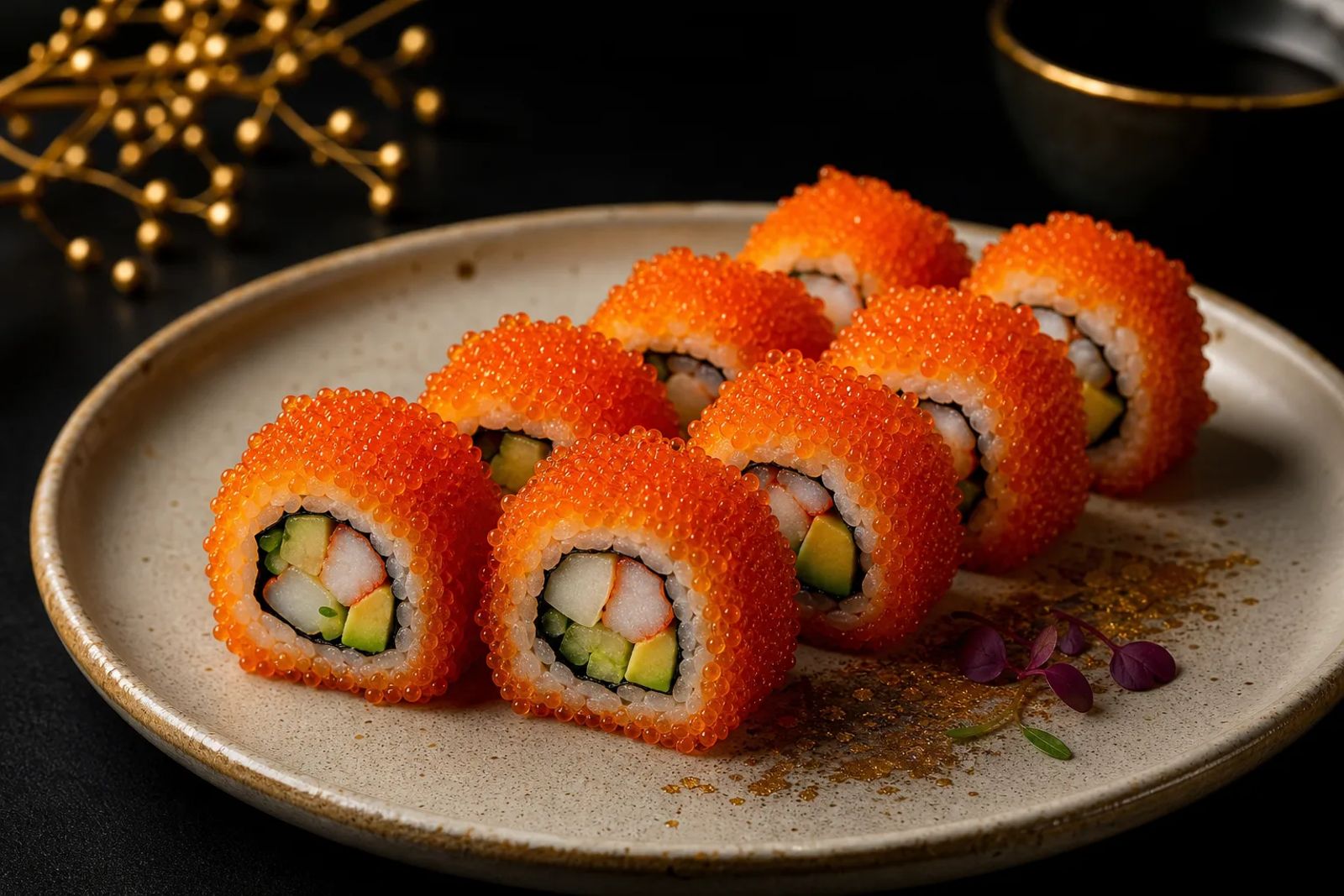
Small eggs, a distinct crunch: tobiko gives a sushi garnish a texture all its own. These are flying fish eggs, and their many colours usually come from seasoning and added colour, rather than different kinds of flying fish.
Which fish does flying fish roe come from?
Flying fish belong to the family Exocoetidae, but that family name does not tell you which species supplied the eggs in a particular product. Tobiko sits alongside the foods covered in the other fish roe guide.
Along southern Peru, a fisheries report documents egg collection from Cheilopogon heterurus and Hirundichthys rondeletii. Sudrablīnis names C. heterurus in a commercial tobiko ingredient list, linking that species directly to a finished product.
Indonesia is another documented source. A 2008 study identifies Hirundichthys oxycephalus in the roe fishery around West Papua and the Makassar Strait. The Peruvian report, published in 2013, names Japan as its principal market. Together, these records trace supply routes, rather than establish a current global production ranking.
How to recognise tobiko
Look for flying fish roe on the ingredient list, then examine the beads. Hokkai describes tobiko as slightly larger than masago, with a distinct pop; Azuma describes its masago as having a delicate texture.
- Identity: choose flying fish roe, rather than capelin roe or herring roe.
- Size: tobiko is generally described as larger than masago, although size ranges for finished products are not well documented.
- Texture: expect firm, individually perceptible beads, rather than masago's finer texture. Colour alone will not identify the roe.
That difference matters when crunch is the reason for the garnish. For more on the other fish, see [capelin roe](a-capelin-roe-masago.
Why so many colours?
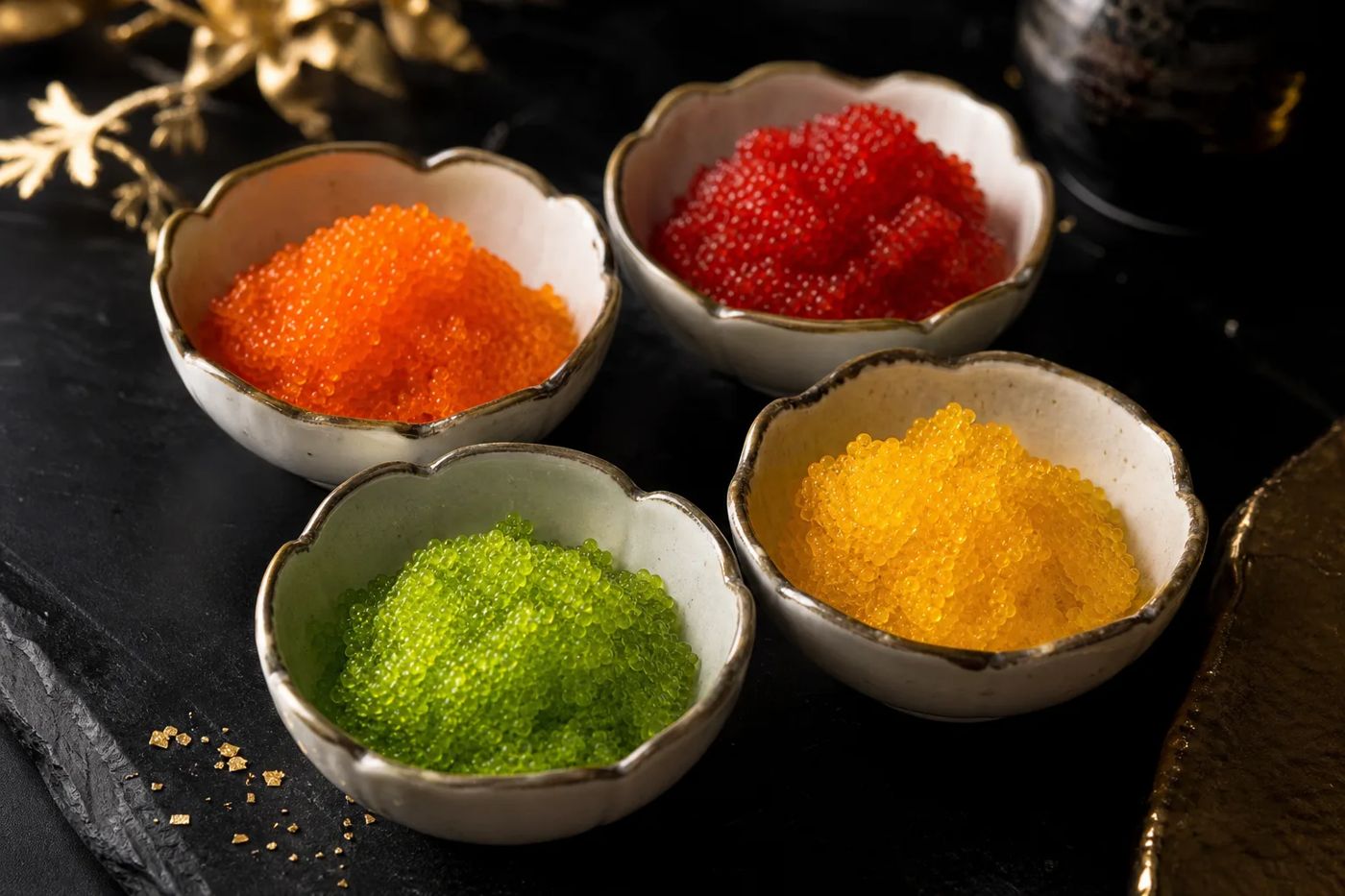
Even orange tobiko can contain added colour. Hokkai's orange product lists E102 and E129: orange does not automatically mean undyed. Natural colour ranges for the commercial species are not well documented. Indonesian supplier Bumi Laut Pertiwi describes dried flying fish roe as golden yellow, but dried raw material cannot serve as a colour standard for fresh or seasoned eggs.
Flavoured versions reveal how seasoning and colour work separately. Azuma's catalogue includes wasabi and yuzu variants. Wulf's green tobiko lists wasabi flavour alongside yellow and blue colours, while a Wismettac listing describes Azuma's yuzu version as containing actual yuzu peel.
Black takes the lesson further: it need not mean squid ink. Sudrablīnis lists E151, E110 and E102 in its black tobiko. A red product listed by JS Professional includes E162, beetroot red, together with E129.
Firm beads and a pleasant smell cannot establish that a chilled ready-to-eat product is safe.
The complete ingredient list tells the story that colour and flavour names leave out.
Additives and naming rules
Check both permissions and names: each has its own legal requirements. Additive permissions depend on where the tobiko is sold, which additive is used and its conditions of use. The table identifies the frameworks to check, not an import allowance.
| Jurisdiction | Applicable framework | What to check |
|---|---|---|
| EU | Regulation (EC) No 1333/2008, Annex II, category 09.3, Fish roe | Listed additives and their conditions of use. |
| Great Britain | GB authorisations register under assimilated food additive law | GB authorisation, not simply an EU or overseas label. |
| Northern Ireland | EU food additive rules generally apply | EU permissions; assess any specific movement scheme separately. |
| United States | 21 CFR Parts 73 and 74 | Colour additive authorisation for the intended use. Yellow No. 5 and dehydrated beet powder have food listings. |
For US naming, FDA's nonbinding CPG 540.150 says unqualified caviar should mean salted sturgeon roe. Other roe may use the fish name with caviar, provided the words are substantially equal in size and prominence and the required added-colour declaration is included.
EU consumer naming and information rules include Articles 7 and 17 of Regulation (EU) No 1169/2011. Great Britain applies its assimilated food information legislation; Northern Ireland generally follows the EU rules.
These retail requirements are separate from customs classification. In the EU Combined Nomenclature, sturgeon caviar and substitutes fall under 1604 31 00 and 1604 32 00 respectively. A description such as seasoned flying fish roe helps identify what the product is.
In Japan, the Consumer Affairs Agency explains that processed food labels identify ingredients and additives separately. Familiarity on a sushi menu does not exempt tobiko from that framework.
Read the allergens too
Fish is only the starting point. Tobiko seasonings can introduce other allergens, including wheat and soya from soy sauce. Some commercial formulations also blend flying fish roe with herring roe, as Azuma's catalogue explicitly records.
If squid ink is present, its mollusc origin matters. Regulation (EU) No 1169/2011 requires mollusc allergens to be identified and emphasised in the EU and generally in Northern Ireland. Great Britain has corresponding assimilated food information rules.
The US major allergen regime covers fish and crustacean shellfish, but not molluscs. To check for squid, read beyond a US Contains statement.
Using and storing tobiko
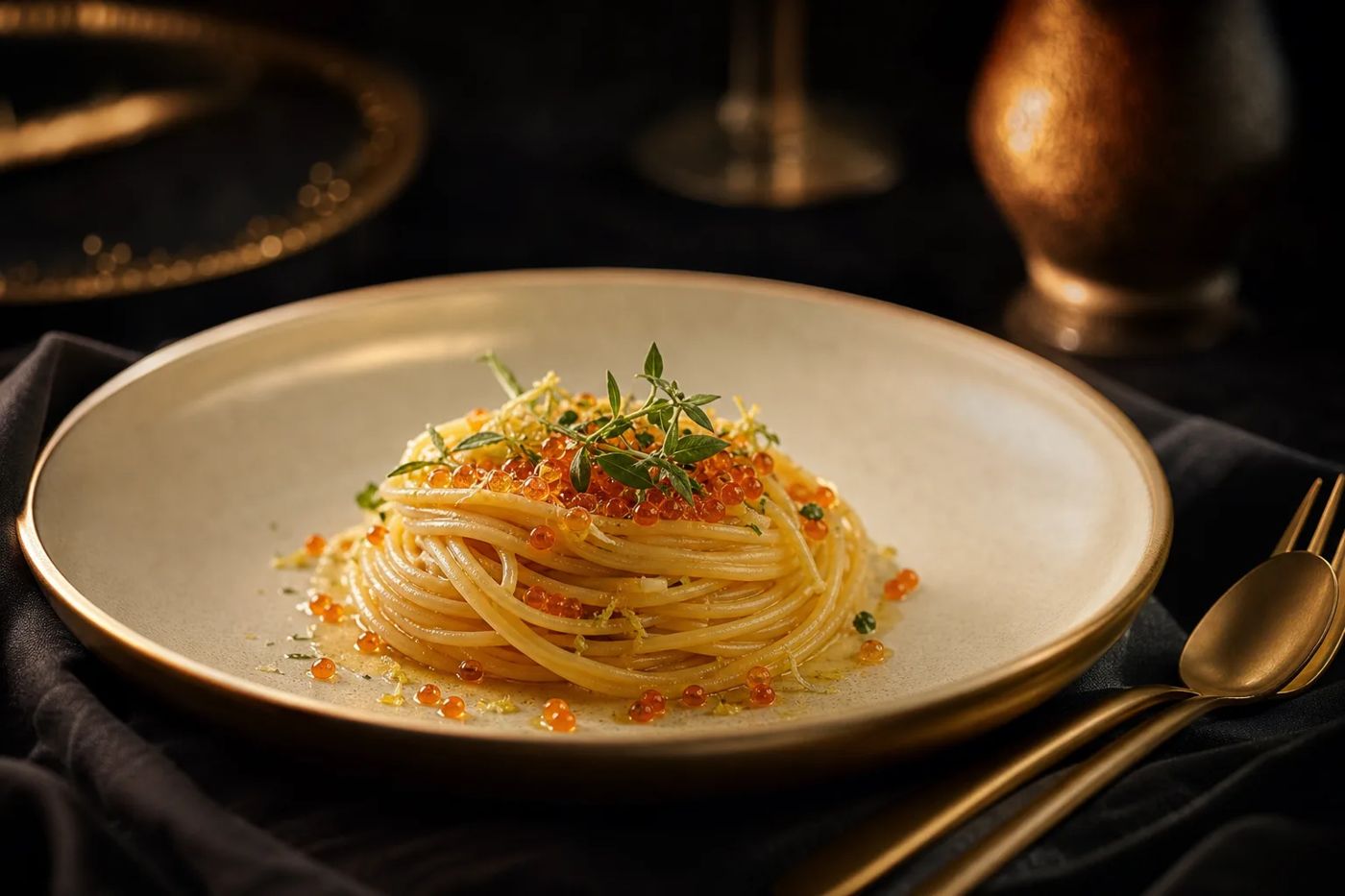
Give the beads somewhere to stand out. Use tobiko over sushi, in a poke bowl or as a finishing garnish, where its small, firm eggs remain noticeable. Salads, pasta and small appetisers also give its texture and colour room to work.
For assembly ideas, follow tobiko and masago in sushi and poke. Keep the roe as a finishing ingredient; seasoned products will not necessarily behave alike in a hot dish.
For storage, follow the pack. Wismettac's yuzu tobiko listing specifies frozen storage below -18 °C (about 0 °F) and thawing under refrigeration. Other products are sold chilled. Use the storage instructions and stated period after opening for the product in hand.
Never borrow a shelf life from another brand or colour variant. Firm beads and a pleasant smell cannot establish that a chilled ready-to-eat product is safe.
Sources
-
FAO. The living marine resources of the Western Central Atlantic, species identification guide, Exocoetidae section, 2002. Family identification and flying fish biology. Source PDF.
-
Instituto del Mar del Perú, Alex Guardia Otárola. Extracción de ovas de peces voladores Cheilopogon heterurus (Rafinesque) e Hirundichthys rondeletii (Valenciennes), en el litoral sur del Perú. Informe IMARPE 40(3 to 4), pages 160 to 175, 2013. Repository abstract retrieved. Repository record.
-
Indonesia Ministry of Marine Affairs and Fisheries, BAWAL. Eksploitasi sumber daya ikan terbang (Hirundichthys oxycephalus, famili Exocoetidae) di perairan Papua Barat: pendekatan riset dan pengelolaan. Journal article, BAWAL 2(2), 2008, pages 83 to 91. Article record.
-
Sudrablīnis. Tobiko. Manufacturer's product descriptions and ingredient lists, undated, retrieved November 2026.
-
Bumi Laut Pertiwi. Flying fish. Supplier's raw-material specifications, referring to SNI 2720.1:2010, undated. Raw-material information.
-
Hokkai Suisan. Tobiko. Supplier's product description, ingredients and storage instructions, undated, retrieved November 2026.
-
Azuma Foods International. 2025 Spring product catalogue, 2025 edition. Tobikko and masago descriptions, including formulations containing herring roe. Catalogue PDF.
-
Wulf's Fish. Wulf's tobiko. Supplier's ingredient declarations, undated, retrieved November 2026.
-
Wismettac. Flying fish roe tobiko yuzu 300 g. Distributor's product record for Azuma, undated, retrieved November 2026. Yuzu peel, frozen storage and refrigerated thawing instructions.
-
JS Professional. Flying fish roe “Tobikko” red frozen 500 g. Distributor's ingredient declaration, undated, retrieved November 2026.
-
European Commission. Commission Regulation (EU) No 1129/2011, establishing the Union list in Annex II to Regulation (EC) No 1333/2008, 2011. Fish roe category and additive conditions. This is a historical amending instrument, not verification of the complete November 2026 list. Official text.
-
Food Standards Agency. Authorised regulated food and feed products for Great Britain: guidance. Current online guidance retrieved November 2026. GB additive authorisations and the post-April 2025 framework.
-
Food Standards Agency. Food additives authorisation guidance and General food law. Current online guidance retrieved November 2026. GB and Northern Ireland jurisdictional distinctions.
-
US Food and Drug Administration, electronic Code of Federal Regulations. 21 CFR 74.705, FD&C Yellow No. 5; 21 CFR 73.40, Dehydrated beets (beet powder). Current online sections retrieved November 2026.
-
US Food and Drug Administration. CPG Sec. 540.150: Caviar, use of term, labeling. October 1989 revision, retrieved November 2026. Nonbinding naming guidance. Guidance.
-
UK Government and Food Standards Agency. Food labelling and packaging: ingredients list; Packaging and labelling. Current online guidance retrieved November 2026. Ingredients, allergen emphasis and applicable GB food information legislation.
-
Japan Consumer Affairs Agency. Japan's food labelling system. English-language explanatory leaflet, April 2024 edition. Leaflet PDF.
-
US Food and Drug Administration. Questions and answers regarding food allergens, including the food allergen labeling requirements of the Federal Food, Drug, and Cosmetic Act. Edition 5, January 2025. Question B.9 distinguishes molluscan from crustacean shellfish.
The piece was researched using fisheries records, official regulatory material and explicitly attributed commercial ingredient declarations, without first-hand tasting.
Last checked: November 2026