
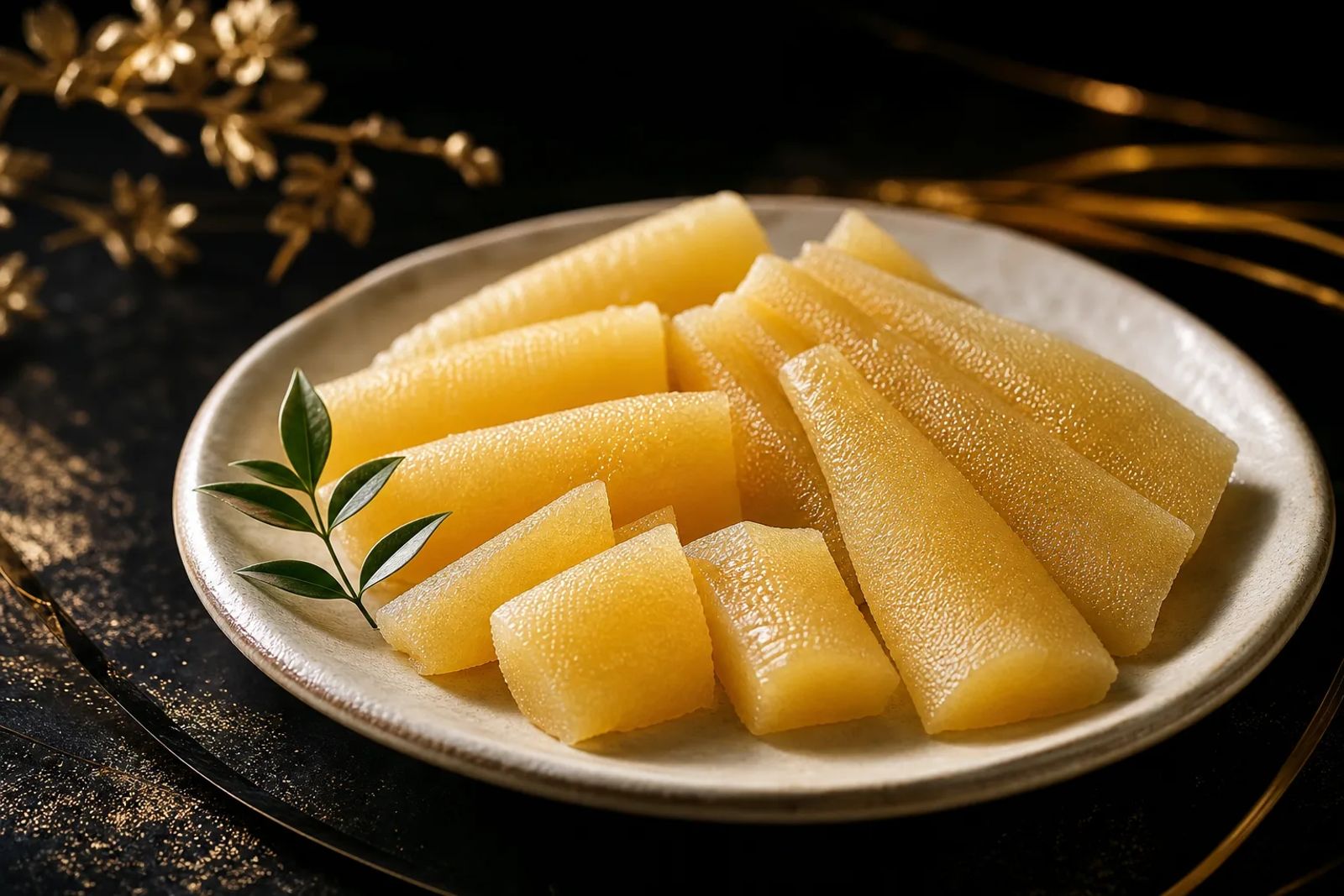
A crisp bite is kazunoko’s signature, particularly in North Pacific roe, according to Japan’s Food and Agricultural Materials Inspection Center, FAMIC. At New Year, its many eggs carry another meaning: descendants and family continuity.
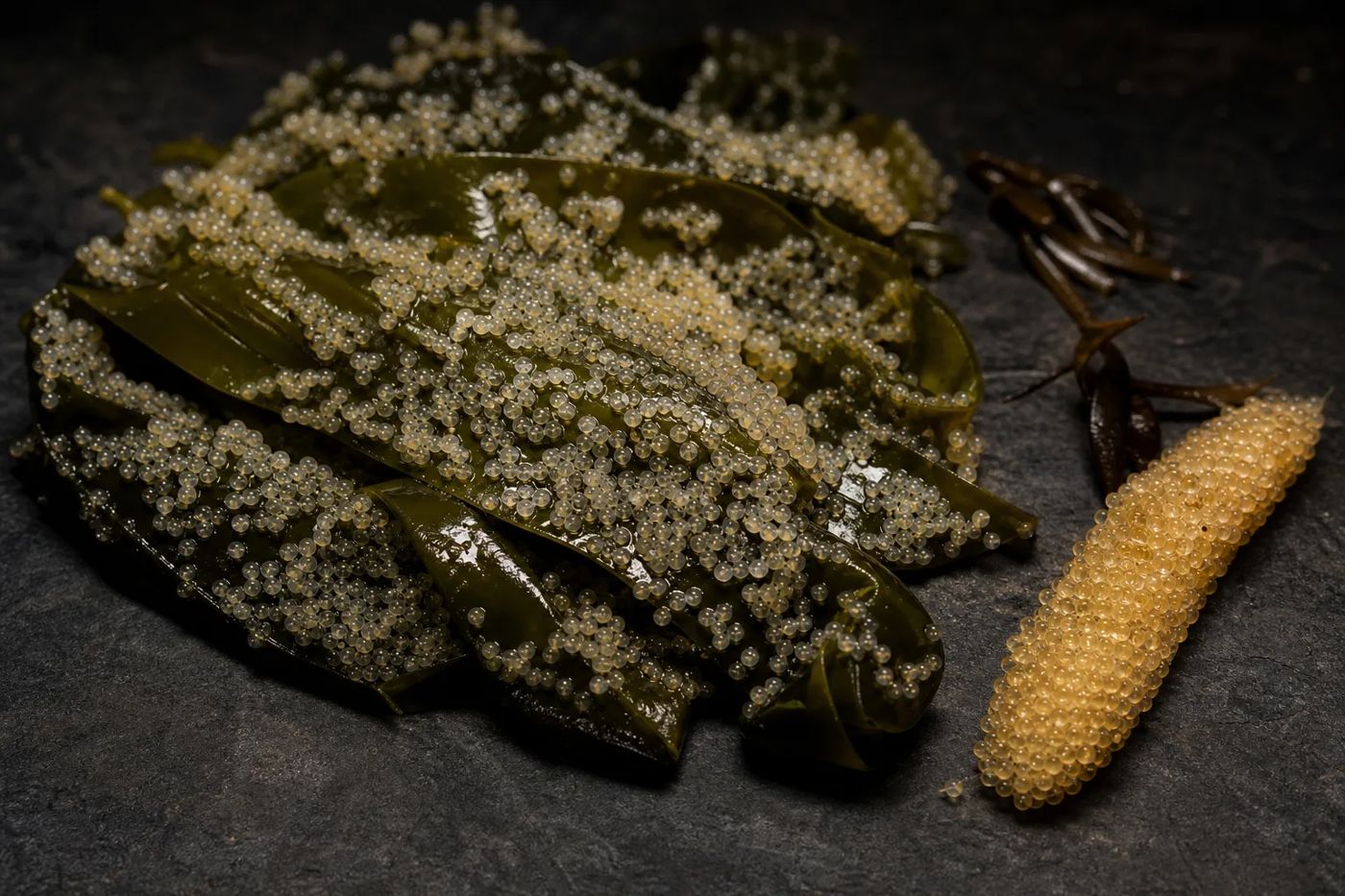
Kazunoko is herring roe held together in its skein, the natural egg sac, and preserved by salting or drying, or sold already seasoned. Herring roe on kelp begins differently: fish lay their eggs on seaweed, which is harvested with the eggs attached and eaten in Japan as komochi konbu.
In short
- Pacific and Atlantic herring both supply the Japanese roe market.
- Salted skeins need desalting before seasoning.
- British Columbia and Alaska regulate spawn on kelp fisheries separately.
What kazunoko is
A whole skein holds its shape. Unlike a spoonful of separated eggs, it can be cut into pieces while keeping its compact structure. The Japanese names tell you how it has been prepared: shio kazunoko is salted roe, hoshi kazunoko is dried roe, and ajitsuke kazunoko is seasoned roe. These are preparations of herring eggs, not different fish species. Kazunoko alone does not identify where the herring were caught.
Texture varies with the roe. Alaska’s Commercial Fisheries Entry Commission describes Atlantic roe as smaller and softer, helping explain its use in seasoned products. Preparation shapes flavour too: salt curing and soy seasoning describe different treatments, rather than the character of the underlying roe.
In Japan, kazunoko belongs to osechi, the foods prepared for New Year. It also has a life beyond the celebration. FAMIC records everyday regional uses, including matsumaezuke in Hokkaido and bean dishes in Fukushima and Yamagata. The dedicated New Year preparation covers the dish itself; the Japanese roe culture guide explores its wider food culture.
Which herring supply kazunoko
Both Pacific herring, Clupea pallasii, and Atlantic herring, Clupea harengus, supply the Japanese roe market. Pacific roe is particularly associated with intact salted kazunoko; Atlantic roe also goes into seasoned preparations. A 2005 Alaska market review documents this pattern, rather than an exclusive division between the two species.
British Columbia and Alaska are established North Pacific sources, and Hokkaido also produces herring roe. FAMIC’s 2022 account identifies the United States and Canada as Japan’s principal overseas suppliers at that time, rather than offering a current ranking of every exporting country.
Herring eggs are an important first fresh food of the year in the Heiltsuk account given to Canada’s Northern Gateway review.
The crucial distinction is how the eggs are harvested. Sac roe fisheries catch herring before spawning and remove the ovaries during processing. Spawn on kelp fisheries collect eggs already laid outside the fish. Alaska’s fisheries authority describes both systems; British Columbia manages roe herring and spawn on kelp as separate fisheries.
How kazunoko is prepared
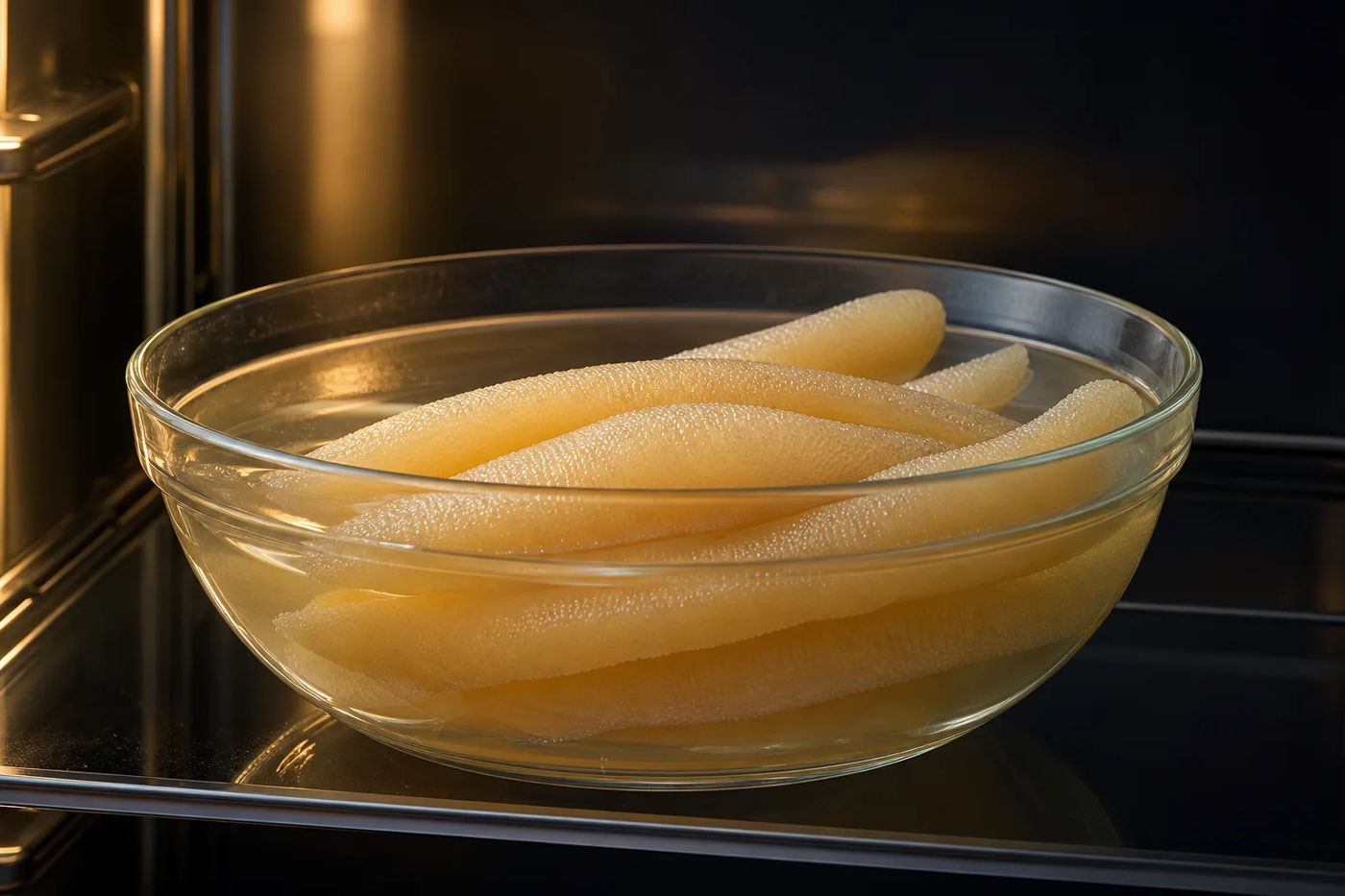
Salted kazunoko needs preparation before serving. Fukuoka City’s public health cookery notes give this method for salted skeins. Follow the product’s storage instructions, and use a different approach for dried or already seasoned roe.
- Make a light brine with 6 g salt in 1 litre of water. The source gives this quantity for 360 g salted kazunoko.
- Soak for half a day to one day. Keep the roe refrigerated as a precaution and follow the pack’s handling instructions: desalting does not cook or sterilise it.
- Gently lift away the thin surface membrane with the pads of your fingers, keeping the skein together.
- Season for the dish, commonly with dashi and soy sauce. Check the soy sauce for wheat as well as soya; the roe itself is fish.
Do not overdo the soaking. The Japanese seafood processors’ federation warns that excessive desalting can produce bitterness. It also advises refrigerating desalted roe and eating it promptly. Once prepared, the dish no longer has the keeping instructions of the unopened salted product.
Herring roe on kelp (komochi konbu)
The eggs attach to the kelp as the herring spawn in the water. This is what makes komochi konbu different from a kazunoko skein placed on seaweed. Also written komochi kombu, the name means kelp bearing eggs; FAMIC uses it for seaweed carrying herring spawn.
Harvesters can work with several systems. In an open pond, or open pound in Alaska’s terminology, they suspend kelp where free-swimming herring can spawn on it. A closed pond holds captured spawning herring in a net enclosure containing suspended kelp, then releases the fish afterwards. Naturally spawned kelp can also be gathered without either structure where the particular fishery authorises it.
In British Columbia, commercial harvesting requires a category J licence or a communal commercial category FJ licence. DFO describes these as limited-entry, party-based fisheries, with operations tied to specified areas. Its 2026 licence notice confirms that both categories remain in use. A licence, however, does not mean an area is open.
Alaska has its own rules. The 2026 Southeast Alaska management plan identifies Craig/Klawock as that year’s only Southeast spawn-on-kelp pound fishery. It requires both a CFEC fishing permit and a separate kelp harvest permit. ADF&G’s general description also includes Prince William Sound and Norton Sound elsewhere in Alaska, but permission for a fishery does not guarantee that it operates every year.
Closed ponds release adult herring after spawning instead of harvesting them for roe. That distinction matters, as do the effects of capture. Alaska’s management guidance explicitly addresses mortality and stress from capture and handling in closed pounds, alongside the requirement to release the fish.
Indigenous fisheries and food traditions
Herring eggs are an important first fresh food of the year in the Heiltsuk account given to Canada’s Northern Gateway review. Representatives described harvesting eggs on kelp and hemlock branches, preserving them and trading them with neighbouring Nations. Their language distinguished eggs on different substrates. These fisheries have food traditions and relationships far beyond supplying Japanese cuisine.
In Southeast Alaska, ADF&G documents Tlingit herring egg harvesting and the sharing of Sitka Sound eggs across communities. Its research with the Sitka Tribe of Alaska treats subsistence harvests as a distinct fishery, separate from the commercial export trade. Eggs may be gathered on deliberately submerged branches as well as seaweed: Indigenous herring egg harvesting is broader than roe on kelp alone.
Fishery status and disagreements
The stock, area and season determine fishery status, not the word herring. DFO’s plan for 7 November 2025 to 6 November 2026 keeps Haida Gwaii closed to commercial harvest while providing limited commercial spawn-on-kelp opportunities on the Central Coast. Other areas have different management approaches, including roe fisheries in Prince Rupert District and the Strait of Georgia. Their planned roe harvest rates for 2026 are 8% and 14% respectively.
The debate also concerns what makes a fishery adequate for the people who depend on it. At an October 2024 federal subsistence council meeting, Sitka Tribe of Alaska testimony supported continuing the Makhnati waters closure and emphasised accessible egg harvests. Total spawning biomass answers one management question. Where, when and for how long spawning occurs answers others for communities. A large forecast alone cannot resolve both.
Herring roe beyond Japan
Butter, rye flour and rye bread offer a different setting for herring roe. Danish food writer Michael Brix describes coating skeins in rye flour, frying them in butter and serving them on rye bread. Norwegian cookery writer Andreas Viestad uses herring roe as a garnish for quick-cured herring. Finland’s K-Ruoka food guide lists silakanmäti, Baltic herring roe, among edible roes. These Northern European examples are distinct from the salted Japanese skein.
Names, origin and labelling
Read the name, ingredients and origin information together. Japanese lettering or processing in Japan does not establish that the fish came from Japan. Ask what is inside: a whole skein, separated eggs or eggs attached to kelp. For the broader distinctions, see other fish roe.
Japan requires food labels in Japanese. Its Consumer Affairs Agency distinguishes ingredient-origin information for domestically manufactured processed foods from country-of-origin labelling for imported finished foods. Commercial food imports also require notification under the Food Sanitation Act. That is a separate obligation from retail labelling.
In the EU, Regulation (EU) No 1169/2011 prohibits misleading food information. Great Britain applies its assimilated, amended version; Northern Ireland applies the EU regulation. These consumer information rules govern whether a description misleads about the food’s identity, rather than a customs tariff category.
In the US, the FDA’s nonbinding Compliance Policy Guide Sec. 540.150 advises that other fish caviar carry the fish name, in substantially equal size and prominence.
Sources
-
Food and Agricultural Materials Inspection Center, Japan. “数の子(カズノコ)” [Kazunoko], 大きな目小さな目, No. 67, New Year edition, 2022, p. 15. Publication PDF.
-
Alaska Commercial Fisheries Entry Commission, Stefanie Carlson. Changes in Roe Herring Markets: A Review of Available Evidence, Report 05-5N, December 2005. Report PDF.
-
Fukuoka City Health and Welfare Bureau, Health Promotion Division. はじめてさんのおせち料理教室 [A beginner's osechi cookery class], 13 December 2019, kazunoko preparation notes. Class notes PDF.
-
National Federation of Fisheries Processing Cooperatives, Japan. よくあるご質問 [Frequently asked questions], undated web edition, kazunoko desalting and storage advice. Questions and answers.
-
Hokkaido Government. ニシン[鰊] [Herring], fisheries information page, undated web edition. Herring information.
-
Fisheries and Oceans Canada. Pacific herring 2025-2026: Integrated fisheries management plan summary, management period 7 November 2025 to 6 November 2026. Plan summary.
-
Alaska Department of Fish and Game. Commercial Herring Fisheries, undated web edition, sac roe and spawn-on-kelp fishery descriptions. Fishery overview.
-
Fisheries and Oceans Canada. Commercial fisheries licensing rules and policies reference document, Pacific region: Spawn on kelp, categories J and FJ, undated web edition. Licensing rules.
-
Fisheries and Oceans Canada. FN0229: Licensing information, 2026 roe herring, spawn on kelp licence issuance, 2026 notice. Fishery notice.
-
Alaska Department of Fish and Game, Aaron Dupuis, Scott Forbes, Bo Meredith and Katie Taylor. 2026 Southeast Alaska Herring Spawn-On-Kelp Pound Fishery Management Plan, Regional Information Report 1J26-04, February 2026. Management plan PDF.
-
Joint Review Panel for the Enbridge Northern Gateway Project. Heiltsuk First Nation oral presentations, Hearing Order OH-4-2011, paragraphs 28671 to 28674; hearing date not shown in the retrieved extract. Hearing record.
-
Alaska Department of Fish and Game. Gathering Herring Eggs, web article, 2015. Article.
-
United States Department of the Interior, Federal Subsistence Management Program. Southeast Alaska Subsistence Regional Advisory Council meeting transcript, 22 October 2024, discussion of the federal waters closure near Sitka. Meeting transcript PDF.
-
Andreas Viestad. Hurtiggravet sild [Quick-cured herring], 22 August 2016, original recipe. Recipe.
-
Michael Brix, Jydefiskeren. Tre ting du kan gøre med silderogn [Three things you can do with herring roe], undated original cookery article. Article.
-
K-Ruoka. Mäti: Vinkit ja reseptit mädin käyttöön [Roe: tips and recipes], web guide, 2025. Roe guide.
-
Consumer Affairs Agency, Japan. Food Labelling, current English-language information portal, undated web edition. Labelling information.
-
Consumer Affairs Agency, Japan. 消費者向けQ&A [Consumer questions and answers on ingredient-origin labelling], undated web edition, questions 4 to 6. Origin-labelling guidance.
-
Ministry of Health, Labour and Welfare, Japan. Import Procedure under Food Sanitation Act, undated web edition, Article 27 notification requirements. Import procedure.
-
Food Standards Agency. Packaging and labelling, updated 4 September 2026, guidance on Regulation No 1169/2011 and its application in Great Britain and Northern Ireland. Official guidance.
-
Department of Health, Ireland. The Food Information to Consumers (FIC) Regulation, updated 12 August 2022, official summary of Regulation (EU) No 1169/2011. Regulation summary.
The piece was researched using Japanese food authorities, Canadian and Alaskan fisheries records, Indigenous testimony, official labelling guidance and attributed Northern European cookery examples.
Last checked: November 2026