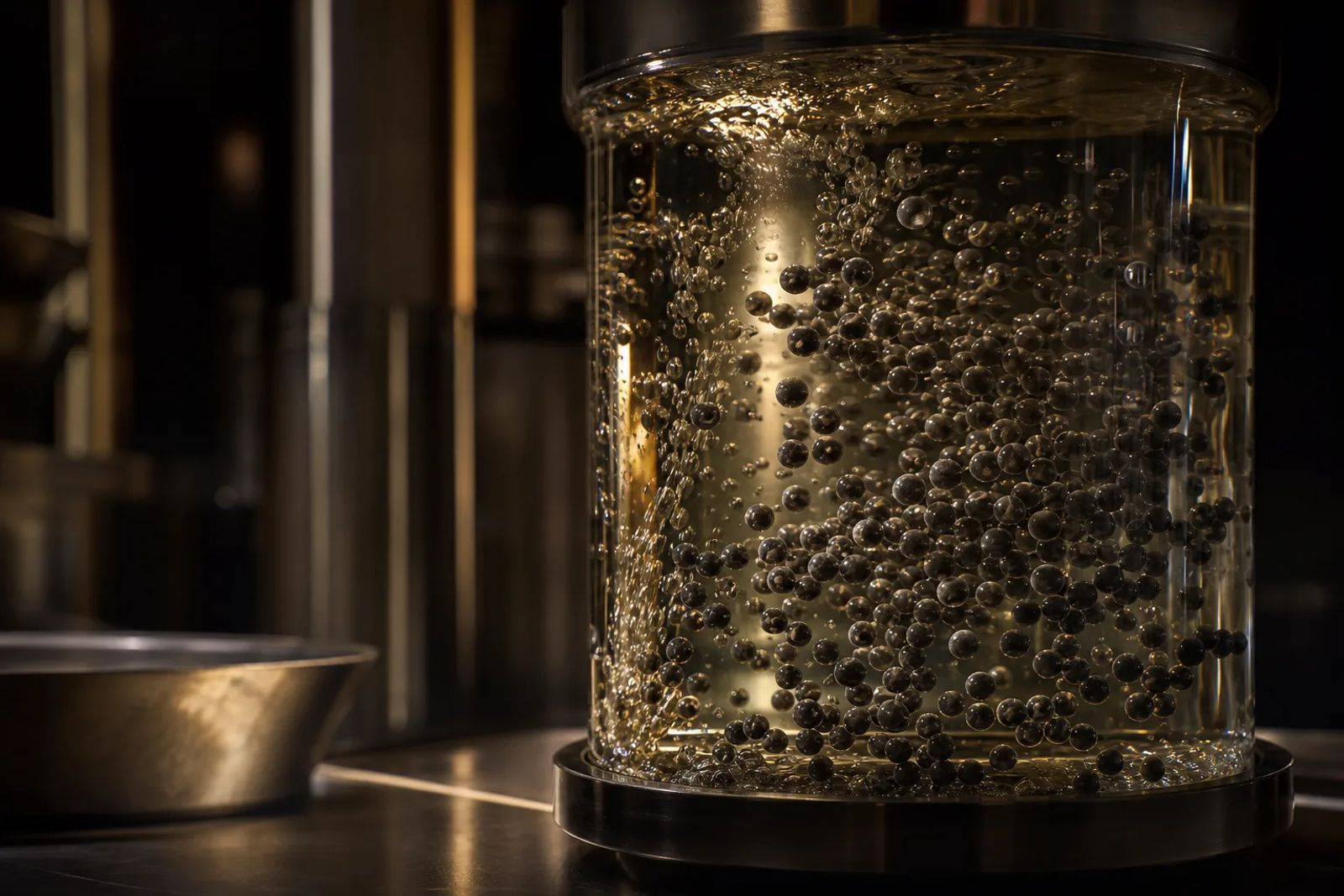
The decisive moment happens outside the fish. Water sets the sperm moving, and controlled mixing brings it into contact with the eggs. In a hybrid cross, those eggs come from a female of one sturgeon species and the sperm from a male of another.
That brief encounter rests on a much longer hatchery process: conditioning the parents, inducing final maturation, collecting their eggs and sperm separately, then checking development, parentage and chromosome complement.
- Identify the female and male parents. A hybrid's trade name is not enough.
- Judge fertilisation, juvenile survival and adult fertility separately.
- Check local medicines rules before using any published hormone protocol.
Choosing and conditioning the parents
The parents need compatible reproductive readiness. Sharing a calendar date is not enough.
Broodstock are the adult fish retained for reproduction. Hatcheries choose healthy, sexually mature females and males with documented identity and origin. Individual tags and breeding records keep their families distinguishable.
Conditioning prepares those fish through appropriate feeding, seasonal temperature management and suitable water quality. Ultrasound helps assess gonadal development. Where egg sampling is justified, the egg polarisation index measures the nucleus's position within the egg, helping the hatchery judge readiness for induction.
The choice of parents shapes the cross long before fertilisation. For the reasons behind particular pairings, see why farms cross species.
Hormonal induction supplies the final trigger
Hormones trigger the final stage; they cannot replace the preceding period of gonadal development and conditioning. Treatment promotes final egg maturation and ovulation in females, and spermiation, the release of collectable sperm, in males.
FAO describes sturgeon and carp pituitary preparations and synthetic gonadotropin-releasing hormone analogues, abbreviated GnRHa. Its protocols distinguish preliminary and resolving injections in females, with schedules adjusted for species, water temperature and egg maturity.
A green sturgeon research report hosted by California's wildlife authority records one GnRHa injection for males and two injections for females: GnRHa first, then GnRHa with the dopamine antagonist domperidone, 12 hours later. That experimental schedule belongs to its research context, rather than serving as a general prescription for hybrid production.
How hybrid sturgeon are bred: the hatchery sequence
Controlled crossing depends on keeping eggs, sperm and records aligned at every stage. The sequence below explains the process, rather than providing dosing or surgical instructions. Each hatchery needs a validated operating procedure suited to its female parent, male parent and facilities.
-
Confirm readiness and separate the batches. Check the intended female and male against their identification records. Prepare clean, labelled equipment and give each cross its own collection and incubation batch.
-
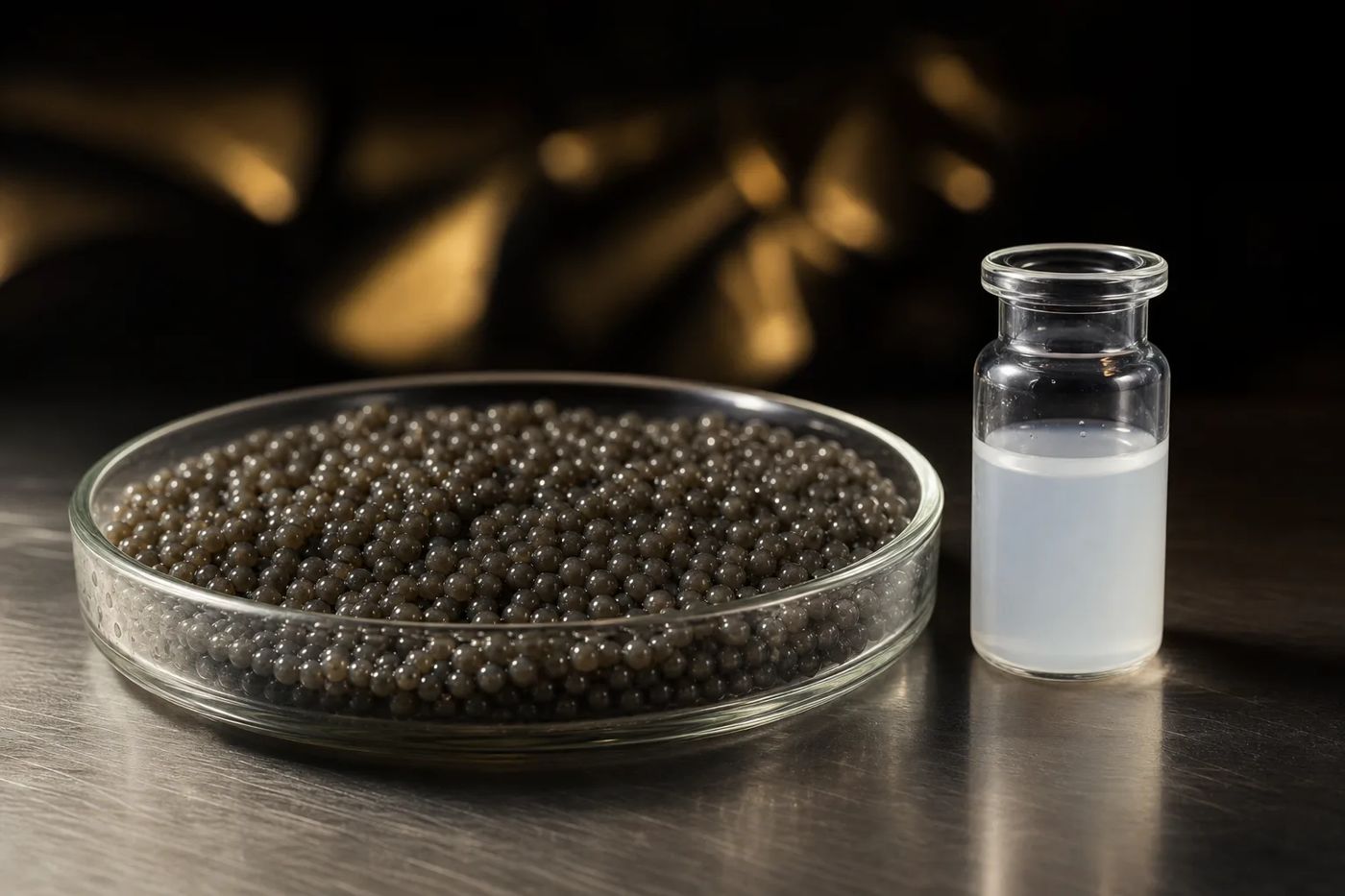
Collect ovulated eggs from the female. These eggs have left their ovarian follicles and are available for fertilisation. Documented collection methods include stripping, sometimes assisted by an oviduct incision, and surgical collection. These are distinct procedures, with different recovery requirements.
-
Collect and assess milt from the male. Milt is the fluid containing sperm. Catheter collection helps obtain a clean sample. Prevent contamination and unintended water contact, then assess sperm concentration and motility before assigning the sample to the cross.
-
Fertilise outside the fish. Combine the female's eggs and the male's sperm using the prescribed dilution and activation procedure. Water activation starts sperm movement, making controlled mixing and prompt handling essential. Keep batches separate: uncontrolled pooling sacrifices parentage information.
-
Remove egg stickiness. Apply the validated de-adhesion treatment after fertilisation to prevent eggs remaining stuck together in the incubator. FAO describes clay, silt, talc and tannin methods, each with different exposure conditions. Rinse away the treatment material before incubation.
-
Incubate and assess development. Transfer the eggs to a suitable flowing-water incubation system. Monitor temperature and oxygen, and remove dead eggs under the hatchery's hygiene procedure. Record embryonic development and hatching separately. The first dividing eggs are an early result, not an assurance of healthy juveniles.
The incubation system must suit the eggs, rather than simply the hatchery's convenience. Follow the subsequent stages in from fertilised egg to juvenile fish.
Stored sperm bridges seasons and distances
The male need not release sperm in the same season or location in which the female ovulates. Storage can bridge that gap.
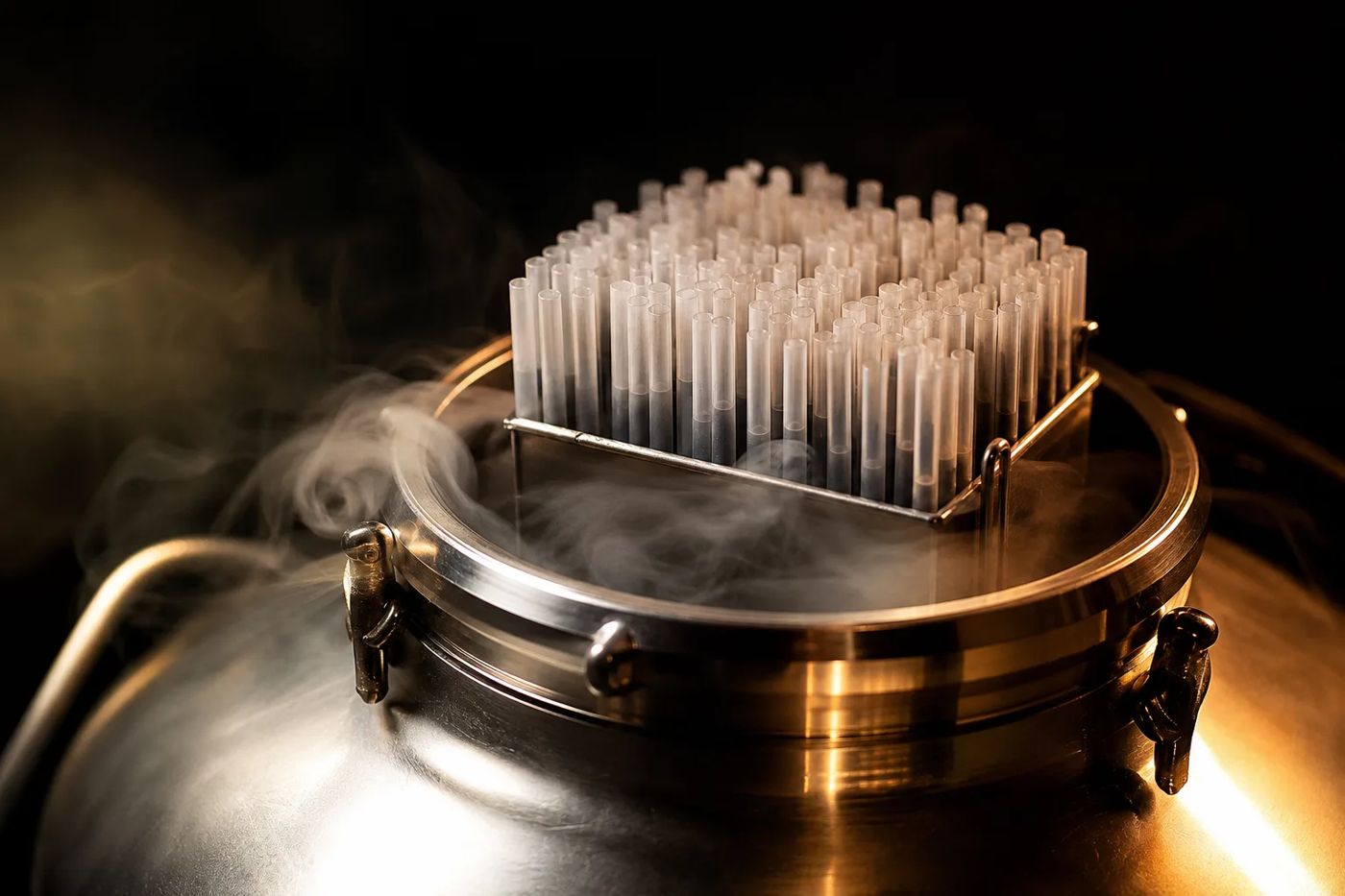
Fresh sperm can be held under a validated chilled-storage protocol for short-term coordination. For longer separation, cryopreservation uses an extender, a protective diluting medium, with a cryoprotectant and controlled freezing, followed by storage in liquid nitrogen. Moving stored sperm still carries health and wildlife-trade requirements.
The male need not release sperm in the same season or location in which the female ovulates.
Movement after thawing tells only part of the story. Research comparing cryoprotectants in Siberian sturgeon found that apparently good post-thaw movement could coexist with reduced fertilising ability. Assess fertilisation and subsequent development as well as motility, and retain the male parent's identity on every stored aliquot.
Why chromosome number and ploidy matter
A hybrid can develop successfully yet struggle to reproduce. The chromosomes inherited from its parents help explain why.
Chromosomes carry genetic material. Ploidy describes chromosome sets, but sturgeon literature uses two conventions.
Evolutionary ploidy reflects ancient genome duplications. Functional ploidy describes how genomes behave in present-day reproduction.
Under the functional convention, studies discuss diploid, tetraploid and higher-ploidy fish. Before interpreting a proposed cross, establish which convention the authors use and whether the actual female and male parents were tested. Individual fish can have unusual chromosome complements.
Development and fertility present different genetic challenges. A hybrid may develop despite an intermediate chromosome complement, then have difficulty pairing chromosomes during meiosis, the cell division that produces eggs or sperm. Experimental crosses also show that some combinations survive early development but fail during juvenile rearing.
Different parental ploidies do not automatically mean sterility. Research on particular hybrid females has demonstrated reproduction involving unreduced eggs, which retain the maternal chromosome complement. See sturgeon genetics, polyploidy and hybridisation for the mechanisms. Fertility must be established for the particular cross.
Keeping hybrid juveniles identifiable
Keep family groups identifiable through hatching, yolk-sac absorption, first feeding and later transfers so survival and growth observations can be linked to each cross.
One controlled breeding study maintained crosses separately before introducing group marks and, later, individual electronic tags. That continuity links survival and growth observations to crosses, rather than to individual parents.
Genetic identification has two jobs: establish which species contributed and identify the individual parents. A Danube study tested 84 sturgeons and retained eight informative nuclear microsatellite markers for hybrid assignment. Nuclear markers examine inheritance from both parents; mitochondrial identification alone cannot establish both sides of a cross.
Flow cytometry measures relative DNA content and helps assess ploidy, while chromosome counting supplies complementary evidence. Neither replaces a suitable parentage panel. Validate marker performance against reference samples from the female and male parents.
Welfare means recovery, not just survival
Surviving egg collection is the beginning of a welfare assessment, not its conclusion. Handling, injections, repeated examinations and invasive collection all count.
FAO recommends methods that support recovery and subsequent reproduction, with suitable anaesthesia and a continuous water supply to the mouth during collection. Follow-up should assess injury and wound healing, feeding and behaviour, recovery of condition, and later reproductive performance.
Calling stripping non-lethal says nothing by itself about pain or long-term harm. The same distinction matters for ovulated eggs and no-kill caviar.
Breeding eggs and eggs collected for food also fall into different categories. Codex CXS 291-2010 permits ovulated eggs from aquacultured sturgeons for caviar, subject to its processing provisions, including treatment to remove adhesiveness and harden the shell. Codex recommends hormone approval by the competent authority. This food standard neither supplies a hatchery fertilisation protocol nor independently authorises medicines nationally.
The legal controls on hormone use
A published hormone schedule does not establish a lawful use. Welfare duties and veterinary medicines rules must both be checked.
In the EU, Directive 98/58/EC includes farmed fish within its general protection framework. Article 3 requires reasonable steps to safeguard welfare and avoid unnecessary pain, suffering or injury. Article 4 excludes fish from the detailed Annex requirements.
Veterinary medicines fall under Regulation (EU) 2019/6. Article 106 concerns use according to authorisation; Article 114 provides the exceptional prescribing framework for food-producing aquatic species. It does not give blanket approval to hatchery hormone schedules.
Check the product and proposed use with the relevant EU Member State competent authority, within the medicines system supported by the European Medicines Agency. In the UK, consult the Veterinary Medicines Directorate. Its prescribing guidance distinguishes Great Britain from Northern Ireland, where the EU aquatic-species framework applies.
In the US, the authority is FDA's Center for Veterinary Medicine. FDA's indexed Ovaprim labelling, for example, prohibits both use in animals intended for food and extra-label use. A medicine featured in aquaculture research may therefore be unlawful for food-producing broodstock.
Records connect the cross to later trade
Traceability starts with the parents, not the finished tin. Record the female's and male's individual identities, species and origins. Add medicines, collection dates, sperm-storage details, the fertilisation batch, incubation transfers and genetic results. Together, these connect the hatchery mating to later stock or roe records.
CITES source codes
CITES distinguishes animals meeting its definition of bred in captivity from those merely born in captivity. Codes C and F are not interchangeable: aquaculture origin alone does not establish C. Resolution Conf. 12.7 (Rev. CoP17) specifically addresses F for caviar from a captive-born female with at least one wild-origin parent.
The CITES caviar register concerns processing and repackaging operations, rather than every hatchery. Separate CITES registration provisions cover operations breeding Appendix I species in captivity for commercial purposes. Check Resolution Conf. 12.10 (Rev. CoP20) and national rules.
CITES labelling
Parent order matters, too. In Resolution Conf. 12.7's labelling guidance, Annex 1 covers the labelling system and Annex 2 gives hybrid codes in male-parent then female-parent order. Naming conventions that put the female first use the opposite order.
National implementation determines enforceable requirements. A CITES label supports traceability but does not independently establish parentage. Connect the breeding records to the wider hybrid caviar documentation.
Sources
-
FAO. Chebanov, M. S. and Galich, E. V. Sturgeon Hatchery Manual. Fisheries and Aquaculture Technical Paper 558, reprinted 2013. Chapters 4, 5, 6, 11 and 15.
Read at fao.org. -
FAO. Sturgeon hatchery practices and management for release: Guidelines. Fisheries and Aquaculture Technical Paper 570, 2011. Sections 5.7, 9, 10, 11 and 15. Conservation hatchery guidance covering reproduction, rearing, release and record keeping.
Read at fao.org. -
Genes. Ploidy Levels and Fitness-Related Traits in Purebreds and Hybrids Originating from Sterlet (Acipenser ruthenus) and Unusual Ploidy Levels of Siberian Sturgeon (A. baerii). Original research, volume 11, article 1164, 2020.
Read at pmc.ncbi.nlm.nih.gov. -
Cech, Doroshov and May. Biological Assessment of Green Sturgeon in the Sacramento San Joaquin Watershed, Phase 2. Report to CALFED, June 2002.
Read at nrm.dfg.ca.gov. -
Scientific Reports. Cryoprotectant-specific alterations in the proteome of Siberian sturgeon spermatozoa induced by cryopreservation. Original research, volume 14, article 17707, 2024.
Read at pmc.ncbi.nlm.nih.gov. -
Cytogenetic and Genome Research. Molecular cytogenetics in artificial hybrid and highly polyploid sturgeons: An evolutionary story narrated by repetitive sequences. Original research, 2013.
Read at pubmed.ncbi.nlm.nih.gov. -
Journal of Applied Ichthyology. Vasil'ev and colleagues. Fertility of females of sturgeon hybrids obtained from species with different levels of ploidy (Acipenser ruthenus and A. dauricus) and their cloning. Original research, 2021.
Read at doi.org. -
Int. J. Mol. Sci. Nuclear Markers of Danube Sturgeons Hybridization. 2011.
Read at pmc.ncbi.nlm.nih.gov. -
FAO and WHO, Codex Alimentarius Commission. Standard for Sturgeon Caviar, CXS 291-2010. Sections 2.1 and 2.3 cover definitions and processing. The Codex register records the standard as last modified in 2026.
Read at codex.fao.org. -
CITES. Conservation of and trade in sturgeons and paddlefish, Resolution Conf. 12.7 (Rev. CoP17). Annexes 1 and 2 cover labelling and species identification codes.
Read at downloads.regulations.gov. -
European Medicines Agency. National competent authorities (veterinary). Live authority directory, accessed November 2026.
Read at ema.europa.eu. -
Council of the European Union. Council Directive 98/58/EC concerning the protection of animals kept for farming purposes, 1998. Articles 2, 3 and 4.
Read at eur-lex.europa.eu. -
European Parliament and Council of the European Union. Regulation (EU) 2019/6 on veterinary medicinal products, 2019. Articles 106 and 114; official text reproduced by the UK National Archives.
Read at legislation.gov.uk. -
Veterinary Medicines Directorate. The cascade: prescribing unauthorised medicines. Live guidance, accessed November 2026, including separate Great Britain and Northern Ireland provisions.
Read at gov.uk. -
US Food and Drug Administration. Ovaprim Injectable Solution. Indexed product labelling, MIF 900-001, retrieved November 2026.
Read at fda.gov.
Last checked: November 2026