
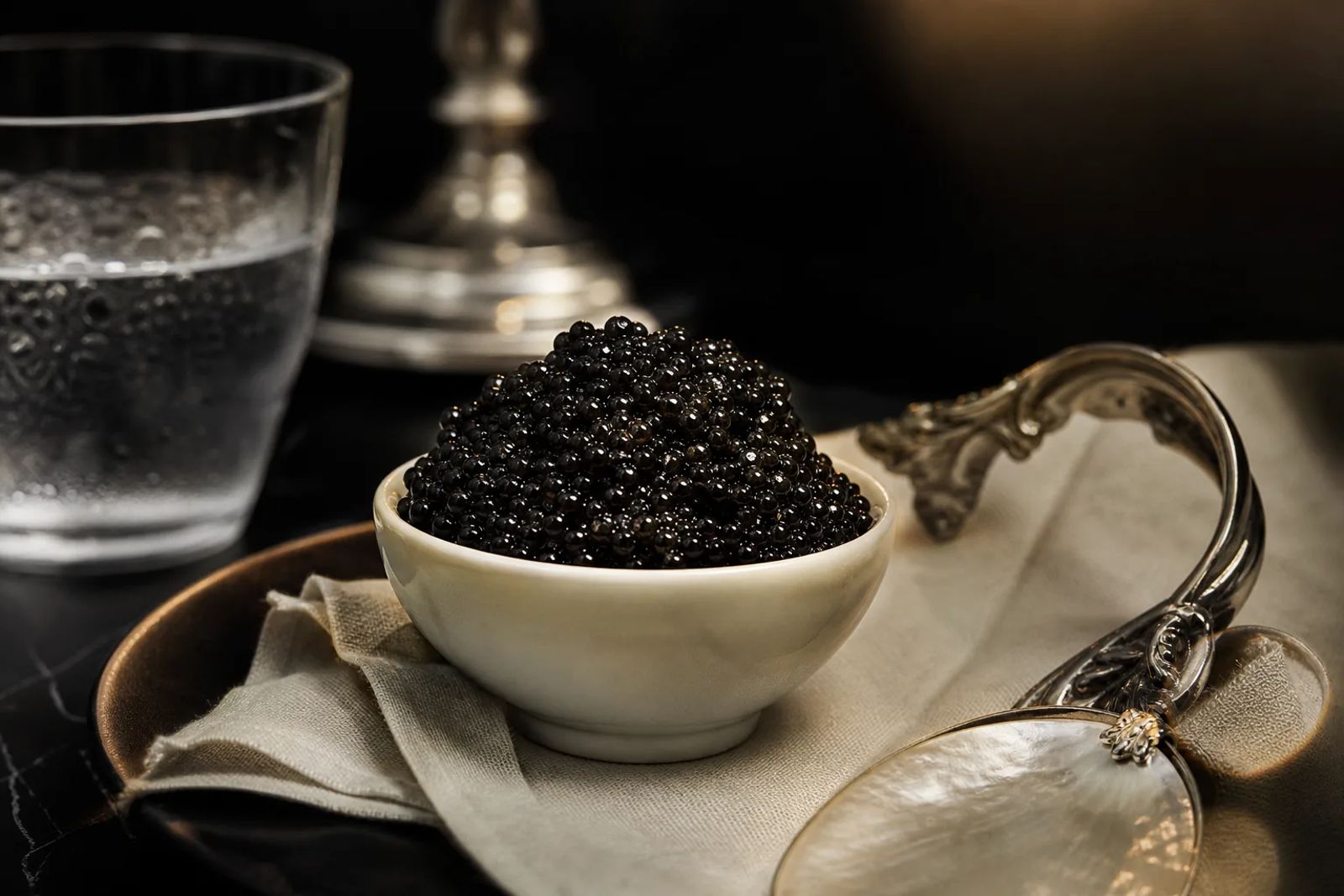
In 1952, a Soviet breeding programme successfully crossed beluga with sterlet. Bester was the result: a hybrid whose salted roe Aquatir describes in colours from pale green to greyish anthracite.
The usual pairing is a female beluga, Huso huso, with a male sterlet, Acipenser ruthenus. That ancestry matters on the label. Bester is a distinct hybrid, and its usual CITES identifier is RUTxHUS, not HUSxRUT.
Bester at a glance
| Field | Verified position |
|---|---|
| Usual female parent | Beluga, Huso huso. |
| Usual male parent | Sterlet, Acipenser ruthenus. |
| Hybrid code | RUTxHUS: male sterlet, female beluga. HUSxRUT: the reciprocal cross. |
| Farming countries and dates | Russia: Teplovsk Hatchery in the early programme; Aksai Fish Farm from 1963. |
| Colour | Pale green to greyish anthracite, according to Aquatir. |
| Parents’ IUCN status | Beluga: Critically Endangered (2022). Sterlet: Endangered (2022). No separate assessment is assigned here to the hybrid. |
What the name bester caviar means
A female beluga crossed with a male sterlet produces the conventional bester. Reverse the parents, pairing a female sterlet with a male beluga, and the hybrid is often called sterbel. The distinction is biological, not typographical.
Throughout this article, crosses appear female parent first in ordinary prose, following the convention in the Codex caviar standard and much farming literature. CITES label codes reverse that order, putting the male first.
The reciprocal cross has a documented experimental history too. In a 2023 experiment, Fopp-Bayat and colleagues used eggs from four sterlet females and frozen, then thawed beluga sperm. Molecular and chromosome analyses confirmed the resulting hybrids.
Reverse the parents, pairing a female sterlet with a male beluga, and the hybrid is often called sterbel.
Bester is neither pure beluga nor pure sterlet. The name also does not cover every beluga hybrid. Crosses involving Siberian sturgeon have different parentage, explored in other beluga hybrids.
The Soviet programme behind the cross
Bester emerged from years of experimental breeding. In his account of the programme, VNIRO researcher I. A. Burtsev dates Nikolyukin’s experimental sturgeon hybridisation to 1949 and the successful beluga and sterlet hybrid to 1952. He credits N. I. Nikolyukin and N. A. Timofeeva, whose paper on the cross appeared in 1953.
The early fish were raised at Teplovsk Hatchery near Saratov. From 1963, work continued at Aksai Fish Farm near Rostov-on-Don. Burtsev also describes genetic and selection research at the Russian Federal Research Institute of Fisheries and Oceanography, VNIRO.
It was a successful cross, but not the first sturgeon hybrid: earlier experimental crosses were already documented.

Fertility and the next generations
Bester is fertile. Burtsev reports breeding through later generations, including backcrosses, in which a hybrid is mated with a parental species. A direct hybrid, a later generation and a beluga backcross therefore have different pedigrees.
For a connoisseur, the breeder’s parentage record is more useful than a broad trade description. Ask two questions: which fish supplied the eggs and sperm when the line was established, and is the roe-producing fish a direct hybrid or a descendant of further crosses?
Those details make the name on the container more informative. “Bester” identifies a cross; the breeding record tells you which line produced the roe.
How CITES codes reveal the cross
Read the male parent first on a CITES hybrid label. HUS means beluga and RUT means sterlet. Under the order expressly set out in US 50 CFR 23.71(b)(2)(i), male sterlet with female beluga gives RUTxHUS; male beluga with female sterlet gives HUSxRUT.
These are species identifiers, not complete labels or quality grades.
The CITES resolutions index lists Resolution Conf. 12.7 (Rev. CoP17) after CoP20. Read its labelling guidelines alongside its species-code annex. The scientific description gives the parentage; the code’s writing order tells you how those parents appear on the label.
CITES and Codex do different jobs. CITES addresses wildlife trade and traceability. Codex CXS 291-2010 is an international food standard covering salted sturgeon roe, including hybrids. Its female-first presentation cannot be copied unchanged into a male-first wildlife label.
A full label also records the source, country of origin, year of harvest or repackaging as applicable, and plant and lot identifiers. With repacked caviar, keep origin and repacking details separate. A repacker’s address does not tell you where the fish produced the roe. The label provides a traceability trail rather than laboratory verification of the contents.
Follow hybrid labelling for the complete reading sequence. Assign a source code only with documentary support for the stock’s origin; a seller’s description of a fish as farmed is insufficient.
What to expect from bester caviar
Aquatir describes its bester caviar as pale green to greyish anthracite: a specific description of colour, rather than a promise about every batch.
Parentage is bester’s defining feature. Bead size needs its own evidence. Averaging the egg measurements of pure beluga and pure sterlet will not yield a reliable bester specification, and appearance alone cannot identify the cross that produced a batch.
For flavour and texture, ask for tasting notes on the actual batch instead of borrowing beluga’s reputation. Record the producer, parentage, stated processing style and your own observations separately. That makes comparisons with other caviar meaningful without expecting a hybrid name to predict every mouthful.

Farmed bester and its wild parents
Bester’s farming history is documented in Russia. According to Burtsev, it was raised at Teplovsk Hatchery and, from 1963, at Aksai Fish Farm. Aquatir also lists bester among its caviars.
The wild geography belongs to its parents. Beluga’s native range encompasses the Black, Azov, Caspian and Adriatic seas. FAO describes sterlet in river basins draining to the Black, Caspian and Baltic seas, with its range extending to the Northern Dvina, Ob and Yenisei. These parental ranges are not a native distribution for a farmed hybrid.
The parents’ threatened status concerns wild populations. Producing a hybrid is not the same as rebuilding either wild species. Their biology and conservation are covered in the parent profiles; hybrid caviar places crosses within the wider subject.
Scientific names also need careful handling in trade. CITES retains Huso huso and Huso dauricus. Brownstein and Near (2025) retain Huso huso but propose Sinosturio dauricus. On 22 October 2025, the SSG and WSCS instead favoured Acipenser huso and Acipenser dauricus. These taxonomic proposals should not silently replace the names used in trade documents.
Beluga names and market rules
Calling bester simply “beluga” conceals its sterlet ancestry. Look beyond the front-facing description for the scientific parentage and hybrid identifier. Even “beluga hybrid” leaves an important question unanswered: is the other parent sterlet, Siberian sturgeon or something else?
Trade rules differ across the EU, UK, US, Switzerland, UAE, China, Japan, Russia and Australia. Any 125 g personal effects exemption has conditions.
In the United States, 50 CFR 23.71 expressly covers hybrid caviar labelling for international trade. A separate beluga special rule, 50 CFR 17.44(y), defines beluga caviar as processed unfertilised eggs from female Huso huso, including products containing those eggs. It also contains conditional exemptions, including a facility-specific aquaculture route.
The 2005 rule’s explanatory preamble says the beluga listing did not address hybrids or explain why protecting them would contribute to conserving the species. That distinction matters: pure beluga and bester should not automatically be treated as equivalent. The preamble does not, however, provide current clearance for a particular hybrid shipment.
Before an actual US movement, obtain the current US Fish and Wildlife Service position on the identified cross and transaction. A retailer’s use of “beluga” cannot settle that question. Read the US beluga rule for the distinction between wildlife permits, trade restrictions and qualifying exemptions.
Where to go next
- How Hybrid Caviar Is Labelled: decode the difference between breeding notation and the code on the container.
Sources
-
Burtsev, I. A., VNIRO. “Bester in aquaculture”, in Sturgeon Stocks and Caviar Trade Workshop, IUCN Species Survival Commission proceedings, 1997, pp. 35 to 40. Participant account supporting the breeding history, named facilities, fertility and further crosses. Proceedings PDF.
-
Fopp-Bayat, D., Nitkiewicz, A., Sarosiek, B. and Kowalski, R. K. “The successful production of ‘sterbel’ hybrids using beluga (Huso huso) cryopreserved sperm.” Animal Reproduction Science, volume 249, article 107197, 2023. Primary experiment establishing the reciprocal cross’s parental direction, sample and verification methods. PubMed record and abstract.
-
US Fish and Wildlife Service. 50 CFR 23.71: How can I trade internationally in sturgeon caviar?, annual CFR edition, 2021. Paragraphs (b)(2) and (b)(3) address hybrid code order and container information. Official CFR PDF.
-
US Fish and Wildlife Service. Notice to Wildlife Import/Export Community: CITES Labelling of Sturgeon Caviar, undated bulletin. Gives the male-first convention and the HUS and RUT species codes. Official bulletin.
-
CITES Secretariat. Resolutions of the Conference of the Parties in effect after the 20th meeting, live index retrieved November 2026. Lists Resolution Conf. 12.7 (Rev. CoP17), Conservation of and trade in sturgeons and paddlefish. Resolutions index.
-
Codex Alimentarius Commission, FAO and WHO. Standard for Sturgeon Caviar, CODEX STAN 291-2010, listed by the official Codex register as last modified in 2026. The standard covers salted sturgeon roe, including hybrids. Standard.
-
Chebanov, M. S. and Galich, E. V., FAO. Sturgeon Hatchery Manual, Fisheries and Aquaculture Technical Paper 558, reprinted 2013. Sections 1.2.1 and 1.2.7 describe the parents’ distribution. FAO manual.
-
Aquatir. Caviar, undated producer product page, retrieved November 2026. Aquatir describes its bester colour as pale green to greyish anthracite.
-
Aquatir. Caviar Book, undated promotional booklet. Producer booklet.
-
World Sturgeon Conservation Society, Paolo Bronzi. IUCN SSG summary report, 13 November 2025, reporting the meeting of 22 October 2025. Records rejection of the broad generic revision and the alternative recommendation to dissolve Huso. Workshop summary.
-
US Fish and Wildlife Service. 50 CFR 17.44: Species-specific rules, fishes, electronic text retrieved November 2026, paragraph (y). Provides the beluga definitions, prohibitions and conditional exemptions. Current electronic regulation.
-
US Fish and Wildlife Service. Endangered and Threatened Wildlife and Plants; Special Rule To Control the Trade of Threatened Beluga Sturgeon (Huso huso), final rule, 4 March 2005, Federal Register 70, pp. 10493 to 10507. Its explanatory preamble discusses the listing’s treatment of hybrids. Official final rule.
Last checked: November 2026