
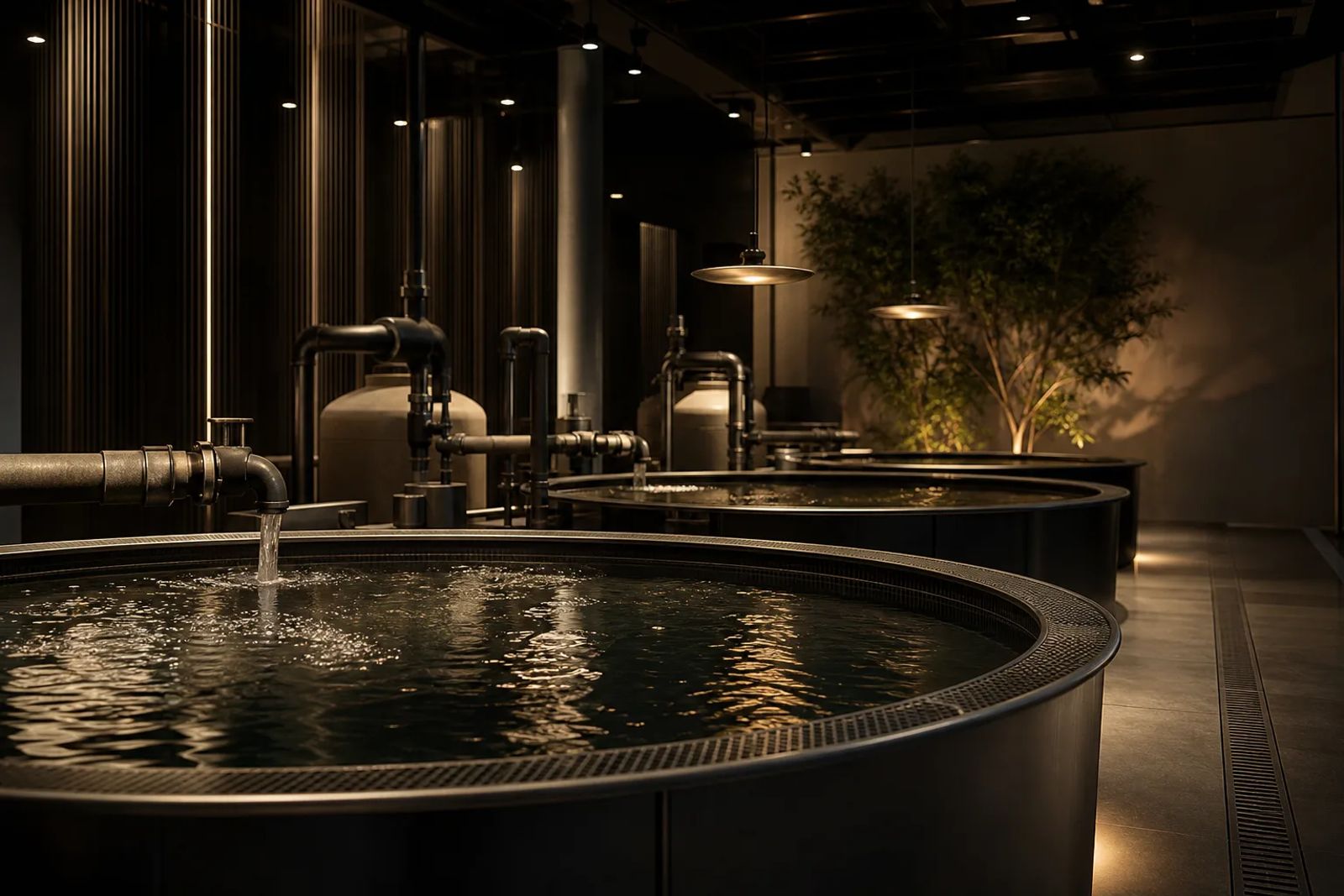
Years of feeding, water testing and daily husbandry stand between stocking a caviar farm and its first harvest. University guidance confirms that farmed females still take years to produce eggs. The work begins long before the fish arrive: establish that your chosen species, site, water supply and processing route can be authorised before committing to construction or stocking. Permission to sell food is only one part of the operation. An experienced aquaculture team must carry it through the wait.
How to start a caviar farm: the planning sequence
Resolve feasibility before ordering equipment. Follow the sequence below to uncover decisions that could stop the project while there is still time to change course. The broader sturgeon farming guide covers husbandry; this page focuses on getting a viable operation off the drawing board.
-
Define the operation and shortlist species. Decide whether to hatch eggs, rear purchased juveniles, hold broodstock, process caviar or combine these activities. Choose candidate species for the site's water regime, lawful availability, handling requirements and intended sales route. A trade name is not enough to make that decision.
-
Specify any hybrid precisely. Require the supplier to name the female parent and male parent in words and document the cross. Ask for growth, maturation and health records from comparable rearing conditions, rather than assuming the hybrid will inherit either parent's performance.
-
Choose the system and site together. Compare ponds, raceways, flow-through tanks and recirculation against seasonal water availability, temperature, discharge capacity and the team's operational skills. For recirculating aquaculture systems, put make-up water, waste management and dependable life-support equipment into the design brief.
-
Prove water and land suitability. Commission a site assessment covering source-water quality, seasonal supply, flood exposure, drainage, access and the receiving environment. Ask the relevant authorities whether abstraction and discharge need separate permissions. Farm authorisation does not automatically cover either.
-
Secure lawful, traceable stock. Buy eggs or juveniles only with documented identity, provenance and animal-health status. Before any international dispatch, establish both countries' requirements for animal-health certification, border controls and wildlife documents. Fertilised eggs are not exempt simply because they are small.
-
Recruit before stocking. Appoint an experienced sturgeon husbandry specialist, supported by aquatic veterinary advice and competent engineering cover. Assign responsibility for feeding, water testing, disease recognition, sex determination, maturity assessment, record-keeping and emergency response. Cover nights and staff absence explicitly.
-
Choose processing well before harvest. An in-house plant needs its own food-law assessment, hygienic layout, trained staff, cold-chain controls and traceability system. If outsourcing, agree who harvests, transports, processes, labels and retains records. Verify the contractor's authorisations separately from the farm's approval.
-
Set the sales route and release conditions. Decide whether to supply fish to a processor, finished caviar to a distributor, or sell directly. Exports require destination-specific food and wildlife clearance. Starting a caviar business covers the trading operation rather than farm design.
Plan for the wait to first caviar
First sexual maturity is not the same as first usable roe, and neither guarantees a repeatable commercial harvest. FAO's sturgeon manuals describe maturity assessment and broodstock management; university guidance confirms the years that farmed females need before producing eggs.
The cited sources give no species-specific first-harvest ranges. Before approving a stocking programme, obtain a verified schedule for every proposed species or cross. It must identify the rearing conditions and state whether age is measured from hatching.
Plan for land, buildings, water infrastructure, energy, feed, staff and veterinary support throughout that wait. Allow space for growing females, quarantine, replacement stock and fish that mature later than expected. Then test a delayed-harvest scenario. The earliest reported maturity is not a delivery date.
Map the permissions for the producing country
Build a permissions register for the exact site and activities. For every approval, record the issuing authority, scope, conditions, renewal requirements and responsible person. The table gives starting points; the full package depends on national, state, cantonal and municipal decisions. Projects in Japan and Russia also require locally verified aquaculture, water, food processing, animal health and CITES permissions.
| Jurisdiction | Licence or registration | Issuing authority | Legal source or official guidance | Checked |
|---|---|---|---|---|
| EU | Animal-health registration or approval; national farm and water permissions; processing registration or approval; alien-species assessment. | Member State competent authorities. | Regulations (EU) 2016/429; (EC) 852/2004, 853/2004 and 708/2007. | November 2026 |
| Great Britain | Farm authorisation; non-native species permissions; abstraction and discharge decisions; fishery-processing approval where required. | Cefas FHI in England and Wales; Scottish FHI; environmental regulators; local authorities. | National aquatic-health legislation; applicable assimilated hygiene law; environmental legislation. | November 2026 |
| Northern Ireland | Aquaculture establishment registration or approval; separate aquaculture licensing; environmental and food permissions. | DAERA; relevant environmental and food authorities. | Regulation (EU) 2016/429; applicable EU hygiene law; national licensing rules. | November 2026 |
| United States | State aquaculture permissions; discharge coverage; seafood HACCP; wildlife trade licensing and permits. | State agencies; EPA or authorised state; FDA; USFWS. | State law; 40 CFR 122; 21 CFR 123; 50 CFR 23.71. | November 2026 |
| Switzerland | Cantonal construction, water, animal-keeping and food permissions; fish-farm registration; recognised training. | Cantonal authorities; consult BLV. | BLV aquaculture coordination report; applicable federal and cantonal legislation. | November 2026 |
| UAE | Farm establishment licence; environmental approval; live aquatic-organism import permit. | MOCCAE and relevant emirate authorities. | MOCCAE licensing services; UAE Aquaculture Guide (2017). | November 2026 |
| China | Aquaculture and seed-production permissions as applicable; seed import approval and quarantine. | Fisheries authorities; confirm border requirements with Customs. | MARA's 2023 aquaculture inspection notice and seed-import administrative guidance. | November 2026 |
| Australia | Establish whether a lawful live-stock import pathway exists before planning stocking. | DAFF; federal environmental and state authorities. | Biosecurity Act 2015; EPBC Act 1999; DAFF sturgeon implementation requirements. | November 2026 |
| CITES framework | Processing or repackaging registration, separate from shipment permits. | National CITES Management Authority. | Resolution Conf. 12.7 (Rev. CoP17), paragraph 2(a), Annexes 1 and 2; national implementation. | November 2026 |
Confirm current requirements and exemptions with the relevant authorities for your proposed site and activities.
A CITES label supports traceability, but cannot establish what is inside the tin.
In England, the Environment Agency handles relevant abstraction and discharge permissions; elsewhere, use the corresponding regulator. Caviar processing normally falls under local-authority fishery-products approval. The fact that caviar is food does not make this an application to the FSA.
In the US, California's aquaculture registration is a state example, not a national licence. Seafood HACCP means hazard analysis and critical control points. Its processing obligations under 21 CFR 123 are separate from permission to grow fish.
Australia requires an early check on imports. DAFF's 2024 sturgeon notice made consideration of import applications conditional on further implementation and publication of final conditions. Confirm the current position with DAFF and BICON before planning an import.
Keep CITES registration separate from export permission
A farm authorisation, a plant code and a shipment permit do different jobs. Resolution Conf. 12.7 (Rev. CoP17) recommends registering caviar processing and repackaging plants; Annex 1 provides labelling guidance and Annex 2 species codes. A farm that processes and packages caviar needs to be considered within that framework.
Ask the national Management Authority which registrations and transaction documents your activities require. In the US, USFWS explicitly separates aquaculture export permits from commercial wildlife import/export licensing. Even an approved master file still requires shipment documents. For UK CITES questions, contact APHA's Centre for International Trade.
Checking a producer on the CITES register helps verify the relevant operation. A CITES label supports traceability, but cannot establish what is inside the tin. For border procedures, use importing, exporting and re-exporting caviar, then confirm the particular species, origin and destination with the authorities.
Make welfare and biosecurity daily practice
Have a written health plan agreed with an aquatic veterinarian before the fish arrive. Cover incoming-stock quarantine, separation of cohorts, disinfection, mortalities, diagnostic sampling, movement records, medicines and local rules for reporting suspected disease.
Set welfare procedures for transport, grading, examination, anaesthesia where applicable, and humane killing at harvest. Staff must know how to recognise distress and respond when water conditions deteriorate. Sturgeon diseases and farm biosecurity develops the health programme; use it alongside veterinary advice.
Test the systems that can fail
Before stocking, demonstrate what happens when pumping or oxygen delivery fails. Verify alarms, standby supplies, isolation arrangements and the team's response. The equipment, monitoring and emergency procedures must work together before stocking reaches the proposed final capacity.
These tests address the operational vulnerabilities documented in FAO guidance: water quality, feeding, sanitation, quarantine, maintenance and staff competence. That guidance establishes their importance, rather than ranking the reasons commercial caviar farms close. Turn each vulnerability into a commissioning test with a clear response.
Find training and independent advice
Start with the aquaculture regulator and water authority for the proposed site. Then seek a university aquaculture department and an aquatic veterinarian. Together, these contacts provide the regulatory, technical and veterinary advice needed to shape the project.
FAO's manuals offer structured technical references, including material prepared with World Sturgeon Conservation Society expertise. Read them as a foundation for supervised farm experience, not a replacement for it.
Switzerland's ZHAW advertises specialist aquaculture training recognised by BLV. Before enrolling with any provider, ask about practical placements, sturgeon-specific supervision and coverage of water treatment, biosecurity and food processing. Choose training that connects the written plan to the daily work of keeping fish healthy.
Sources
-
FAO. Chebanov, M.S. and Galich, E.V., Sturgeon Hatchery Manual, Fisheries and Aquaculture Technical Paper 558, 2013. Publication and full report.
-
FAO. Chebanov and colleagues, Sturgeon hatchery practices and management for release: Guidelines, Fisheries and Aquaculture Technical Paper 570, 2011. Its principal purpose is conservation hatchery management, not commercial farm feasibility. Publication.
-
University of Florida, IFAS Extension. Technically Speaking, What Is Sturgeon Caviar?, FA194, online edition checked November 2026. Article.
-
European Commission. What do I need to do if I want to start an aquaculture activity in the EU?, undated online guidance; Aquaculture establishments, online guidance on Regulation (EU) 2016/429 and Delegated Regulation (EU) 2020/691. Starting an aquaculture activity; aquaculture establishments.
-
European Union, EUR-Lex. Regulation (EU) 2016/429, Animal Health Law, 2016; Council Regulation (EC) No 708/2007, Concerning use of alien and locally absent species in aquaculture, 2007. Animal Health Law; alien-species regulation.
-
Cefas and GOV.UK. Fish, mollusc or crustacean farm authorisation; Fish Health Inspectorate; Introduce or keep non-native fish, lobsters and crayfish, online editions checked November 2026. Farm authorisation; inspectorate responsibilities; non-native fish permissions.
-
Scottish Government. Fish Health Inspectorate: authorisation and registration, online collection checked November 2026. Collection.
-
DAERA. Applications for registration or approval of an Aquaculture Establishment; Aquaculture and licensing of aquaculture establishments, online editions checked November 2026. Animal-health registration and approval; aquaculture licensing.
-
Environment Agency. Check if you need a licence to abstract water, updated 2 July 2026; Discharges to surface water and groundwater: environmental permits, online edition checked November 2026. Abstraction; discharge permits.
-
Food Standards Agency and Food Standards Scotland. Applying for approval of a meat or food establishment; Local authority approvals, online editions checked November 2026. FSA approval guidance; Scottish approval guidance.
-
California Department of Fish and Wildlife; NOAA Fisheries; US EPA. Aquaculture Registration, online edition checked November 2026; Washington, Oregon and California Aquaculture Resources and Permitting Information, updated 26 August 2026; Aquaculture NPDES Permitting, online edition checked November 2026. California registration; NOAA permitting resources; EPA discharge permitting.
-
US Government and FDA. 21 CFR Part 123: Fish and Fishery Products, electronic edition checked November 2026; Aquacultured Seafood, online edition checked November 2026. Regulation; FDA guidance.
-
US Fish and Wildlife Service. 3-200-80: Export of Fertilized Live Eggs/Caviar/Meat from Aqua-Cultured Paddlefish/Sturgeon (CITES), online edition checked November 2026; Notice to Wildlife Import/Export Community: CITES labelling of sturgeon caviar, bulletin checked November 2026. Aquaculture export application; labelling bulletin.
-
CITES. Resolution Conf. 12.7 (Rev. CoP17), Conservation of and trade in sturgeons and paddlefish, 2016 revision, published copy checked November 2026. Resolution.
-
APHA and GOV.UK. Bringing food into Great Britain: Check if you need a CITES permit, online edition checked November 2026. Used for the APHA contact, not as commercial farm licensing guidance. Guidance.
-
Swiss Federal Food Safety and Veterinary Office, BLV. Aufbau einer Koordinationsstelle Aquakultur, report, undated edition, section 2.3.2 on authorisation procedures. ZHAW. Fachspezifische Berufsunabhängige Ausbildung (FBA) Aquakultur, course listing checked November 2026. BLV report; ZHAW training.
-
UAE Ministry of Climate Change and Environment, MOCCAE. UAE Aquaculture Guide, 2017; Licence to establish an aquaculture production farm and Import permit for live fish and aquatic organisms, service editions checked November 2026. Guide; for the farm licensing service, check the MOCCAE website.
-
China Ministry of Agriculture and Rural Affairs, MARA. Notice on the 2023 special aquaculture inspection action, 农办渔〔2023〕19号, 2023; Ministry Gazette, June 2020, administrative guidance on aquatic seed imports and exports. Inspection notice; administrative guidance.
-
Australian Department of Agriculture, Fisheries and Forestry, DAFF. Animal Biosecurity Advice 2024-A08: Release of the final report on the sturgeon BIRA, 2024; Import of live sturgeon for aquaculture: Final biosecurity import risk analysis, 2024. DCCEEW. Live Import List, updated 4 November 2026. DAFF implementation notice; risk analysis; Live Import List guidance.
This piece was researched from official regulatory guidance, legal texts, FAO technical manuals and university material, with planning recommendations distinguished from legal requirements.
Last checked: November 2026