
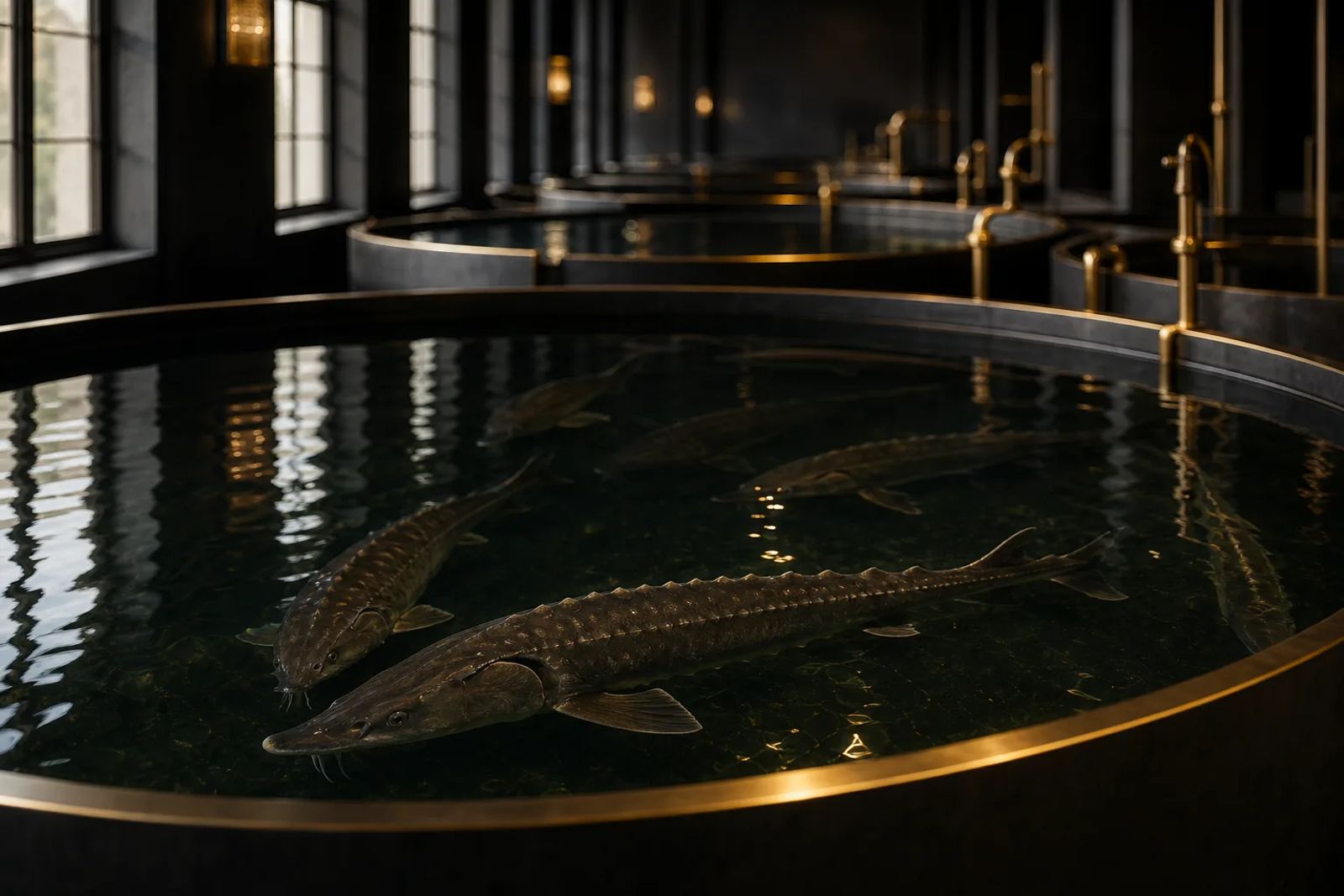
The wait for caviar is measured in years: UF/IFAS describes female sturgeon retained to ages 5 to 9 years, depending on species. Even after years of rearing, the final preparations can take weeks. In one documented farm visit, fish spent up to six weeks in cleaner water before harvest to clear unwanted flavours.
From hatchery to harvest, genetics and maturity shape the finished roe, but so do water, feed, temperature and handling. Raising sturgeon means managing egg development, not simply growing a larger fish.
The breeding plan comes first
Choosing a species and suitable breeders sets the farm’s course for years. Broodstock are adults kept for reproduction rather than the next caviar harvest. Some businesses run their own hatcheries; others buy fertilised eggs or juveniles. A caviar farm can specialise without carrying out every stage on one site.
Documented choices include Siberian sturgeon (Acipenser baerii), Russian sturgeon (Acipenser gueldenstaedtii) and white sturgeon (Acipenser transmontanus). The right stock must suit local conditions and production aims. Speed of growth is only part of the calculation: producers interviewed in a 2026 study also cited yield, temperament and import restrictions. China farms hybrids too, whose records need to identify both female and male parents.
Breeders are selected and monitored for health, reproductive condition and genetic management. The sturgeon farming hub maps the specialist subjects behind these decisions.
The cycle: hours, weeks and years
A hatchery measures incubation in hours; a caviar farm plans for years. These documented examples distinguish time spent in a stage from age at a milestone, rather than prescribing a timetable for every species or farm.
| Stage | What happens | Documented timing | Key decision |
|---|---|---|---|
| Broodstock | Select and condition breeders | Ongoing; establishing stock from juveniles takes years | Keep healthy, suitable breeders |
| Spawning and incubation | Fertilise and incubate eggs | FAO examples span 50 to 240 hours across species and 10 to 24 °C (50 to 75 °F) | Match the thermal regime to the species |
| Larval rearing and weaning | Move from yolk reserves to feeding | One FAO protocol substantially reduces live feed over 12 to 15 feeding days | Confirm feeding success before changing diets |
| Grow-out and sexing | Grow juveniles and separate sexes | Years; UF/IFAS describes male meat harvest at ages 2 to 4 years | Identify females with minimal handling |
| Maturation | Females develop harvestable roe | UF/IFAS describes retaining females to ages 5 to 9 years, depending on species | Judge egg development, not age alone |
| Purging | Hold fish in cleaner water before harvest | Up to six weeks in one documented farm visit | Check that off-flavours have cleared |
| Harvest | Move roe into hygienic processing | Depends on the farm and processing plan | Match fish handling to processing capacity |
FAO manuals supply the incubation and feeding examples; UF/IFAS guidance supplies the production ages. The purging duration describes a reported farm practice rather than an industry standard.
From spawning to the first feed
Hatchery staff assess mature females and commonly use hormones to induce ovulation. They combine the eggs with milt, the male’s sperm-bearing fluid, then treat the fertilised eggs to reduce stickiness. Incubation follows in flowing, oxygenated water.
Newly hatched larvae begin life on their yolk reserves. As those reserves run down, staff introduce suitable feed and check that the fish eat it. Weaning means the transition from live food to a formulated diet, although some protocols start directly with formulated feed. The hatchery guide follows this sensitive transition in detail.
Growing fish and finding the females
Grow-out takes place in ponds, cages, raceways or tanks. Flow-through farms continuously bring in replacement water. Recirculating aquaculture systems, usually called RAS, treat and reuse much of theirs. The farm systems guide explains these physical arrangements, including systems that combine several approaches.
A young sturgeon’s outward appearance cannot reliably reveal its sex. Trained staff use ultrasound to examine the gonads, or reproductive organs; biopsy or direct examination may also be used, depending on the fish and protocol. Selected males stay as breeders.
Bringing the roe to readiness
Size alone does not make a female ready for harvest. Staff monitor individuals as their ovaries develop, using ultrasound and, where appropriate, egg sampling to judge the developmental stage. Managing temperature, light and maturation is about reproductive timing, not simply warming the water to make fish grow faster.
Throughout that development, water and feed both influence quality. Farmers manage oxygen, waste and fish health, adjusting feeding to the stock’s needs. The goal is suitable body condition and egg development, rather than maximum weight. Producer interviews repeatedly linked water quality, stress and feeding with caviar quality; those accounts describe experience rather than controlled demonstrations of a particular flavour.
As harvest approaches, attention also turns to unwanted flavours. Purging, also called depuration, tackles unwanted flavour compounds by holding fish in cleaner water before harvest. Research in recirculating sturgeon production has identified geosmin and 2-methylisoborneol, compounds associated with earthy or musty taints. Clearing them is not the same as merely emptying the gut. Purging addresses quality; food safety requires separate controls.
Harvest moves the roe from the fish into processing. Conventional harvest means slaughtering the female and removing her ovaries. Some methods involving living fish use hormones to induce ovulation, then collect the ovulated eggs by stripping. The harvesting guide takes over here, covering handling and the transition from farm management to roe extraction.
The roe must then be separated from ovarian tissue, cleaned, salted and kept under controlled chilled conditions. Gentle handling helps protect the eggs from damage; prompt chilling helps preserve quality. Readiness in the fish and hygiene in the processing room are separate essentials.
How large is sturgeon farming?
Worldwide farmed sturgeon production reached about 123,476 tonnes in 2020, according to FAO statistics reproduced by EUMOFA in 2023. China accounted for an estimated 104,280 tonnes, reported as 84% of the total. These figures measure fish, not caviar.
A hatchery measures incubation in hours; a caviar farm plans for years.
China is central to the industry, but its share of fish tonnage does not give its share of the caviar market. FAO GLOBEFISH reported Chinese caviar output of 135 tonnes in 2018. EUMOFA lists Italy, France, Poland and Germany as the leading EU producers in 2018; farms also operate in the US. Each figure or location answers a different question, and the production measures belong to their stated years.
Which rules apply to a farm?
A farm licence is not an export permit or food-premises approval. Operating permissions, animal-health controls and environmental consents depend on location; processing roe and exporting it bring separate requirements.
EU: Regulation (EU) 2016/429, the Animal Health Law, sets the animal-health framework, including registration and approval requirements for aquaculture establishments. Regulations (EC) No 852/2004 and 853/2004 cover food hygiene. Regulation (EC) No 338/97 implements wildlife-trade controls. National authorities also determine site and water permissions.
UK: Relevant national authorities administer aquaculture authorisation. In England and Wales, businesses apply to the Fish Health Inspectorate. Food-hygiene requirements need separate checks for Great Britain and Northern Ireland, rather than assuming that farm authorisation covers processing or export.
US: Farm permissions depend on the state and the operation, alongside applicable federal controls. FDA seafood HACCP rules under 21 CFR Part 123 govern processing. USFWS handles wildlife-trade requirements separately, so each requires its own compliance checks.
China: The same distinction between activities matters: location and water-use permissions, aquatic animal health, food processing and wildlife trade require separate checks with the competent authorities. The licences depend on the activity and site. National production figures do not establish an individual establishment’s authorisation to export.
International caviar traceability centres on registered processing and repackaging operations, rather than a register of every farm or retailer. Domestic law implements CITES recommendations. A CITES label supports traceability; it does not independently test the contents.
Welfare and environmental trade-offs
Good welfare has to last beyond egg collection. Water quality, crowding, injury, handling, transport and slaughter matter throughout the fish’s life. Eight producer interviews reported in 2026 identified perceived links between welfare and product quality, but did not establish comparative welfare outcomes for different harvest methods. Immediate survival after collection alone cannot demonstrate good long-term welfare or successful later reproduction.
Environmental performance depends on the individual farm. Examine water abstraction, effluent treatment, energy use, feed sourcing, disease control and escape prevention. Recirculation changes these trade-offs rather than eliminating them; the sustainability guide examines the evidence across systems. Neither a harvest method nor a farming system settles the question: good outcomes depend on the fish’s whole life and the farm’s actual environmental performance.
Sources
-
FAO. Chebanov and Galich, Sturgeon Hatchery Manual, FAO Technical Paper 558, 2011, reprinted 2013. Chapters 4 to 6 and 8; Table 26. Full manual.
-
FAO. Chebanov, M. and colleagues. Sturgeon hatchery practices and management for release: Guidelines. FAO Fisheries and Aquaculture Technical Paper 570, 2011. Chapters 5, 7 to 11, 14 and 19. Its conservation-hatchery context is distinguished from commercial caviar production. Full guidelines.
-
FAO. Cultured Aquatic Species Information Programme: Acipenser baerii. Archived species profile, undated web edition. Production systems, seed supply and nursery sections. Species profile.
-
University of Florida, IFAS Extension. Chapman, F. A. and Van Eenennaam, J. P. Sturgeon Aquaculture: Specialized Techniques: Determining the Sex of Sturgeon by Direct Examination of the Gonad Using a Minimally Invasive Surgical Procedure. FA183, retrieved web edition; publication year not established from the retrieved record. Extension publication.
-
University of Florida, IFAS Extension. Sturgeon Aquaculture: Specialized Techniques: Determining the Stage of Sexual Maturity in Female Sturgeon for Artificial Spawning: The Egg Polarization Index or PI. FA153, reviewed August 2025. Extension publication.
-
EUMOFA, European Commission. The caviar market: Production, trade and consumption in and outside the EU. 2021 edition, production-cycle section. Report.
-
EUMOFA, European Commission. Sturgeon meat and other by-products of caviar: Production, trade and consumption in and outside the EU. February 2023; manuscript completed January 2023. Publisher-indexed report retrieved; direct PDF access was blocked. Production figures were checked against the supplied China sheet.
-
FAO GLOBEFISH. Chinese sturgeon and caviar industry. 30 September 2019. Article.
-
Frontiers in Fish Science. Animal welfare in European caviar production: insights from sturgeon producers. 2026 research article, DOI 10.3389/frish.2026.1828234. Methods, thematic findings and discussion. Research article.
-
USDA Agricultural Research Service. Geosmin and 2-Methylisoborneol Cause Off-Flavors in Cultured Largemouth Bass and White Sturgeon Reared in Recirculating-Water Systems. Publication record 164921; N. Am. J. Aquaculture 67, 2005.
-
Aquaculture Research. Distribution of Odorant Compounds in Recirculating Aquaculture Systems Used in Sturgeon Farming. 2025, article 2377886. Publisher-indexed abstract and analytical-method description. Publisher record.
-
Aquaculture Reports. Feeding during off-flavour purging in recirculating aquaculture systems? An exploratory characterisation of waterborne and feedborne odour-active compounds in Russian sturgeon (Acipenser gueldenstaedtii). Journal of Agriculture and Food Research 26, 2026, article 102615. Publisher record.
-
Fisheries Research and Development Corporation. The Australian Barramundi Industry. Project 2009/324, report published 2010. Sturgeon farm-visit account used only for the reported purging example. Report.
-
European Commission, EU Aquaculture Assistance Mechanism. What do I need to do if I want to start an aquaculture activity in the EU? Undated web guidance. Guidance.
-
Cefas, GOV.UK. Fish, mollusc or crustacean farm authorisation. Retrieved web guidance, undated edition. Guidance.
-
DAERA. Aquaculture and licensing of aquaculture establishments. Retrieved web guidance, undated edition. Guidance.
-
US FDA. Aquacultured Seafood. Retrieved web edition, covering seafood HACCP, drug controls and agency responsibilities. Guidance.
-
New Jersey Department of Agriculture. Aquaculture. Retrieved web guidance, undated edition; used as a state-level example of licensing administration. Guidance.
-
Jinan municipal government service portal. Aquaculture certificate application guidance. Retrieved 2026 web edition, citing the Fisheries Law revised on 27 December 2025 and aquaculture registration measures.
-
European Commission. EU Wildlife Trade Reference Guide, Annex XIV, sturgeon and paddlefish guidance. Undated web edition, referring to Resolution Conf. 12.7 (Rev. CoP17). Reference guide.
Researched from the dated sources listed above.
Last checked: November 2026