
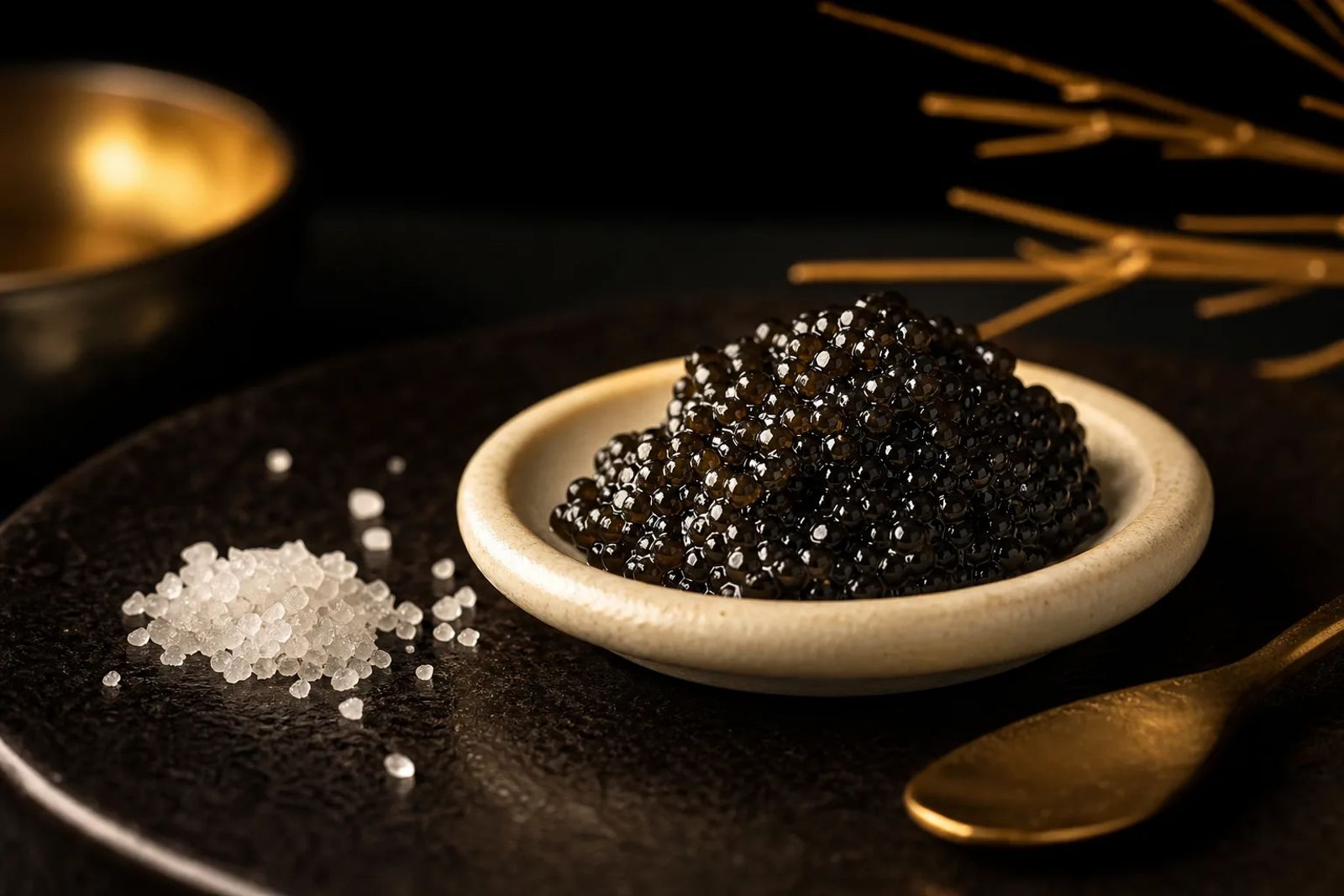
In 1983, Miyazaki began researching sturgeon received through Soviet-Japanese scientific cooperation. Thirty years later, producers formed a cooperative and began full-scale caviar production. Japan's caviar story starts with fish, hatcheries and patience.
Today, Japan farms sturgeon in Miyazaki, Hokkaido and other prefectures. This is caviar, distinct from ikura or tarako, with its own questions of species, provenance and processing. One important national rule is clear: Japan does not authorise boric acid or borax as caviar preservatives.
Japan at a glance
| Species farmed | White sturgeon (Acipenser transmontanus) in Miyazaki. Japan Caviar's product range also documents Japanese-farmed Siberian sturgeon (Acipenser baerii). |
| Farming regions | Documented examples include Miyazaki; Bifuka, Hokkaido; and Niimi, Okayama. These do not constitute a national census. |
| CITES registered operations | 26 Japanese entries, including farms. Processing and repackaging share one field. |
| Trade regime | Foreign Exchange and Foreign Trade Act; METI CITES procedures; Fisheries Agency facility registration; Food Sanitation Act and Food Labelling Standards. |
| Geographical indication | As of November 2026, MAFF's published geographical indication register contains no caviar entry. |
| Wild stocks | Sakhalin sturgeon (Acipenser mikadoi): historical native populations considered lost locally. Kaluga (Huso dauricus): historical occurrence and occasional later captures, without evidence of recovered breeding stocks. |
| Country's role | Farmed roe origin, processor and consumer market, with national arrangements for repacking and re-export. |
The first distinction to make is simple: was the caviar produced from Japanese-farmed fish, or handled by a Japanese business? Those are different claims. For the wider picture, explore caviar producing countries and Asia. For an individual product, read its traceability and ingredient information.
Where Japanese caviar is farmed
Miyazaki offers the clearest documented story of prefectural research growing into a caviar industry. Its fisheries account traces the work from fish received in 1983 through Soviet-Japanese scientific cooperation to reproduction, juvenile production and, eventually, caviar. This was a programme built around raising fish, rather than importing finished roe.
- 1983: Miyazaki began its sturgeon research programme.
- 2004: The prefecture reports achieving the complete farming cycle for white sturgeon.
- 2011: It established mass juvenile production and developed its caviar maturation technique.
- 2013: Producers formed a cooperative and began full-scale caviar production.
Completing the farming cycle means producing another generation from farmed broodstock. It goes beyond raising imported juveniles to harvest. White sturgeon anchors the official Miyazaki account, while Japan Caviar's range also documents Siberian sturgeon caviar. The regional name tells only part of the story; the species still matters.
Bifuka, in Hokkaido, also traces its programme to 1983. The prefecture's Kamikawa administration describes fish received through Japanese-Soviet friendship arrangements, but records the public caviar launch much later, in 2021. The start of sturgeon husbandry and the arrival of commercial caviar are separate milestones.
Further south, Niimi City's official information documents sturgeon farming and caviar manufacture in Okayama. Together, these places give a verified picture of production, though not an exhaustive national map. Registered export plants and regional brands cannot, by themselves, establish the scale of farming across Japan.
Were sturgeon native to Japan?
Yes. Japan's native sturgeon history, especially in Hokkaido, is distinct from the story of its modern caviar farms. Ishikari City's museum identifies Sakhalin sturgeon and kaluga as the two species thought to have occurred historically. It describes former upstream migrations in the Ishikari, Teshio, Kushiro and Tokachi rivers.
The museum considers the Japanese populations effectively extinct. It also records occasional later captures of kaluga, including one at the Ishikari River mouth in 2004. These are records of fish appearing, rather than a return of self-sustaining breeding populations. Hokkaido University's educational account makes the same distinction between later visitors and the former river stocks.
What Japanese caviar is known for
Restrained saltiness, fat and umami feature in the tasting comments reported by Miyazaki's prefectural promotional account. They offer a more tangible introduction to the caviar than nationality alone: a description of balance, grounded in a particular programme and its products.
For caviar, keep three things in view: the fish, where it was farmed, and what happened to its eggs afterwards.
Miyazaki's documented identity rests on hatchery research, controlled maturation and caviar made with roe and salt. In 2013, the prefectural account described a formulation of about 3% salt. Both that formulation and the reported tasting comments belong to the Miyazaki product described, rather than defining a national recipe, flavour or texture.
Japan's long-established appreciation of fish roe provides useful cultural context. It does not turn salmon roe or pollock roe into sturgeon caviar. Japanese roe culture explores that separate subject. For caviar, keep three things in view: the fish, where it was farmed, and what happened to its eggs afterwards.
Japan's additive rules apply to imports too
Caviar lawfully made overseas may still be inadmissible in Japan. The Food Sanitation Act operates a permission system for additives, with specifications and conditions of use. Under Japan's additive framework, neither boric acid nor sodium tetraborate, also called borax, is authorised as a caviar preservative.
Responsibility for setting food hygiene standards transferred from MHLW to the Consumer Affairs Agency in April 2024. MHLW continues to administer imported-food controls through quarantine stations. Checking the current position therefore means reading the CAA additive lists alongside MHLW's import procedures.
For commercial food imports, MHLW requires notification and assesses ingredients, additives and manufacturing methods, among other matters. A shipment judged non-compliant cannot be imported. Obtain the actual formulation before shipment; a general assurance that the caviar meets European standards does not answer the Japanese regulatory question.
The wider comparison is covered in borax in caviar. For Japanese production, a formulation without borax must still satisfy the rest of the additive framework. Its absence says nothing on its own about sensory grade or the quality of handling.
Food labels and Japanese origin
A Japanese manufacturer's address does not tell you where the sturgeon was raised. To establish origin, look beyond the business details and read the relevant ingredient and country declarations.
Prepacked caviar sold in Japan must meet the Food Labelling Act and Food Labelling Standards, with required information in Japanese. Subject to the applicable provisions and exemptions, this includes the food name, ingredients and additives, net quantity, date marking, storage instructions, responsible business details and nutrition information.
For domestically manufactured processed foods, Japan's ingredient-origin system generally addresses the principal ingredient by weight. Imported finished foods instead carry a country-of-origin declaration. The distinction matters when Japanese manufacture and Japanese-farmed roe might otherwise be mistaken for the same thing.
Japan's Fisheries Agency also states that the caviar's original country remains identified separately from its country of repacking. Country of origin versus repacking explains how to read that distinction. A CITES label supplies traceability information; it does not independently verify the contents.
CITES registration and overseas trade
Export registration opens a regulatory route, not every destination's border. Japan's own registration requirements and the importing jurisdiction's conditions must both be satisfied for the product concerned.
METI administers Japan's CITES trade procedures under the Foreign Exchange and Foreign Trade Act. The Fisheries Agency's caviar scheme registers relevant facilities for export or re-export, distinguishing farms, initial processing plants and repackaging plants. It is a facility registration scheme, rather than a census of Japanese caviar businesses.
The agency published a national facility list updated on 9 October 2026. The public CITES register lists 26 Japanese entries, including aquaculture facilities, and combines processing and repackaging in one field. The national list identifies registered activities separately.
For the EU, the European Commission's country and establishment conditions must cover the actual product. Under Regulation 2026/2228, effective 4 November 2026, Japan is listed for aquaculture finfish and finfish products. Individual establishment and consignment requirements still apply.
For Great Britain, check fishery-product import conditions and APHA's CITES requirements separately. Northern Ireland has a different import framework; a Great Britain clearance does not cover it. In the US, caviar imports engage both FDA food controls and US Fish and Wildlife Service requirements, including the caviar-specific rules in 50 CFR 23.71.
These jurisdictions are regulatory examples, rather than confirmed destinations for every Japanese producer. Switzerland, the UAE, China, Russia and Australia also apply destination rules. The 125 g personal baggage exemption depends on species, labelling and national implementation, so check those conditions before relying on it.
Assess the product, not the nationality
The most revealing comparison is between named species and documented processing styles. National reputations are a less precise guide to what is actually in the tin.
Ask five direct questions: did the roe come from Japanese-farmed fish? Which species supplied it? Was it pasteurised? What was added? How does the producer specify its handling? Together, those answers describe the caviar far more clearly than a country name alone.
Sources
-
Miyazaki Prefecture, Fisheries Policy Division. みやざきキャビア1983 [Miyazaki Caviar 1983], updated 18 March 2021. Official programme chronology.
Read at hinatamafin.pref.miyazaki.lg.jp -
Fisheries Agency of Japan. Japan Caviar, product range, company page, retrieved November 2026.
Read at japancaviar.jp -
Hokkaido Government, Kamikawa General Subprefectural Bureau. 美深振興公社「美深キャビア」 [Bifuka Promotion Corporation: Bifuka Caviar], March 2024 feature, webpage updated May 2026.
Read at kamikawa.pref.hokkaido.lg.jp -
Niimi City. 蝶鮫屋 [Chozameya], undated official municipal information, online edition retrieved November 2026.
Read at city.niimi.okayama.jp -
Ishikari City Museum. 石狩のチョウザメ(生物編) [Ishikari's sturgeons: biology], 2010 account, webpage updated 28 February 2025.
Read at city.ishikari.hokkaido.jp -
Hokkaido University, LASBOS. Classification and distribution of sturgeons, undated educational resource, online edition retrieved November 2026.
Read at repun-app.fish.hokudai.ac.jp -
Miyazaki Prefecture. 世界で競う本格熟成 “純国産”キャビア、宮崎から [Matured Japanese caviar from Miyazaki], Jaja, issue 28, 2013. Prefectural promotional account containing named commentators' tasting assessments.
Read at pref.miyazaki.lg.jp -
Consumer Affairs Agency. Food additives, current online regulatory explanation, retrieved November 2026; references Food Sanitation Act Articles 12 and 13 and Ministry of Health and Welfare Notification No. 370 of 1959, as amended.
Read at caa.go.jp
Read at caa.go.jp -
Japan Food Chemical Research Foundation. List of designated additives, online list linked by the Consumer Affairs Agency, retrieved November 2026.
Read at ffcr.or.jp -
Ministry of Health, Labour and Welfare. Import procedure under Food Sanitation Act, undated current online guidance, retrieved November 2026.
Read at mhlw.go.jp -
Ministry of Health, Labour and Welfare. Imported-food monitoring report, explanatory glossary, undated PDF. The glossary identifies boric acid as an undesignated additive.
-
Consumer Affairs Agency. Food labelling; Japan's Food Labelling System, April 2024 English leaflet; New Country of Origin Labelling System for Ingredients Q&A, online editions retrieved November 2026.
Read at caa.go.jp
Read at caa.go.jp
Read at caa.go.jp -
Tokyo Metropolitan Government. For those who create labels on processed foods in the Japanese language for the first time, undated current online guidance, retrieved November 2026.
Read at hokeniryo1.metro.tokyo.lg.jp -
Fisheries Agency of Japan. キャビアの輸出・再輸出について [Export and re-export of caviar], current online procedures; Registered caviar facilities list, updated 9 October 2026.
Read at jfa.maff.go.jp
Read at jfa.maff.go.jp -
Ministry of Economy, Trade and Industry. Export flowchart, English online edition retrieved November 2026, undated.
Read at meti.go.jp -
Ministry of Agriculture, Forestry and Fisheries. 登録産品一覧 [Registered GI products], register dated 10 July 2026, retrieved November 2026.
Read at maff.go.jp -
JETRO. 水産物の輸入規制、輸入手続き [EU import restrictions and procedures for fishery products], current online export guidance, retrieved November 2026.
Read at jetro.go.jp -
UK Government. Importing fishery products or bivalve molluscs; Bringing food into Great Britain: check if you need a CITES permit, current online guidance, retrieved November 2026.
Read at gov.uk
Read at gov.uk -
US Customs and Border Protection. Importing seafood, published 6 April 2026.
Read at help.cbp.gov -
US Government Publishing Office. 50 CFR 23.71: How can I trade internationally in sturgeon caviar?, 2023 annual edition. Current text is available through the eCFR.
Read at govinfo.gov
Last checked: November 2026