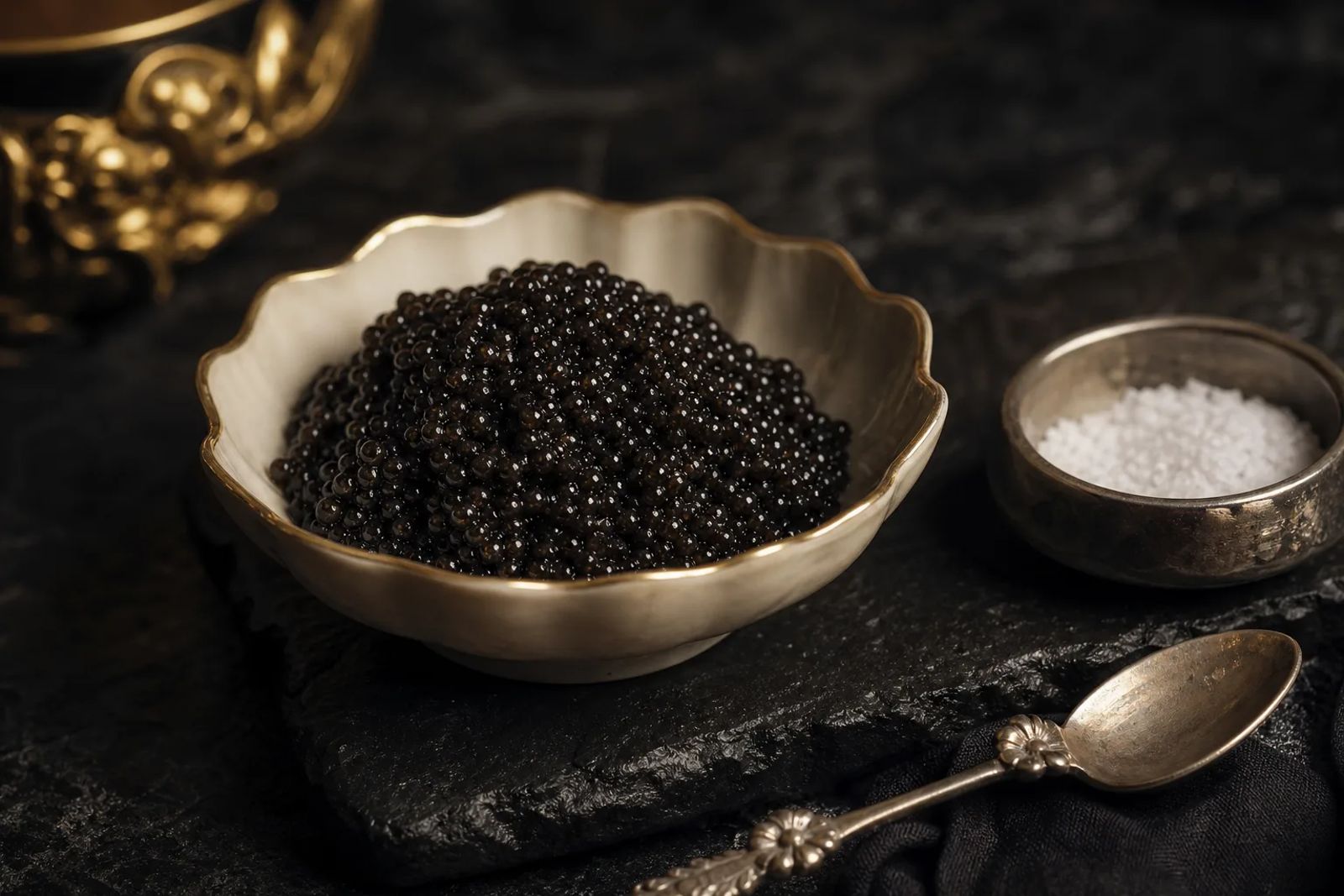
A hint of sweetness: seller IKRAA Caviar describes borax as a possible reason for a sweet taste in caviar, though taste cannot identify the additive. Behind that description sits a precise chemical identity, sodium tetraborate, E285, and a set of rules that changes with the destination.
Used alongside salt, borax is permitted specifically in sturgeon caviar under restricted conditions in the EU and Great Britain. For the United States, check the FDA's current position before export.
What borax and boric acid are
Borax and boric acid are different compounds. Sodium tetraborate, commonly called borax, is E285; boric acid is E284. Both contain boron, the element on which EFSA bases its toxicological assessment. Their weights are not interchangeable with the weight of boron. An E number identifies the additive, not how much is present in the food.
Two regulations do different jobs. Regulation (EU) No 231/2012 sets food-additive specifications; Regulation (EC) No 1333/2008 sets permissions for use. Permission to use food-grade material does not extend to household or industrial borax. This is a formulation controlled by the processor, never an ingredient to add at home.
Why processors use borax in caviar
Preservation comes first. Boron compounds inhibit microbial growth and help delay spoilage. Some processors pair them with a lower salt formulation.
Swiss seller Cavian publishes a formulation containing salt and E285, and says its lower salt content helps retain caviar's flavour. That explains the supplier's approach, but does not establish how much salt can be reduced, a standard salt reduction or a standard shelf life. It also does not mean every borax-treated caviar contains less salt than every salt-only product. For the salt cure itself, see salting and malossol.
Flavour descriptions help explain why some processors retain borax. IKRAA Caviar's description points to sweetness, but no controlled comparison establishing a universally sweeter or softer flavour has been published. To isolate borax's contribution, a comparison would also need to control salt concentration, maturation and the starting roe.

The EU limit: read the units carefully
The EU permission is narrow: sturgeons' eggs only. Annex II, food category 09.3, covers fish roe, but its E284 and E285 entries do not extend to salmon, trout or lumpfish roe. Each entry gives a maximum of 4,000 mg/kg, with footnote 54 specifying that the level is expressed as boric acid.
That is 4 g per kilogram on a boric-acid basis, not automatically 4 g of the sodium tetraborate preparation added to the batch. Laboratory results reported as elemental boron need conversion before comparison with the limit. The specification should state the chemical form, assay basis and reporting units.
Do not add the two allowances together. EFSA describes the authorised maximum as 4 g boric acid per kilogram, but the Annex II entries have no explicit combined-use footnote. A mixed formulation needs a documented regulatory interpretation, not an assumed doubled ceiling.
Great Britain means England, Scotland and Wales. Its FSA register lists both additives as authorised, and the register's guidance directs users to the relevant Annex II conditions. Northern Ireland follows the applicable EU additives regime, rather than the GB register. Check the two routes separately, even where their permissions match.
Where borax is allowed or not authorised
The clearest distinctions: restricted permissions in the EU, Great Britain and Switzerland; no permission for borax in food in Australia; neither additive authorised in New Zealand. For the United States, check the FDA's current position.
Destination rules apply to caviar placed on that market, including imported food. “Not confirmed” means no current official text was found; it is neither an authorisation nor a ban. Those destinations need further checking before shipment release.
| Destination | Rule for caviar | Legal source | Checked |
|---|---|---|---|
| EU | E284 and E285: 4,000 mg/kg as boric acid; sturgeon eggs only. | Regulation 1333/2008, Annex II, category 09.3. | November 2026 |
| Great Britain | Both authorised; same caviar restriction and limit. | FSA register; Annex II conditions. | November 2026 |
| Northern Ireland | EU additives conditions apply. | EU Regulation 1333/2008; government authorisation guidance. | November 2026 |
| United States | Check the FDA's current position. | No specific FDA rule found; food-contact uses are separate. | November 2026 |
| Japan | Not confirmed in current Japanese lists. | CAA framework; substance-level listing not confirmed. | November 2026 |
| Switzerland | E284 and E285: 4,000 mg/kg as boric acid; sturgeon roe (caviar) only. | Additives Ordinance (ZuV) annexes, edition in force from 1 August 2026. | November 2026 |
| Russia and EAEU | Not confirmed. | TR CU 029/2012 applies; caviar provisions not confirmed. | November 2026 |
| China | Not confirmed in current national text. | GB 2760 applies; caviar provisions not confirmed. | November 2026 |
| Australia | Borax is not permitted in food. | NSW Food Authority, citing the Food Standards Code. | November 2026 |
| New Zealand | Not authorised: Schedules 15 and 16 do not list borax or boric acid as food additives. | Australia New Zealand Food Standards Code, current schedules. | November 2026 |
| UAE | Not confirmed. | Applicable GSO standard not confirmed. | November 2026 |
The US food-contact distinction
Permission for packaging is not permission for caviar. FDA's inventory lists borax under several indirect food-additive provisions in 21 CFR, covering specified food-contact uses rather than addition to the roe. A 2014 FDA training key, available through a third party copy, says boric acid is not allowed. Check FDA's current view before relying on that historical material.
Importers should reject assurances based only on a packaging authorisation or an E number. Request the legal basis for the intended direct food use, covering the actual additive and destination. An approval for another purpose cannot settle that question.
What the safety assessment says
EFSA's 2013 re-evaluation established a group acceptable daily intake, or ADI, of 0.16 mg boron per kilogram of body weight per day. The assessment used a developmental toxicity study in rats and an uncertainty factor of 60. Crucially, the ADI is expressed as boron, not borax or boric acid.
For a person weighing 60 kg, that corresponds to 9.6 mg boron per day: 60 multiplied by 0.16. It is a benchmark for long-term daily exposure, not a recommended intake, a caviar ingredient limit or an acute poisoning threshold. Boron from other dietary sources counts towards total exposure too.
The European Commission's 2010 review records category 1B reproductive toxicity classifications for boric acid and specified sodium tetraborates. These concern the substances' capacity to harm fertility or development, rather than a finding that any legally compliant portion causes reproductive harm. Hazard classification identifies the capacity for harm; dietary risk assessment addresses exposure. They answer different questions.
How to identify it on the label
Read the ingredients list. Look for borax, sodium tetraborate or E285, and for boric acid or E284. The supplier may describe their function as a preservative. A chemical name and its corresponding E number identify the same additive; choosing one form of declaration over the other does not signal a different recipe.
For professional purchasing, go beyond a photograph of the lid. Request the destination-market artwork and signed ingredient specification. Confirm whether the supplied batch contains either additive, which name or number appears in its declaration, and the specified concentration on the correct measurement basis. The wider checks are covered in how to read a caviar label.
In the EU and Northern Ireland, additives requiring declaration in the ingredients list are generally identified by their functional class followed by their specific name or E number. The legal reference is Annex VII, Part C of Regulation (EU) No 1169/2011. Verify the corresponding Great Britain and other destination requirements before approving artwork. In the United States, declaring an additive on the label does not itself make its use lawful.
Export compliance: control the formulation, not just the label
Agree the recipe for the destination before contracting an export lot. An EU-compliant formulation is not automatically acceptable in the United States. Require the processor to confirm compliance with that market's additive rules, and keep separate specifications for borax-containing and borax-free batches. Batch records should link the agreed formulation to the goods supplied.
Where verification testing is required, commission an appropriately accredited laboratory. Agree the analyte, method, reporting units and decision criteria before testing begins. A generic “borax certificate” is of little use unless it defines what was measured. Repacking the roe or changing the declared name cannot change its chemical composition.
FDA explains that import alerts can lead to detention without physical examination. Release then depends on evidence overcoming the apparent violation. This review did not reliably establish a current borax-specific caviar import alert. Check the live FDA alert database for the product and supplier before dispatch, rather than relying on an unverified alert number.
The caviar processing hub explains where formulation fits into production. For destination requirements, see EU caviar rules, US caviar rules and UK caviar rules.
Sources
-
European Parliament and Council. Regulation (EC) No 1333/2008 on food additives, 2008, Annex II as subsequently amended. EUR-Lex record and consolidated-text search result retrieved; the latest complete consolidation was not accessible.
Read at eur-lex.europa.eu. -
The National Archives, legislation.gov.uk. Regulation (EC) No 1333/2008, consolidated text dated 2 December 2011, Annex II, category 09.3 and footnote 54. This historical official text was used to inspect the entries, not to establish present-day currency.
Read at legislation.gov.uk. -
Food Standards Agency. Authorised Regulated Food and Feed Products for Great Britain: food additive authorisations, register updated 19 February 2026; E284 and E285 entries updated 1 April 2025. The retrieved register lists both as authorised in England, Scotland and Wales.
-
Food Standards Agency. Sodium tetraborate (borax), E285, live register record, and Food additive authorisations: guidance, current online versions retrieved November 2026.
Read at data.food.gov.uk
Read at data.food.gov.uk. -
UK Government and Food Standards Agency. Food additives authorisation guidance, current online version retrieved November 2026; Northern Ireland authorisation section.
Read at gov.uk. -
EFSA Panel on Food Additives and Nutrient Sources added to Food. Scientific Opinion on the re-evaluation of boric acid (E284) and sodium tetraborate (borax) (E285) as food additives. EFSA Journal 11(10):3407, adopted 3 October 2013, published 24 October 2013.
Read at efsa.onlinelibrary.wiley.com. -
European Commission, Scientific Committee on Consumer Safety. Opinion on boron compounds (CMR), 2010.
Read at ec.europa.eu. -
US Food and Drug Administration. Inventory of Food Contact Substances Listed in 21 CFR: Borax, live record retrieved November 2026. The record identifies specified indirect uses and instructs users to consult the individual regulations.
-
US Food and Drug Administration. ORA Laboratory Manual, Volume IV, Section 10: Food Standards and Additives, answer key, copy bearing a print date of 11 June 2014, page 26. FDA-authored archival document retrieved from a third-party mirror.
Read at fda.report. -
US Food and Drug Administration. Import Alerts and Import Alerts by Number, live databases retrieved November 2026.
Read at fda.gov
Read at accessdata.fda.gov. -
Consumer Affairs Agency, Japan. Food Additives, current online framework retrieved November 2026, including the designation system and links to permitted-additive lists.
Read at caa.go.jp. -
NSW Food Authority. Borax and boric acid, current online guidance retrieved November 2026.
Read at foodauthority.nsw.gov.au. -
Swiss Confederation. Additives Ordinance, SR 817.022.31, historical text available through LexFind, indexed as 2021, category covering fish roe. Current consolidation not established.
Read at lexfind.ch. -
Cavian. Ingredients and nutritional values, undated company statement retrieved November 2026.
Read at cavian.ch. -
IKRAA Caviar. How to buy caviar, 19 August 2020.
Read at ikraacaviar.com. -
Centre for Food Safety, Hong Kong. Abuse of Boric Acid and Borax in Foods, Food Safety Focus 131, 2017.
Read at cfs.gov.hk.
Research combined retrieved regulatory records, official scientific assessments and explicitly attributed supplier statements; outstanding current-law checks are recorded in the evidence log.
Last checked: November 2026