
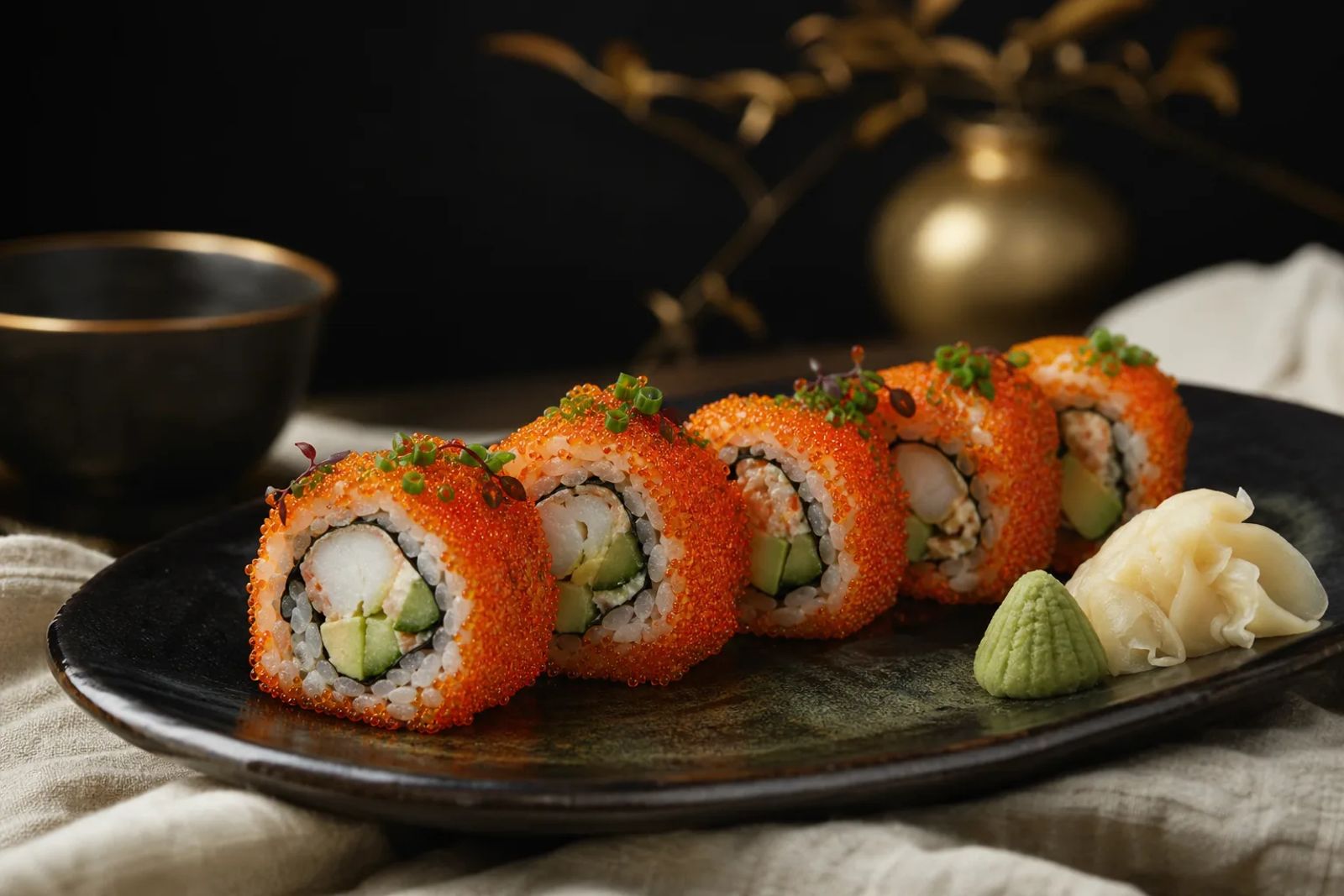
Masago is capelin roe, the tiny fish eggs commonly used on sushi rolls and as a garnish. At spawning, the eggs are reddish and approximately 1 mm across, according to Fisheries and Oceans Canada. On a roll, masago gives a fine-grained coating rather than a scatter of large, conspicuous beads.
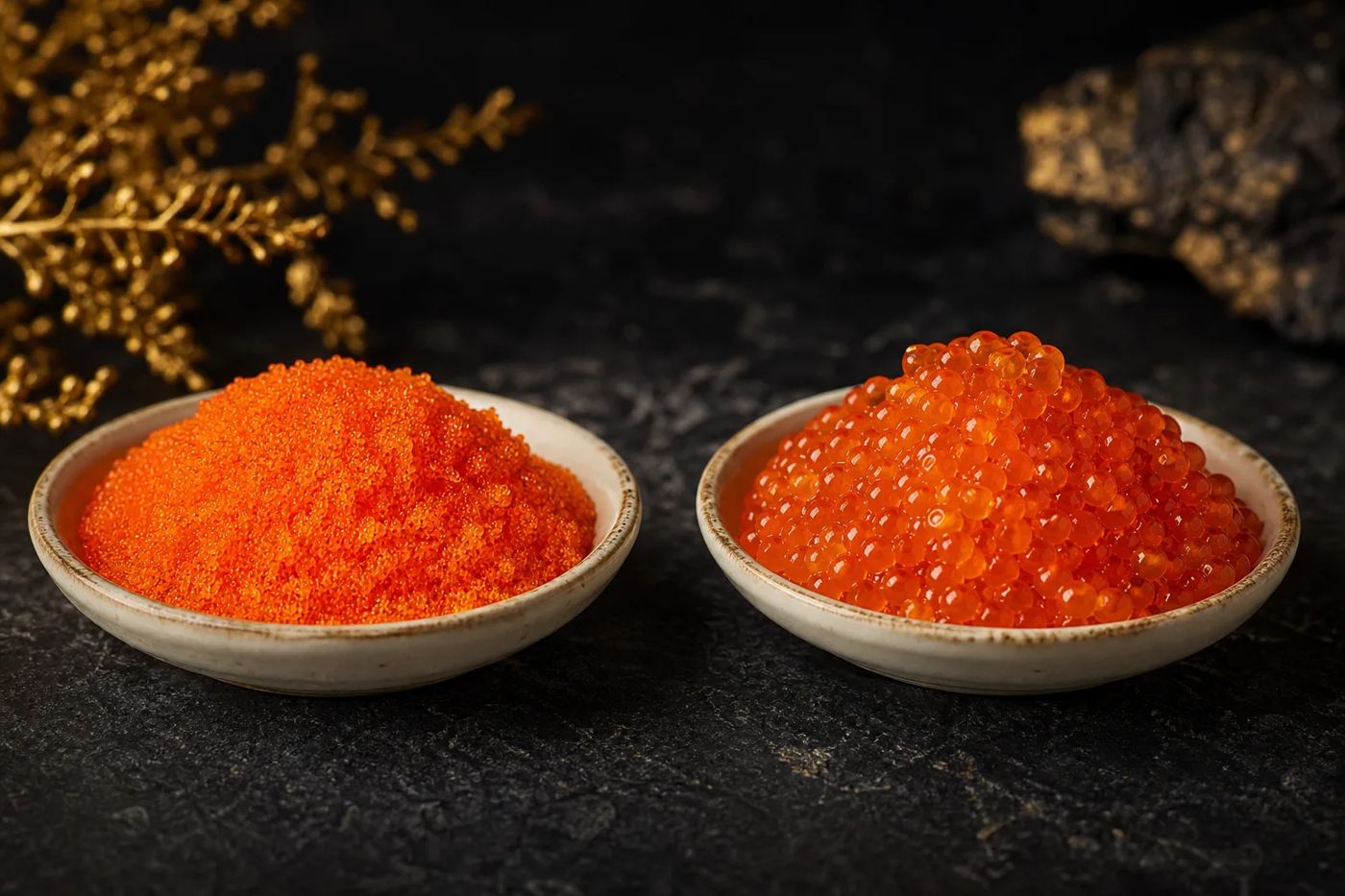
Masago is not tobiko, which comes from flying fish. One documented commercial source is Atlantic capelin, Mallotus villosus, a small schooling smelt. Pacific capelin, Mallotus catervarius, is recognised separately, so check the species on an individual product. Commercial masago may be seasoned, and its colour may come from added dyes rather than the eggs themselves.
What masago brings to a dish
Seasoning shapes masago's character as much as the roe itself. Icelandic processor Vignir G. Jónsson describes its wasabi masago as crunchy, with fish, sweet, salt and wasabi flavours. Sugar, salt and mirin all appear in the specification's ingredient list.
The spawning description is a starting point, not a specification for processed masago. Look to the individual product for those details.
Masago and tobiko: can you substitute them?
Yes, for a roll coating or scattered garnish. Sushi supplier Make Sushi explicitly describes masago as a substitute for tobiko. The texture matters: manufacturer Beijing Shipuller describes tobiko as larger and crisper, and masago as smaller and more delicate. Choose tobiko when a more pronounced crunch is central to the dish.
Read the ingredients rather than relying on the name alone. One Azuma Foods specification for a product called masago lists both herring and capelin roe. For the identity and uses of the fish behind tobiko, see flying fish roe.
A small fish with a large role
Capelin feeds cod, seabirds and marine mammals. It eats zooplankton, the small animals drifting in seawater, and passes that food energy to larger predators. Managing a capelin fishery therefore means considering the wildlife that depends on it, as well as the catch.
The fish lives in northern Atlantic, Arctic and northern Pacific waters. Fisheries include those for the Iceland, East Greenland and Jan Mayen stock, the Barents Sea stock managed by Norway and Russia, and stocks around Newfoundland and Labrador in Canada.
Japan has long been an important market for capelin. Fisheries and Oceans Canada identifies it as the primary destination for roe-bearing females when Canada's inshore roe fishery developed in the late 1970s.
How the fisheries are managed
There is no single worldwide masago quota. Catch limits apply to particular stocks and seasons. The position below was checked in November 2026; scientific catch advice and a legally agreed quota are distinct.
Iceland and neighbouring waters: On 12 October 2026, MFRI and the Greenland Institute of Natural Resources jointly advised an intermediate catch of 105,773 tonnes for 2026/2027. Final advice was expected in January or February 2027.
Norway and Russia: The Barents Sea capelin quota was zero in both 2025 and 2026, closing the directed fishery. The October 2026 assessment also recommended zero catches for 2027; that recommendation should not be confused with an adopted quota.
Canada: Fisheries and Oceans Canada set a 2026 total allowable catch of 14,533 tonnes for the eastern and southern Newfoundland and Labrador management area, unchanged from 2025. Area openings, fleet allocations and monitoring requirements operate within that limit.
Look beyond the colour
Orange, black or green tells you little about the fish species or flavour. Latvian processor Sudrablīnis lists Sunset Yellow FCF (E110) in its orange masago, Brilliant Black BN (E151) with other colours in its black version, and tartrazine (E102) plus Brilliant Blue FCF (E133) in its green version.
Nor does green mean that wasabi alone supplies the colour. Vignir G. Jónsson's specification lists wasabi flavouring separately from its blue and yellow dyes. The same document reports 5.5 g salt per 100 g, not 5.5 g sodium.
Check compound ingredients as carefully as the roe. Soy sauce may introduce soya and wheat, as Make Sushi's ingredient list demonstrates, while fish roe remains a fish ingredient whatever its colour. For more on appearance, see naturally coloured roe.
Names, labels and permitted additives
“Seasoned capelin roe” gives a beginner the clearest description. US FDA guidance also allows a fish-qualified name such as “capelin caviar”, with the fish name and “caviar” in substantially the same size and prominence. It calls for a prominent declaration of artificial colour. This is nonbinding guidance, not a separate legal standard of identity.
In the EU, Regulation (EU) No 1169/2011 requires food information not to mislead and sets rules for the name of a food, including a descriptive name where appropriate. Great Britain applies the assimilated regulation with domestic amendments; Northern Ireland generally follows the EU framework. A customs category does not determine whether a retail name is truthful.
Orange, black or green tells you little about the fish species or flavour.
Before reaching a compliance conclusion, check the product formulation and the current permissions and conditions for these colours in capelin roe under EU, Great Britain, Northern Ireland and US law.
Japan requires Japanese-language labelling for packaged processed foods, including the food name, ingredients, additives and storage instructions. Japan's Consumer Affairs Agency also distinguishes ingredient-origin requirements for foods processed domestically from origin labelling for imported finished products.
Serving and storing masago
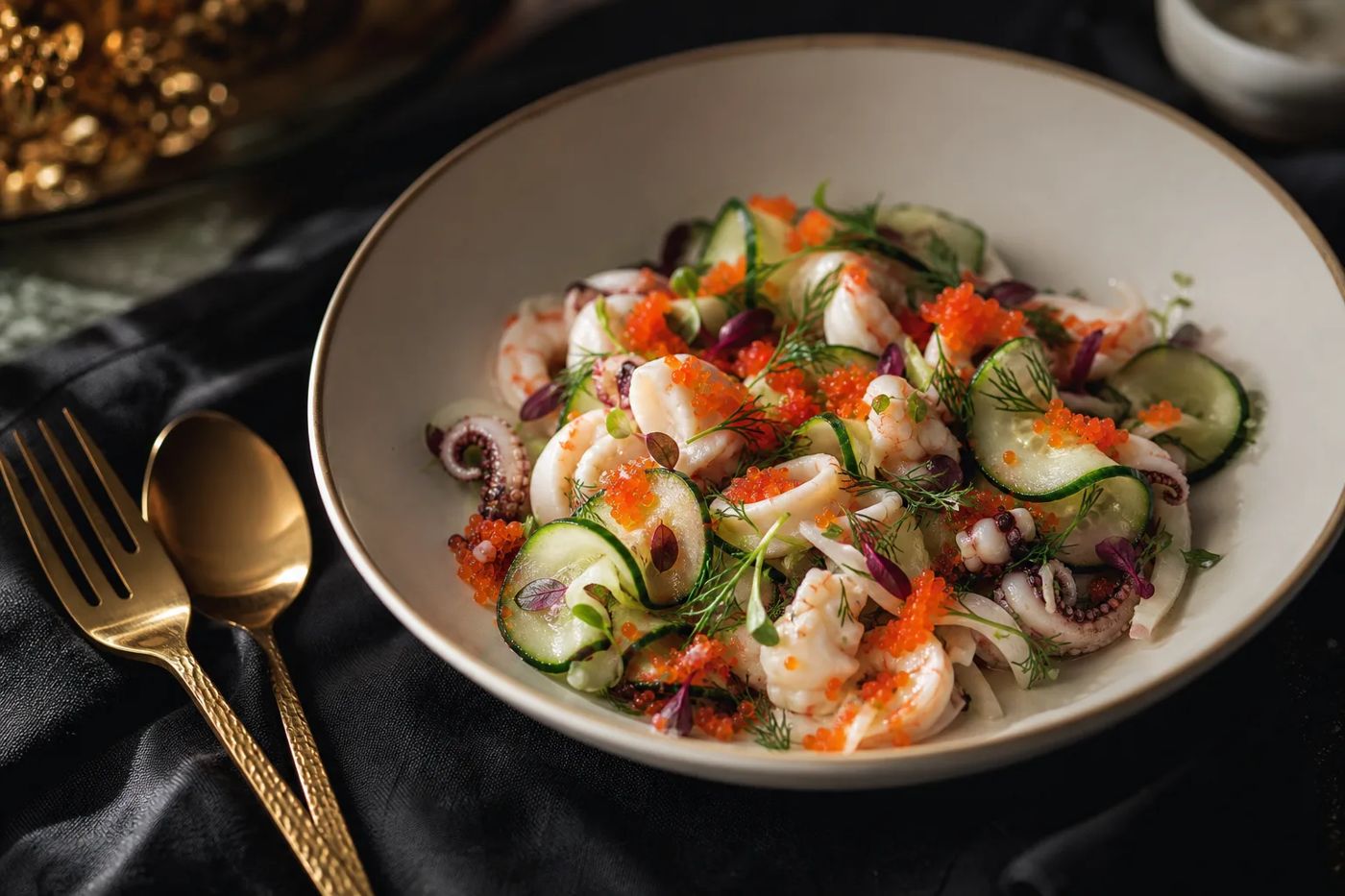
Coat a sushi roll, fill seaweed-wrapped sushi or finish a poke bowl. Masago can also be stirred into a dressing or spooned over a cold seafood salad. For storage, start with the pack. Follow its storage instructions and, if frozen, its thawing instructions; another product's shelf life is no substitute. Thaw in the fridge, keep prepared roe separate from raw seafood, and use clean utensils.
In the United States, FDA home guidance recommends refrigeration at 4 °C (40 °F) or below. Follow a colder product instruction if one is specified.
Freezing does not kill every harmful germ, and a pleasant smell cannot establish safety. Use the labelled use-by date and the manufacturer's instructions after opening or thawing, rather than appearance alone, to guide when the roe should be used.
Where to go next
- Other Fish Roe: explore the wider roe family.
Sources
-
Fisheries and Oceans Canada. Atlantic Capelin (Mallotus villosus). Online species profile, undated edition retrieved November 2026. Biological background, fisheries and the historical Japanese market.
https://www.dfo-mpo.gc.ca/species-especes/profiles-profils/capelin-capelan-eng.html -
Fisheries and Oceans Canada. Capelin Northwest Atlantic Fisheries Organization Divisions 4RST (Capelin Fishing Areas 12-16). Integrated fisheries management plan, 2017 online edition. Section 2.1 describes reddish eggs approximately 1 mm in diameter.
https://www.dfo-mpo.gc.ca/fisheries-peches/ifmp-gmp/capelin-capelan/index-eng.html -
Marine and Freshwater Research Institute. Capelin: technical report. Intermediate assessment for the 2026/2027 season, 12 October 2026.
https://www.hafogvatn.is/static/extras/images/31_cap_2026_2_techreport_en.html -
Institute of Marine Research and Joint Russian-Norwegian Arctic Fisheries Working Group. Barents Sea Capelin. Report 2026-10, October 2026. Records the zero quotas for 2025 and 2026 and recommends zero catches for 2027.
https://www.hi.no/hi/nettrapporter/imr-vniro-en-2026-10 -
Fisheries and Oceans Canada. Capelin in NAFO Divisions 2J3KLPs 2026. Fisheries management decision, 2026.
https://www.dfo-mpo.gc.ca/fisheries-peches/decisions/fm-2026-gp/atl-28-eng.html -
Sudrablīnis. Masago. Manufacturer's ingredient declarations for orange, red, black and wasabi products, undated online edition retrieved November 2026.
-
Vignir G. Jónsson hf. Specification: Masago Wasabi. Issue 1, undated document hosted by Innnes, retrieved November 2026. Product identity, ingredients, sensory specification and salt declaration.
https://innnes.is/media/zgfpdxzh/611524_70570_611524.pdf -
Beijing Shipuller Co., Ltd. Strategic Sourcing of Frozen Tobiko and Masago for Japanese Cuisine Optimized Through Yumart Portfolio. Company press release, 2026, distributed through EIN Presswire. Used only for attributed comparative texture descriptions.
https://world.einnews.com/pr_news/881084170/strategic-sourcing-of-frozen-tobiko-and-masago-for-japanese-cuisine-optimized-through-yumart-portfolio -
Make Sushi. Masago (Seasoned Capelin Roe) 1kg. Supplier's product description and ingredient declaration, undated online edition retrieved November 2026. Documents substitution for tobiko and a formulation containing wheat and soya.
-
Azuma Foods (Canada) Co., Ltd. Masago Orange: Seasoned Fish Caviar Orange, item 11040. Undated product specification hosted by Wismettac, retrieved November 2026. Documents a formulation containing herring and capelin roe.
https://ecatalog.wismettacusa.com/upload/pdf/146973390629fb8cf42e8e3.38749001.pdf -
US Food and Drug Administration. CPG Sec. 540.150: Caviar, Use of Term, Labeling. October 1989 edition, current FDA webpage retrieved November 2026. Nonbinding naming and added-colour guidance.
https://www.fda.gov/inspections-compliance-enforcement-and-criminal-investigations/compliance-policy-guides/cpg-sec-540150-caviar-use-term-labeling -
European Parliament and Council. Regulation (EC) No 1333/2008 on food additives. Annex II, category 09.3. The 2012 consolidated text was retrieved; a December 2024 consolidated edition was located through the official search extract.
https://www.legislation.gov.uk/eur/2008/1333/pdfs/eur_20081333_2012-08-13_en.pdf
https://eur-lex.europa.eu/eli/reg/2008/1333/2024-12-16/eng -
Food Standards Agency. Guidance on using the Register of Food Additive Authorisations. Online guidance retrieved November 2026, describing the register introduced on 1 April 2025 and subsequent updates.
https://data.food.gov.uk/regulated-products/food_authorisations/guidance -
Food Standards Agency. Approved additives and E numbers. Published 25 June 2026. Explains quantitative restrictions and the distinction between assimilated legislation and Northern Ireland's EU framework.
https://www.gov.uk/government/publications/approved-additives-and-e-numbers/approved-additives-and-e-numbers -
US Government, electronic Code of Federal Regulations. 21 CFR 74.706: FD&C Yellow No. 6. Online text retrieved November 2026.
https://www.ecfr.gov/current/title-21/chapter-I/subchapter-A/part-74/subpart-A/section-74.706 -
UK Government. Packaging and labelling. Online guidance retrieved November 2026. Describes Regulation 1169/2011, truthful food names and descriptive naming.
https://www.gov.uk/government/publications/packaging-and-labelling/packaging-and-labelling -
Consumer Affairs Agency, Japan. Food Labelling and New Country of Origin Labelling System for Ingredients: Q&A, Ingredients Subject to Labelling. Online guidance and English Q&A, retrieved November 2026.
https://www.caa.go.jp/en/policy/food_labeling/
https://www.caa.go.jp/en/policy/food_labeling/pdf/syokuhin_en_011.pdf -
Tokyo Metropolitan Government. For Those Who Create Labels on Processed Foods in the Japanese Language for the First Time. Undated online guidance retrieved November 2026.
https://www.hokeniryo1.metro.tokyo.lg.jp/shokuhin/eng/hyouji/yunyuu.html -
US Food and Drug Administration. Selecting and Serving Fresh and Frozen Seafood Safely. Consumer guidance dated 5 March 2024, checked November 2026.
https://www.fda.gov/food/buy-store-serve-safe-food/selecting-and-serving-fresh-and-frozen-seafood-safely
This piece was researched using fisheries authorities, government food guidance and legislation, with manufacturer descriptions identified as such and ingredient lists checked against named formulations.
Last checked: November 2026