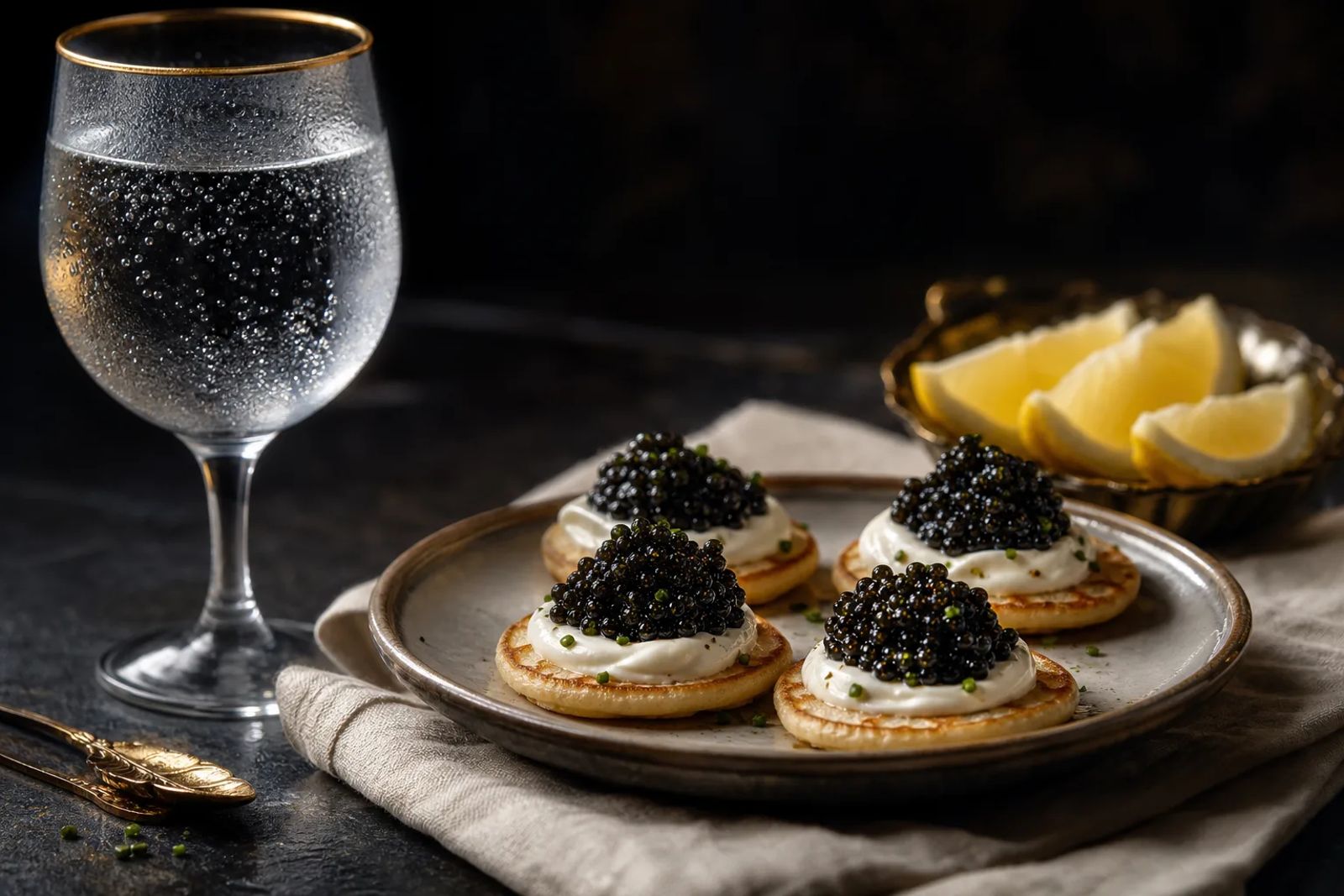
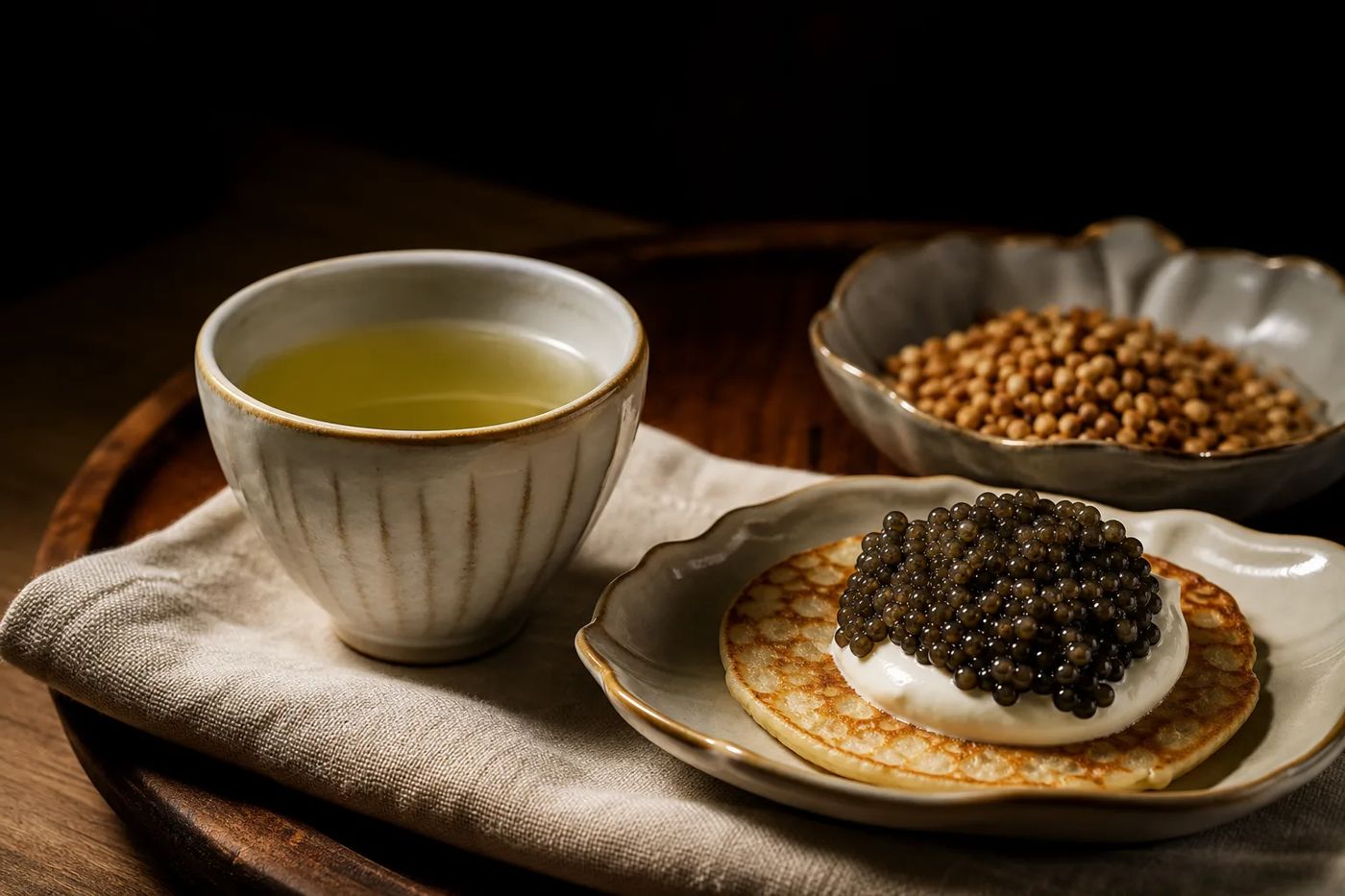
Eel, caviar and green tea blended with roasted rice: that is sommelier Kaori Yoshioka's pairing, described in her Michelin interview. A glass need not contain alcohol to earn its place beside caviar. It needs to leave you looking forward to the next mouthful.
For a simple starting point, choose sparkling water: bubbles, no sweetness and no competing flavour. Light green tea and a restrained dealcoholised sparkling wine offer other routes, provided the drink's actual alcohol content suits the person drinking it.
What a good non-alcoholic pairing should do
Refresh the palate. Accompany the caviar. Leave its flavour room to unfold. Those are more useful goals than copying an alcoholic drink.
WSET's pairing teaching, as of March 2026, identifies alcohol, sweetness, acidity, tannin and flavour as a drink's key components. For caviar, look for enough presence to accompany the food without persistent sweetness, bitterness or perfume following you into the next mouthful. Acidity and bubbles can help, but a quiet cup of tea can make just as much sense.
You may be avoiding alcohol because of pregnancy, driving, health, faith or simple preference. None needs explaining to a host. The practical distinction is whether you want to avoid alcoholic drinks or need to avoid alcohol itself. Offer water alongside more elaborate options so guests can choose without discussing their circumstances.
The broader drinks with caviar guide covers choices across the table; caviar and champagne explores the familiar sparkling-wine comparison.
Non-alcoholic pairings to try
Start with one drink and plain water. Dinner does not need a competing flight of glasses. These options draw on published serving ideas and ingredient characteristics rather than a comparative caviar tasting.
| Drink | What it brings | Source |
|---|---|---|
| Plain sparkling water | Bubbles without sweetness. | Caviar producer's serving guide, 2025 1. |
| Dealcoholised still or sparkling wine | Wine-like flavour, plus bubbles in sparkling versions. Check sweetness; do not assume dryness. | Retailer pairing guidance 2. |
| Alcohol-free spirit alternatives | Botanical aroma and a base for dilution, rather than vodka-like neutrality. | WSET's flavour principles 3. |
| Green tea | A savoury direction, including roasted-rice tea served with eel and caviar. | Sommelier Kaori Yoshioka, interviewed by Michelin 4. |
| Kombucha | Fermented tea; match its acidity and sweetness to the plate. | TTB's production description 5. |
| Verjuice or shrubs | Tart grape juice or fruit-and-vinegar syrup, diluted into a longer drink. | Producer description 6 and Great British Chefs' method 7. |
With water, begin plain. Put lemon in a separate dish and let each person decide whether citrus belongs in the glass. With dealcoholised wine, taste the whole pairing: a drink that works with blinis and cream may be less appealing beside caviar served alone.
Yoshioka's tea pairing is specific to a composed dish, rather than green tea and caviar in every form. At home, begin with an unflavoured tea and follow its brewing instructions.
Spirit alternatives have personalities of their own. Treat them as mixers, not substitutes for vodka's neutrality. Dilution and restraint are useful here: concentrated spice, smoke or a strongly bitter tonic can dominate the pairing. Taste the finished glass, including the mixer, before serving it with the food.
Verjuice is the tart juice of early-picked grapes; a shrub combines fruit, sugar and vinegar. Both bring acidity without trying to imitate wine. Dilute either with water to taste rather than serving the concentrate neat. Keep fruit flavours restrained beside plain caviar; a fuller dish gives a more assertive shrub room to work.
Serving the drinks well
For sparkling wine, WSET gives a serving range of 6°C to 10°C (43°F to 50°F). This is a conventional wine reference, not a tested optimum for every alcohol-removed drink. Follow the producer's serving instructions where supplied. WSET also warns that chilling below 6°C (43°F) can mask flavour in white, rosé and sparkling wines.
Water, tea, kombucha and mixed drinks do not need one compulsory serving temperature. Cool water and small pours of tea make it easy to judge each drink beside the food and adjust your choice.
Keep serving temperature separate from safe storage. Chilling a drink for flavour does not replace following its refrigeration and storage directions.
What alcohol-free drink labels actually mean
ABV means alcohol by volume. The important detail is the alcohol content, not simply the promise on the front of the bottle. Label terms may be governed by law or voluntary guidance, with meanings that differ around the world. Their thresholds are not personal medical or religious recommendations. The distinctions below were checked in November 2026.
UK: guidance, wine rules and regional differences
In England, DHSC's voluntary Low-alcohol descriptors guidance, published in 2018, recommends alcohol-free only for drinks from which alcohol has been extracted and which contain no more than 0.05% ABV. De-alcoholised has a ceiling of 0.5% ABV after extraction; low alcohol means no more than 1.2% ABV. These are distinct recommendations, not alternative names for zero alcohol, and must be read alongside applicable labelling law.
The guidance also discourages non-alcoholic alongside names commonly associated with alcoholic drinks, apart from a narrowly defined sacramental-wine exception. The government's consultation concerned England, rather than a uniform UK-wide statute. On 16 June 2026, a health minister said the government still planned to consult on a 0.5% alcohol-free ceiling. That statement did not change the rules.
Wine has category-specific rules too. Northern Ireland follows applicable EU wine provisions under the Windsor Framework, subject to arrangements for eligible retail movements from Great Britain. A wine description authorised in Great Britain is therefore not necessarily authorised identically in Northern Ireland.
EU: wine rules and national differences
Under Regulation (EU) No 1308/2013, as amended by Regulation (EU) 2021/2117, dealcoholised wine has no more than 0.5% ABV. Partially dealcoholised means above 0.5% but below the category's normal minimum alcoholic strength. Both descriptions allow residual alcohol.
For caviar, look for enough presence to accompany the food without persistent sweetness, bitterness or perfume following you into the next mouthful.
A further change has been enacted, with labelling provisions that are not yet applicable. Regulation (EU) 2026/471 replaces these wine descriptors from 19 September 2027: alcohol-free at no more than 0.5% ABV, accompanied by 0.0% at no more than 0.05%; alcohol reduced above 0.5% and at least 30% below the category's minimum strength before dealcoholisation. Previously compliant labelled stock may continue until exhausted.
These provisions govern wine, not every soft drink across the EU. National practices differ. Germany's federal nutrition authority explains that drinks labelled alkoholfrei can contain up to 0.5% alcohol. France's Décret n° 92-307, Article 1, reserves bière sans alcool for beer at no more than 1.2% ABV. Read each example within its country and drink category, rather than transferring it to wine or another country's label.
US: FDA and TTB distinguish the terms
FDA's nonbinding CPG Sec 510.400, Dealcoholized Wine and Malt Beverages, treats non-alcoholic as less than 0.5% ABV, rather than zero. For dealcoholised wine, its policy calls for dealcoholized or alcohol-removed in the product identity, plus a statement that it contains less than 0.5% alcohol by volume. The guidance reserves alcohol-free for no detectable alcohol.
TTB's binding malt-beverage rule, 27 CFR 7.65(d) to (f), permits non-alcoholic with an adjacent less than 0.5% statement. Alcohol free requires no alcohol. Low alcohol and reduced alcohol mean less than 2.5% ABV for that category, rather than the UK guidance's 1.2% ceiling. Those malt-beverage thresholds should not be applied automatically to botanical spirit alternatives.
When avoiding every trace matters
Kombucha needs particular care. Fermentation produces alcohol and can continue after bottling. US TTB rules apply if the drink reaches 0.5% ABV at any point during production or afterwards, even when it was below that level at bottling. Follow the maker's storage directions and seek product-specific alcohol information; fermented tea should not simply be assumed alcohol-free.
For pregnancy, the UK NHS recommends not drinking alcohol if pregnant or planning pregnancy. The US CDC says there is no known safe amount, safe time or safe type of alcohol during pregnancy. Neither establishes a safe allowance for low-alcohol drinks. Plain water is the straightforward choice if you want to avoid interpreting residual-alcohol claims.
The food deserves attention too. Chilled ready-to-eat fish products can carry Listeria, so ask your midwife or doctor about the caviar as well as any concerns about drinks.
Green tea contributes caffeine: UK NHS guidance limits total caffeine during pregnancy to 200 mg daily. For the food rather than the drink, see caviar during pregnancy. For faith-based decisions, is caviar halal? separates the relevant questions. A low ABV figure alone is not a religious ruling.
Choosing for your table
Ask guests what they would like to drink before they arrive, not why they are not drinking. Where strict avoidance matters, show the original ingredient and alcohol information before decanting an unfamiliar product.
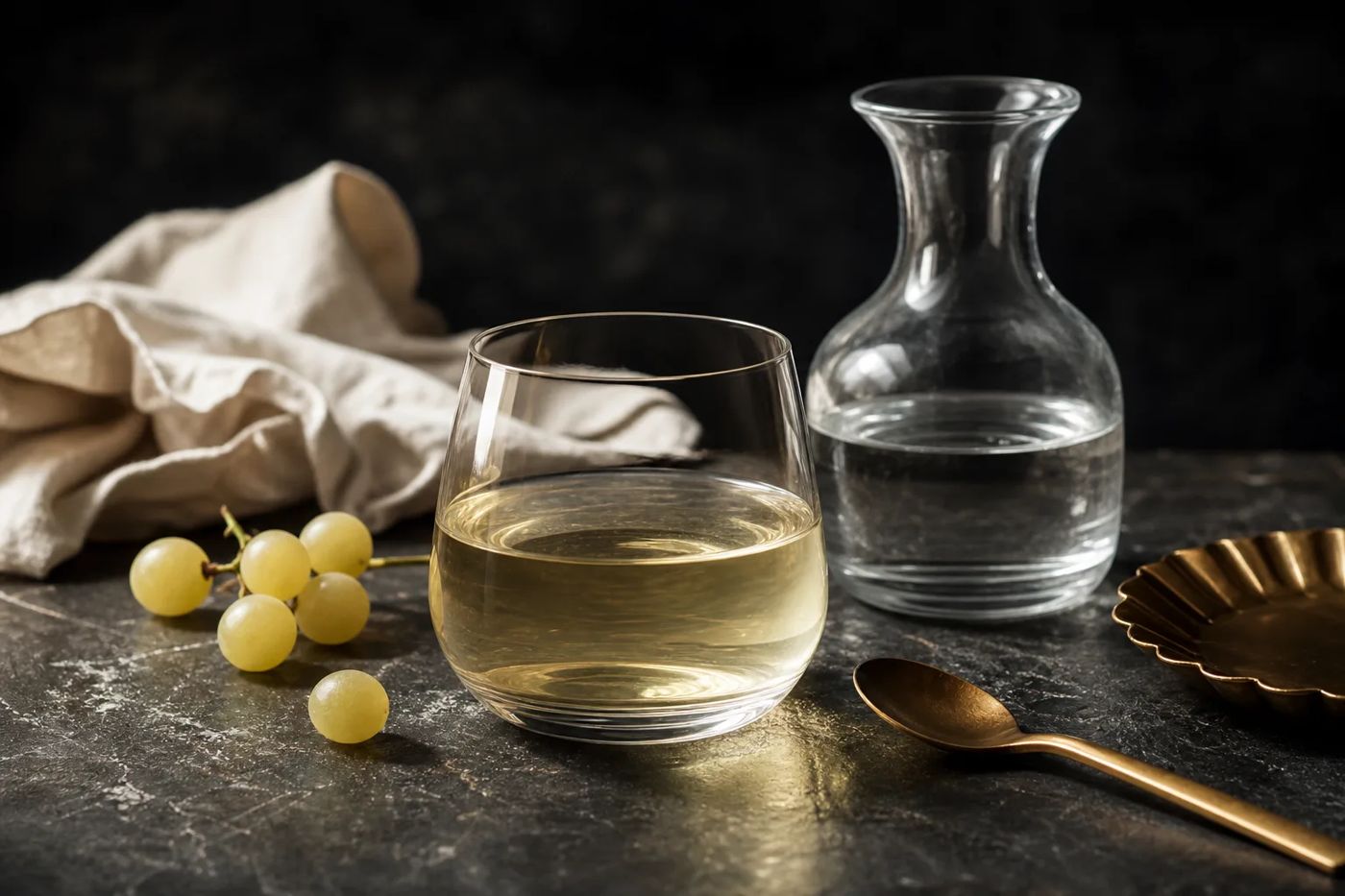
Then serve the chosen drink in a proper glass and offer still water alongside it. Let the glass accompany the caviar, not become the evening's subject.
Sources
- OM Caviar. What to Eat With Caviar: Best Food & Drink Pairings. Undated online serving guide. Producer recommendations, not independent tasting evidence;
- TSARINE Caviar. Best Non-Alcoholic Champagne for Caviar: Pairing Guide. 2026 online edition. Retailer recommendations; the title is reproduced for identification only;
- Wine & Spirit Education Trust. How to pair drinks with spice. 2026 online edition. Used for general pairing components, not as evidence of a caviar tasting. Source.
- Michelin Guide. MICHELIN Restaurants Where Nonalcoholic Drinks Are the Perfect Pairing. 20 January 2026. Includes sommelier Kaori Yoshioka's pairing practice. Source.
- Alcohol and Tobacco Tax and Trade Bureau. Kombucha. Current online guidance, checked 2026. Source.
- Wölffer Estate Vineyard. Verjus. Undated producer description, checked 2026. Used for the producer's account of early-harvest grape juice and spritzer use;
- Great British Chefs. How to Make a Shrub. 2025 online edition. Source.
- Wine & Spirit Education Trust. Temperatures of wine service and storage. 26 April 2022. Source.
- Wine & Spirit Education Trust. Level 1 Award in Wines workbook. English, Issue 1.2; publication year not stated. “Storage and service of wine”, page 21. Source.
- Department of Health and Social Care. Low-alcohol descriptors guidance. December 2018. Source.
- Department of Health and Social Care. Updating labelling guidance for no and low-alcohol alternatives: consultation. 2023 edition. Source.
- UK Parliament. Written question 8439: low and no alcohol descriptor guidance. Answered 16 June 2026. Source.
- UK Government. Detailed policy assessment: COM(2025) 137 final. 2025. Covers EU wine rules applicable in Northern Ireland and the Northern Ireland Retail Movement Scheme distinction. Source.
- Direction générale de la concurrence, de la consommation et de la répression des fraudes. Désalcoolisation des vins: quelles sont les règles relatives à l'élaboration et à l'étiquetage des produits? 2025 online guidance. Explains Regulation (EU) No 1308/2013 as amended by Regulation (EU) 2021/2117. Source.
- European Parliament and Council. Regulation (EU) 2026/471. 24 February 2026, particularly Article 1(10), Article 5 and Article 6. Official text reproduced by Spain's Boletín Oficial del Estado. Source.
- Bundeszentrum für Ernährung. Versteckter Alkohol in Lebensmitteln. 2026 online edition. Source.
- French Republic, Légifrance. Décret n° 92-307 du 31 mars 1992, Article 1, consolidated amended text. Source.
- US Food and Drug Administration. CPG Sec 510.400 Dealcoholized Wine and Malt Beverages: Labeling. Issued 1980, last revised May 2005, updated November 2005. Source.
- US Department of the Treasury. 27 CFR 7.65: Alcohol content. Current electronic Code of Federal Regulations, checked 2026, paragraphs (d) to (f). Source.
- NHS. Drinking alcohol while pregnant. Reviewed 13 March 2023; current page checked 2026. Source.
- NHS. Foods to avoid in pregnancy. Current online guidance, checked 2026. Source.
- US Centers for Disease Control and Prevention. About Alcohol Use During Pregnancy. 14 August 2026. Source.
This piece was researched through official labelling rules and health guidance, professional drinks education, a published sommelier interview and clearly distinguished producer serving suggestions; no comparative tasting was conducted.
Last checked: November 2026