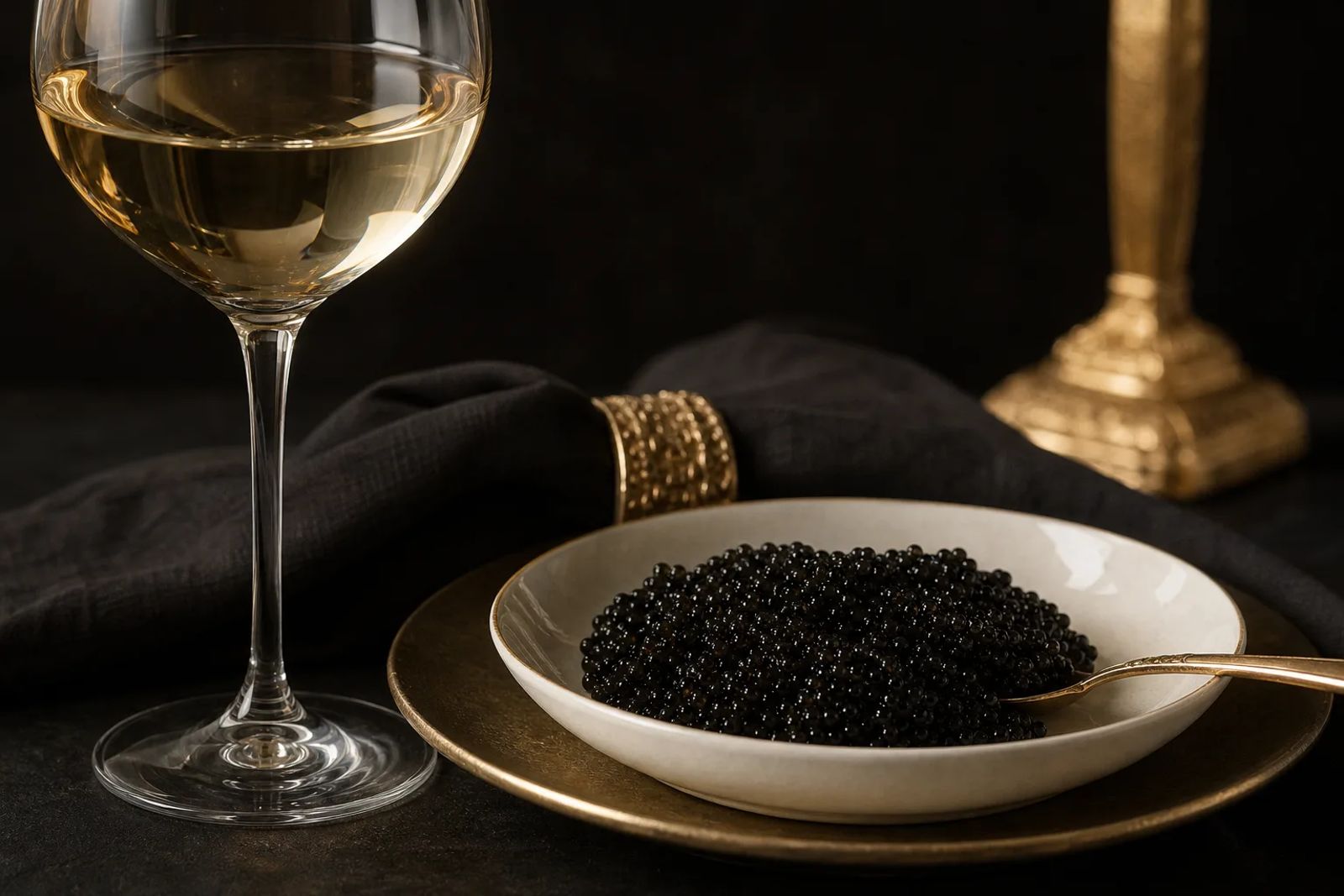
Firm grains of six-month-aged caviar, served with mature white Bordeaux: a pairing dinner reported by winemaker Vincent Cruège shows how far still wine can take this match. Caviar does not need bubbles. A white wine can bring freshness, restraint or a long finish, while leaving the roe at the centre of the mouthful.
For an easy starting point, choose dry Chablis, dry Riesling or a restrained Chardonnay, styles recommended by the experts below. For the wider choice of drinks, explore drinks with caviar. Here, the focus is still whites: how to choose a style, rather than chase a particular bottle or producer.
What white wine needs to do
Leave room for the caviar. That matters more than the grape name. Sommelier and Bourgogne wine school trainer Stéphane Philippe recommends Chablis Premier Cru for its salty notes. Chef Daniel Boulud, whose advice is reported by Williams Sonoma, favours a crisp, dry white over a rich, oaky wine that masks the roe.
Salt helps explain the appeal of freshness. WSET, the Wine & Spirit Education Trust, says salt can make wine seem sweeter while softening perceived acidity and bitterness. A white with lively acidity can therefore stay refreshing alongside salty food. This is general food-pairing guidance rather than the result of a controlled caviar tasting.
The practical test is simple: enjoy the wine after a mouthful, then return to the caviar. Can you still taste the roe clearly? Restraint should give it space, not leave you drinking something without flavour. The best starting point is a wine with enough character to enjoy and enough freshness to invite the next spoonful.
Still white wine styles to consider
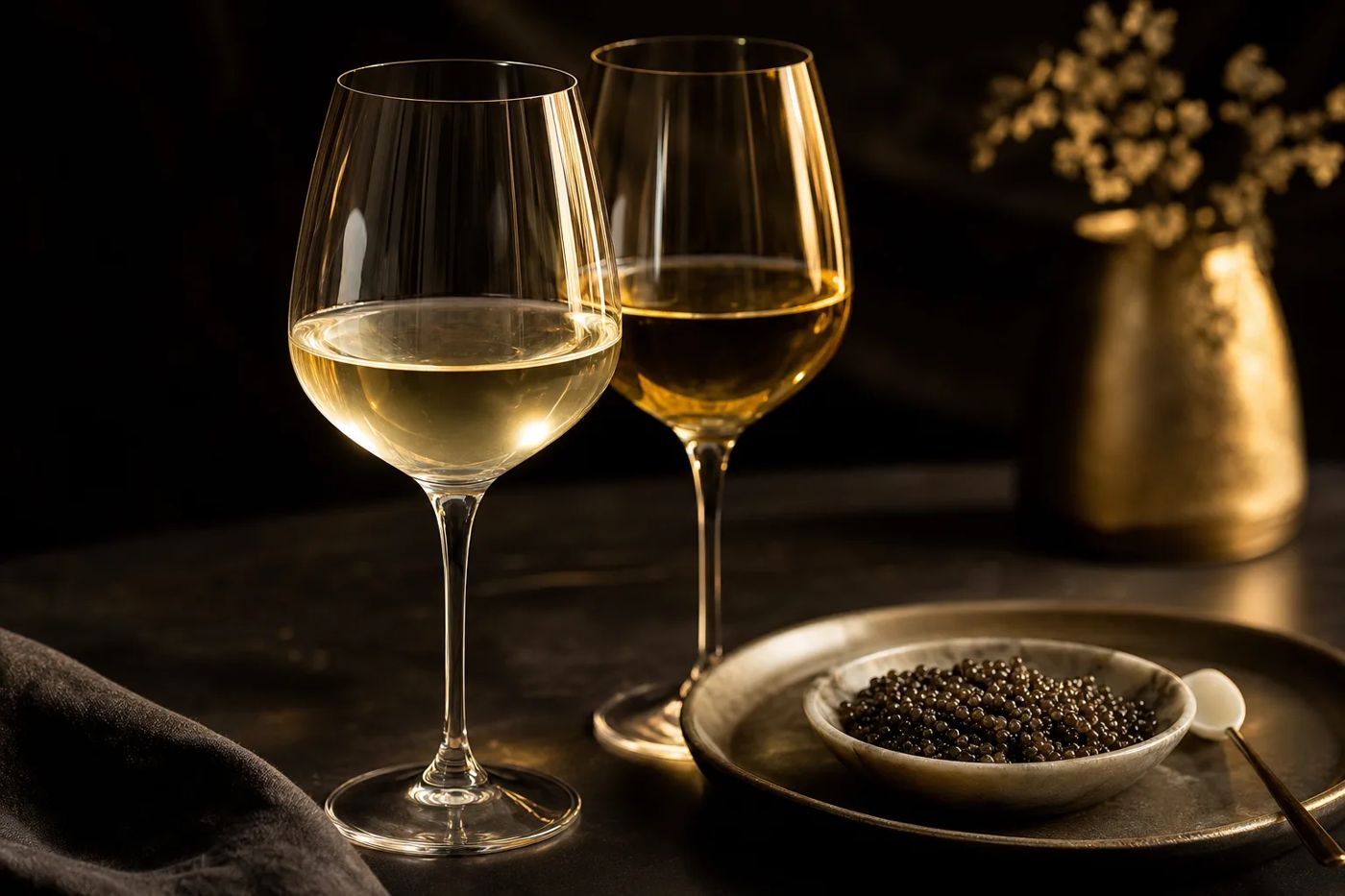
Chablis appears repeatedly in expert recommendations, but it is not the only route. Dry Riesling, Sauvignon Blanc, Chenin Blanc and restrained Chardonnay all have advocates. Choose the style as carefully as the grape: these recommendations identify useful qualities, rather than a ranking or a promise about every bottle.
| Style or appellation | Key trait | Recommended role | Source |
|---|---|---|---|
| Chablis Premier Cru | Salty notes | A match for caviar | Stéphane Philippe, Bourgogne wine school |
| Dry Riesling | Acidity and freshness | A still white alternative | Sommelier Perrine Prieur, in Veranda |
| Sauvignon Blanc or Chenin Blanc | Acidity | To serve alongside caviar | Educator Emily Cappiello, in Veranda |
| Crisp, restrained Chardonnay | Dryness and restraint | An alternative with a caviar meal | Daniel Boulud, reported by Williams Sonoma |
Prieur also recommends Chablis. Cappiello includes it alongside Sauvignon Blanc and Chenin Blanc, giving several ways into a fresh still white without making any one grape compulsory.
One distinction is worth knowing before choosing: Chablis is Chardonnay, not a separate grape. The official regional wine body describes the local appellations as white wines made from Chardonnay. Those appellation names are protected geographical designations. They identify wines from a defined area, made under specified rules, rather than simply naming a flavour.
Oak, alcohol and sweetness: what to watch
Rich, dominant oak is the concern, not Chardonnay itself. Boulud warns that rich, oaky wines can cover the caviar, yet his suggested alternatives include Chablis, Pouilly-Fuissé and an austere New World Chardonnay. Ask about the wine's style before ruling out the grape.
“Fresh, dry and without dominant oak flavour” is a useful brief when seeking advice. It tells the person helping you more than “white Burgundy” and leaves room to distinguish a restrained bottle from a richer interpretation. A familiar appellation alone cannot settle that question.
Sweetness deserves an open mind. WSET notes that salty foods can work with sweet wines through contrast, so salt alone gives no reason to declare that a sweet white must clash with caviar. Dry wine is a straightforward starting preference here, not a requirement of taste chemistry.
If you enjoy a little sweetness, taste the combination rather than deciding by the label. Does the wine leave you wanting another spoonful, or does sweetness become the main thing you notice? The answer belongs to that mouthful, not to a blanket prohibition.
With alcohol, pay attention to the sensation in the glass. Avoid a wine that feels hot or dominates the roe. This is a practical recommendation: there is no established caviar-specific alcohol threshold, nor evidence that alcohol alone causes a clash.
What age and lees ageing change
A young, crisp white is a starting point, not the only rewarding direction. Vincent Cruège told the American Culinary Federation's National Culinary Review that older whites with a long finish could accompany caviar's complexity. He included richer young caviar and longer-aged, saltier examples, and cited mature dry white Bordeaux from Pessac-Léognan.
His account of pairing dinners makes mature whites worth considering deliberately. It was a winemaker's experience rather than an independent comparative trial, so it offers a route to explore, not an age formula: older is not automatically better, and no particular number of years guarantees a match.
Lees ageing is a separate question. No published caviar-pairing recommendation is specific to lees-aged still whites. There is no reason in that absence to dismiss them, but “lees aged” alone cannot promise a particular texture or pairing effect. Choose the wine for what it actually brings to the glass, rather than expecting those words to decide the match.
Match the caviar you are serving
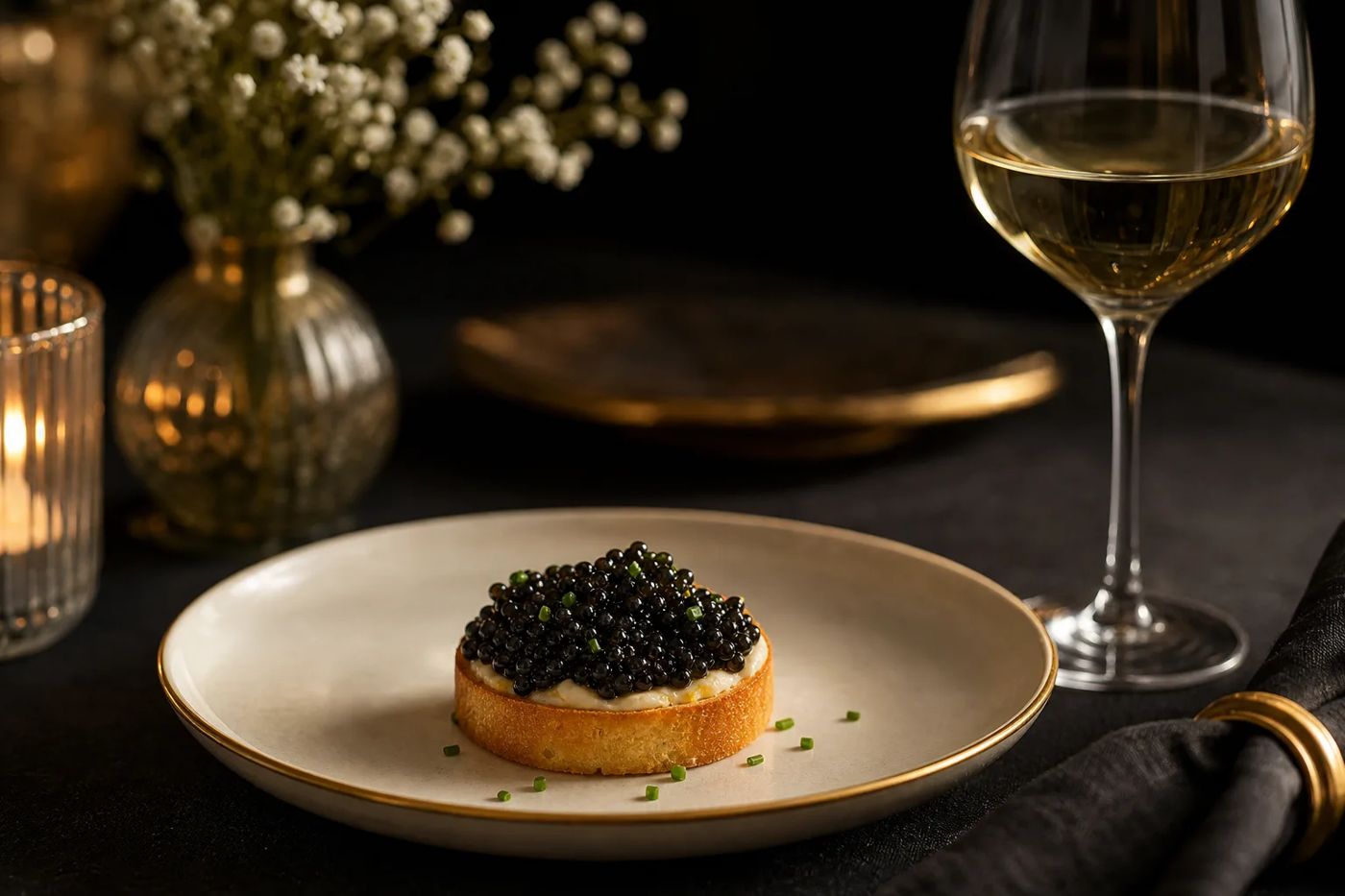
Taste the caviar as it will reach the table. If you plan to serve it plain, assess the wine with plain roe. If it will arrive on a prepared bite, compare the complete mouthful. There is little value in choosing for an ingredient that nobody will taste alone.
The best starting point is a wine with enough character to enjoy and enough freshness to invite the next spoonful.
Cruège's dinner offers an unusually precise example: mature white Bordeaux accompanied six-month-aged caviar described as having firm grains. That combination belongs to that event. Firm roe does not automatically call for mature wine, and saltier caviar does not necessarily demand greater wine weight.
Nor do the published examples support a chart assigning different grapes to mild, salty or firm caviar. Let the balance in the mouth decide. The aim is to find a still wine that works with the caviar in front of you, not to make it imitate sparkling wine. For that separate comparison, turn to caviar and champagne.
Serve white wine at the right temperature
Give the wine its appropriate serving temperature and keep the caviar under its own labelled handling conditions. Wine service ranges are not storage instructions for roe.
The Court of Master Sommeliers Europe recommends 7 to 10 °C (45 to 50 °F) for light whites and 10 to 13 °C (50 to 55 °F) for heavier whites.
For Chablis, the official regional body gives more specific guidance:
| Wine | Serving temperature |
|---|---|
| Petit Chablis with food | 9 to 10 °C (48 to 50 °F) |
| Chablis and Chablis Premier Cru | 10 to 11 °C (50 to 52 °F) |
| Chablis Grand Cru | 12 to 14 °C (54 to 57 °F) |
Use a clean, ordinary stemmed white-wine glass, preferably one you can comfortably swirl rather than a flute. Pour a little first. Taste it with the caviar before filling everyone's glass, leaving yourself the chance to change course without turning the meal into a formal tasting.
Alcohol and pregnancy guidance
In the UK, the Chief Medical Officers advise not regularly exceeding 14 units of alcohol a week. If drinking that amount, spread it over three days or more. These are health guidelines, not serving targets for a caviar meal.
Their pregnancy advice is clear: not drinking alcohol is the safest approach if pregnant or if you could become pregnant.
In the United States, the Dietary Guidelines for Americans 2025 to 2030 advise consuming less alcohol for better overall health and say pregnant women should avoid it completely. They also identify people taking medicines or with medical conditions that interact with alcohol among those who should avoid drinking.
Speak to a doctor, pharmacist or midwife for personal advice about pregnancy, medicines or a medical condition. If you do not drink, choose non-alcoholic pairings. A complete caviar service does not need wine.
Where to go next
- Caviar and Sake: explore a still drink with a different flavour structure.
- Caviar with Beer, Sherry and Cocktails: look beyond wine, with fortified styles treated separately.
Sources
- Bureau Interprofessionnel des Vins de Bourgogne, Focus on Chablis Premier Cru, undated web edition. Named pairing advice from Stéphane Philippe. Official page.
- Williams Sonoma, What to Drink with Caviar, undated web edition. Reports Daniel Boulud's still-white recommendations and warning about rich, oaky wines. Article.
- Wine & Spirit Education Trust, Winter wine and food matching, 21 December 2020. General guidance on salt, perceived acidity, bitterness and sweet-wine contrasts. WSET guidance.
- Veranda, Jaime Milan, How to Pair Wine and Caviar the Right Way, According to Sommeliers, 5 November 2025 web edition. Recommendations attributed to Perrine Prieur and Emily Cappiello. Article.
- Bureau Interprofessionnel des Vins de Bourgogne, Les 4 appellations des vins de Chablis et son cépage Chardonnay, undated web edition. Appellation and grape information. Official overview.
- American Culinary Federation, Deborah Grossman, National Culinary Review, November/December 2017, “Caviar shines with aged white and red wines”, p. 57. Reports Vincent Cruège's pairing dinners. Issue PDF.
- Court of Master Sommeliers Europe, Service Standards, version 24.1, 2024, “Storage and serving temperatures”. Standards PDF.
- Bureau Interprofessionnel des Vins de Bourgogne, How to serve a Chablis wine?, undated web edition. Appellation-specific serving temperatures. Official serving guidance.
- UK Chief Medical Officers, UK Chief Medical Officers' Low Risk Drinking Guidelines, 2016 edition. Weekly consumption and pregnancy guidance. Guidelines PDF.
- US Departments of Agriculture and Health and Human Services, Dietary Guidelines for Americans, 2025 to 2030, current edition, p. 5, “Limit alcoholic beverages”. Guidelines PDF.
This piece was researched through named expert recommendations, official wine education and regional sources, and national alcohol guidance, with editorial preferences distinguished from documented pairing claims.
Last checked: November 2026