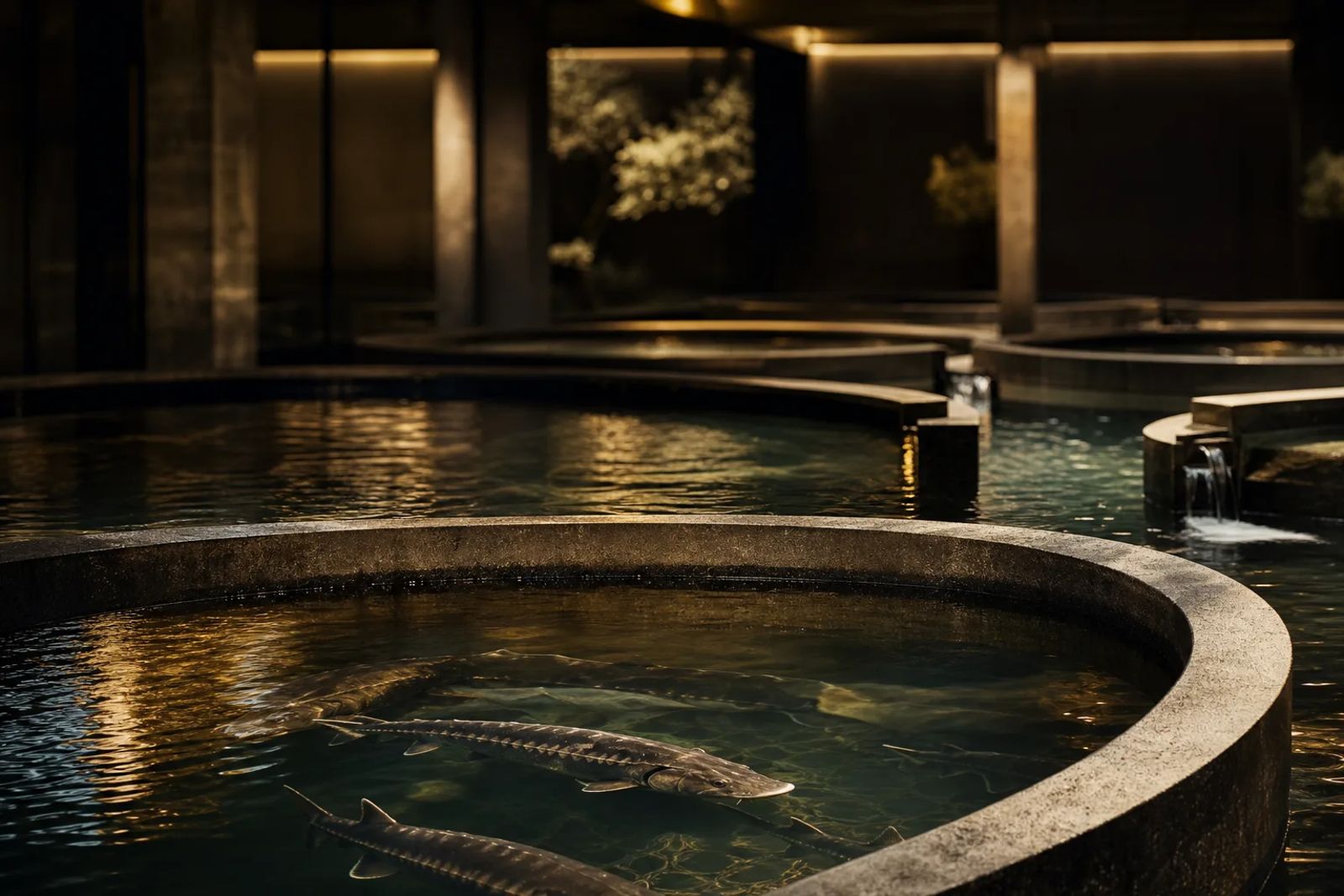
An EU organic sturgeon farm has a precise ceiling: 30 kg of live fish per cubic metre of water. Its obligations reach well beyond the label, into the water, feed, health and handling of the fish.
That is what makes organic caviar an interesting claim. Where a jurisdiction has organic aquaculture rules, it describes a regulated production system. A private certification logo tells a different story, defined by its published standard, independent checker and certificate scope. Neither covers every aspect of the fish or roe.
What organic sturgeon farming requires in the EU
Organic sturgeon farming starts with the farm, not the logo on the finished caviar. The EU explicitly covers freshwater sturgeon in Implementing Regulation (EU) 2020/464, Annex II, Part V, alongside the general organic aquaculture requirements in Regulation (EU) 2018/848. Those rules generally prohibit closed recirculation growout systems, except hatcheries, nurseries and facilities producing organic feed organisms.
The requirements reach into daily husbandry:
- Space and water: maximum stocking density is 30 kg/m³, measured as live fish weight per cubic metre of water. Water flow in every rearing unit must support welfare, and effluent water must be of equivalent quality to incoming water.
- Feed: rules for carnivorous aquaculture animals prioritise organic aquatic feed and specified fishmeal and fish oil sources, including material from sustainable fisheries. Organic does not mean vegetarian. The standard regulates the origin of feed ingredients rather than banning marine ingredients.
- Young fish: the starting rule is stock from organic broodstock and organic production units. Defined exceptions mean certification does not establish that every ancestor was organically farmed.
- Health and handling: farms must prevent disease, maintain an animal health management plan and restrict veterinary treatment. Artificial hormones cannot be used to induce spawning. Handling must minimise stress and physical damage, although fish may still need medicine.
These rules govern how the fish are raised. An organic claim on finished caviar also requires the relevant preparation and handling controls. Follow the wider production sequence in sturgeon farming.
Organic means different things in different markets
Great Britain: Defra requires certification by an approved organic control body. The aquaculture baseline remains the assimilated framework built on Regulations (EC) 834/2007 and 889/2008, with amendments. Later EU changes do not apply automatically: check the published GB aquaculture standards for the operation concerned.
Northern Ireland: Regulation (EU) 2018/848 applies to organic aquaculture. When reading the legal basis on a certificate, distinguish Northern Ireland from Great Britain.
United States: USDA has no organic standards for aquatic animal products. Sturgeon caviar therefore cannot be USDA organic certified or carry the USDA organic seal. USDA guidance does allow aquatic animal products certified under another government’s organic regulations to be sold as organic in the US, without suggesting USDA certification. That route uses another government’s rules, not a US aquaculture standard.
Switzerland: the Organic Farming Ordinance was extended to aquaculture from 1 January 2025. The cited sources do not specify the requirements for sturgeon and finished caviar, so check the current certificate and implementing rules.
Even so, the logo alone cannot establish the species, the origin of the roe or the condition of the caviar in your hand.
China: GB/T 19630-2019 includes aquaculture requirements for conversion, water, feed and husbandry. It remains listed as current following a March 2026 review. To establish whether a particular sturgeon farm or finished caviar product holds Chinese organic certification, check its certification documents.
Japan: MAFF’s published organic JAS standards list does not provide a sturgeon aquaculture standard. Organic algae and other JAS schemes do not amount to organic certification of farmed fish. Any organic caviar claim needs a separate documentary check of its precise basis.
Which private schemes cover sturgeon?
A scheme can certify aquaculture without covering sturgeon. Eligibility is the first thing to check.
Private certification is voluntary, but using a scheme’s mark requires compliance with its requirements. This table separates documented sturgeon eligibility from the existence of a broader aquaculture programme. It is neither a ranking nor an endorsement.
| Scheme | Owner | Covers sturgeon? | What it checks | Checked |
|---|---|---|---|---|
| ASC | Aquaculture Stewardship Council | No sturgeon on the published eligible species list | Farm management, environmental impacts, welfare and human rights for eligible species | November 2026 |
| BAP | Global Seafood Alliance | Historically documented; confirm current eligibility | Farm standard: environmental and social responsibility, animal health and welfare, food safety | November 2026 |
| GLOBALG.A.P. IFA | Legal owner not given in the cited sources | Yes, sturgeon appear in its product list | Food safety, environment, welfare, workers and traceability | November 2026 |
| Naturland | Naturland association | Sturgeon applicability not stated in the cited sources | Organic aquaculture husbandry, stocking density, feed and ecosystem protection | November 2026 |
| Friend of the Sea | World Sustainability Organization S.r.l. | Sturgeon applicability not stated in the cited sources | Programme includes inland aquaculture, feed and chain of custody standards | November 2026 |
ASC’s newer Farm Standard still depends on its eligible species list; it does not extend certification to every farmed fish. BAP’s sturgeon certificate was valid in 2023 to 2024, demonstrating applicability during that period. Current certification of the same farm needs a fresh check.
Independent certification bodies carry out scheme assessments. The logo is the sign, not the audit. Ask which standard version was used and whether the certificate covers the farm or only another facility. Then check chain of custody: the documented connection through successive handlers that links certified production to the caviar.
How to check an organic certificate
Follow the certificate through to the product. An organic farm certificate is only one part of the evidence trail for a processed food.
In the EU, a competent authority supervises the organic control system. An authorised control body or control authority checks operators before certification, with farmers, processors and traders all forming part of that system.
Start with the certifier’s name and control body code. Use the authority’s approved body list to confirm that the checker is recognised. For EU operators, look for the organic certificate through the public TRACES search. Request the current certificate and product schedule from the business, then verify them with the issuing body. A cropped logo is no substitute.
Match these details:
- Legal business name.
- Farm or processing site.
- Product scope.
- Validity dates.
- Certification status.
GLOBALG.A.P. offers verification through its IT platform using the producer’s identification number. For a UK organic claim, begin with Defra’s approved control body list, then follow the listed body’s own verification route.
What certification can and cannot tell you
Certification describes production requirements. It does not identify a species independently, assess flavour or establish that a particular container has stayed fresh.
Some schemes include traceability and food safety requirements. Even so, the logo alone cannot establish the species, the origin of the roe or the condition of the caviar in your hand. Those questions need their own evidence.
CITES addresses wildlife trade and caviar traceability, rather than organic husbandry. Its country of origin and processing or repacking information therefore answer different questions from an organic certificate. For the markings themselves, see how to read a caviar label. The traceability label records information; it does not independently verify the contents.
One audited requirement also cannot settle every environmental or welfare question. Compare the actual farming system and its evidence with is farmed caviar sustainable?, rather than treating organic status as a verdict on sustainability as a whole.

Make “natural” and “eco” earn their place
“Natural” and “eco” need an explanation, not a nod of approval. Neither substitutes for a named certificate. Ask what the claim means and what evidence supports it.
In the EU, Directive 2005/29/EC addresses misleading commercial practices, with the green claims changes made by Directive (EU) 2024/825 applying from 27 September 2026. UK consumer law also restricts misleading claims. In the US, the FTC Green Guides explain how environmental marketing claims may be deceptive. They are guidance, rather than binding legislation.
Terminology also changes between markets. Defra removed “bio” and “eco” from its guidance list of terms related to organic methods in April 2023. Older summaries are therefore a poor shortcut to the current GB advertising position.
Turn broad wording into a measurable statement. Ask for the standard followed, the site covered, the requirement met and the current certificate. If a seller cannot provide those details, the wording remains an unverified claim. It should not be treated as certified organic production.
Where to go next
- How to Read a Caviar Label: separate wildlife traceability information from other statements on the container.
Sources
-
European Parliament and Council. Regulation (EU) 2018/848 on organic production and labelling of organic products, 2018, particularly Annex II, Part III. Indexed official text; check the consolidated text for the current wording. EUR-Lex.
-
European Commission. Implementing Regulation (EU) 2020/464, 2020, Annex II, Part V, “Sturgeon in fresh water”. Indexed official text. EUR-Lex.
-
European Commission, Directorate-General for Agriculture and Rural Development. Organic production and products, current web guidance, undated. European Commission.
-
European Commission, Directorate-General for Agriculture and Rural Development. Control and enforcement, current web guidance, undated. European Commission.
-
Defra. Organic food: labelling and advertising rules, updated 20 August 2025. GOV.UK.
-
Defra. Organic products: approved UK control bodies, current web register. GOV.UK.
-
UK Government. Multi-Annual National Control Plan for Great Britain 2026 to 2030, 2026, organic production controls. GOV.UK.
-
Soil Association Certification. Aquaculture, including links to baseline GB and Northern Ireland aquaculture standards updated 18 May 2026. Programme guidance only; the linked standards themselves are not cited. Soil Association.
-
USDA Agricultural Marketing Service. Strengthening Organic Enforcement Frequently Asked Questions, current guidance, section on aquatic animal products and NOP import certificates. USDA AMS.
-
Swiss Federal Council. Ordonnance sur l’agriculture biologique et la désignation des produits et des denrées alimentaires biologiques, RS 910.18, version effective 1 January 2025, official text hosted by the Canton of Neuchâtel. Ordinance PDF.
-
Swiss Federal Office for Agriculture. Vue d’ensemble du train d’ordonnances agricoles 2024, PA22+, 2024, explanation of the extension to aquaculture. FOAG PDF.
-
State Administration for Market Regulation, China. GB/T 19630-2019: Organic products, requirements for production, processing, labelling and management system, standard record, including review dated 18 March 2026. National standards platform.
-
Chinese national standard, copy hosted by OFDC. GB/T 19630-2019, 2019, section 4.6, aquaculture. Standard PDF.
-
Ministry of Agriculture, Forestry and Fisheries, Japan. List of JAS, current standards index, undated. MAFF.
-
Aquaculture Stewardship Council. ASC Farm Standard, version 1.0.1A2, published programme text, “Eligible species” and standard scope. ASC programme centre.
-
Global Seafood Alliance, Best Aquaculture Practices. Standards, current document register, including Farm Standard Issue 3.1, 7 March 2023. BAP standards register.
-
Acoura Marine Ltd trading as LRQA. Certificate of Conformity: Azerbaijan Fish Farm LLC, facility F12868, certificate AM290315, issued 30 August 2023, expired 27 August 2024. Issuer’s certificate, from a distributor-hosted copy. Certificate PDF.
-
GLOBALG.A.P. Integrated Farm Assurance for aquaculture, version 6 programme guidance, current web edition. GLOBALG.A.P..
-
GLOBALG.A.P. Product list, version 6.0, March 2024, aquaculture entries. Product list PDF.
-
GLOBALG.A.P. Integrated Farm Assurance for aquaculture factsheet, 11 March 2025. Factsheet PDF.
-
Naturland. Standards: Aquaculture, current programme overview, undated. Naturland.
-
Friend of the Sea. Sustainable Seafood Certification and Accreditation, current programme guidance, undated. Friend of the Sea.
This page was researched using official legislation, government guidance, scheme documentation and an issued certificate.
Last checked: November 2026