
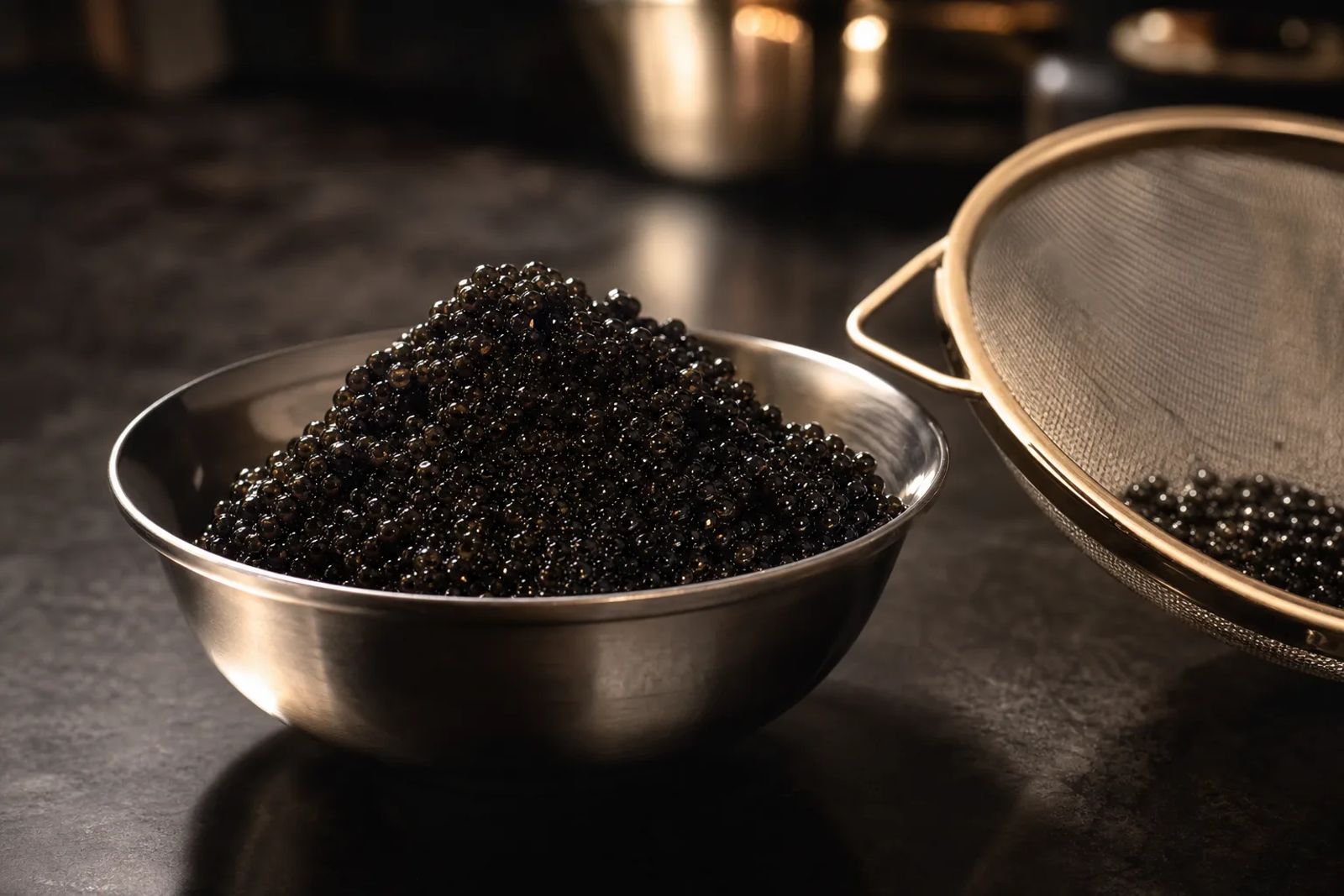
On a caviar tin, even the year can tell two different stories. An original CITES label records the harvest year; a repacked tin records the year of repackaging. The plant code may lead to the original processor or the latest repacker, rather than the farm that raised the fish.
That is the distinction behind private-label caviar: one business sells caviar made or packed by another. It is a lawful, established arrangement. The brand on the lid is only part of the story, and the label must still identify the responsible businesses required by the destination market.
How private-label caviar reaches the tin
The simplest route is farm-to-brand. A farm with a processing operation prepares the caviar, seals it in the client's packaging and hands over finished tins. The brand markets them without opening them. Replacing decorative branding on a sealed tin is different from taking out the roe and filling a new primary container: the receptacle directly touching the caviar.
A second route brings in a processor or repacker. It buys caviar from supplying farms and packs products to agreed specifications under the client's branding. A third combines farming with purchasing. A brand may own farms and still source roe elsewhere, so farm ownership does not establish where every batch began.
These arrangements let brands increase packing capacity, offer species they do not farm and arrange supply across the year. They explain how the business works, rather than how good the caviar is.
Five identities the contract should keep separate
The farm, original processor, latest repacker, responsible food business operator and brand owner each have a distinct role. Keep all five separate in supplier records. One company may perform several, but a shared address or a logo does not establish that connection.
A private-label contract should specify the species, permitted origins, product specification and packing site, with documents linking incoming lots to outgoing tins. Assign responsibility for artwork approval, label application, batch release, complaints and recalls. These are recommended procurement controls, not a claim that every jurisdiction prescribes the same contract.
Require approval before the supplier changes the farm, processor or repacker. Decide which changes call for revised origin statements. Allocating tasks by agreement does not remove a business's statutory responsibilities. For the wider commercial structure, start with the caviar industry.

Whose name belongs on the food label?
The business named on the food label need not be the business that filled the tin. Ordinary food information rules identify a business legally connected with marketing the food. Wildlife-trade marking serves a different purpose.
Under EU Regulation (EU) No 1169/2011, Article 8 identifies the operator responsible for food information. Article 9 requires its name or business name and address. Article 8 also makes that operator responsible for ensuring the information is present and accurate. Contracting out the filling does not contract out that duty.
The table covers business identity requirements in selected markets, checked in November 2026, rather than a complete labelling checklist. Japan, Russia and Australia need separate checks. See caviar labelling laws for the wider requirements.
The logo identifies the brand; the records connect it to the fish.
The listed address identifies a responsible business, not necessarily the packing site.
| Market | Business identity required | Legal or official source |
|---|---|---|
| EU | EU-established operator under whose name the food is marketed, or the EU importer if that operator is outside the EU. | Regulation (EU) No 1169/2011, Articles 8 and 9. |
| Great Britain | Operator's UK address, or its UK importer's address. | Assimilated food information rules; GOV.UK labelling guidance. |
| Northern Ireland | NI or EU operator address, or the NI or EU importer where required. | EU food information rules; GOV.UK guidance. |
| United States | Manufacturer, packer or distributor's name and place of business; state the relationship if the named business did not manufacture the food. | 21 CFR 101.5. |
| Switzerland | Name and address of a business producing, importing, packing, filling or selling the food, generally the distributor. | FSVO, Information on food labels. |
| China | Imported prepacked food: Chinese labelling identifying origin and the domestic agent's name, address and contact details. | Food Safety Law, Article 97. |
| UAE | Confirm current UAE requirements with the authorities before labelling. | US Department of Commerce, UAE labelling guidance, 2019. |
In the US, 21 CFR 101.5(c) requires wording such as “Manufactured for” or “Distributed by” when the named business is not the manufacturer. Section 101.5(e) allows a principal business address instead of the actual manufacturing or packing location, unless misleading. “Distributed by” describes a legitimate relationship. It neither admits wrongdoing nor identifies the packing site.
Follow the code to the business that filled the tin
Start with the CITES label on the primary container, rather than the decorative lid. Resolution Conf. 12.7 (Rev. CoP17), Annex 1, distinguishes first processing from repackaging. Domestic law implements this international system, including EU Regulation (EC) No 865/2006 and US 50 CFR 23.71; the legislation is not identical in every Party.
Original container: the processing-plant field identifies the facility responsible for first packaging. Repacked container: the repackaging-plant field identifies the latest repacker. The country-of-origin field remains separate. When repacking takes place in a different country, the plant code incorporates that country's ISO code. Read the year accordingly: harvest on the original label, repackaging on the repacked label.
Search the CITES register using the complete plant code and country. Record the registered operation and any available facility details. The register lists processing and repackaging operations, not every retail brand, so a missing brand name is not evidence that a seller is unlawful. Take unresolved matches or missing details to the relevant national CITES Management Authority.
Follow the register checking guide for the lookup and origin versus repacking when the countries differ.To reach the farm behind a processing plant, request batch-linked supplier records. Plant registration alone does not establish farm ownership.
What the establishment mark tells you
An establishment mark offers another route to the premises that handled the caviar. For caviar handled by an establishment requiring approval in the EU, Great Britain or Northern Ireland, look for an identification mark where applicable. It commonly contains a country identifier and establishment approval number. This is distinct from the health mark used for certain meat.
Check both the number and the authorised activities against the competent authority's approved establishment list. Under Regulation (EC) No 853/2004, Annex II, Section I, a new identification mark is required when wrapping or packaging is removed, or further processing occurs, in another establishment. That mark identifies the establishment carrying out the operation, not automatically the original farm. It can therefore legitimately point to a different business from the food label's name-and-address statement.
Great Britain applies its assimilated hygiene rules; Northern Ireland follows the applicable EU regime. Current UK guidance distinguishes GB marks from Northern Ireland marks. Compare the establishment number as well as the country wording, and keep the two systems separate: do not expect a CITES registration number and a food-establishment approval number to be interchangeable.

What the identifiers leave unanswered
A code is a route into the records, not a test of the roe. A CITES label provides traceability information, but a valid-looking code cannot independently establish the contents, species, authenticity or compliance. Disputed identity calls for documentary investigation and appropriate analytical testing, beyond a register search.
The same repacker can also handle very different caviar. Different specifications, incoming lots and handling histories may pass through one facility. Equally, different brand names may lead back to the same farm. Follow the particular lot rather than drawing conclusions from shared premises or separate logos.
When production and origin claims mislead
“Produced by” is a powerful phrase because it can suggest farming, processing or both. A business that only selected and marketed the caviar needs evidence for any wording implying that it raised the fish or processed the roe. The location of its headquarters never establishes the roe's origin.
In the EU, Article 7 of Regulation (EU) No 1169/2011 prohibits misleading food information, including claims about origin and manufacturing methods. Great Britain has corresponding food information rules; Northern Ireland follows the applicable EU food information duties. Across the UK, the unfair commercial practices provisions of the Digital Markets, Competition and Consumers Act 2024 apply to practices from 6 April 2025.
In the US, the relationship statement required by 21 CFR 101.5 sits alongside the FTC's rules against deceptive advertising and its requirement for a reasonable basis for objective claims. “Our farm”, claims of in-house production and geographical descriptions all need substantiation. They are factual claims, not decorative language.
A disclosure standard that works
Ask for a written role statement naming who farmed, first processed, last repacked and markets the batch. For professional procurement, reconcile that statement with the CITES fields, establishment approval and transaction records before approving artwork. Keep dated copies. A later supplier change should not silently alter the meaning of an existing claim.
Useful disclosure describes the actual relationship: packed for the brand by a named operation, with the roe's origin stated separately where required. A supplier may decline to name the farm publicly for reasons of commercial confidentiality. That is different from having no traceability. Base the procurement decision on records available for verification. The logo identifies the brand; the records connect it to the fish.
Sources
-
Atlas Caviar New York. Company webpage, undated. Describes its packing facility, relationships with supplying farms, and private-label and co-packing services as company statements rather than verified arrangements;
-
CITES. Resolution Conf. 12.7 (Rev. CoP17): Conservation of and trade in sturgeons and paddlefish, 2016 revision, particularly paragraph 2 and Annex 1. Resolution.
-
European Parliament and Council. Regulation (EU) No 1169/2011 on the provision of food information to consumers, 2011, Articles 7, 8 and 9. Official text via the EUR-Lex search record. Legal text.
-
UK Government. Food labelling: giving food information to consumers, updated 20 September 2022; and Packaging and labelling, online guidance checked November 2026. Food information guidance; packaging guidance.
-
US Food and Drug Administration. 21 CFR 101.5: Food; name and place of business of manufacturer, packer, or distributor, eCFR text current to 3 November 2026. Regulation.
-
Swiss Federal Food Safety and Veterinary Office. Information on food labels, online guidance checked November 2026, particularly sections 5 to 7. Guidance.
-
China, State Administration for Market Regulation. Food Safety Law of the People's Republic of China, official Chinese text published on the authority's website in 2023, Article 97. Legal text.
-
US Department of Commerce. United Arab Emirates: Labeling/Marking Requirements, 2019, archived official market guidance. This is not verification of the current UAE technical-standard edition. Guidance.
-
European Commission. Regulation (EC) No 865/2006, consolidated text dated 18 February 2025, particularly Article 66 on marking and registered caviar operations. Consolidated regulation.
-
US Fish and Wildlife Service. 50 CFR 23.71: How can I trade internationally in sturgeon caviar?, eCFR text checked November 2026, particularly paragraphs (a), (b) and (i). Regulation.
-
European Parliament and Council. Regulation (EC) No 853/2004 laying down specific hygiene rules for food of animal origin, 2004, Annex II, Section I; EUR-Lex record identifies a consolidated version dated 7 May 2026. Legal text and consolidation record.
-
Food Standards Agency and UK Government. Guidance on health and identification marks, online guidance checked November 2026. Guidance.
-
Food Safety Authority of Ireland. Brexit and Food Law in Ireland: Questions and Answers, 2021, question 4.7, distinguishing the identification mark from the responsible operator's address. Document.
-
Competition and Markets Authority. Unfair commercial practices, CMA207, updated 18 November 2025, particularly the overview and misleading-actions guidance. Guidance.
-
US Federal Trade Commission. FTC Policy Statement Regarding Advertising Substantiation, 1984; and Advertising and Marketing, online guidance checked November 2026. Policy statement; advertising guidance.
This piece was researched from official legal texts and authority guidance, with commercial service descriptions used only to document advertised private-label arrangements and procurement recommendations identified as editorial advice.
Last checked: November 2026