
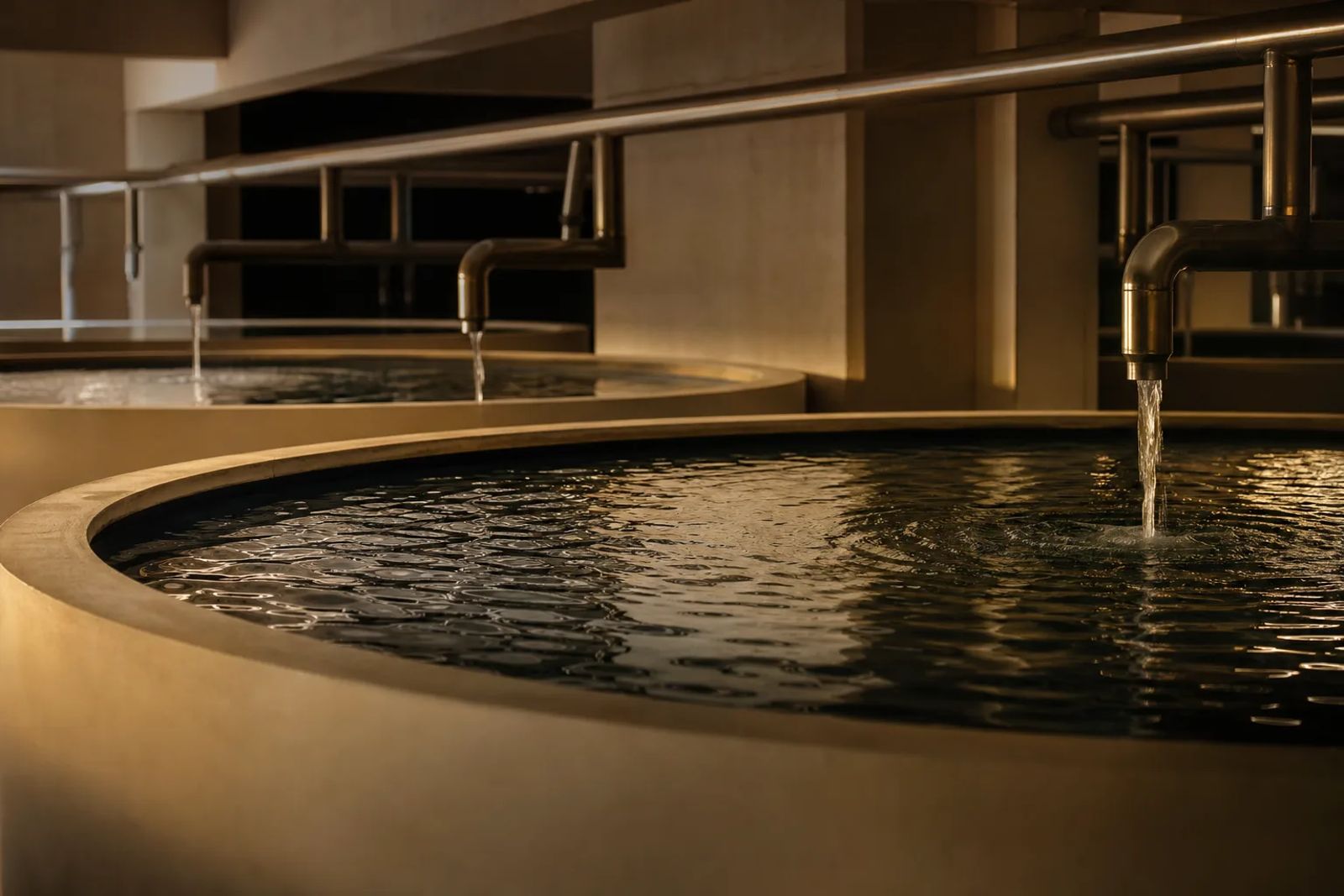
Abu Dhabi has a documented history of producing caviar and sturgeon meat. The harder question is what is being harvested today. Historical project material describes Siberian sturgeon in an indoor recirculating system; CITES lists UAE businesses including Emirates Aqua Technologies and Pristine Fish Farm. The historical and registration records tell different parts of the story.
UAE fact box
- Species farmed: Siberian sturgeon (Acipenser baerii), reported in historical project promotional material 4.
- Farming region: Both named UAE operations have Mussafah addresses in the CITES register.
- CITES operations: As of November 2026, CITES lists seven UAE entries, all for processing or repackaging. None of the published codes has a P or R suffix.
- Import and export regime: Federal Law No. 11 of 2002 and MOCCAE CITES certification, with separate food controls.
- PGI or PDO: Not publicly documented.
- Wild stocks: Native sturgeon occurrence has not been independently verified; no wild-stock claim is made.
- Role: Historical roe production, alongside processing and trading businesses registered with CITES.
A caviar plant can handle imported roe without keeping a single live sturgeon. That distinction runs through the profiles in caviar producing countries: farms, processing plants and trading businesses have different roles, even when their names suggest otherwise.
Saudi Arabia fact box
- CITES operations: Caviar Court displays registration code SA-01 on its website, a company statement.
- Import and export regime: Wildlife trade falls under the Environmental Law and its Executive Regulation for Trade in Wildlife Species, Their Products and Derivatives; food controls apply separately.
- PGI or PDO: Not publicly documented.
- Wild stocks: Native sturgeon occurrence has not been independently verified; no wild-stock claim is made.
- Role: Caviar Court Food Processing identifies itself as a Saudi caviar business.
Saudi Arabia's Ministry of Environment, Water and Agriculture, MEWA, promotes aquaculture development. For an individual sturgeon farm, however, a current licence and recent harvest need their own documentation. National policy supplies the context, not those records.
Sturgeon farming in the UAE: the historical record
The opening date depends on the record consulted. The UAE government's Green Economy Report 2014 records the opening of Emirates AquaTech's Abu Dhabi farm in November 2013 and describes caviar and sturgeon meat production. Its capacity figure is a maximum, rather than an audited annual harvest, and therefore establishes neither historical output nor present production.
The National reported an opening in 2011. The government report's November 2013 date supports a public launch, while leaving the dates of construction, stocking and first commercial harvest unresolved.
Promotional material from the 2013 SIAL exhibition adds a picture of the historical project: Siberian sturgeon and an indoor recirculating system. It is historical project evidence, not a verified description of today's stock or equipment. For the technology behind that approach, see recirculating aquaculture systems.
Read the registration, then check the farm
The retrieved UAE CITES register names Emirates Aqua Technologies Caviar Factory LLC and Pristine Fish Farm, both at Mussafah addresses. Pristine's entry records a registration date of 3 June 2022. Despite the word “Farm”, the entry alone does not establish that live sturgeon are being raised there.
In Saudi Arabia, Caviar Court Food Processing's website displays registration code SA-01 and news items dated 2014 and 2018. The company's registration statement does not independently confirm farming or harvest.
| Operation | Country | Documented position | Evidence | Checked |
|---|---|---|---|---|
| Emirates AquaTech | UAE | Historical production; present harvest unverified | Government report, 2014 | November 2026 |
| Pristine Fish Farm | UAE | Registered; farming unverified | CITES register | November 2026 |
| Caviar Court Food Processing | Saudi Arabia | Company claim; current farm status unverified | Company website | November 2026 |
Start with how to check a caviar producer on the CITES register. Read the registered activity, not just the trading name. Then ask the relevant national authority and the operator for evidence of what the business actually does today.
From food security policy to harvest records
The UAE's National Food Security Strategy 2051 supports technology-led local production, diversified import sources and international partnerships. MEWA presents Saudi aquaculture as supporting food security, the national economy and private investment under Vision 2030. These are government objectives; assessing the named caviar projects requires operational records.
Ask for four things: a current aquaculture licence, a stock inventory, dated harvest records, and independently verifiable dispatch or inspection documents. They answer four distinct questions. Is farming authorised? Are fish present? Has roe been collected? Has product been released?
Water, cooling and continuous power
For a Gulf project, examine cooling alongside pumping, oxygen supply, filtration and standby power: recirculating aquaculture depends on treating and reusing water instead of passing the whole supply through once. FAO guidance identifies supplementary water, effluent disposal, water temperature and reliable electricity as design requirements. Reuse reduces replacement demand; water intake and waste management remain essential.
Request the actual source of replacement water, seasonal temperature records, energy metering and the discharge route. Do not assume that an indoor building resolves the environmental questions.
The environmental footprint of caviar farms explains why water reuse and environmental performance are different measures.
Trading is not farming
The UAE has a documented historical caviar trading role. A UAE CITES authority presentation to the Standing Committee describes imports, repacking and re-exporting, with permit-based import data for 2004 and 2005. Those records establish historical activity, rather than a current global-hub ranking or contemporary re-export volume.
The CITES Trade Database contains trade records reported by Parties. Saudi Arabia's SFDA also lists an Italian establishment authorised for sturgeon roe. That is an import approval, distinct from a shipment record or evidence of Saudi-grown eggs. For dining and retail culture, see caviar in Dubai and the Gulf.
Authorities and destination market access
CITES paperwork and food clearance are separate tasks. In the UAE, MOCCAE issues distinct import, export and re-export CITES certificates under the federal framework. Its published guidance distinguishes UAE-bred specimens from previously imported ones. Food clearance requires a separate enquiry, including with the competent emirate authority.
In Saudi Arabia, consult MEWA for aquaculture authorisation and SFDA for food import requirements. The National Center for Wildlife states that it handles wildlife import, export and reexport permits. Check facility permissions separately.
For EU access, one restriction is decisive. Annex IX of Implementing Regulation (EU) 2021/405, consolidated on 4 November 2026, authorises UAE fishery products only under its wild catch column. It therefore does not authorise UAE aquaculture-origin caviar. Saudi Arabia appears without that remark, although country listing alone grants neither establishment nor consignment approval.
Northern Ireland follows the relevant EU framework. Great Britain, the United States and Australia each require separate destination checks. An old report of US clearance, a CITES registration or an EU country listing cannot substitute for permission to ship into those jurisdictions.
Origin and traceability
Follow the eggs back to harvest, not merely to the place where they were repacked. For international trade, compare the CITES label with the accompanying documents and the supplier's harvest and processing records. The label supplies traceability information; independent verification of the contents requires more.
The CITES personal effects exemption covers up to 125 g per person in individually labelled containers, subject to destination rules. Check those rules before relying on the exemption.
Follow the eggs back to harvest, not merely to the place where they were repacked.
For the wider regional picture, use Middle East and Turkey, distinguishing historical projects from documented current producers. Any Gulf supply proposal needs production evidence dated to the proposed production year, not a launch announcement or an undated sales presentation.
Sources
-
UAE Ministry of Environment and Water. UAE State of Green Economy Report 2014, 2014 edition, aquaculture passage. Records the November 2013 opening and describes caviar production; the stated maximum capacity is not a measured harvest.
-
CITES Secretariat. United Arab Emirates: Register of caviar exporters, live register, checked November 2026. Its activity column combines processing and repackaging.
Read at cites.org -
The National, Jessica Hill. Day in the life: Abu Dhabi sturgeon farm manager takes care of his brood, 11 October 2014. Contemporary reporting identifying Siberian sturgeon and an opening in 2011.
Read at thenationalnews.com -
SIAL Middle East promotional announcement, reproduced by UAE Today. Emirati Caviar On The Menu At SIAL Middle East, concerning the November 2013 exhibition; publication date not displayed. Describes the historical indoor recirculating project and its stock.
Read at uaetoday.com -
Caviar Court Food Processing. Company homepage, undated, with news entries dated 18 March 2014 and 1 January 2018. Displays CITES registration code SA-01.
Read at caviarcourt.com -
UAE Government. National Food Security Strategy 2051, updated 30 December 2024. Describes technology-led production and diversification of food sources as policy objectives.
Read at u.ae -
Saudi Ministry of Environment, Water and Agriculture. Aquaculture, undated live policy page, checked November 2026. Attributes aquaculture development objectives to the ministry and Vision 2030.
Read at mewa.gov.sa -
FAO, J. Kepenyes. Chapter 15: Recirculating systems and re-use of water in aquaculture, Chapter in FAO's Inland Aquaculture Engineering, published in 1984. Defines recirculation and identifies water, effluent, temperature and power requirements.
Read at fao.org -
UAE CITES Management Authority. United Arab Emirates’ Perspective on Combating Illegal Trade in Caviar, reproduced in CITES Standing Committee information document SC54 Inf. 6. Includes permit-based import information for 2004 and 2005 and describes the federal legal framework.
Read at cites.org -
Saudi Food and Drug Authority. List of Italy approved Establishments for the Export of Aquacultural Fisheries Products to the Kingdom of Saudi Arabia, dated 22 May 2024. Lists an approval for sturgeon roe.
Read at sfda.gov.sa -
UAE Ministry of Climate Change and Environment. Ministry of Climate Change and Environment Launches Electronic CITES Certificates, 2 February 2021. Explains the distinction between import, export and reexport certificates.
-
European Commission. Commission Implementing Regulation (EU) 2021/405, consolidated text of 4 November 2026, Annex IX. The UAE is authorised only for wild catch; Saudi Arabia also has aquaculture authorisations.
Read at eur-lex.europa.eu -
Swedish Food Agency. Guide: finding an authorised country and establishment for import to the EU, undated live guidance, checked November 2026. Explains product-specific country restrictions and separate establishment checks.
Read at livsmedelsverket.se
Last checked: November 2026