
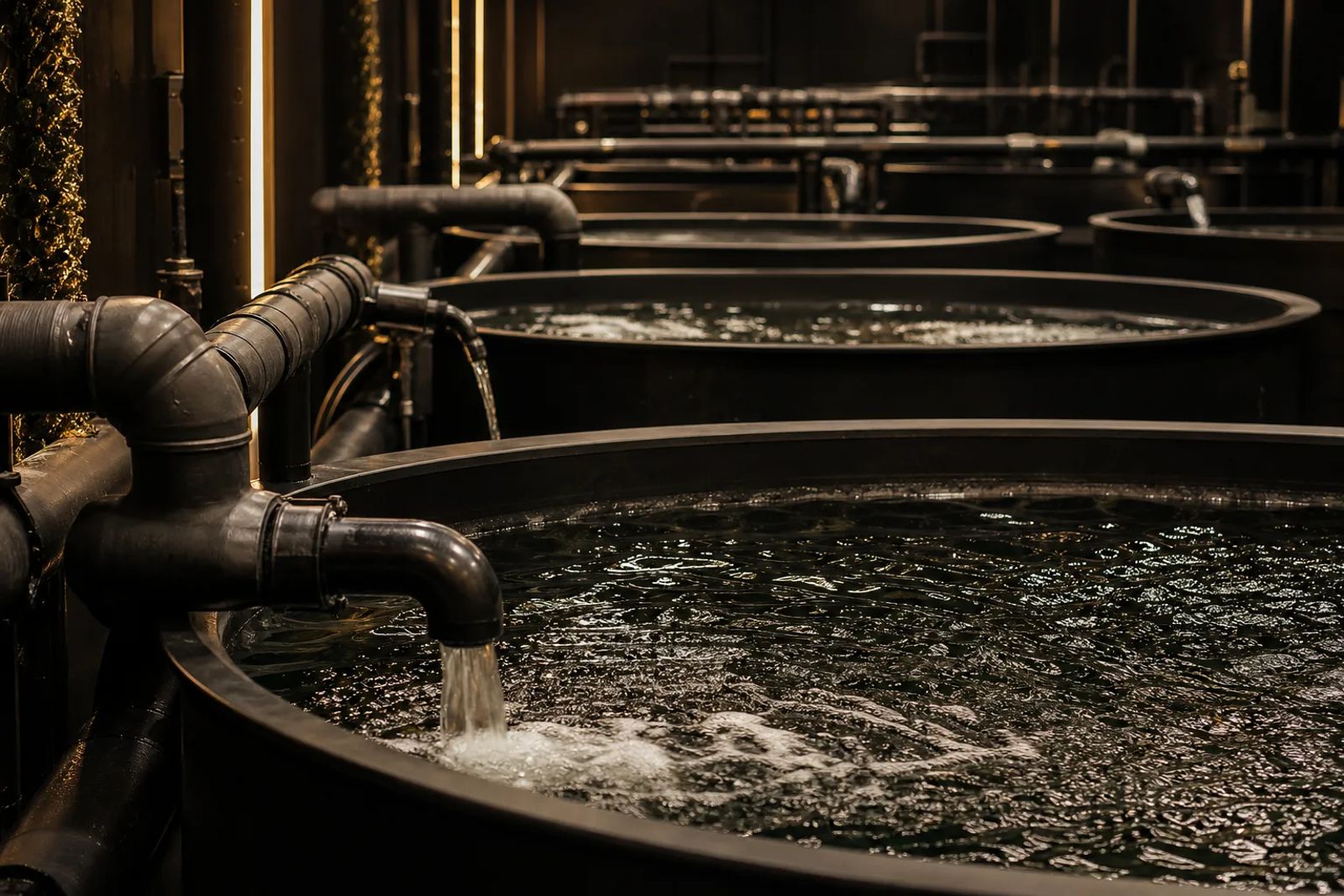
By March, half the white sturgeon females kept in ambient water in one experiment had regressed ovaries. Moving females with intact follicles into cold water supported normal egg development in most fish. Temperature management can protect a developing harvest, but timing matters as much as the thermometer reading.
Farms use water temperature to regulate growth, protect developing eggs and guide suitable groups of females through a controlled seasonal cycle. Light can also influence ovarian development, although the evidence is more limited and supports no single lighting programme for every sturgeon. Scheduling groups separately may spread harvests; availability throughout the year can also reflect processing and storage.
Warmer water can speed growth without bringing eggs closer to harvest
A faster-growing sturgeon is not necessarily a sturgeon approaching reproductive readiness. In sturgeon farming, body growth and earlier puberty are related but distinct outcomes. Puberty is the first reproductive maturation; vitellogenesis is the accumulation of yolk in developing eggs during reproductive cycles.
FAO's Siberian sturgeon profile links earlier puberty on farms to more favourable rearing conditions than those in cold native rivers. It does not isolate temperature as the switch. The whole rearing environment matters when interpreting that comparison.
A 2025 sterlet experiment illustrates the difference between growth evidence and maturation evidence. Researchers compared an ambient treatment around 18 °C (64 °F) with treatments reaching 21 °C (70 °F) and 27 °C (81 °F). Short exposure to the warmest treatment improved subsequent larval growth. The fish were not followed through puberty or caviar harvest, so those experimental temperatures offer no adult maturation recommendation.
Cultured white sturgeon also show why a farm cannot run by age alone: females entered puberty and yolk accumulation asynchronously. A cohort, a group defined by age or production history, contains different biological clocks.For managing a harvest, establish the developmental stage of each female.
Why a seasonal cold period can matter
Cold holding can preserve the opportunity for normal egg development. The clearest experimental evidence comes from Webb and colleagues' work with gravid white sturgeon previously raised at 16 to 20 °C (61 to 68 °F).
The researchers compared transfer to cold water in autumn with continued exposure to ambient conditions until spring. Cold holding was at 12 ± 1 °C (about 54 °F). Samples of ovarian follicles and blood tracked egg development and reproductive hormones.
The March regression finding was striking. Yet females with intact follicles benefited from transfer to cold water in either autumn or early spring, with normal development continuing in most fish. The authors concluded that cooling extended the period of maturation competence without overriding the females' internal reproductive rhythms. The study supports stage-dependent cold holding, not indefinite preservation of ripe eggs.
Other species have different protocols. FAO's hatchery manual describes cold holding of spring-running Russian sturgeon at 4 to 5 °C (39 to 41 °F) for extended prespawning management. For specified seasonal forms of stellate sturgeon, it gives 6 to 8 °C (43 to 46 °F). These broodstock protocols depend on migration form and holding duration; they are not universal caviar settings. For Siberian sturgeon, FAO describes vernalisation, a cold-conditioning period, without prescribing one temperature and duration for every stock.
Spawning readiness is not the caviar endpoint
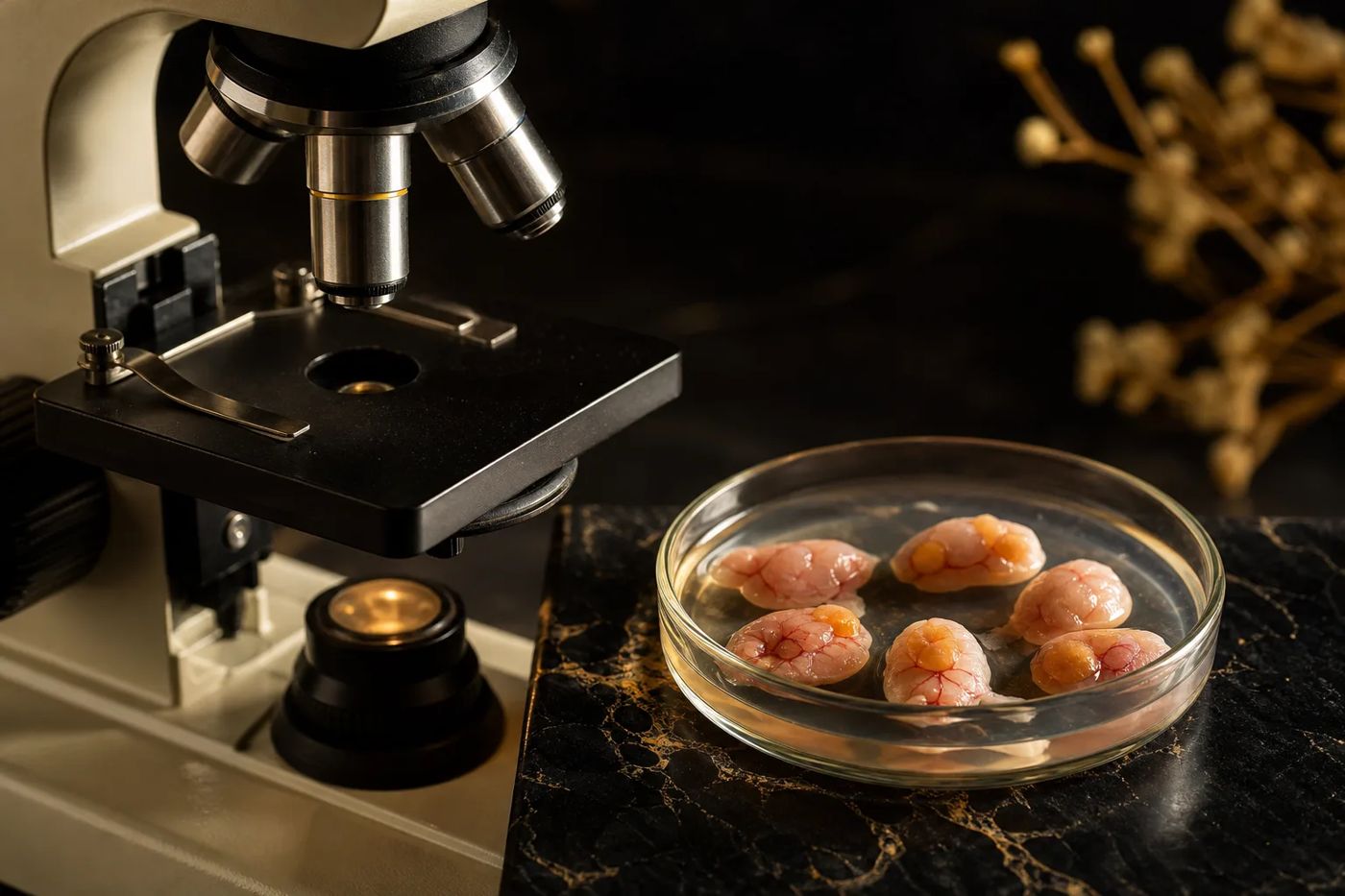
Conventional caviar production collects eggs before ovulation, their release from the ovarian follicles. Hatcheries seeking fertilisable eggs have a different endpoint, and much of the temperature evidence comes from that work. A regime that improves response to spawning hormones does not, by itself, establish the best conditions for caviar texture or harvest yield.
As spawning readiness approaches, the egg nucleus moves towards the egg's outer edge. University of Florida guidance explains that temperature strongly influences the rate of this movement. Environmental records therefore belong beside an ovarian assessment, never in its place.
Temperature control creates a useful window. Examination establishes whether an individual fish is ready within it. The guide to checking egg ripeness explains that decision.
What light can, and cannot, do for developing eggs
Supplementary light has increased egg growth in adult female Russian sturgeon. A 2025 study provides direct evidence in a field where older sturgeon literature often described a plausible but experimentally unresolved reproductive role.
Photoperiod is the daily pattern of light and darkness. Over 145 days in a flow-through system, researchers compared natural light with supplementary lighting that provided either eighteen hours of light and six of darkness, or continuous light.
The treatments increased average egg diameter and reduced variation in ovarian development. They did not significantly change indices of nuclear position and relative ovarian mass, egg production rate or caviar quality grade. Light therefore has a potential management role in that setting, but the study establishes neither a replacement for cold conditioning nor a preference for continuous illumination.
For a farm trial, record the light that actually reaches the fish: duration, intensity, spectrum and interruptions to darkness. Keep temperature and husbandry comparable between groups. Judge success by ovarian development and harvest outcomes, not growth alone. These steps make a trial interpretable; they are experimental design recommendations, not an established lighting programme.
Evidence at a glance
Each finding belongs to a particular experiment or management context. Read them separately, rather than combining them into one operating schedule for every species, age and farm system.
| Factor | Effect on maturation | Species studied | Source |
|---|---|---|---|
| Earlier cold holding | Maintained ovarian development in most transferred females | White sturgeon | Webb et al., 2001 |
| Supplementary lighting | Increased egg growth; no demonstrated quality-grade improvement | Russian sturgeon | Cai et al., 2025 |
| Warm larval treatment | Improved growth; adult reproductive effects untested | Sterlet | Sterlet study, 2025 |
| Indoor RAS conditions | Gonadal abnormalities observed; individual environmental causes unresolved | Russian sturgeon | Rzepkowska et al., 2020 |
How farms shift and spread harvests
Controlling the water is only half the task. Farms must also select females ready to respond. FAO's Siberian sturgeon profile documents temperature management extending egg availability from December to May. It also makes clear that females within one cohort do not mature together. This is an extended breeding window, rather than evidence of a continuous twelve-month harvest.
Natural-water farms work within the seasonal temperatures of their supply. Heated water can support growth when that supply would otherwise be cold. Chilled holding lets selected females experience a different regime from the growing stock. FAO's hatchery manual describes controlled cooling and warming, with gradual transitions instead of abrupt transfers between temperature extremes.
As spawning readiness approaches, the egg nucleus moves towards the egg's outer edge.
Recirculating aquaculture systems treat and reuse water, allowing operators to separate the thermal programme from outdoor seasons. That control is a capability, not evidence that constant warmth is reproductively suitable. The important distinction is between growing groups and conditioning groups, rather than the label on the whole farm. The guide to recirculating aquaculture systems explains the infrastructure.
Feed manufacturer Alltech Coppens describes artificial wintering followed by spring conditions in its commercial sturgeon guidance. It also presents RAS as a means of supplying caviar throughout the year. This industry account describes an approach, rather than a comparative trial establishing a universal maturation timetable or continuous harvest under a defined regime. Staggering groups may help spread harvests, but the account does not independently establish that outcome throughout the year.
A harvest calendar is also different from the availability of processed caviar. A product's availability should not be read as a record of when its eggs were collected. For the wider seasonal picture, see wild runs and year-round farming.
When the regime is wrong
Prolonged warm holding with continued feeding can produce excessive fat deposition and delay final maturation, FAO warns. Poorly matched conditions can also mean delayed development, ovarian regression or the loss of an intended harvest window. Adjusting the thermostat alone misses part of the problem: nutritional status and developmental stage need to be assessed together.
Atresia is the breakdown and resorption of ovarian follicles. Histological examination of Russian sturgeon reared in an indoor RAS documented it alongside other abnormalities and substantial ovarian fat deposition. The study did not compare controlled thermal or lighting treatments, so it cannot assign either factor as the sole cause or support a judgement against RAS as a production system.
When a maturation target is missed, follow the fish's history rather than the calendar. Review developmental assessments, temperature records and feeding history, together with water quality and handling events. Compare affected and unaffected females before changing the programme for the whole stock. The explanation of oocyte stages and atresia covers the underlying tissue changes.
What a useful farm record should show
For professional interpretation, ask for the species and stock, developmental stage at entry to conditioning, actual temperature records, lighting programme and method used to establish harvest readiness. Record outcomes by group, including females that failed to progress, not just those harvested. These evidence-quality recommendations help distinguish an environmental treatment from a claim built only around successes.
A producer's statement that it uses seasonal control provides context. Measuring claimed gains in maturation speed or harvest reliability, and establishing a transferable protocol, requires documented conditions and outcomes.
Sources
-
FAO. Chebanov, M. S. and Galich, E. V., Sturgeon Hatchery Manual. FAO Fisheries and Aquaculture Technical Paper No. 558, 2013. Sections on overwintering, controlled reproductive holding and domesticated broodstock management. Full manual.
-
FAO. Cultured Aquatic Species Information Programme: Acipenser baerii. Archived profile, publication date not displayed in the retrieved edition. Sections “Biological features”, “Broodstock” and “Ongrowing techniques”. Archived profile.
-
Scientific Reports, Springer Nature. Developmental responses of sterlet (Acipenser ruthenus) to temperature modulation with insights into intestinal and morphological traits. Published article, 2025. Full article.
-
Environmental Biology of Fishes, Springer. Doroshov, S. I., Moberg, G. P. and Van Eenennaam, J. P., Observations on the reproductive cycle of cultured white sturgeon, Acipenser transmontanus. Volume 48, pages 265 to 278, 1997. Abstract retrieved through Ghent University. University-hosted abstract.
-
Aquaculture, Elsevier. Webb, M. A. H. et al., Effects of thermal regime on ovarian maturation and plasma sex steroids in farmed white sturgeon, Acipenser transmontanus. Volume 201, pages 137 to 151, 2001. Publisher abstract retrieved. Article record.
-
University of Florida IFAS Extension. Sturgeon Aquaculture: Specialized Techniques: Determining the Stage of Sexual Maturity in Female Sturgeon for Artificial Spawning: The Egg Polarization Index or PI. Publication FA153, reviewed August 2025. Extension publication.
-
Aquaculture, Elsevier. Cai, H. et al., Effects of nighttime LED supplementary lighting on growth, ovarian development and serum hormone levels of Acipenser gueldenstaedtii in flow-through system. Volume 596, article 741757, 2025. Publisher abstract retrieved. Article record.
-
Animals, MDPI. Rzepkowska, M. et al., Histological Evaluation of Gonad Impairments in Russian Sturgeon (Acipenser gueldenstaedtii) Reared in Recirculating Aquatic System (RAS). Volume 10, article 1439, 2020. Published article.
-
Alltech Coppens. Sturgeon Species Tool. Commercial technical booklet, September 2022 edition. “Harvest” section. Technical booklet.
This piece was researched by comparing experimental studies, university guidance, FAO technical publications and an explicitly attributed commercial account, separating reproductive findings from growth results and operational inference.
Last checked: November 2026