
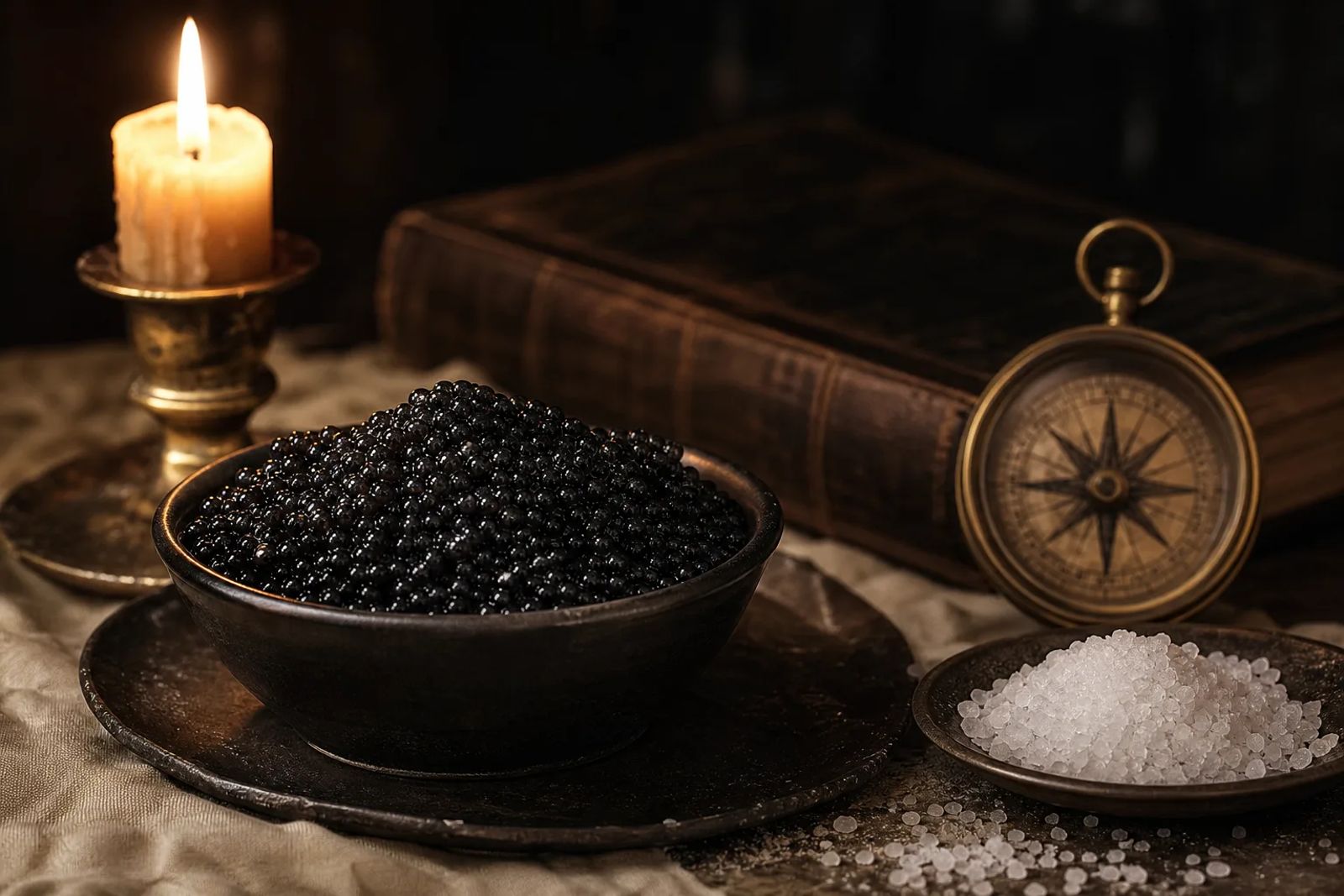
In the seventeenth century, the traveller Adam Olearius described boats heavily laden with salt, caviar and salted fish moving upstream from the Caspian fisheries. Caviar was cargo: a perishable food sustained by preservation and river transport.
Its story reaches further back, to people catching sturgeon and eating fish eggs, long before salted roe became an international trade. Black Sea and Caspian commerce, imperial and state fisheries, and finally aquaculture, the farming of aquatic animals, shaped the food familiar today. The history of caviar collection explores the individual eras.
Before caviar, there were fishing communities
Caviar's earliest roots lie far from royal tables. At the Iron Gates of the Danube, archaeologists have identified sturgeon remains in prehistoric settlements, including Mesolithic contexts. The bones establish that people caught and used these fish. Whether they ate, salted or traded the eggs remains unknown.
Direct evidence of roe eating comes from another fish entirely. In a 2018 study, researchers analysed proteins in food crusts on pottery from Friesack 4 in Germany and identified carp roe in a vessel about 6,000 years old. Here was a cooked roe meal preserved in the archaeological record. Salted sturgeon caviar belongs to a different chapter, despite headlines that carry its history back into the Stone Age.
Persia, Greece and Rome: prized fish, elusive roe
Pliny the Elder's Natural History records a striking reversal of taste: the fish called acipenser, once considered the noblest of fishes, had fallen out of favour. Classical Greece and Rome clearly belong to the history of sturgeon as food. The esteem Pliny describes, however, does not establish whether its roe was prepared as caviar is today.
Ancient Persia has acquired a more elaborate caviar legend. Stories credit Persians with inventing it or eating it as a strengthening medicine. These circulate widely, including in later institutional accounts, but the sources cited identify no ancient record behind them. The Persian linguistic connections explored in where the word comes from concern the name, rather than establishing who first salted the eggs.
Byzantium and the merchants of the Black Sea
A thirteenth-century fresco near Arta identifies caviar sellers. It is a vivid glimpse of a medieval food trade that was already recognisably commercial. David Jacoby's study of Byzantine trade draws on travellers, frescoes, merchants' accounts and notarial records to trace caviar through Constantinople and the Black Sea. Later accounts record consignments moving through trading networks.
Genoese and Venetian merchants linked fisheries around the Sea of Azov and the Don with Mediterranean consumers. Caviar travelled in barrels. Records of damaged containers expose the trade's practical vulnerability: water or poor packing could ruin a consignment. Western Europe did not suddenly discover this delicacy centuries later. Merchants were already organising its passage across considerable distances.
Reported landings reached a record in 1890; by 1901, catches were less than a tenth of that peak.
Ottoman expansion reshaped those routes. From the later 1500s, after losing its Black Sea colonies, Venice invested in Muscovy caviar carried on Flemish ships. The appetite endured; political control changed how it was supplied.
The Volga, Astrakhan and the tsars
Astrakhan gave Russia's Caspian fisheries a powerful commercial centre. Close to the Volga delta, it joined abundant fishing grounds to the great river route into Russia. Olearius's seventeenth-century account captures the scale of that traffic: caviar formed part of a substantial transport economy.
Under the tsars, caviar served both commerce and the court's food culture. Later accounts associate imperial tables particularly with sterlet roe. Yet royal taste is only one strand of the story. Behind the court stood the people who caught, processed and ate sturgeon, and a system built around fisheries, preservation and trading privileges.
Persian fisheries and an international nineteenth century
The Caspian's shared waters bound Persian and Russian fisheries together. Persian fisheries developed through concessions and foreign involvement, particularly Russian influence. Commercial agreements and competing state interests shaped the later Iranian industry, rather than leaving it as an isolated tradition. Russian and Iranian caviar history follows those connections.
Nineteenth-century improvements in transport brought distant European consumers within easier reach. The supply stretched well beyond the Caspian. Sturgeon also lived in European and North American rivers, and their roe could enter the same international market. The trade's geography was wider than caviar's familiar Russian association.
The United States shows how quickly abundance could unravel. A major Atlantic sturgeon fishery expanded after a caviar market developed around 1870. Reported landings reached a record in 1890; by 1901, catches were less than a tenth of that peak. These figures measure fish, rather than caviar tonnage. They chart rapid depletion, not a harmless interlude of plenty.
Paris, Soviet power and Iranian nationalisation
Paris helped shape the modern caviar trade in the 1920s, with Petrossian dating its original Paris shop to 1920. That company history marks the building of a specialist business around an established food, rather than caviar's introduction to Europe, where medieval records already document its trade.
After the Russian Revolution, Soviet state control brought production and exports into a new system. Caviar earned foreign currency while fisheries were managed through restrictions, monitoring and hatchery stocking, with young fish released to support wild populations. These hatcheries served a different purpose from farms raising females to produce roe. The Soviet state monopoly examines the system in detail.
Iran followed a different institutional path: when the joint Soviet and Iranian fisheries concession expired on 31 January 1953, the fisheries passed into Iranian control. Nationalisation and the creation of an Iranian state fisheries company made caviar an instrument of national economic policy, extending its significance well beyond associations with the shah's table.
Hospitality gave caviar another international stage. Accounts of journeys to the Soviet Union record it at dinners, while surviving Cold War reception menus place it before visiting political leaders. Exports carried it abroad; carefully chosen food offered to foreign guests reinforced its identity through diplomacy.
The Soviet collapse and the CITES turning point
The Soviet Union's dissolution in 1991 disrupted central control of the northern Caspian fisheries. Illegal fishing and trade expanded as enforcement faltered. Sturgeon populations, already under pressure from fishing, dams and damaged habitat, faced an accelerating crisis.
CITES, the Convention on International Trade in Endangered Species of Wild Fauna and Flora, became a decisive part of the response. A listing proposal adopted at CoP10 in 1997 took effect on 1 April 1998, bringing the remaining sturgeons and paddlefish into Appendix II. Some species were already listed. The 1998 change completed their coverage.
Coordinated catch and export quotas, trade restrictions and a universal caviar labelling system followed. Labels supply traceability information rather than certifying the contents. These measures governed international trade; they did not impose a single worldwide ban on eating caviar.
From wild fisheries to farms
Aquaculture changed caviar's relationship with the rivers that had supplied it. EUMOFA's 2021 market study identifies 1984 as the first year of sturgeon aquaculture harvest recorded in FAO statistics. Experimental successes may have come earlier. Production rose sharply from the early 2000s, following years of work on breeding, rearing and keeping fish until their eggs matured.
The map changed with the methods. Documented farming countries include China, Italy and the United States, establishing production centres beyond the traditional Caspian fisheries. Raising sturgeon for meat and keeping females for roe are distinct undertakings. Both form part of the move from wild to farmed.
The scale of that transformation is clear in the production studies. EUMOFA's 2021 report described nearly all market caviar as farmed and estimated world caviar output at 380 tonnes for 2018. Its February 2023 study identified China as the leading caviar producer. These are dated findings, rather than a 2026 production total, and they describe an international farm industry, not a restored wild Caspian fishery. Farming has changed where caviar comes from, while the recovery of wild sturgeon remains a separate conservation task.
Five turning points
These dates trace shifts in trade and control, rather than the invention of caviar. | Date | What changed | |---|---| | 1890 | Reported United States Atlantic sturgeon landings reached their historic peak. | | 1920 | Petrossian dates its original Paris shop to this year. | | 1953 | The Soviet and Iranian fisheries concession ended. | | 1991 | The Soviet Union dissolved. | | 1 April 1998 | CITES coverage extended to all remaining unlisted sturgeons and paddlefish. |
Sources
-
University of Edinburgh repository. Sturgeon fishing along the Middle and Lower Danube, in The Iron Gates in Prehistory, 2008, archived chapter. PDF.
-
PLOS ONE. Fine Endmesolithic fish caviar meal discovered by proteomics in foodcrusts from archaeological site Friesack 4 (Brandenburg, Germany), 2018, article e0206483. Research paper.
-
WWF. Saving Sturgeons, full report, 2016, section “Sturgeons in culture and history”. Report.
-
Pliny the Elder. The Natural History of Pliny, Volume II, Bostock and Riley translation, nineteenth-century edition, Book IX, chapter 27. Digital copy.
-
David Jacoby. Caviar Trading in Byzantium, published archival study, digital scan; published in Mare et litora in 2009, pages 349 to 364. Scan.
-
Central European University, Daria Ageeva. Thesis chapter 2.2.1, “Sturgeon”, 2022. Thesis.
-
Cambridge University Press, edited by Maureen Perrie. The Cambridge History of Russia, Volume I: From Early Rus’ to 1689, 2006, discussion of Russia's geographical environment and river transport. Edition.
-
FAO. International trade in aquatic animals and aquatic animal products, FAO Fisheries Circular 990, 2004, chapter “Sturgeons (Acipenseriformes)”. Chapter.
-
Encyclopaedia Iranica. Fisheries, 1999, online edition. Article.
-
NOAA National Marine Fisheries Service. Proposed Listing Determinations for Three Distinct Population Segments of Atlantic Sturgeon in the Northeast Region, Federal Register, 6 October 2010, historical fisheries discussion. Document.
-
Petrossian. Boutique caviar Paris Rive Gauche, undated company account, checked November 2026. Company history.
-
US Fish and Wildlife Service. Federal Register, Volume 67, Number 147, 31 July 2002, beluga sturgeon proposed rule, historical fisheries discussion on page 49659. Document.
-
US Fish and Wildlife Service. Commercial Fisheries Review, Volume 16, Number 10, October 1954, “Iran”, preserved in NOAA's archive. Contemporary report.
-
CIA Reading Room. Travel account dated 22 October 1965, declassified record CIA-RDP67B00446R000500080005-4. Archival document.
-
New East Digital Archive. Power dining: what did the world’s Cold War leaders get for dinner at the Kremlin?, 2015, reproductions of reception menus. Documentary feature.
-
CITES Secretariat. A brief history of sturgeons and CITES, archived 2011 copy preserved in the US federal regulatory record. Archived official account.
-
European Commission, EUMOFA. The Caviar Market: Production, Trade and Consumption in and outside the EU, 2021 edition. Report.
-
European Commission, EUMOFA. Sturgeon Meat and Other By-products of Caviar: Production, Trade and Consumption in and outside the EU, February 2023. Report.
This piece was researched through archaeological studies, archival scholarship, contemporary records and official fisheries and trade reports, with company history explicitly attributed.
Last checked: November 2026