
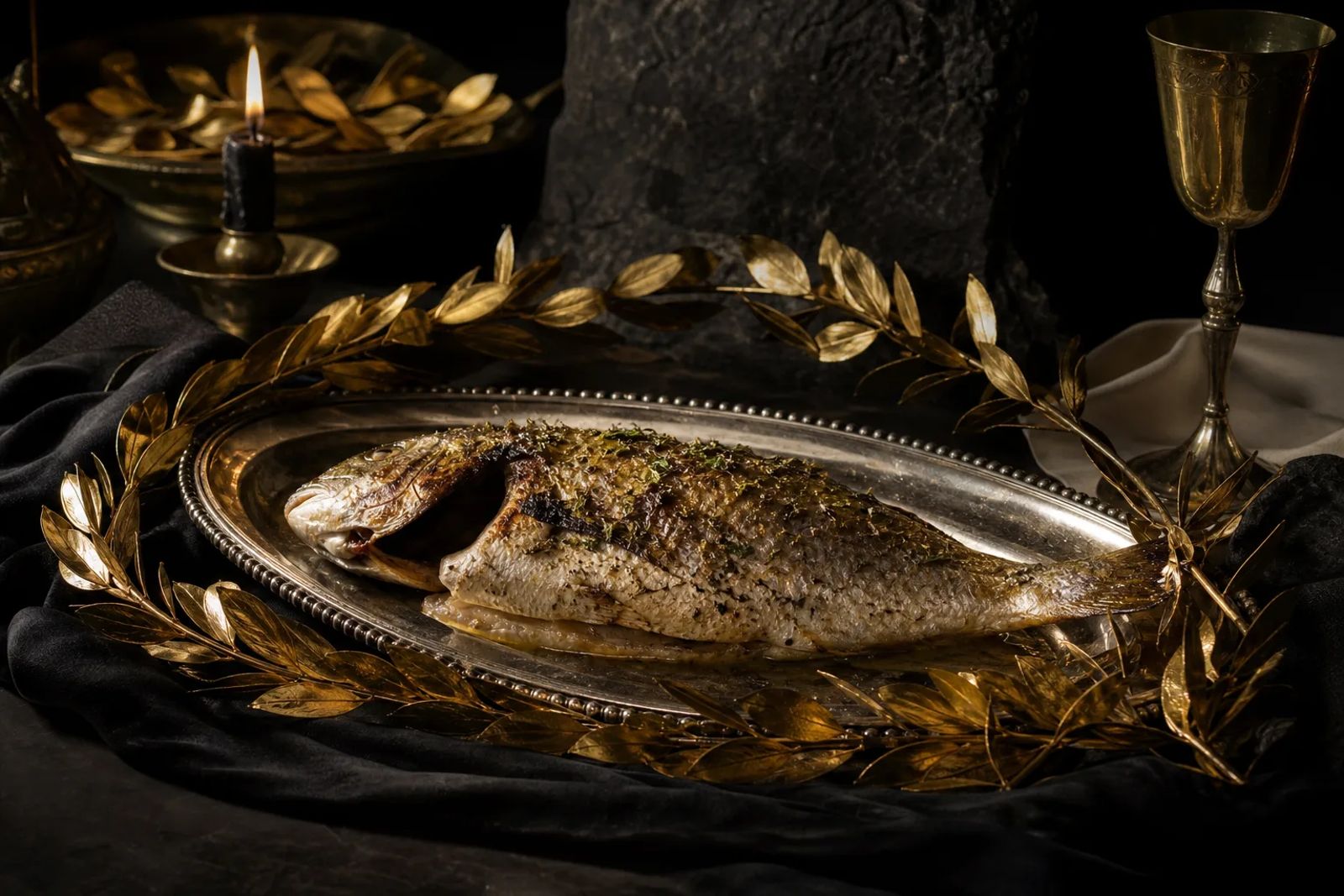
Garlanded attendants, a flute player, an emperor's dinner: in Macrobius's Saturnalia, a fish arrives with the ceremony of a guest of honour. It is a memorable entrance. Macrobius describes the fish, not a dish identified as salted roe.
Sturgeon were known, eaten and sometimes highly prized in the ancient Mediterranean and Black Sea world. Salted sturgeon roe, prepared as a distinct food, leaves a much fainter trail. The ancient sources cited here do not support the familiar claim that Persians invented caviar or took it as medicine.
What counts as evidence of ancient caviar?
The decisive question is simple: what was on the plate? Eating sturgeon flesh, eating roe, meaning fish eggs, and preparing salted sturgeon roe separately require distinct kinds of evidence. An account of eating the fish does not establish that its eggs were eaten or separately salted.
Keep that distinction in view and familiar stories change shape. Music accompanying a fish into a dining room tells us about ceremonial service. A salting vat tells us about fish processing. Neither identifies a serving of salted eggs. The wider history of caviar follows the story beyond these ancient references.
Greek sources: fish from the Black Sea
Herodotus describes two valuable resources associated with the Borysthenes, the modern Dnieper: large fish and naturally occurring salt at the river's mouth. Writing in the fifth century BCE, he praises the river in Histories 4.53 and names its fish antakaioi. G. C. Macaulay's translation calls them “huge fish without spines”, “to be used for salting”.
The passage supports a fishery supplying preserved fish in the Scythian world. Roe, egg extraction and the separate salting of eggs never enter the description. Calling this the first written record of caviar changes the food Herodotus actually describes.
Athenaeus brings the story to the banquet table. In Deipnosophists 7.294e to 295a, he moves among Greek fish names and the Roman akkipesios, conventionally identified as sturgeon. Charles Burton Gulick's Loeb translation describes a fish carried about at Roman banquets with pipes and wreaths.
The chronology matters. Athenaeus wrote under the Roman Empire, drawing on much earlier Greek authors. John Wilkins's study explains why this passage's association with Archestratus, a fourth century BCE food poet, is disputed. The Roman dinner scene cannot simply be moved back into Archestratus's lifetime.

Roman sturgeon: prestige, then a change of taste
Even a celebrated fish could fall from favour. In Natural history 9.60, also numbered book 9, chapter 27, Pliny the Elder says the acipenser had once been especially esteemed but was no longer admired in his own day. H. Rackham's translation gives the older verdict as “the noblest of the fishes”.
Pliny also associates the fish with the name elops and describes its unusual scales. These details help explain a persistent difficulty: Latin names, their Greek equivalents and ancient zoological descriptions do not always fit neatly around modern species.
A retelling begins with a prized sturgeon, calls it a caviar fish, then shortens the description to caviar.
Macrobius supplies the grand entrance in Saturnalia 3.16.6 to 8. Quoting Sammonicus Serenus about an emperor's dinner, he describes the fish arriving with garlanded attendants and a flute player. The Latin phrase in 3.16.7, a coronatis ministris cum tibicine introferri, means “brought in by garlanded attendants with a flute player” in our translation.
The scene reaches us through a later author quoting earlier testimony, rather than a surviving menu or Macrobius's own eyewitness account. Its centrepiece is unmistakably the fish. Neither this passage nor Pliny's identifies salted roe as the dish.
Ancient Persia: following the origin story
The Persian story is alluring: roe eaten to restore strength or treat illness, sometimes linked to a supposed name meaning “cake of power”. A FAO chapter on sturgeons repeats it, so the tale circulates well beyond sellers' websites. Yet the chapter supplies no identifiable ancient passage for the medicinal claim.
What would establish such a custom? A dated text naming the preparation and its use, or archaeological evidence identifying the food itself. An institutional publication can point towards evidence, but its standing alone cannot fill that gap.
Houshang Alam's Encyclopaedia Iranica entry documents Iranian caviar and discusses a proposed Persian derivation of its name. It establishes neither an ancient medicinal origin nor a date for the recipe: a word's ancestry and a food's preparation are separate questions. The articles on the word's origins and Iranian caviar culture pursue those questions while keeping later evidence in its own period.
Archaeology: bones, vats and missing eggs
Sturgeon bones give the ancient fishery a physical presence. Arturo Morales and colleagues' peer-reviewed survey in Archaeofauna 16 (2007) gathers northern Black Sea assemblages spanning the seventh century BCE to the fourth century CE. They include sturgeon remains: identifiable skeletal material, rather than recovered bowls of salted eggs.
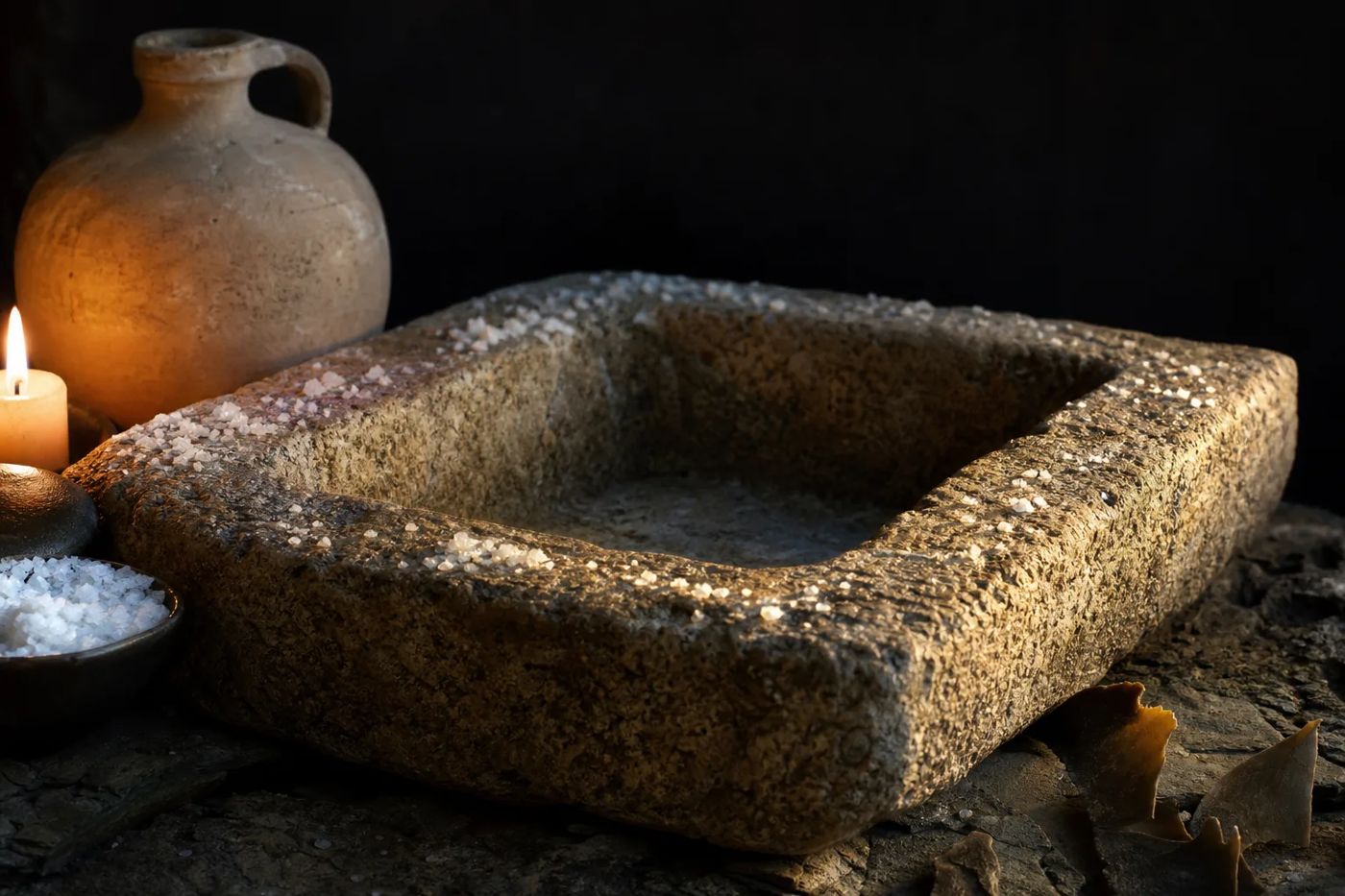
Salting vats reveal another part of the work. Jakob Munk Højte's archaeological study describes installations at Tyritake and Myrmekion, alongside fish remains and equipment. At Myrmekion, anchovy bones at the bottom of vats indicate at least the final catch. Sturgeon bones elsewhere in the area cannot identify those installations as caviar workshops.
Nor did every method of preserving fish leave a substantial building behind. Højte stresses that drying, smoking and some salting methods need not produce masonry tanks. Read the evidence in both directions: absent vats do not rule out preserved fish production; surviving vats do not, by themselves, identify a particular roe product.
Ancient fish names: read beyond the label
An ancient fish name is a clue, not a modern scientific label. David Braund's study of antakaios argues for sturgeon, perhaps specifically the starry sturgeon, drawing on literary descriptions and images on Bosporan coins. That identification rests on a particular body of evidence; it does not make every ancient large fish a named modern species.
Older translations sometimes smooth away this difficulty by supplying a familiar English fish name. Look for the distinction between what the ancient writer describes and the animal a later editor believes it to be. The English label is an interpretation worth examining.
A short timeline of the evidence
| Period | Source and passage | What it establishes |
|---|---|---|
| Fifth century BCE | Herodotus, Histories 4.53 | Large antakaioi taken for salting; no description of salted roe. |
| First century CE | Pliny, Natural history 9.60 | A changed reputation for the acipenser, described as a fish. |
| Roman imperial period | Athenaeus, Deipnosophists 7.294e to 295a | A fish served with music and decoration at Roman dinners. |
| Late antiquity | Macrobius, Saturnalia 3.16.6 to 8 | Earlier testimony quoted about ceremonial fish service at an imperial dinner. |
How ancient caviar myths take shape
The fish becomes its roe. A retelling begins with a prized sturgeon, calls it a caviar fish, then shortens the description to caviar. Music, garlands and imperial diners survive. The dish changes almost unnoticed.
Modern authority becomes ancient testimony. A later summary acquires the weight of an original source when its references go unchecked. The Persian medicinal story gains circulation through a reference publication, while its ancient source remains missing.
A place becomes a date. A region's later importance in caviar culture is projected backwards into antiquity. Neither that association nor a Persian explanation of the word dates the preparation's beginnings.
How to judge a claim about ancient roe
Start with the reference, not the anecdote. Find the author, work, book and section so that the passage can be recovered and read. Then ask three direct questions: what is the food, how is it prepared, and who identifies the fish? That last answer may be the ancient writer or a modern translator.
Finally, separate the event's date from the date of the text preserving it. Macrobius quoting an earlier writer offers useful testimony of one kind; material recovered from a securely dated archaeological deposit offers another. Read each for what it contains, and let that determine which questions it can answer.
Where to go next
- The Complete History of Caviar: follow the longer chronology beyond the classical sources.
- Caviar in the Ottoman Empire, Medieval Italy and the Caspian Trade: explore the later trading and culinary settings.
Sources
-
Lexundria. Herodotus, Histories 4.53, translated by G. C. Macaulay, 1890 edition, digital transcription. Read the passage.
-
Harvard University Press, Loeb Classical Library, reproduced by LacusCurtius. Athenaeus, The Deipnosophists, volume III, translated by Charles Burton Gulick, 1929, book 7, particularly 294e to 295a. Read the text.
-
Society for the Promotion of Hellenic Studies. John Wilkins, “Athenaeus the Navigator”, The Journal of Hellenic Studies 128, 2008, pp. 132 to 152, particularly p. 146. Read the article.
-
Harvard University Press, Loeb Classical Library, reproduced by Attalus. Pliny the Elder, Natural History, volume III, translated by H. Rackham, 1940, book 9, section 60. Read the passage.
-
LacusCurtius, University of Chicago web hosting. Macrobius, Saturnalia, Latin text, book 3, sections 16.6 to 16.8; undated digital transcription, accessed 2026. The short English rendering in this article is our translation. Read the Latin text.
-
Food and Agriculture Organization of the United Nations. “Sturgeons (Acipenseriformes)”, online chapter, particularly “From the myth to the dissolution of the Soviet Union”; undated web edition, accessed 2026. Used to document the circulation of the Persian origin story, not to establish its ancient truth. Read the chapter.
-
Encyclopaedia Iranica. Houshang Alam, “Caviar”, volume V, fascicle 1, 1990, pp. 99 to 101; updated online edition, 2013. Read the entry.
-
Archaeofauna. Arturo Morales, Ekaterina Antipina, Aluna Antipina and Eufrasia Roselló, “An ichthyoarchaeological survey of the ancient fisheries from the Northern Black Sea”, volume 16, 2007, pp. 117 to 172. Read the deposited article.
-
Aarhus University Press. Jakob Munk Højte, “The Archaeological Evidence for Fish Processing in the Black Sea Region”, in Tønnes Bekker-Nielsen, editor, Ancient Fishing and Fish Processing in the Black Sea Region, 2005, pp. 133 to 166. Read the chapter.
-
Problems of History, Philology and Culture. David Braund, “Antakaios: Aphrodite's Sturgeon?”, 2023, issue 3. Read the journal's abstract and publication record.
-
Project Gutenberg. Aristotle, History of Animals, translated by Richard Cresswell, digital edition, 2019; especially the translator's identification notes and Greek index entries for ellops. Read the edition.
This article was researched by comparing classical passages and their translations with archaeological studies, while tracing modern origin stories separately from ancient testimony.
Last checked: November 2026