
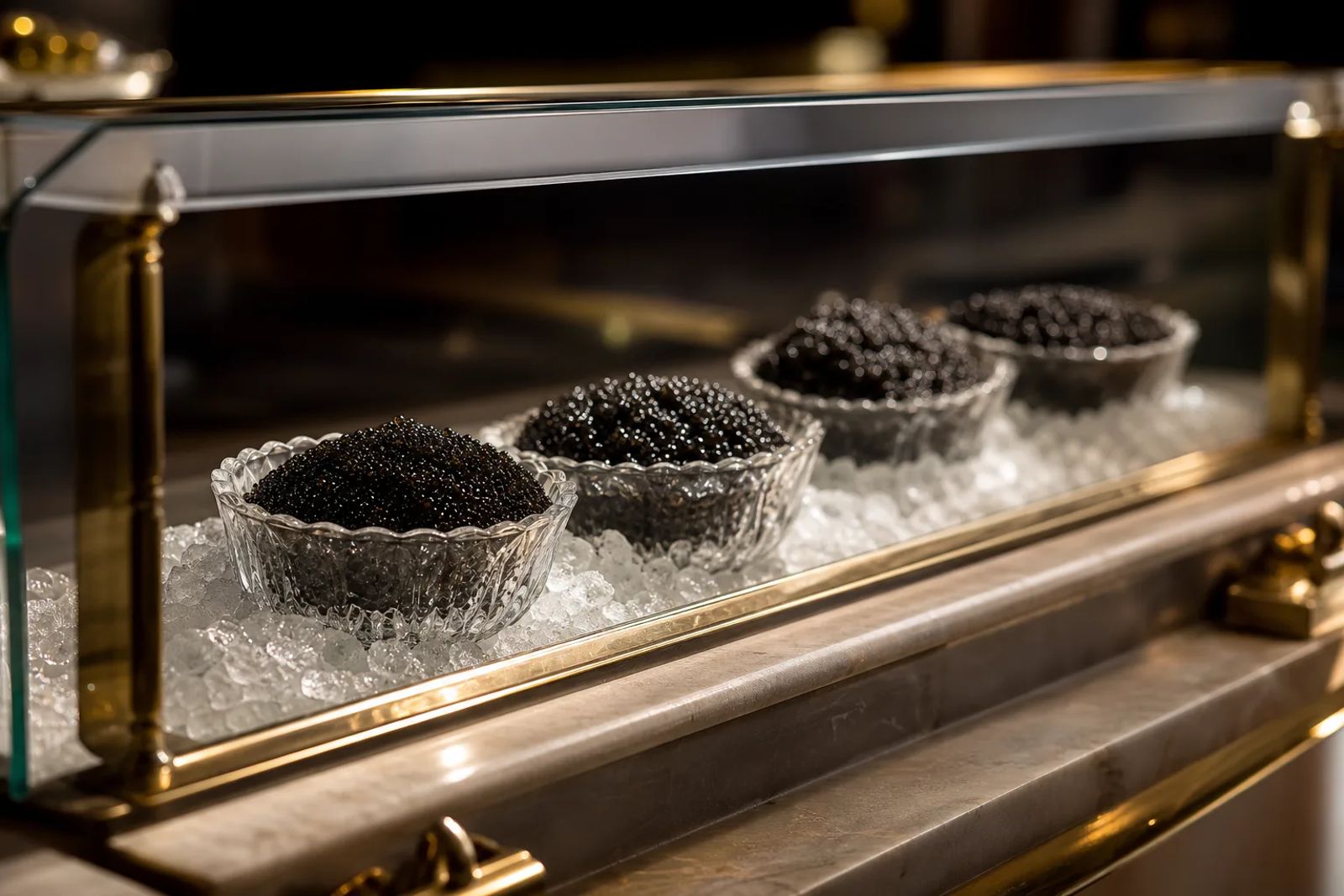
The name on a caviar lid may belong to a business that never raised the fish. It could identify the farmer, processor, repacker or retailer. The revealing details lie beyond the brand.
Whether buying from a farm, specialist house, food shop or online seller, choose one that identifies the fish and its origin, explains who packed it, and takes clear responsibility for storage and the sale.
Where to buy caviar: compare the seller types
Start with the batch, not the category of shop. Outlet type alone establishes neither trustworthiness nor quality. Packing arrangements overlap: a farm may use a separate processor, while a retailer may sell the processor's sealed container or caviar transferred into a new container by a repacker. Use these questions to establish who does what, not to rank seller types.
| Seller type | What to check | Packing to establish | Questions to ask |
|---|---|---|---|
| Farm selling direct | Farm identity, location and evidence connecting the batch to its fish. | Packed on site or by a separate processor. | Is this roe from your own fish? Who processed and packed it? |
| Caviar house or processor | Legal operator, named processing facility and batch details. | Original processing container or later repack. | Do you farm fish, process purchased roe, repack it, or combine these roles? |
| Repacker brand | Repackaging facility and the roe's original country. | New primary container filled from another container. | Where was the roe produced? Who repacked this batch? |
| Deli or fishmonger | Actual stock, full label and food business identity. | Supplier's sealed container or separately repacked stock. | May I see the full label? Is this retail stock rather than service stock? |
| Supermarket own label | Responsible business and product specification. | Retail pack under supermarket branding. | Who processed or repacked it? What are this batch's species and origin? |
| Online shop | Contracting business, contact address and details of the product being dispatched. | Original sealed or repacked retail container; another business may dispatch it. | Who holds and sends the caviar? Who handles delivery complaints? |
| Online marketplace | Individual seller, dispatching business and platform protection terms. | Third-party seller's pack; check the actual container. | Is the seller a business or private individual? Does buyer protection cover chilled food? |
| Restaurant or bar retailing | Retail operator, supplier and unopened takeaway pack. | Sealed retail container or separately prepared retail pack. | Is this a labelled retail product? What storage instructions and date apply? |
| Airport or duty-free shop | Retail operator, full label and intended border crossing. | Sealed retail container, sometimes with extra travel packaging. | Can I legally carry this quantity and species through transit and into my destination? |
No packing arrangement guarantees quality. Ask about the stock you will receive, rather than accepting a photograph or specification covering several different products.
The brand on the lid is not necessarily the farm
A repacker transfers caviar into new primary containers: the containers directly holding the roe. Its address identifies that operation, not necessarily the place where the fish were raised. A brand's nationality or headquarters tells you no more about the roe's origin.
Ask two separate questions: which country did the roe originate in, and which facility packed this container? Clear answers make the supply chain easier to follow.
For product choices, rather than seller checks, use how to buy caviar.
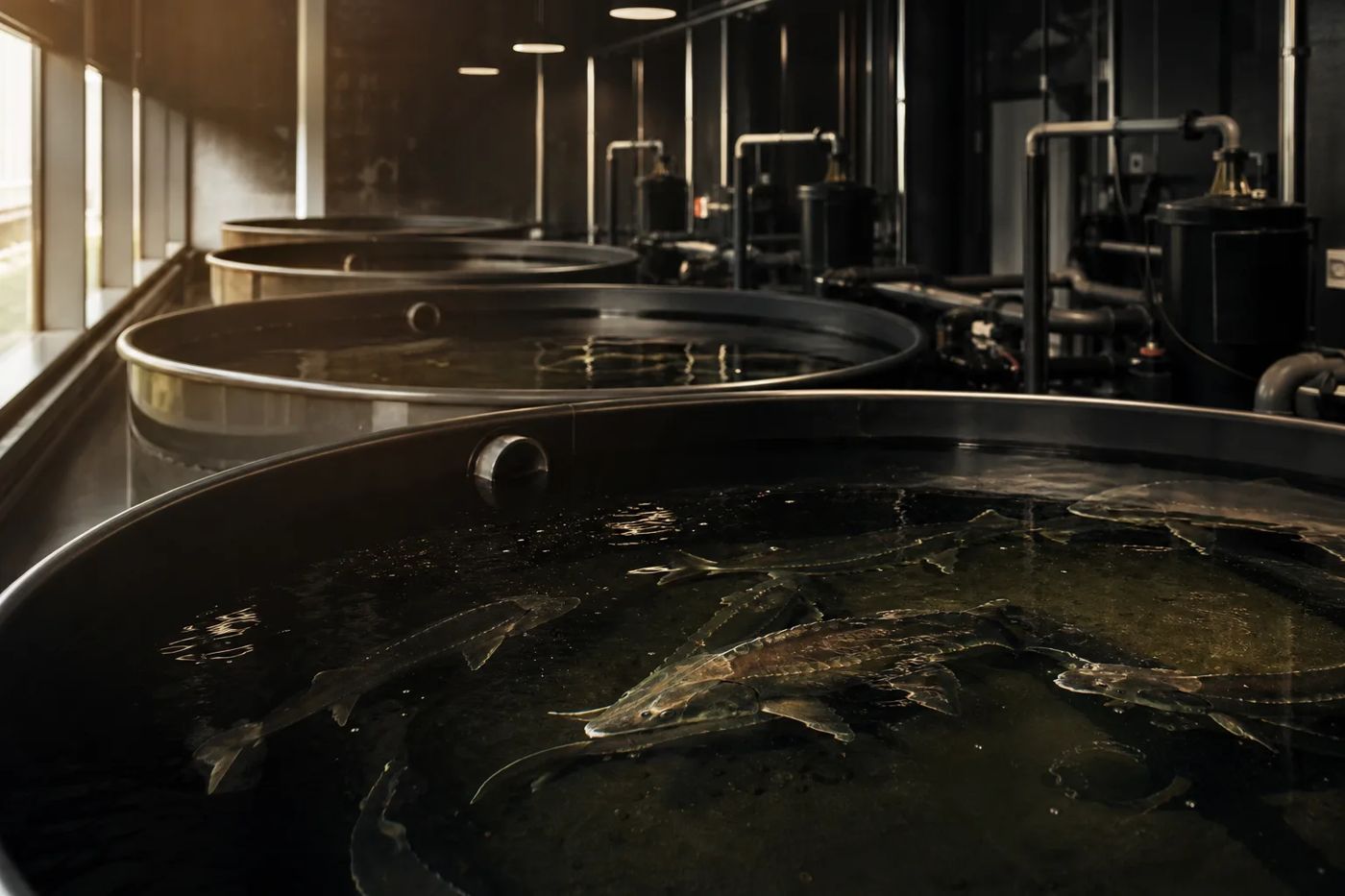
Check the business, the facility and the label
Know who is taking your order. Find the seller's legal name, physical contact address and a working way to reach someone responsible. Those details should match across the website, checkout and invoice. If the correspondence address is an office, ask where the caviar is actually held.
For caviar bearing a CITES label, identify the processing or repackaging facility through its code. CITES is the international wildlife trade convention. Its caviar register lists registered operations, not every shop or farm: a retailer's absence does not establish illegality, and farm licensing is a separate matter.
Compare the facility's legal identity and registration number, not merely a similar brand name. Registration is not a quality endorsement. A CITES label supports traceability but does not prove what is inside the container. Follow the CITES register checking method, and take discrepancies to the national CITES authority.
Duty-free is a tax arrangement, not a passport through wildlife or food import controls.
Before paying, request readable food-label details and CITES markings for the stock offered. Check species, origin, ingredients, net weight, storage instructions, date information and the responsible operator. Establish whether the container is original or repacked. A generic photograph of a lid cannot answer a question about a particular batch's provenance.
Food business registration: three different systems
Company registration and food business registration are different things. Ask which authority supervises the seller's food operation, then check the relevant public information or enquiry service.
In the EU, Article 6 of Regulation (EC) No 852/2004 requires food business operators to notify the competent authority of establishments for registration. Some activities also require approval.
Food businesses in England, Wales and Northern Ireland, including online sellers, must register locally at least 28 days before trading. FSA guidance covers England, Wales and Northern Ireland; Food Standards Scotland provides Scottish guidance.
In the US, requirements depend on the activity and location. FDA registration applies to many manufacturing, processing, packing and holding facilities, but farms, retail food establishments and restaurants have exemptions under 21 CFR 1.226. For a shop, check the applicable state or local food permit or inspection record rather than demanding an FDA registration number from every retailer.
Online shops and marketplaces: know your seller
An online shop tells you how caviar is sold, not who produced it. On a marketplace, identify the business making the sale, the business holding the stock and the business dispatching it. They may have different roles. Do not assume that the platform's name, reviews or delivery service establish a particular seller's identity or handling standards.
Read the chilled-food exclusions in any buyer protection policy before ordering. Keep the listing, seller correspondence and receipt, and ask who will resolve a damaged, delayed or incorrectly described order.
For packaging, dispatch timing and arrival checks, follow safe online ordering. A promotional photograph of insulation tells you little about the delivery you will receive.

Cancellation rights are not complaint rights
Do not assume an online caviar order comes with a 14-day change-of-mind return period. Perishable goods have specific exceptions.
In the EU, national laws implementing Directive 2011/83/EU govern consumer distance contracts. Article 16(d) excludes goods liable to deteriorate or expire rapidly from the usual withdrawal right. In the UK, the Consumer Contracts Regulations 2013, regulation 28(1)(c), contain the corresponding exception.
In the US, ordinary online purchases carry no general federal cooling-off right. The FTC's Mail, Internet, or Telephone Order Merchandise Rule, 16 CFR Part 435, instead governs shipping promises and refunds for delay or non-shipment. State law and the seller's stated policy may provide additional rights.
Cancellation rules do not give a seller permission to supply the wrong product. Ask for the complaints procedure before ordering. If the delivery differs from its description, preserve the evidence promptly.
Buying while travelling: plan the journey home
Duty-free is a tax arrangement, not a passport through wildlife or food import controls. A legal purchase at your destination may still be illegal to export or bring home.
Before visiting a farm shop, restaurant counter or airport retailer, check the rules for departure, transit and arrival. Read customs rules country by country before buying, rather than at the departure gate.
The checks below concern caviar carried by travellers, not allowances for international postal orders. For the EU, Great Britain, Northern Ireland and the US, confirm current personal import requirements in the linked customs guide before buying.
- Switzerland: official traveller guidance from the Swiss food office gives a maximum of 125 g per person without CITES permits for caviar carried by travellers. Individual allowances cannot be combined for one larger container.
- UAE: ask MOCCAE to confirm the applicable personal-baggage exemption or permit requirement. Do not assume a worldwide 125 g allowance.
- China: ask China Customs whether the particular caviar product is admissible in personal baggage before buying.
- Japan: METI's Appendix II personal-use caviar notice sets a limit of 125 g per person per entry for its exemption.
- Russia: check Russian export conditions and your destination's import rules. A departure allowance does not establish an arrival allowance.
- Australia: check biosecurity conditions for the particular fish product as well as wildlife controls. A CITES exemption alone is insufficient.
Keep the labelled container and receipt. Ask how you will maintain the producer's specified storage conditions throughout the journey, including the time between an airport purchase and your next refrigerator.
Our policy on sellers
caviar.uk does not recommend shops or rank sellers. These checks apply to any business. The site has no commercial relationships unless a relationship is explicitly disclosed.
A detailed answer supported by records is more useful than a reassuring sales description.
Sources
-
CITES Secretariat. Resolutions of the Conference of the Parties in effect after the 20th meeting, live index, undated. Lists Resolution Conf. 12.7 (Rev. CoP17), Conservation of and trade in sturgeons and paddlefish. Official resolutions index.
-
CITES Animals Committee. AC27 Doc. 21.3, 27th meeting, 2014. Discusses processing plants, repackaging plants and traders selling already labelled containers. Official meeting document.
-
United States, Code of Federal Regulations. 50 CFR § 23.71: How can I trade internationally in sturgeon caviar?, electronic text retrieved November 2026, reproduced by Cornell Legal Information Institute. Regulatory text.
-
European Parliament and Council. Regulation (EC) No 852/2004 on the hygiene of foodstuffs, 2004, Article 6; EUR-Lex record identifies a consolidated version dated 24 March 2021. Official legal record and text.
-
Food Standards Agency. Food business registration, updated 25 June 2026. Official guidance.
-
US Food and Drug Administration. How to Start a Food Business, live guidance retrieved November 2026; and Questions and Answers Regarding Food Facility Registration, seventh edition, 2018. Business guidance; registration guidance.
-
European Parliament and Council. Directive 2011/83/EU on consumer rights, 2011, Articles 6, 9 and 16(d), as amended. Official legal record and text.
-
United Kingdom. The Consumer Contracts (Information, Cancellation and Additional Charges) Regulations 2013, SI 2013/3134, original instrument, regulation 28(1)(c). Official instrument.
-
US Federal Trade Commission. Buyer’s Remorse: The FTC’s Cooling-Off Rule May Help; Business Guide to the FTC’s Mail, Internet, or Telephone Order Merchandise Rule; and Online Shopping. Live guidance retrieved November 2026, explaining the Cooling-Off Rule and 16 CFR Part 435. Cooling-off guidance; shipping rule guidance; online shopping guidance.
-
Swiss Federal Food Safety and Veterinary Office. Foods brought into the country by travellers, live guidance, undated, retrieved November 2026. Official traveller guidance.
-
General Administration of Customs, China. Customs government services: frequently asked questions about inbound and outbound mail, live guidance, undated, citing Ministry of Agriculture and Rural Affairs and Customs Announcement No 470 of 2021. Official questions and answers.
-
Ministry of Economy, Trade and Industry, Japan. Treatment of caviar listed in CITES Appendix II, Import Notice No 3 of 2008, issued 28 February 2008, effective 1 April 2008. Official notice, Japanese.
-
Australian Department of Agriculture, Fisheries and Forestry. Bringing or mailing goods to Australia, live guidance, undated, retrieved November 2026. Official biosecurity guidance.
-
Researched from the dated sources listed above.
This piece was researched using official legal texts.
Last checked: November 2026