

Silky, with gentle marine salinity: that is how Calvisius describes its white sturgeon caviar. Its Oscietra offers a different prospect, with firm beads and notes of hazelnut and ripe pear. The choice begins here, with the texture and flavour you want to taste, rather than a prestige name. Then match the pack size and delivery date to your guests, your menu and the time available to keep it chilled.
Choosing caviar for an occasion: the planning table
Start with the way you plan to serve it. Use this shortlist to focus the choice, then ask the supplier about the particular batch: a species name alone cannot describe every tin.
| Occasion | What matters most | Style that suits | Piece to read |
|---|---|---|---|
| Quiet treat for one or two | Tasting it plain | Unpasteurised granular caviar | How to buy caviar |
| Dinner party starter | Fit with the dish | Clearly described flavour and texture | Presenting Caviar at a Dinner Party |
| Drinks and canapés | Distinct beads in each bite | Firm caviar or trout roe | Caviar Canapé Recipes |
| Comparative tasting | Meaningful contrasts | Different species or preparations | Hosting a Caviar Tasting at Home |
| Cooking and garnishing | The finishing touch | Caviar added last, or suitable other roe | Caviar Canapé Recipes |
| Celebration | Pace of service | Smaller packs opened in stages | Presenting Caviar at a Dinner Party |
| Gift | Plans and refrigeration | A manageable sealed pack | The Caviar Gift Guide |
Match the flavour to the moment
A quiet tasting gives one caviar the stage. Choose a selection you genuinely want to explore, and leave room to eat it plain. For a plated starter, settle its role first: should it sit quietly beside potato or egg, or bring a more pronounced marine note?
Producer descriptions make useful menu guides. The silky Calvisius selection is white sturgeon (Acipenser transmontanus); its firmer Oscietra is Russian sturgeon (Acipenser gueldenstaedtii). For a canapé or starter where distinct beads matter, that Oscietra is worth considering. For a stronger marine accent, the producer describes its Siberian sturgeon (Acipenser baerii) selection as firmer and more marine.
These descriptions belong to the selections, rather than defining the species. Petrossian describes its Siberian Baïka as delicate in texture with a strong oceanic flavour. Ask about the actual caviar in front of you, rather than treating “Siberian” as shorthand for firm.
For a comparative tasting, choose a small number of deliberately different selections. Several grand-sounding names need not make an interesting comparison. Keep accompaniments consistent and ask what differs: species, salting, maturation or heat treatment. Knowing those differences gives the tasting a focus, rather than leaving several variables tangled together.

Choose for the bite, not just the spoon
On a canapé, distinct beads matter. Ask for caviar that can be spooned neatly onto your chosen base. A firmer selection helps the eggs retain their identity instead of disappearing into a soft topping.
Non-sturgeon roe can be exactly the right ingredient. Riverence describes its rainbow trout roe as having a crisp bite and delicate briny finish, and recommends it for toast, omelettes and garnishing. Consider it when texture and a clear savoury accent matter more than tasting sturgeon caviar itself.
For cooking, distinguish a finishing garnish from an ingredient the recipe actually heats. Add caviar off the heat unless a reliable recipe specifies otherwise. As Codex processing guidance explains, heat changes egg proteins and can harden the grains or alter flavour. Choose a recipe that gives the roe its place at the finish, rather than improvising a long simmer.
Fresh or pasteurised: choose the holding time
Ask what “fresh” means. The useful distinction here is between unpasteurised and pasteurised caviar. Granular means separate eggs; pasteurised means heat-treated. The terms describe different things. Codex CXS 291-2010 covers granular salted sturgeon roe, rather than every preparation sold under a caviar-related name.
Pasteurisation may extend unopened keeping time, with firmer grains and changed flavour among the possible trade-offs. Choose by the product's stated date and storage instructions, not a general promise of months. A pasteurised jar still needs the storage conditions specified for it, and opening it ends the unopened shelf life.
For an occasion some way ahead, compare the actual remaining shelf life of both options. Unpasteurised caviar may suit perfectly when delivery can be scheduled close to the event. Consider pasteurised caviar when its confirmed holding period fits your plans better.
One large tin or several small ones?
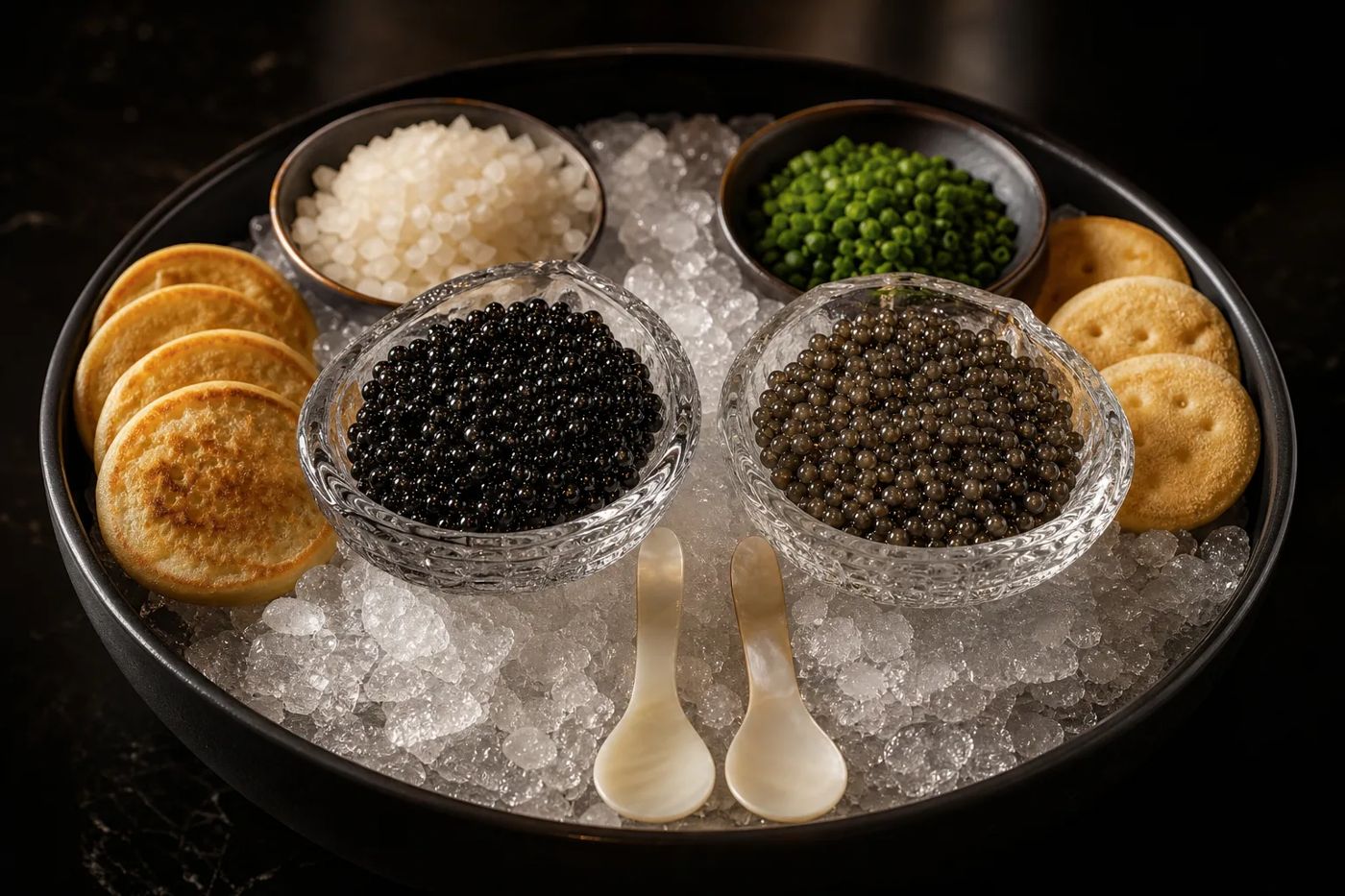
Choose the tin for the service, not the spectacle. One large tin works well for a shared sitting with a predictable appetite and someone responsible for serving. Several smaller tins make more sense for staggered arrivals, separate courses or a long celebration. The reserves can stay sealed in the fridge while the first pack is served.
Opening starts a different clock. Caviar House says its caviar is best enjoyed within 24 hours after opening; Prunier's FAQ gives 48 hours. Follow your particular product's instructions, including any shorter limit, rather than borrowing another producer's timetable. A pleasant smell or tidy appearance cannot establish safety.
Calculate quantities with portion weights by occasion and the portion planner. Count the people who intend to eat caviar, rather than automatically allowing for every guest.
Resist opening an extra tin merely to fill out the display. When attendance is uncertain, keep a reserve sealed and plan another course that does not depend on opening it. That leaves room to respond to appetite without committing the whole supply.
Order early, arrange delivery carefully
Confirm availability before building the occasion around a particular caviar. Ask about pack sizes, dispatch days and the remaining shelf life guaranteed on arrival. Ordering lead times vary by supplier, so enquire early, especially for a celebration where a missed delivery would be difficult to work around.
A firmer selection helps the eggs retain their identity instead of disappearing into a soft topping.
Book an attended delivery with a sensible margin before service. The party should not depend on the final courier run. Decide who will refrigerate the parcel immediately, how any journey to the venue will stay cold, and what action to take if it arrives warm or damaged.
Prepare the fridge before ordering. Leave space for air to circulate and check the temperature with a thermometer. UK FSA household guidance recommends 5°C (41°F) or below; US guidance recommends about 4°C (40°F) or below. Caviar may need colder storage, so follow its own instructions. Prunier, for example, specifies -2°C to +2°C (28°F to 36°F).
Tasting temperature is a separate matter. Caviar House suggests 8°C to 9°C (46°F to 48°F) for tasting, rather than for holding the supply throughout a party. Bring out only what will be eaten promptly and keep reserves cold. US FDA guidance limits unrefrigerated perishable food to two hours, or one hour above 32°C (90°F).
Check guests' needs before choosing
Dietary requirements can change the ingredient, not merely the portion. Ask privately before ordering and offer an alternative that belongs naturally on the menu.
- Pregnancy: The US FDA advises against raw fish and advises cooked fish to protect against microbes. Consider a thoroughly cooked alternative; judge a pasteurised product by its own safety information. Personal concerns belong with a doctor or midwife.
- Fish allergy: Do not assume any fish's roe is suitable. Prevent cross-contact and let the guest follow their allergist's individual advice, as explained in US ACAAI guidance.
- Children: Offer a cooked alternative to uncooked roe. US FDA advice for children recommends fish cooked to safe internal temperatures rather than raw fish.
- Kosher: Major US rabbinic bodies do not recognise sturgeon caviar as kosher. Ask about certified alternative roe and follow the guest's requirements; Chabad's explanation gives the background.
- Halal: Confirm the guest's requirements for the actual product. Encyclopaedia Iranica documents Ayatollah Khomeini's 1983 permission, but one ruling should not be assumed to cover every Muslim guest.
Choose a gift the recipient can use
The best gift tin is one the recipient can enjoy on their own terms. Agree an arrival date, confirm immediate access to refrigeration and make sure there is a realistic opportunity to open it. Ask whether they would prefer to taste the caviar plain, share it at a meal or use it in cooking, then choose as carefully as you would for your own table.
A smaller pack they can finish is more thoughtful than a larger one that creates a deadline. Include the storage instructions and use-by information. Above all, avoid sending an unexpected perishable delivery to someone who may be travelling or away from home.
Sources
- FAO and WHO, Codex Alimentarius Commission. Standard for Sturgeon Caviar, CXS 291-2010, adopted 2010; amendments through 2024 in the official PDF retrieved, and a further modification in 2026 according to the Codex register. Sections 1, 2 and 7. Official document.
- FAO and WHO. Code of Practice for Fish and Fishery Products, CXC 52-2003, 2020 publication, section 20, especially 20.19, pasteurisation. Publication copy.
- European Commission. Caviar d'Aquitaine, published single document, C/2024/6592, 2024. Product description and permitted maturation periods for different preservation methods. EUR-Lex document.
- Calvisius. The Egg Three-Caviar Gift Set, current online edition, publication year not stated. Producer descriptions of its white, Russian and Siberian sturgeon selections;
- Petrossian. Baika Caviar, current online edition, publication year not stated. Seller's description of texture and flavour;
- Riverence Provisions. Rainbow Trout Roe, current online edition, publication year not stated. Producer description and suggested culinary uses;
- Prunier. FAQ, current online edition, publication year not stated. Storage temperature and instructions after opening. French-language FAQ.
- Caviar House. Caviar FAQ: Storage, Tasting and Choosing, current online edition, publication year not stated. Opened storage, tasting temperature and delivery handling. FAQ.
- Food Standards Agency. Storing chilled foods at incorrect temperatures, online report, publication year not established from the retrieved extract. Household guidance summary, page 8. Report.
- US Food and Drug Administration. Selecting and Serving Fresh and Frozen Seafood Safely, current online edition, publication year not stated in the retrieved extract. Storage, serving and foodborne illness precautions. Consumer guidance.
- FoodSafety.gov. 4 Steps to Food Safety, current online edition, publication year not established from the retrieved extract. Refrigeration temperatures and time limits. Consumer guidance.
- US Food and Drug Administration and Environmental Protection Agency. Questions & Answers from the FDA/EPA Advice about Eating Fish for Those Who Might Become or Are Pregnant or Breastfeeding and Children Ages 1 to 11 Years, current online edition. Section VI, question 2, on avoiding raw fish. Questions and answers.
- American College of Allergy, Asthma & Immunology. Fish Allergy, current online edition, publication year not stated. Individual assessment and cross-contact precautions. Clinical consumer guidance.
- Chabad.org. Is Sturgeon Kosher?, current online edition, publication year not stated. Explanation of the position of major rabbinic bodies. Religious guidance.
- Encyclopaedia Iranica. Caviar, 1990, online edition. Account of Ayatollah Khomeini's 1983 ruling on sturgeon and caviar. Scholarly reference.
This piece was researched using official food standards, national food safety guidance, religious and scholarly references, and explicitly attributed producer descriptions and handling instructions.
Last checked: November 2026