
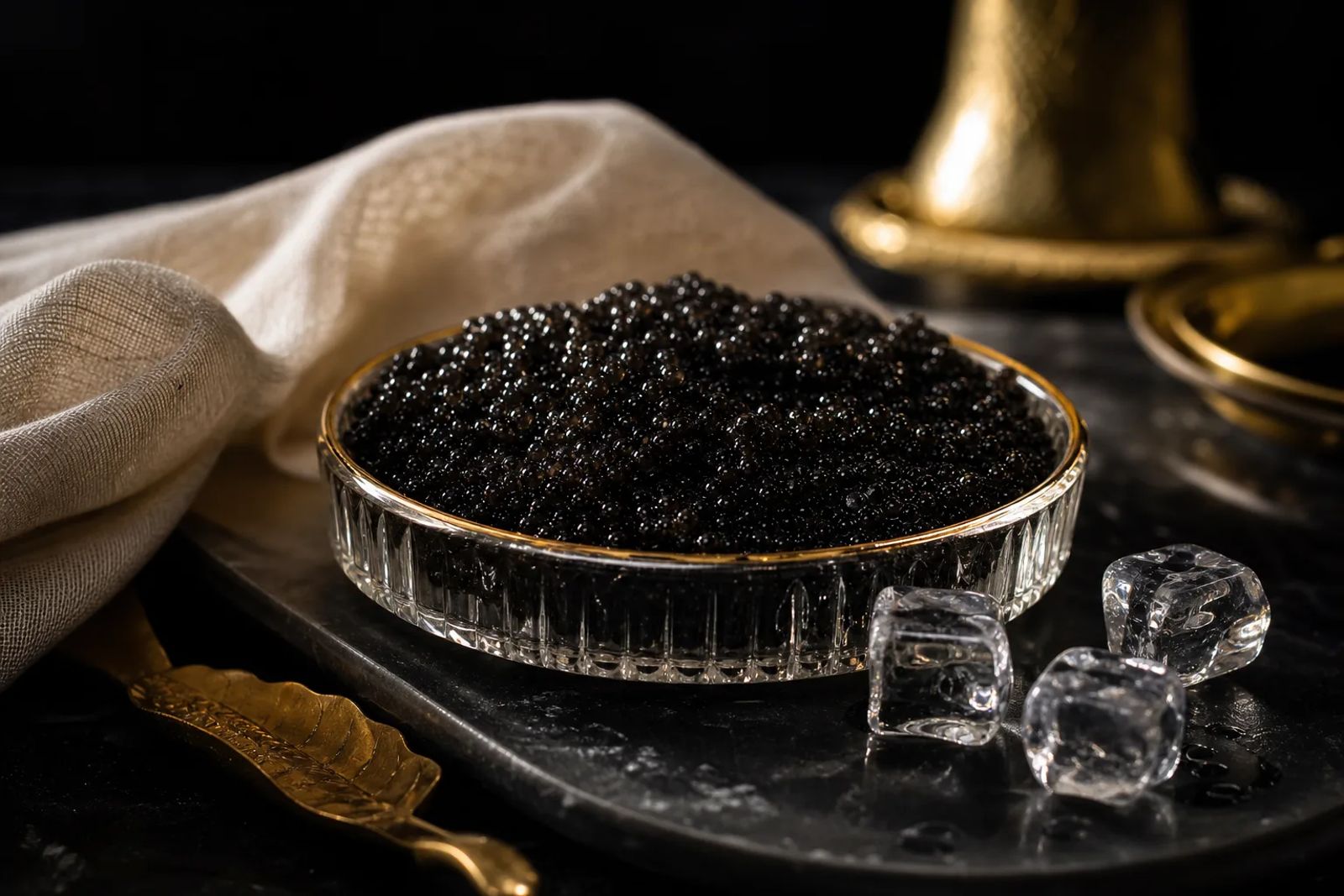
A freezer can take the pop out of caviar: damaged eggs can become weaker, with liquid leaking out after thawing. Yes, caviar can be frozen, but for most chilled sturgeon caviar, the sensible home advice is to keep it chilled. Codex permits freezing only when quality deterioration is avoided. The producer's instructions for your particular product matter more than any general freezer rule.
What Codex says about freezing
The Standard for Sturgeon Caviar, CXS 291-2010, covers salted sturgeon roe, meaning fish eggs. Section 2.3 states:
“Freezing as well as frozen storage of caviar is not permitted unless the deterioration of quality is avoided.”
Quality is the deciding condition. Codex neither bans freezing outright nor approves it for every tin. It is an international reference standard, not automatically binding national law.
The text records amendments in 2013, 2018 and 2024; the Codex register lists a further modification in 2026. For the wider processing requirements, see the Codex standard.
What freezing does to the eggs
Ice crystals are the problem. As water freezes, crystals form and grow, potentially damaging biological structures. In caviar, damage to the egg envelopes can weaken the beads, dull their pop and release liquid after thawing. How much changes depends on the product and freezing process.
Research on Russian sturgeon ovarian fluid and egg homogenate examined ice formation and cracking during extreme cooling. Its scope was cryobiology, rather than salted caviar in a household freezer; it does not establish how finished caviar behaves after thawing.
Producers give different instructions. Black River Caviar advises against freezing because thawing may degrade texture and break eggs. Marshallberg Farm permits freezing its unopened, vacuum-sealed tins, while acknowledging possible texture change. For a closer look at what holds each bead together, see the egg membrane.
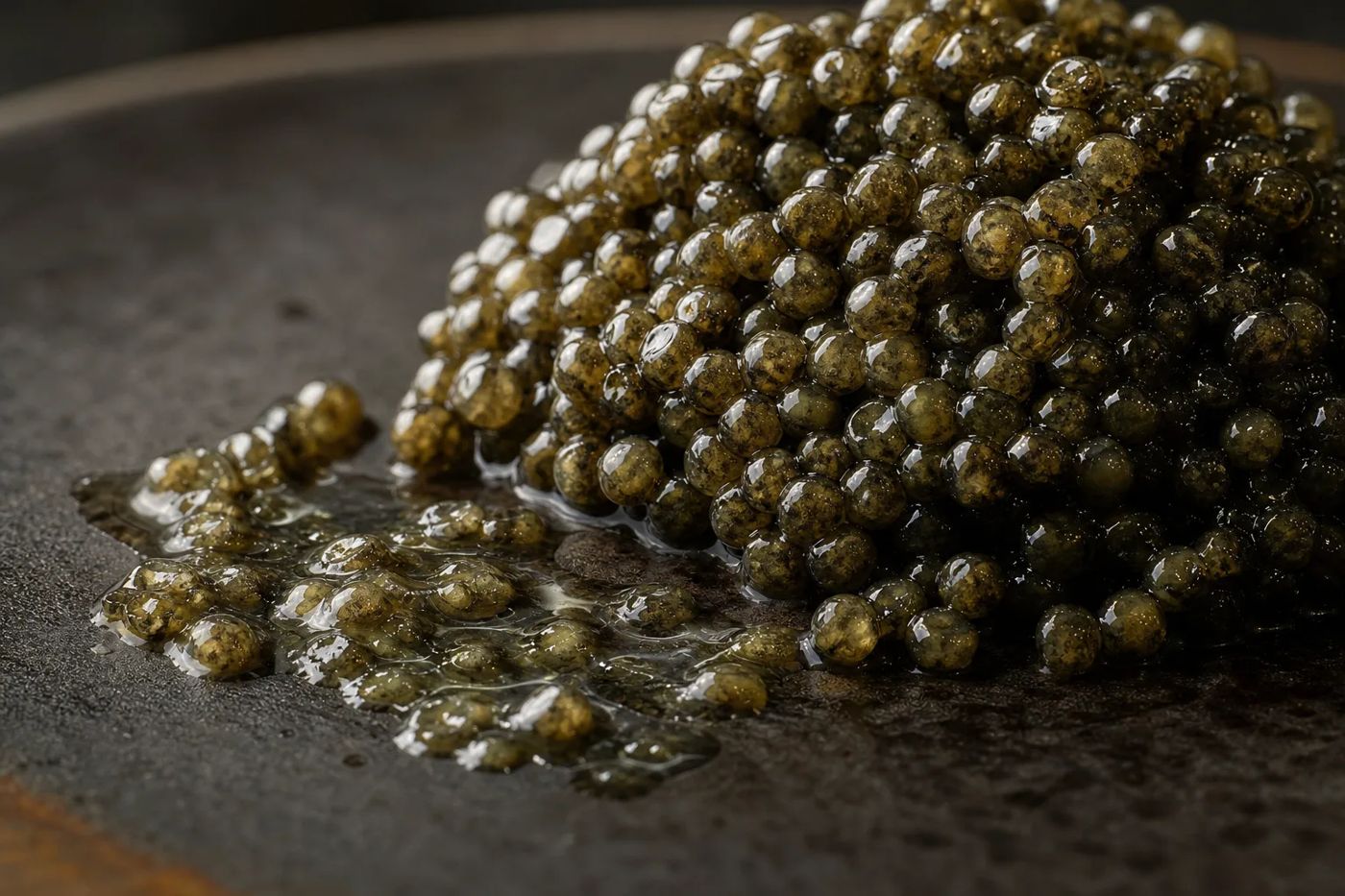
Is frozen caviar used commercially?
Yes. Japan Caviar says it flash freezes its caviar after maturation to preserve its chosen stage of flavour development. That explains the company's purpose, rather than establishing independently that freezing leaves quality unchanged.
Research reported by the Western Regional Aquaculture Center also developed freezing approaches for cultured sturgeon caviar. Neither example makes a domestic freezer equivalent to a controlled commercial process.
What should a defrosted label say?
The rules depend on where the food is sold. These are retail food-information rules, not customs classifications. The position below was checked in November 2026.
EU: Regulation (EU) No 1169/2011, Annex VI, Part A, point 2, normally requires food frozen before sale and sold thawed to carry “defrosted” alongside its name. Exceptions cover ingredients in a final product, technologically necessary freezing, and foods where thawing has no negative effect on safety or quality.
A separate duty remains: treatment must be disclosed when leaving it out would mislead. A supplier's assurance that its caviar freezes well does not, by itself, establish an exception.
UK: The corresponding Annex VI requirement remains in the assimilated food-information regulation in Great Britain. EU food-information law applies in Northern Ireland. These are distinct legal routes.
US: The FDA sources cited do not establish an equivalent blanket requirement to put “defrosted” beside every thawed food's name. Federal regulation 21 CFR 101.95 restricts “fresh” when it implies an unprocessed food. Previously frozen food does not meet that definition, and labelling must not mislead.
If your producer permits freezing
Freeze only an unopened product whose producer explicitly permits it. This is not a way to extend an opened tin's life. Marshallberg Farm provides one documented example; follow your own product's instructions wherever they differ.
- Keep the original seal intact. Check the producer's freezing instructions and date information before putting the container away.
- Set the freezer to -18°C (0°F) or below. This is the FDA's domestic freezer recommendation. Use a colder temperature if the product requires it.
- Thaw in the refrigerator at or below 4°C (40°F). Follow any colder temperature specified by the producer. Never thaw on the worktop or in warm water. The US Food and Drug Administration recommends refrigerator thawing for seafood; Marshallberg advises moving its tin to the fridge the day before serving.
- Observe the producer's refrigerated temperature and post-thaw use period. Do not refreeze: Japan Caviar specifically warns that refreezing damages quality.
These examples offer no universal freezer shelf life. For the normal chilled routine, start with storing caviar and follow home storage guidance. Another producer's dates are not a substitute for those on your product.
Freezing is not a safety treatment
Freezing does not reliably kill Listeria monocytogenes, the bacterium that causes listeriosis. FDA guidance distinguishes stopping its growth while frozen from eliminating contamination. USDA explains that microbes can become active again after thawing.
In caviar, damage to the egg envelopes can weaken the beads, dull their pop and release liquid after thawing.
Do not freeze caviar to rescue it from incorrect storage. Neither a normal smell nor a bead that looks intact establishes safety. Follow the producer's handling instructions, and discard the product if those conditions have not been met.
Why some other roes are sold frozen
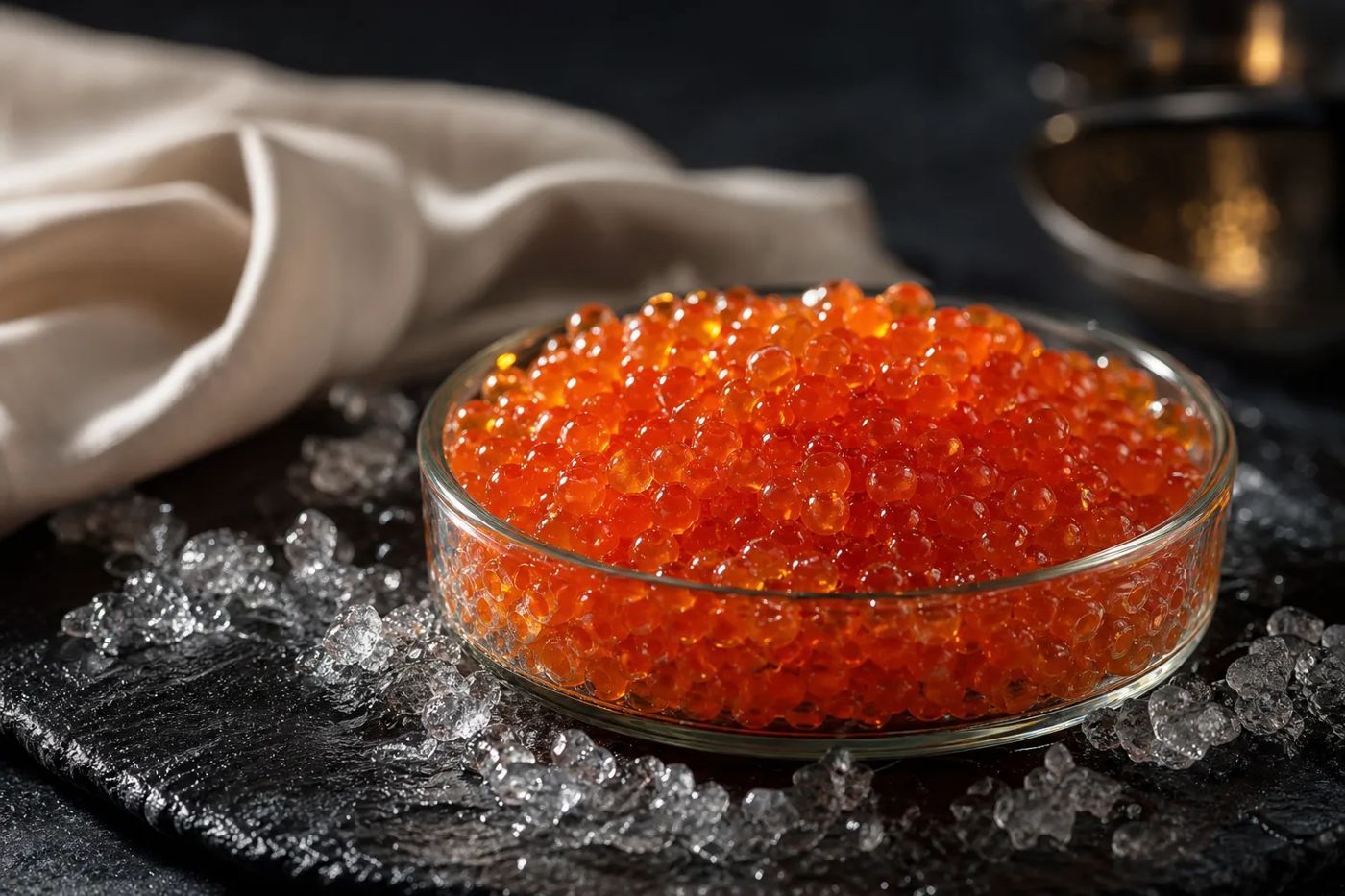
Salmon roe and tobiko, flying fish roe, are established frozen commercial products. Mitsui & Co. Seafoods lists frozen salmon roe within its roe business, including supply associated with Japan. Pafco lists frozen ikura and tobiko.
The Western Regional Aquaculture Center report describes differences between salmon and sturgeon roe proteins and their response to some membrane-firming treatments. It does not, on those findings alone, establish which roe retains its texture better after freezing.
The practical distinction is preparation: choose a product prepared for frozen storage rather than assuming every kind of roe can be frozen in the same way. For salmon-specific handling, see salmon roe.
Using caviar after thawing
If safely handled caviar has lost some firmness, give it a role where separate, springy beads matter less. Fold it through a finished sauce or spoon it over cooked potatoes.
Add it off the heat rather than simmering it. Heating changes egg proteins and will not restore a damaged membrane.
Sources
-
FAO and WHO, Codex Alimentarius Commission. Standard for Sturgeon Caviar, CXS 291-2010, adopted 2010, amended 2013, 2018 and 2024. Section 2.3 contains the freezing provision. Canonical PDF, retrieved through FAO's document proxy.
-
Black River Caviar. Caviar Q's and A's, undated producer guidance, retrieved November 2026. The preservation section advises against freezing because of texture degradation and broken eggs. Producer guidance.
-
Marshallberg Farm. What temperature should I store my caviar?, undated producer guidance, retrieved November 2026. Permits freezing unopened, vacuum-sealed tins and gives refrigerator-thawing advice. Producer guidance.
-
Russian Academy of Sciences. Biophysics, volume 65, issue 3, 2020, research abstract concerning ice microparticle formation in Russian sturgeon ovarian fluid and egg homogenate. Retrieved journal document.
-
Western Regional Aquaculture Center, Barbara Rasco and project collaborators. Optimizing Quality and Shelf-Life, project termination report, 2006. Objective 4 reports freezing research and differences between salmon and sturgeon roe proteins. Research report.
-
Japan Caviar. Freeze to capture the moment, undated company account, retrieved November 2026. Describes flash freezing after maturation. Company account.
-
Japan Caviar. Frequently asked questions, Japanese-language producer guidance, undated, retrieved November 2026. Dated 22 April 2026. Gives frozen-storage and thawing instructions and advises against refreezing.
-
European Parliament and Council. Regulation (EU) No 1169/2011 on the provision of food information to consumers, 2011, Annex VI, Part A, points 1 and 2. Official regulation.
-
UK legislation. Regulation (EU) No 1169/2011, assimilated version, Annex VI, Part A, retrieved November 2026. Official legislative text.
-
UK Government. Packaging and labelling, updated 4 September 2026. Explains the application of assimilated food-information law in Great Britain and EU food-information law in Northern Ireland. Official guidance.
-
US Food and Drug Administration. 21 CFR 101.95: “Fresh,” “freshly frozen,” “fresh frozen,” “frozen fresh”, reproduced in the official Code of Federal Regulations, 2025 edition. Official CFR volume.
-
US Food and Drug Administration. Selecting and Serving Fresh and Frozen Seafood Safely, current online guidance retrieved November 2026. Covers refrigerator thawing and recognises seafood sold as previously frozen. FDA guidance.
-
US Food and Drug Administration. Listeria (Listeriosis) and CPG Sec. 555.320 Listeria monocytogenes, current online versions retrieved November 2026. Give domestic appliance temperatures and distinguish frozen growth inhibition from pathogen elimination. Consumer guidance; compliance policy guide.
-
US Department of Agriculture, Food Safety and Inspection Service. Does freezing food kill bacteria?, updated 14 August 2024; Controlling Listeria monocytogenes in Post-lethality Exposed Ready-to-Eat Meat and Poultry Products, January 2014, page 36. The latter's freezing discussion concerns microbial survival, not caviar-specific processing rules. Consumer explanation; technical guideline.
-
Mitsui & Co. Seafoods. Products, undated business description, retrieved November 2026. Lists frozen salmon roe and the geographical scope of its roe business. Company product information.
-
Pafco. Roe, undated commercial product category, retrieved November 2026. Lists frozen salmon roe and tobiko.
-
Schubring, R. Research article in Thermochimica Acta, volume 415, pages 89 to 98, 2004, publisher article identifier S0040603103004829. Sections 3.3 and 3.5 discuss freezing and heat-induced changes in roe proteins. Retrieved full text.
This piece was researched using the retrieved Codex standard, official legislation and food-safety guidance, original research documents and explicitly attributed producer instructions.
Last checked: November 2026