
All 26 surviving species of sturgeon and paddlefish were at risk of extinction in IUCN’s 2022 reassessment. Twelve years earlier, in 2010, IUCN had called sturgeon “the most threatened group of animals on the IUCN Red List”, with 85% of sturgeon species at risk. Their slow reproductive cycle makes the loss of breeding adults and damage to rivers painfully slow to recover from.
What “most endangered” actually measures
The striking figure is the proportion of species threatened with extinction. It measures how widely danger has spread through a group, rather than how many individual animals are disappearing or whether that group contains every species closest to extinction.
IUCN’s 2010 comparison used that proportion, alongside a separate figure for species classified as Critically Endangered. In Red List terminology, “threatened” brings together three categories: Vulnerable, Endangered and Critically Endangered. Endangered alone is one specific category.
That gives the historical claim a clear meaning and a date. It is not a permanent ranking against every possible grouping of life. In October 2026, IUCN Save Our Species described sturgeon as “among the world’s most threatened groups of species”, without announcing a new comparative ranking.
The numbers behind the claim
The 2022 global reassessment covered 27 species of sturgeons and paddlefishes: 17 Critically Endangered, three Endangered, five Vulnerable, one Extinct in the Wild and one Extinct. Paddlefishes are close relatives within the order Acipenseriformes, but sit outside the true sturgeon family.
| Statement or figure | Source | Year | What it measures |
|---|---|---|---|
| 85% at risk | IUCN global update | 2010 | Proportion of sturgeon species at risk |
| 63% Critically Endangered | IUCN global update | 2010 | Proportion in the highest threat category |
| 17 CR; 3 EN; 5 VU; 1 EW; 1 EX | IUCN global reassessment | 2022 | Category totals, including both paddlefish species |
| “Among” the most threatened groups | IUCN Save Our Species | 2026 | Conservation description, without a new numerical ranking |
CR, EN and VU are the three threatened categories. EW means Extinct in the Wild; EX means Extinct. The widely repeated 2022 headline that all 26 remaining species were at risk includes the species surviving only in captivity. The formal threatened categories contain 25 species.
These figures record dated assessments, rather than a live fish count or a recalculated 2026 total.

Why sturgeon recover so slowly
A mature female represents years of survival and the possibility of years of future spawning. Losing her can take much more from a river than a single fish.
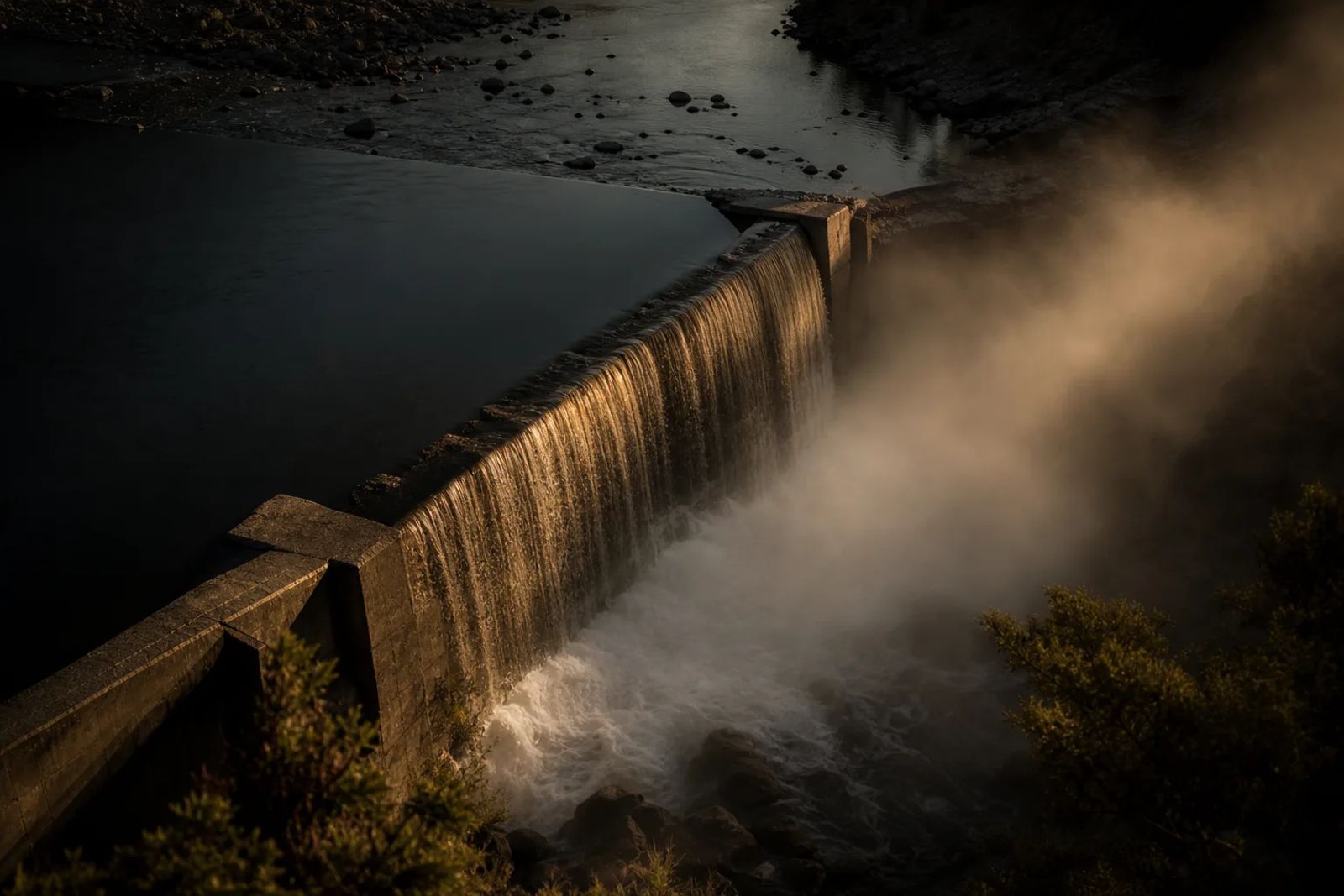
A dam can leave apparently healthy adults swimming downstream while cutting off successful reproduction upstream.
The problem is not that sturgeon produce few eggs. It is that producing eggs, getting them fertilised and raising young that eventually reproduce depend on adult fish surviving for many years in a functioning river system.
Atlantic sturgeon make the timescale tangible. The Atlantic States Marine Fisheries Commission reports female maturity between 7 and 30 years and a lifespan of up to 70 years. Maturation is generally slower towards the northern part of their range. These figures do not set a rule for every species.
Even mature females do not necessarily spawn every year. NOAA’s Atlantic sturgeon framework gives a usual interval of 2 to 5 years, with shorter intervals documented in some rivers. The cost of losing a breeder extends beyond her next spawning: reproductive opportunities stretching years ahead disappear too.
Many sturgeons also need to migrate to suitable spawning grounds. Atlantic sturgeon commonly return to their birth river. A dam can leave apparently healthy adults swimming downstream while cutting off successful reproduction upstream. The long evolutionary history explored in the living fossil story does not make them resistant to that interruption.
The human pressures that compound the problem
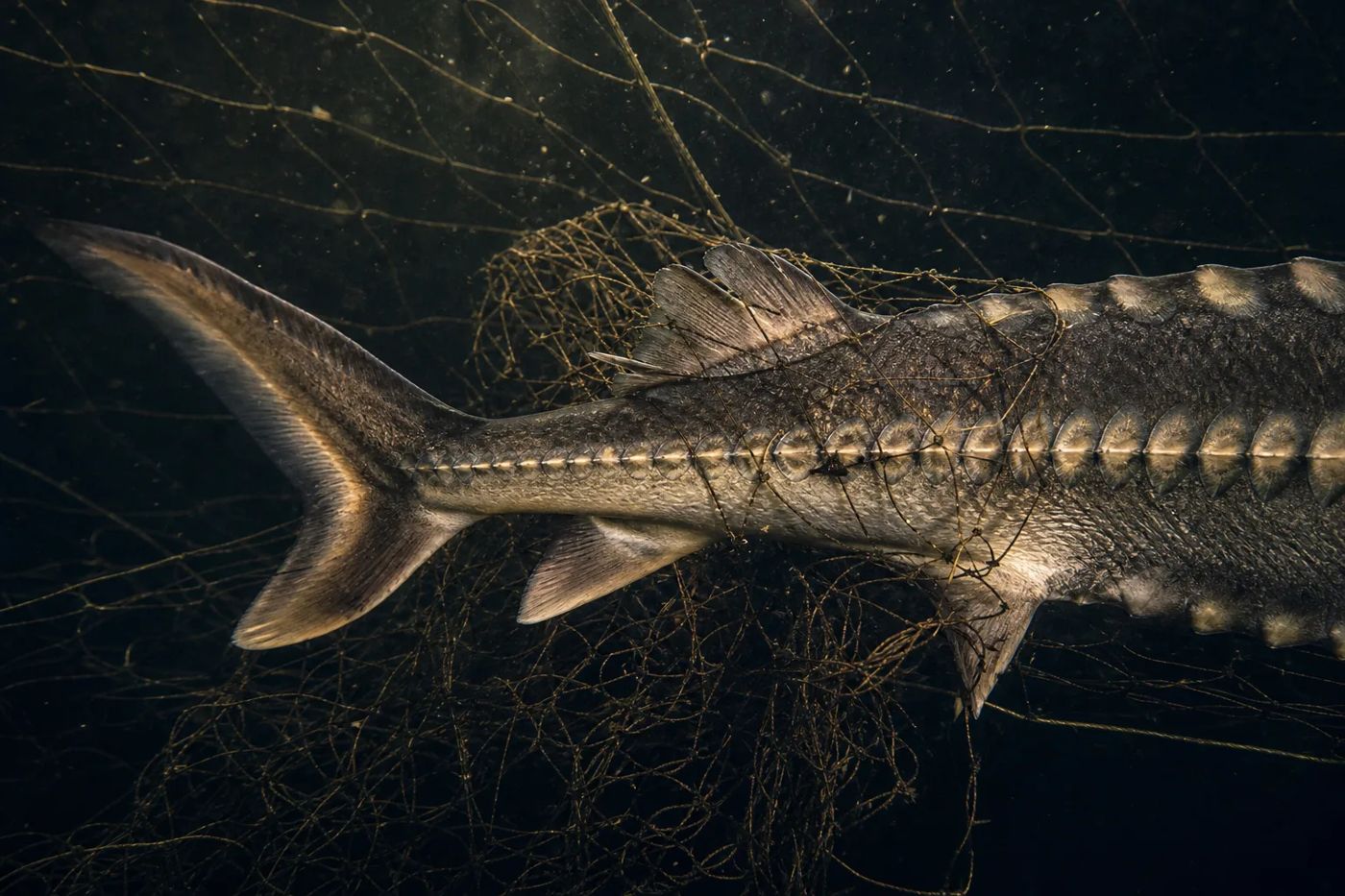
Overfishing and poaching remove breeding fish. Sturgeons have been caught for meat and for caviar, their prepared roe or eggs. Taking females carrying eggs directly removes reproductive adults. Illegal fishing continues to undermine protection even after commercial fisheries close. Sturgeon poaching examines that enforcement challenge.
Dams and altered habitat break the reproductive cycle. A barrier need not block every route to cause damage. Changes to flow, sediment and spawning habitat can also make accessible river stretches unsuitable. Eggs and young fish need the right conditions, not simply a channel containing water.
Extinction, and reasons not to give up
The Chinese paddlefish has disappeared altogether. The Yangtze sturgeon survives in captivity but had lost its self-sustaining wild population. The 2022 reassessment confirmed their respective categories: Extinct and Extinct in the Wild.
Those are the findings published in 2022, rather than dates for the deaths of the final animals. The extinct Chinese paddlefish explains the evidence behind its loss and why many years can separate the last confirmed sighting from an extinction assessment.
Elsewhere, young fish offer a reason to persist. In its account of the 2022 assessments, the North American Sturgeon and Paddlefish Society reported young Adriatic sturgeon in a northern Italian river. Their presence suggested natural reproduction after decades of conservation releases. In 2022, the species moved from Extinct in the Wild to Critically Endangered. It had not recovered.
In the United States, the Fish and Wildlife Service reported in 2024 that stocking and habitat work had strengthened lake sturgeon populations and returned fish to areas where they had disappeared. Sustained action can achieve real gains. But releasing hatchery fish alone does not prove that a population is self-sustaining.
Protection is not the same as recovery
An IUCN category describes extinction risk; it does not itself ban fishing or trade. CITES regulates international trade in listed wildlife, while domestic laws govern capture restrictions and habitat protection. All sturgeons and paddlefishes have been covered by CITES since April 1998; some species were listed earlier.
Europe
In the EU, the Habitats Directive provides species and habitat protections, supported by the Pan-European Action Plan for Sturgeons. The plan supplies a conservation framework rather than a single fishing law applied identically in every Danube country.
In the UK, check protection by nation. For England, Natural England’s guidance identifies European sturgeon as protected under the Wildlife and Countryside Act 1981 and the Conservation of Habitats and Species Regulations 2017. Its account includes protection against deliberate capture and damage to breeding sites.
For the Danube, the Bern Convention Secretariat monitors the shared action plan and coordinates national reporting. Cooperation across borders is essential: protecting fish in one stretch cannot compensate for continued losses elsewhere on the same migration route.
United States
In the US, the Endangered Species Act can protect particular population segments rather than every population of a species. NOAA identifies four Atlantic sturgeon segments as Endangered and the Gulf of Maine segment as Threatened. These legal classifications are distinct from IUCN’s global assessment.
China
In China, a ten-year commercial fishing ban began in 332 Yangtze conservation areas on 1 January 2020. It extended to the main river, major tributaries and large lakes on 1 January 2021, and the State Council reinforced implementation in 2024.
Caspian region
In the Caspian, Russia’s fisheries agency reported in November 2025 that the countries had agreed to extend their commercial sturgeon fishing ban through 2026, with exceptions for research and artificial reproduction. The Caspian states are Russia, Kazakhstan, Azerbaijan, Iran and Turkmenistan.
What this means for caviar today
The documented origin of farmed caviar and a wild population’s survival are connected questions, but they need different answers. An extinction-risk listing does not make every tin of farmed caviar unlawful. Equally, legal trade does not establish that wild populations are recovering.
Farmed caviar remains subject to applicable wildlife-trade controls. A CITES label provides traceability, not proof of the contents. Read the conservation guide alongside the Red List account.
Sources
-
IUCN. Sturgeon more critically endangered than any other group of species, press release, 18 March 2010. Original release.
-
IUCN. Migratory monarch butterfly now Endangered - IUCN Red List, press release, 21 July 2022, especially the global sturgeon reassessment paragraphs. Original release.
-
IUCN Save Our Species. Species conservation highlights from COP17 in Yerevan, 29 October 2026, section “Securing a future for sturgeons”. Original article.
-
North American Sturgeon and Paddlefish Society. IUCN Assessment 2022, 1 August 2022, assessment account and comparative species table. Assessment account.
-
Atlantic States Marine Fisheries Commission. Atlantic Sturgeon, undated species account, current page retrieved November 2026, section “Life History”. Species account.
-
NOAA Fisheries. Atlantic sturgeon framework, December 2023 PDF, life-history discussion of spawning intervals and reproductive output. Framework document.
-
NOAA Fisheries. Atlantic Sturgeon, current species account retrieved November 2026, sections on biology, threats and legal status. Species account.
-
US Fish and Wildlife Service. Collaborative conservation keeps lake sturgeon off endangered list, 22 April 2024. Agency release.
-
Council of Europe, Bern Convention. National Focal Points for the Pan-European Action Plan for Sturgeons, current institutional account retrieved November 2026, including the 2018 plan and 2024 implementation recommendations. Conservation framework.
-
Natural England. Fish: advice for making planning decisions, published 2022, current guidance retrieved November 2026, section “How fish are protected”. Official guidance.
-
State Council Information Office of China. Chinese police seizes over 190 tonnes of illegal fishery catches in Yangtze River in 2024, 20 February 2025, reporting the Ministry of Public Security statement and the ban’s commencement and scope. Official account.
-
State Council of China. China to push 10-year fishing ban in Yangtze waters, 21 March 2024, account of the implementation circular. Official account.
-
Russian Federal Agency for Fisheries, Upper Ob territorial administration. Preserving valuable fish stocks: Caspian countries agree to extend the commercial sturgeon fishing ban [English translation of Russian title], 27 November 2025. Official announcement.
-
European Commission. EU Wildlife Trade Reference Guide, Annex XIV, “Trade in sturgeon and paddlefish specimens”, current online edition retrieved November 2026. Reference guide annex.
Last checked: November 2026