
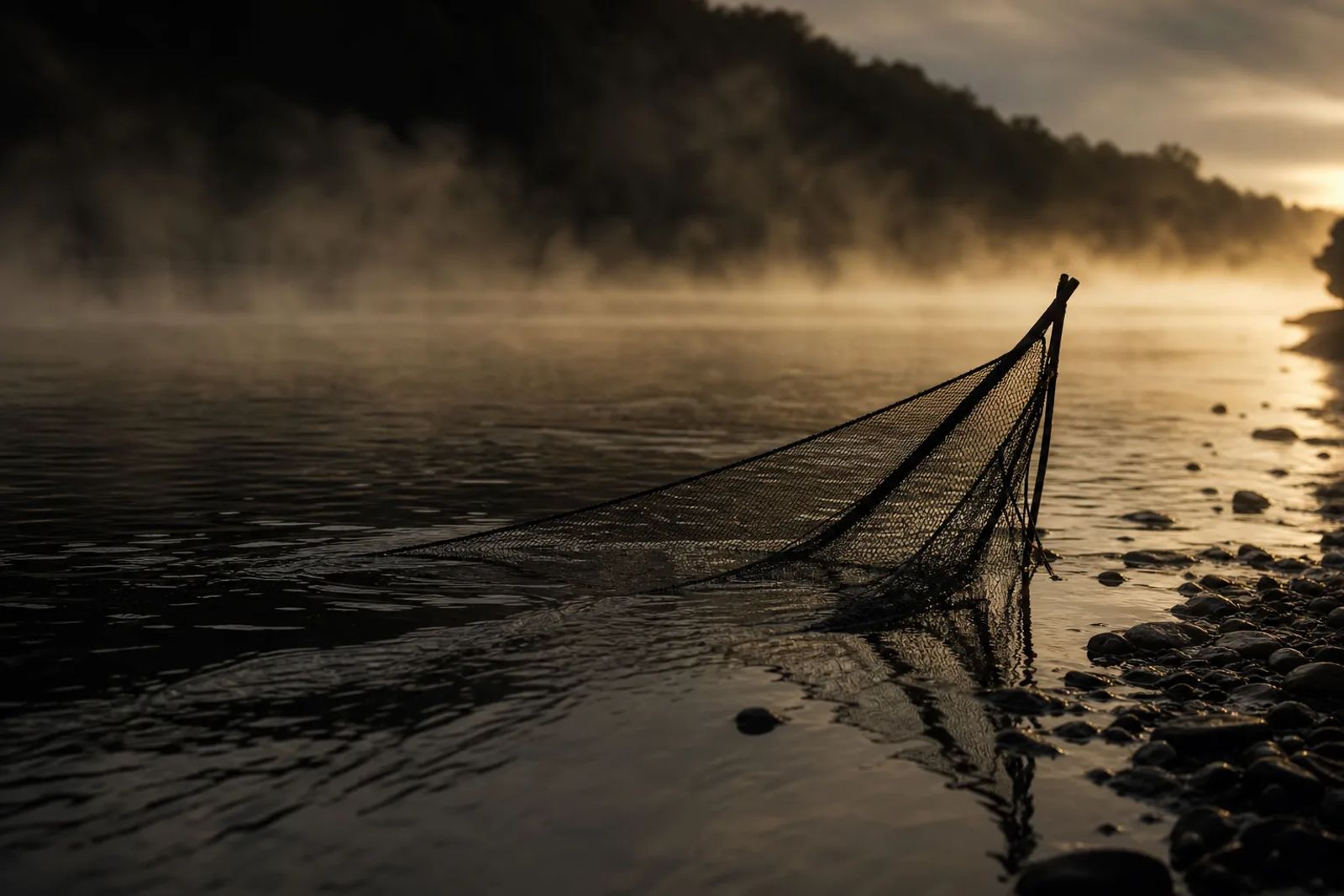
In June 2025, Russian fisheries inspectors reported the seizure of 100 sterlet during an operation on the Oka, a tributary of the Volga.
Poaching is documented across the Caspian and Volga system, the Lower Danube and Black Sea, the Amur basin and North America. The evidence varies in date and scope, but the threat is clear. IUCN and TRAFFIC identify illegal fishing and trade as pressures on wild populations: removing breeding fish for their roe and meat undermines recovery.
Why sturgeon poaching is so damaging
A mature female carries more than the eggs taken from her. She also carries the possibility of future spawning seasons. Killing her removes both.
Sturgeon grow slowly, mature late and may not breed every year. Demand for roe and meat makes them valuable targets, but their biology makes those losses difficult to replace. Even the many eggs produced by surviving fish cannot simply replenish a depleted population.
Spawning migrations bring fish into river corridors where poachers can intercept them. California's wildlife authority warns that large spawning females are targeted for caviar: precisely the fish whose survival is particularly important for reproduction.
The IUCN Sturgeon Specialist Group's 2022 report explicitly links the “impact of poaching and illegal trade” to population declines. Dams, damaged spawning habitat and pollution can compound the damage, leaving depleted populations with fewer opportunities to recover.
California's wildlife authority warns that large spawning females are targeted for caviar: precisely the fish whose survival is particularly important for reproduction.
For the biology behind this slow recovery, read why sturgeon are so vulnerable. Producing eggs is one thing. Successfully replacing adult fish in the wild is another.
Where the evidence comes from
Every record has a date and a reach. An older case or threat assessment cannot automatically describe conditions today, while seizures reveal detected activity rather than its full extent. Patrol effort, reporting and access all shape the record, so a change in seizures need not mean a matching change in poaching. The table distinguishes recent reports from older cases and assessments, showing what each establishes.
| Basin and jurisdictions | Dated evidence | Source | What it establishes |
|---|---|---|---|
| Caspian and Volga, Russia and Kazakhstan | Patrol and seizure reports, 2025 | Rosrybolovstvo; Kazakhstan police | Continuing detected offences |
| Southern Caspian, Iran | Questionnaire study published in 2021 | Aghilinejhad | Local evidence, not a basin-wide estimate |
| Lower Danube and Black Sea, Romania, Bulgaria and Ukraine | Enforcement records covering 2016 to 2025 | WWF, 2026 | Illegal catches and trade |
| Amur, Russia and China | Threat assessment published in 2021 | USFWS | Persistent illegal harvest despite restrictions |
| North America, US and Canada | Cases reported in 2018, 2024 and 2002 respectively | USFWS; Oregon; British Columbia | Separate cases, not a continental estimate |
Caspian and Volga
For the Oka operation, the agency said possible proceedings under Criminal Code Article 256 were being considered; it did not report convictions. A separate June 2025 Rosgvardiya release documented seized sturgeon carcasses in Astrakhan.
In Kazakhstan, Atyrau police's 2025 account of the Bekire operation described joint work with fisheries inspectors against illegal catching, transport and sale in the Ural and Caspian area, including seizures of sturgeon and roe. Together, these records show continuing enforcement encounters, although they cannot establish the proportion of the population lost.
Research elsewhere around the sea offers a different window. A study published in 2021 questioned 203 illegal fishers in the southeastern Caspian. TRAFFIC's earlier regional research included fieldwork in Azerbaijan, Iran and Russia during 2001. These are dated, geographically specific accounts, rather than a picture of present-day poaching in every coastal state, including Turkmenistan.
For current restrictions, see Caspian fishing rules by country. The earlier political and economic upheaval belongs in the Caspian poaching crisis, not as a blanket explanation for every modern offence.
Danube and Black Sea
WWF's July 2026 assessment estimated that at least 3,366 sturgeon were affected by documented wildlife crime. The report compiled official enforcement records from Romania, Bulgaria and Ukraine for 2016 to 2025, combining reported fish counts with estimates converted from seized weights. That figure is neither a count of observed killings nor an estimate of all illegal catches.
The report also describes sturgeon fishing bans in Romania, Bulgaria, Ukraine, Serbia and Moldova. The comparable enforcement dataset covers only the first three countries, so it cannot rank all five.
Amur
Unsustainable harvest for caviar and meat was identified as the foremost threat to Amur sturgeon in a 2021 USFWS proposed listing assessment. The river is shared by Russia and China, and the assessment discussed fishing restrictions in both countries.
This is a dated assessment of the threat, rather than a count of offences in 2026.
North America
North American cases concern both native sturgeon and their relatives, paddlefish. In 2018, USFWS reported a federal sentence arising from illegal commercial paddlefish activity involving Indiana and neighbouring states. A separate Oregon case concerned white sturgeon: the state's wildlife department reported in February 2024 that a defendant had served jail time following illegal retention in Scappoose Bay in 2022.
Across the border, Canada's record includes an older case. British Columbia's government reported a 60-day custodial sentence in August 2002 for Fraser River white sturgeon offences under federal Fisheries Act and provincial Wildlife Act regulations. That historical case establishes neither today's incidence nor current maximum penalties. Together, these remain separate examples, not a continental estimate.

Targeted poaching is not the same as bycatch
The distinction begins with intent. Targeted poaching means deliberately fishing for sturgeon in breach of applicable law. Bycatch is an incidental capture while fishing for something else.
What happens after an accidental capture matters. Whether an encounter becomes an offence depends on the applicable rules, including retention, reporting and release obligations.
An accidentally caught fish can still die. Conservation monitoring must therefore record incidental mortality as well as deliberate removals, without treating every accidental encounter as targeted crime. The responses differ: fisheries management must reduce accidental capture, while enforcement must establish unlawful conduct and responsibility.
Official reports describe unlawful nets, prohibited retention and commercial handling of fish or roe. These categories explain the problem without operational detail. A seizure alone does not establish that every allegation will result in a conviction.
What enforcement can do
Protection has to follow the fish beyond the river. Fisheries rules govern capture and retention; wildlife legislation can protect particular species or populations; trade offences can reach fish and roe as they move onwards.
CITES addresses international wildlife trade through national implementation. It is not a single worldwide domestic anti-poaching statute.
In the US, the Lacey Act, 16 U.S.C. sections 3372 and 3373, addresses trafficking in fish taken unlawfully. Its application and penalties depend on the conduct and applicable law. In the 2018 paddlefish case, the defendant received a 24 month federal sentence on the wildlife trafficking count, concurrent with a firearms sentence, and forfeited fish products and equipment. That was the sentence in this case, rather than a standard penalty for every paddlefish offence.
On the river, patrols can prevent losses as well as gather evidence. Kazakhstan's 2025 Bekire programme linked fisheries, interior and national security agencies. In Oregon, public reporting enabled officers to investigate the Scappoose Bay case. All five recovered sturgeon were released alive.
Reporting does not mean confronting suspected offenders. California's CalTIP programme accepts confidential reports of suspected wildlife offences, while Oregon's case shows the value of an observation from a lawful river user. Follow the relevant authority's reporting advice. Leave investigation to the officers responsible.
DNA, trade checks and the limits of paperwork
DNA can identify the species behind meat, eggs or processed material. Such testing can expose a mismatch between a product and its declared species. The Leibniz Institute for Zoo and Wildlife Research lists caviar trade controls among its wildlife forensic services.
Identifying the species does not, by itself, establish whether a fish was wild or farmed. A 2022 CITES Standing Committee document expressly recognises this limitation and the need to combine DNA with other techniques, including isotope analysis. Isotopes are chemical signatures that, interpreted against suitable reference material, can provide evidence about origin and rearing conditions.
Paperwork needs scrutiny too. A CITES label supplies traceability information, but cannot independently establish what a container holds. Investigators must compare the product, documents and supply chain rather than accept the container's appearance as evidence of lawful origin.
The onward market is examined in the illegal caviar trade. The broader fraud and poaching guide connects these enforcement questions.

What recovery requires
The weight of confiscated roe is only one measure of enforcement. Outcomes also need to be judged by whether breeding adults survived, offences were prosecuted, repeat offending was disrupted and neighbouring authorities shared information. A successful seizure demonstrates detection, but does not, on its own, show that the wild population is recovering.
Protection must also last beyond a single patrol season. IUCN's specialist group identifies ending illegal fishing and trade, restoring populations and restoring habitats as primary tasks. For a migratory fish, keeping adults alive and keeping the river usable are complementary requirements. Recovery needs both.
Sources
-
IUCN Species Survival Commission. 2022 report of the IUCN SSC Sturgeon Specialist Group, reporting year 2022, published in the SSC annual-report series. Passages on population declines, forensic methods and conservation priorities. Report.
-
California Department of Fish and Wildlife. Sturgeon report card, undated live guidance, section “Report poaching”. Explains the targeting and reproductive importance of large females and the CalTIP reporting programme. Guidance.
-
Federal Agency for Fisheries, Moscow-Oka Territorial Administration, Russia. Sturgeon products of suspected poaching origin seized during a raid in Vladimir region [translated title], 18 June 2025. Enforcement release.
-
Rosgvardiya, Russia. Nearly half a tonne of illegally caught Red Book fish seized with Rosgvardiya assistance in Astrakhan region [translated title], 25 June 2025. Enforcement release.
-
Atyrau Regional Police Department, Kazakhstan. Bekire-2025: more than 1.5 tonnes of fish products seized [translated title], 2025 operation report. Enforcement release.
-
Fisheries Committee, Kazakhstan. First meeting of the Bekire-2025 coordination headquarters held [translated title], 2025. Programme announcement.
-
Aghilinejhad, Seyed Mostafa. Assessing the activities of illegal fisherman in the southeastern Caspian Sea. Journal of Animal Environment, volume 13, issue 1, 2021. Questionnaire study involving 203 illegal fishers. Article and abstract.
-
TRAFFIC. Study on the Social and Economic Aspects of Illegal Fishing in the Caspian Sea, undated retrieved edition, reporting fieldwork undertaken in 2001. Report.
-
WWF. In the Net of Poachers: Ten Years of Documented Wildlife Crime Targeting Sturgeons in the Lower Danube Region (2016-2025), July 2026; accompanying announcement dated 14 July 2026. Report and methodological summary.
-
US Fish and Wildlife Service. Endangered and Threatened Wildlife and Plants; Endangered Species Status for Amur Sturgeon, proposed rule, Federal Register, volume 86, 25 August 2021, pages 47457 to 47468. Proposed rule.
-
US Fish and Wildlife Service. Illegal caviar operation leads to prison time, 3 December 2018. Reports the sentence imposed on 27 November 2018 and explains the Lacey Act's role. Case report.
-
Oregon Department of Fish and Wildlife. Sturgeon poachers serve jail time and pay thousands in restitution, 26 February 2024. Case report.
-
British Columbia Ministry of Water, Land and Air Protection. Sturgeon poaching lands Fraser Valley man in jail, 7 August 2002. Identifies the historical offences, statutes and sentence. Government bulletin.
-
Leibniz Institute for Zoo and Wildlife Research. Wildlife forensics, undated live service description. Includes species identification and caviar trade controls. Service description.
-
CITES Standing Committee. Sturgeons and paddlefish, document SC74 Doc. 47, 2022. Discusses trade controls and the respective capabilities of DNA and isotope analysis. Committee document.
-
IUCN. IUCN SSC Sturgeon Specialist Group, undated live group profile, section “Specialist Group work”. Group profile.
This piece was researched.
Last checked: November 2026