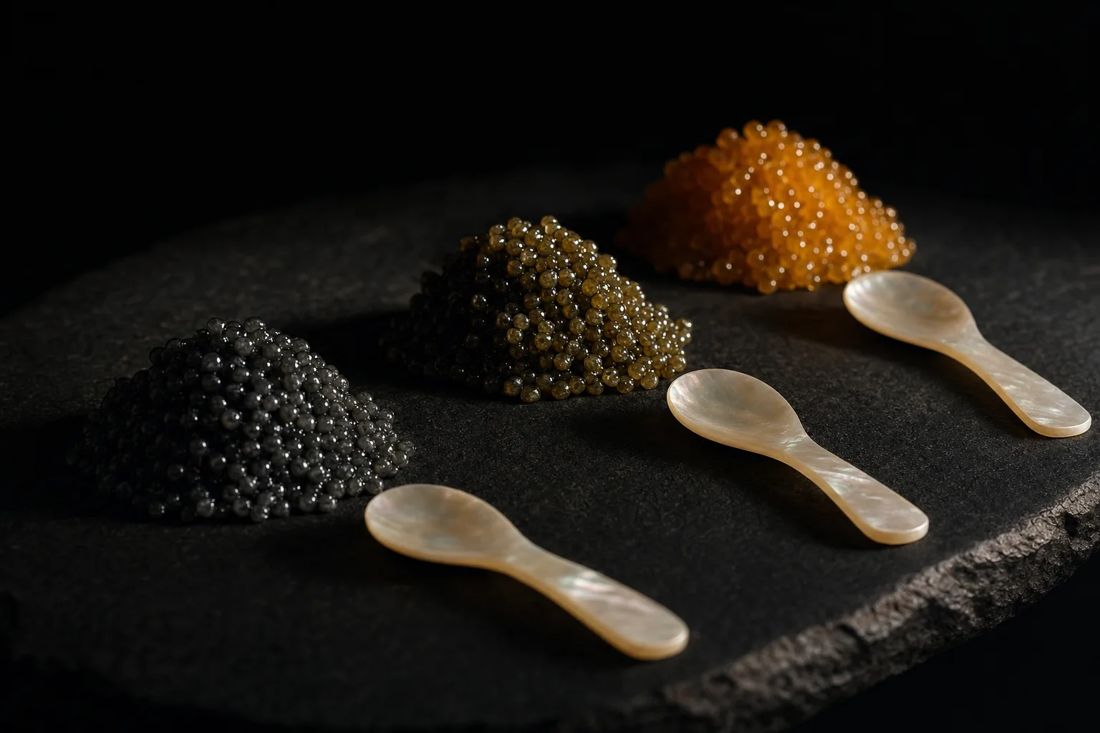
Deep brownish-grey to greyish-black, smooth and delicate, with a subtle fruity aroma: that is how Kaluga Queen describes its Amur sturgeon caviar. Behind those dark beads is Acipenser schrenckii, a fish native to the Amur River basin shared by Russia and China.
Amur sturgeon caviar is the salted roe of this species. It is not another name for Kaluga. The two fish do meet in Chinese aquaculture, where a male Amur sturgeon crossed with a female Kaluga produces an important farmed hybrid. Knowing which fish supplied the roe is the first step towards understanding the caviar.
Amur sturgeon at a glance
| Field | Key facts |
|---|---|
| Common and trade names | Amur sturgeon; Amur sturgeon caviar. |
| CITES scientific name | Acipenser schrenckii Brandt, 1869. |
| Other names | Proposed combination: Sinosturio schrenckii. Historical spelling: schrencki. |
| CITES listing and code | Appendix II; SCH. |
| IUCN Red List | Critically Endangered; assessment published in 2022. |
| Native range | Amur basin and estuary, Russia and China. |
| First farm caviar harvest | Age depends on farming conditions. |
| Bead diameter and colour | Neither identifies the species. |
| Documented farming country | China; this is not a worldwide inventory. |
| Wild trade | International trade falls under CITES controls. Protection differs between the range countries; see below. |
Pure Amur caviar comes from an Amur female; hybrid caviar comes from a hybrid female. That distinction matters more than a trade name or a photograph of the beads. The broader sturgeon species guide places both alongside the other fish whose roe enters caviar production.
The fish of the Amur
The Amur, called Heilongjiang in China, is home to both Amur sturgeon and Kaluga. Amur sturgeon inhabit the river system and its estuary. Their native geography, however, tells a different story from the address of a modern caviar farm: an Amur sturgeon farmed elsewhere in China is not wild Amur River stock.
The scientific name used here, Acipenser schrenckii, is the CITES name. Another name readers may encounter is Sinosturio schrenckii, from the generic reclassification proposed by Brownstein and Near in 2025. At their meeting on 22 October 2025, the IUCN Sturgeon Specialist Group and World Sturgeon Conservation Society rejected that proposal and supported a different arrangement. These taxonomic discussions do not change the CITES codes to use on labels.
A large fish, and a long wait for roe
Amur sturgeon are smaller than Kaluga, but a reported maximum of 3 m and 190 kg makes them substantial fish. Those figures come from a 2002 biological review by Zhuang and colleagues. They are upper limits, rather than typical harvest sizes or a description of the females behind any particular caviar lot.
For the middle Amur, the review places first spawning at 7 to 8 years for males and 9 to 10 years for females. The US Fish and Wildlife Service's biological account reports maturity at about 1.1 to 1.3 m and 6 to 19 kg. These figures describe particular wild populations; farming follows its own conditions and timetable.
The captive evidence gives a different perspective. Examining broodstock, meaning breeding stock, Zhuang and colleagues expected first full female maturity at 5 to 6 years. That expectation did not establish a standard age for the first caviar harvest. Kaluga Queen's June 2026 prospectus offers a specific commercial example: its Amur caviar comes from females with an average maturity age of eight years.
What to look for in the spoon
Kaluga Queen's tasting notes describe its own product, not an independent tasting for this article. For your own comparison, note the species declaration, origin, ingredients and lot details first. Then turn to the spoon. Do the beads separate cleanly? How much resistance does the membrane offer? Record the salinity and the finish after swallowing.
Bead size describes a lot, not the identity of the fish. A producer's selected grade does not establish the species' biological range, and neither darkness nor a large bead separates pure Amur roe from other sturgeon roe or hybrids.
Pure Amur caviar and Kaluga hybrid caviar carry different species declarations. Keep their tasting descriptions separate too: describe the caviar actually being tasted, rather than borrowing a Kaluga hybrid's notes for pure Amur.
Where Amur sturgeon is farmed
China farms pure Amur sturgeon; its role is not confined to repacking imported roe. FAO's 2019 industry account includes Acipenser schrenckii among the country's farmed sturgeons. Kaluga Queen's more recent prospectus lists Amur separately from its hybrid stock and records procurement of Amur fry when its Yingjing Aquaculture Base in Sichuan began operating in 2024.
Yingjing is a documented example of Amur fry procurement associated with the base. For the wider industry, turn to Chinese caviar; retailers' origin claims alone are a poor basis for assembling a list of farms.
Why Amur appears in Kaluga hybrids
The documented Chinese aquaculture cross pairs a female Kaluga, Huso dauricus, with a male Amur sturgeon, Acipenser schrenckii. Their offspring are hybrid fish. When the female hybrids mature, they supply the caviar.
This is a cross between fish, not a mixture of pure Kaluga eggs and pure Amur eggs. Nor does the mother's species alone determine the name of the hybrid's roe.
The commercial attraction includes a balance of farming traits. Kaluga Queen reports stronger adaptability and disease resistance for its hybrid and Amur stocks, while describing pure Kaluga as having a longer growth cycle and greater farming complexity. This is the company's husbandry account, rather than an independent comparison establishing that every hybrid outperforms both parents.
This is a cross between fish, not a mixture of pure Kaluga eggs and pure Amur eggs.
Keep pure Kaluga and Kaluga hybrid caviar separate when comparing identity, production history or sensory character.
Reading the species codes
On a CITES species declaration, pure Amur is SCH. A male Amur sturgeon crossed with a female Kaluga is SCHxDAU, following the male-first convention in the CITES labelling guidelines. The US regulation, 50 CFR 23.71, explicitly uses the same order. These codes are species fields, not complete labels or confirmation that a consignment is lawful.
Codex CXS 291-2010 reverses the order in Annex A: the female species code comes first, then the male. Its section 7.1.3 also calls for ‘hybrid’ in the food name. Thus DAUxSCH under Codex describes the same parent pairing as SCHxDAU under CITES. Codex is an international food standard; it does not automatically become binding national law.
A label provides traceability information, rather than laboratory verification of the contents. Pay particular attention to origin: the country where the roe originated is separate from the repacker's country and plant details. A European repacker does not make Chinese roe European-farmed. The guide to how hybrid caviar is labelled explains the wider conventions. If the trade name and species declaration conflict, ask for clarification.
Import rules are separate from food names
A food name tells you what a product is called; CITES controls govern wildlife trade. Neither replaces the other. Import and labelling requirements vary in the EU, UK, US, Switzerland, UAE, China, Japan, Russia and Australia. Check with the destination authorities before travelling with or importing caviar.
| Jurisdiction | Rule | Source or status | Checked |
|---|---|---|---|
| EU | CITES permits normally apply. Personal luggage allowance: 125 g per person for personal consumption, in sealed, labelled containers. | Belgian CITES authority | November 2026 |
| GB | Caviar and other food products may need CITES permits. Use an authorised entry point. | GOV.UK import guidance | November 2026 |
| NI | EU wildlife trade rules apply; APHA issues Northern Ireland permits. | Editorial verification outstanding | November 2026 |
| US | 50 CFR 23.71 governs CITES labelling. An ESA endangered listing proposed in 2021 is pending; FDA covers naming. | USFWS; FDA | November 2026 |
A farmed population is not a recovered river
Amur sturgeon remains Critically Endangered in the IUCN assessment published in 2022. Overfishing for caviar and meat, including illegal fishing, is central to its decline. Habitat alteration and pollution add to the pressure. Large numbers of fish in farms do not establish recovery of the native river population.
China's national protected-animal list, issued on 1 February 2021, places wild Amur sturgeon populations in Class II. Wild Kaluga appears in Class I in the same document. This is an important legal distinction between the two species, not a judgement on the flavour or quality of their farmed caviar.
For Russia, the US Fish and Wildlife Service's 2021 account reports a commercial fishing ban dating from 1984. It also describes exceptions and enforcement problems surrounding authorised monitoring catches. This account of historical restrictions is not current export authorisation and offers no permission to obtain wild Amur caviar.
Conservation work also crosses the border. China's agriculture ministry reported a joint Russian and Chinese release of Kaluga and Amur juveniles in July 2026. That records an intervention; its eventual success remains a separate question. For neighbouring species and their different conservation histories, continue with Asia's endangered sturgeons.
Sources
-
CITES. Conservation of and trade in sturgeons and paddlefish, Resolution Conf. 12.7 (Rev. CoP17), 2016, including Annex 1. CITES lists Resolution Conf. 12.7 (Rev. CoP17) as effective after CoP20. Document.
-
Zhuang, P., Kynard, B., Zhang, L., Zhang, T., Zhang, Z. and Li, D.; US Geological Survey publication record. Overview of biology and aquaculture of Amur sturgeon (Acipenser schrenckii) in China, Journal of Applied Ichthyology 18: 659 to 664, 2002. Publication record.
-
US Fish and Wildlife Service. Endangered and Threatened Wildlife and Plants; Endangered Species Status for Amur Sturgeon, proposed rule, 86 FR 47457, 25 August 2021. Document.
-
North American Sturgeon and Paddlefish Society. IUCN Assessment 2022, 1 August 2022, reproducing the Sturgeon Specialist Group's assessment results. Assessment summary.
-
IUCN Sturgeon Specialist Group; North American Sturgeon and Paddlefish Society. IUCN SSG Acipenseridae Taxonomy, workshop statement dated October 2025, published 2 December 2025. Statement.
-
Hangzhou Qiandaohu Xunlong Sci-tech Co., Ltd. Global Offering Prospectus, 22 June 2026, Business section, printed pages 132, 133 and 142. Prospectus.
-
FAO GLOBEFISH. Chinese sturgeon and caviar industry, 30 September 2019. Industry account.
-
Codex Alimentarius Commission, FAO and WHO. Standard for Sturgeon Caviar, CXS 291-2010, retrieved edition amended in 2013, 2018 and 2024; section 7.1.3 and Annex A.
-
United States, Code of Federal Regulations. 50 CFR 23.71: How can I trade internationally in sturgeon caviar?, Paragraphs (b) and (c) cover labelling and documentation. Regulation.
-
China, National Forestry and Grassland Administration and Ministry of Agriculture and Rural Affairs. List of National Key Protected Wild Animals, Announcement No. 3 of 2021, issued 1 February 2021; official provincial-government reproduction. Document.
-
Belgian Federal Public Service Health, Food Chain Safety and Environment. Caviar, CITES import and personal luggage guidance. Guidance.
-
UK Government. Bringing food into Great Britain: Check if you need a CITES permit, Guidance on personal food imports. Guidance.
-
US Food and Drug Administration. CPG Sec. 540.150: Caviar, Use of Term, Labeling, October 1989, This is nonbinding compliance guidance. Guidance.
-
China, Ministry of Agriculture and Rural Affairs. China and Russia Hold Fish Release Event, 15 July 2026. Ministry report.
Last checked: November 2026