
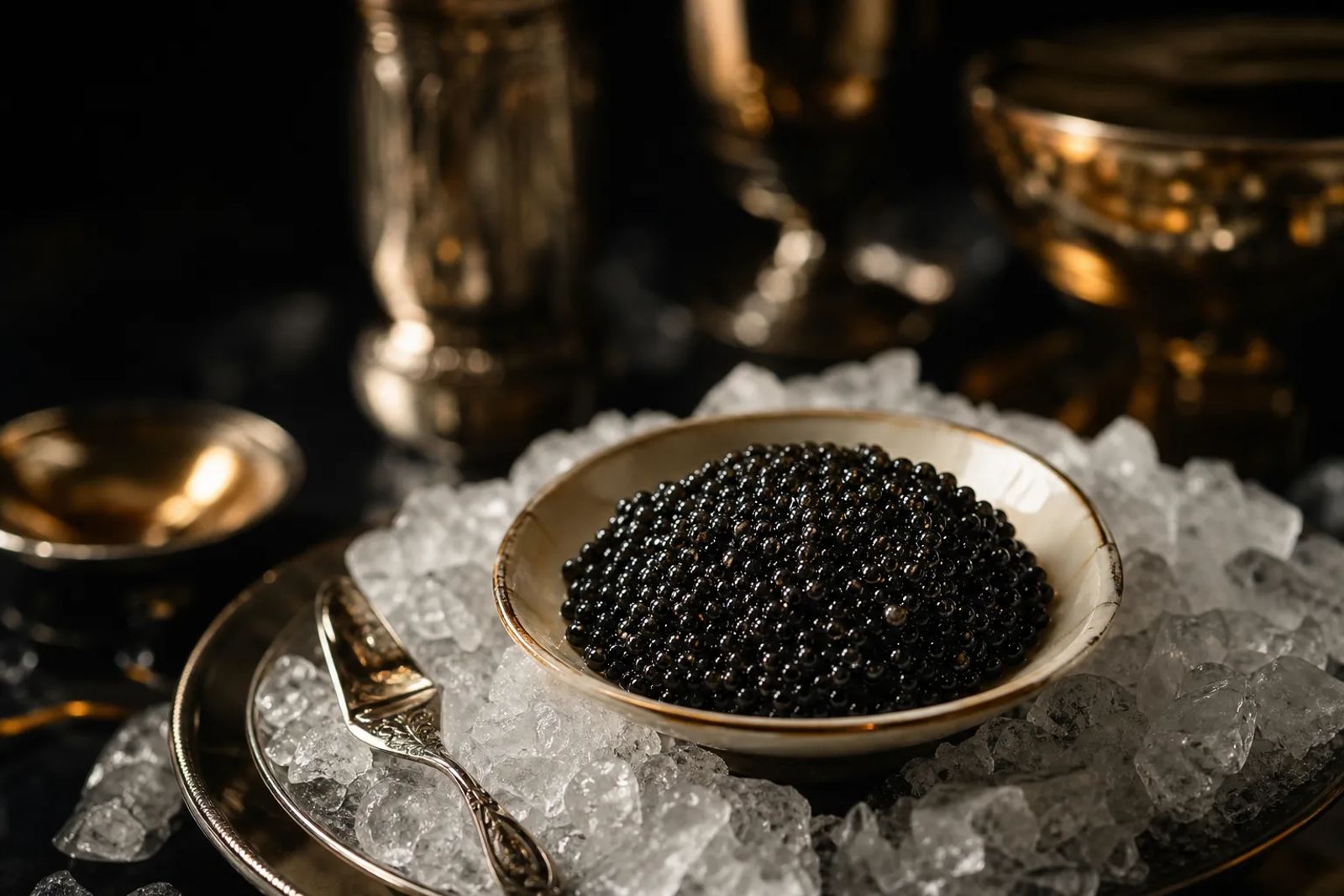
Kaluga caviar begins with an Amur giant, not beluga. It is the salted roe of the sturgeon CITES lists as Huso dauricus, a different species from beluga, Huso huso.
“Kaluga” on a menu leaves an important question unanswered. The name may describe roe from Kaluga itself or a Kaluga and Amur sturgeon hybrid. To distinguish their declared identities, start with the species field on the original container.
Species fact box
| Field | Details |
|---|---|
| Common and trade names | Kaluga; Kaluga caviar. 3,7 |
| CITES scientific name | Huso dauricus. 1 |
| Other scientific names | Acipenser dauricus; Sinosturio dauricus in the 2025 Brownstein and Near classification. 4,6 |
| CITES listing and code | Appendix II; DAU. 1,2 |
| IUCN status | Critically Endangered; assessed 15 September 2019, published 2022, according to IUCN 17. |
| Native range | Amur River basin in China and Russia, including estuarine and coastal waters. 2 |
| Reported female maturity | Kaluga Queen reports an average female maturity age of 15 years. 7 |
| Egg diameter | Kaluga Queen specifies over 3.2 mm 17. |
| Roe colour | Kaluga Queen describes dark brown to golden brown roe. 8 |
| Documented farming country | China, including Kaluga Queen's separately reported Kaluga stock. 7,17 |
| Wild trade restrictions | China's wild populations have first class protection. Russia reported an Amur commercial fishing ban in April 2026. 10,11,12 |
A biological name identifies the fish; a trading description may not. For the wider family, explore sturgeon species. For Kaluga, establish the declared species before drawing conclusions from bead size, colour or a menu name.
An Amur species, not an eastern beluga
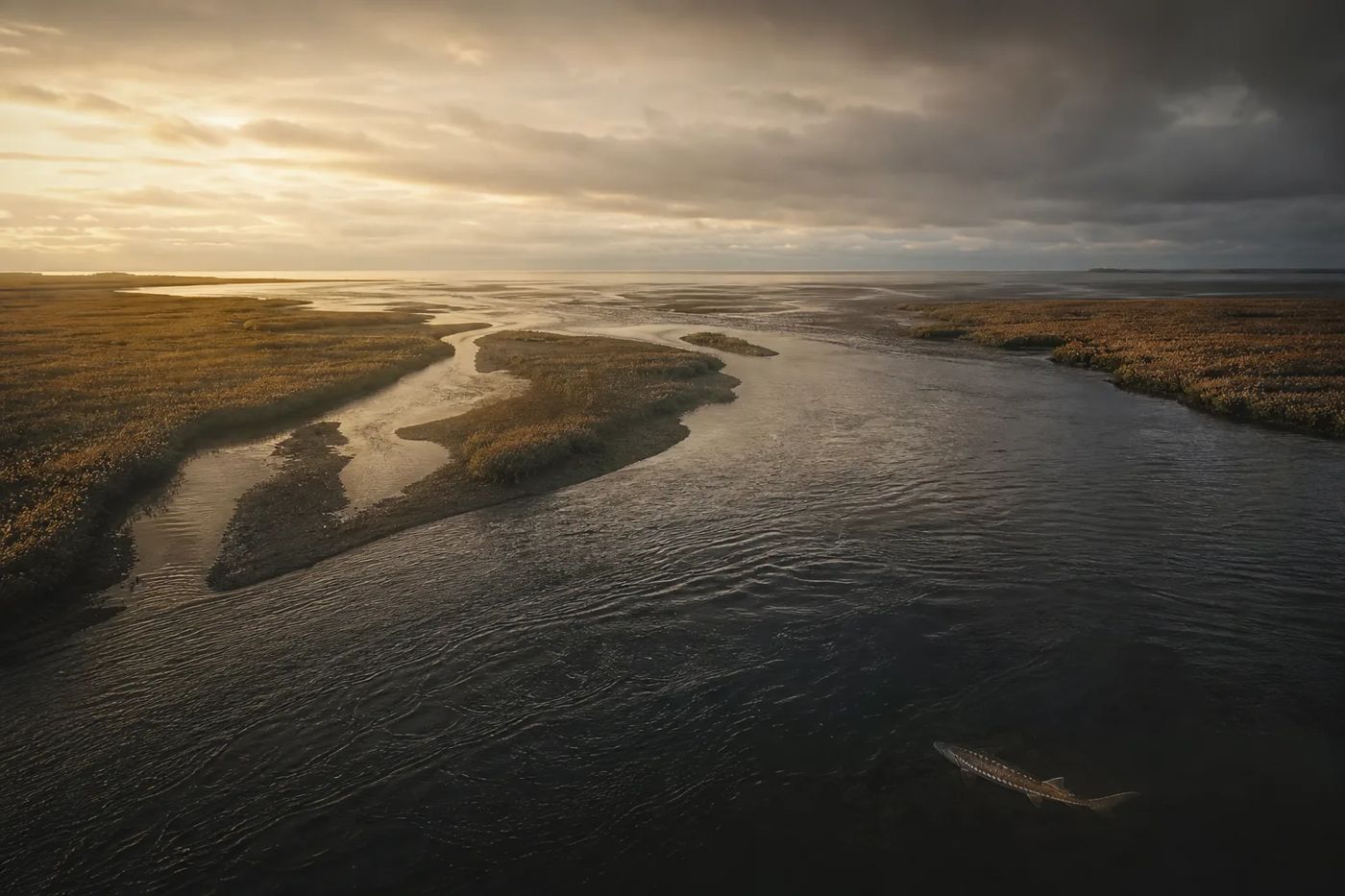
Kaluga belongs to the Amur, also called the Heilongjiang, the river system shared by Russia and China. Its range stretches from the estuary towards the upper reaches and into tributaries. Some fish also use neighbouring coastal waters. This river sturgeon does not necessarily spend its whole life in fresh water.
Kaluga's genus name is disputed. Kaluga and beluga have traditionally shared the genus Huso, but they are different species from different native river systems. Modern molecular classifications do not regard that traditional pairing as a satisfactory account of their evolutionary relationships.
The competing classifications give Kaluga different names. Brownstein and Near's 2025 revision places it in Sinosturio. At their meeting on 22 October 2025, the IUCN Sturgeon Specialist Group and World Sturgeon Conservation Society rejected that revision and supported dissolving Huso within a more conservative classification. Eschmeyer's Catalog of Fishes now accepts Acipenser dauricus.
This article uses Huso dauricus because it is the CITES name attached to DAU. The other names refer to the same fish. The beluga comparison explores what separates their caviar.
A giant that takes years to mature
Kaluga can reach approximately 5.6 metres and 1,000 kilograms, and live to 80 years, according to NOAA Fisheries. Those are upper reported dimensions and longevity, not normal harvest measurements.
Maturity takes time, too. NOAA's account gives wild maturity at 14 to 23 years. The IUCN assessment draws a finer distinction for estuary fish: males mature at 14 to 21 years and females at 17 to 23 years.
Kaluga can reach approximately 5.6 metres and 1,000 kilograms, and live to 80 years, according to NOAA Fisheries.
On the farm, Kaluga Queen's June 2026 prospectus reports an average maturity age of 15 years for its Kaluga females. That figure describes maturity within the company's operation, rather than an independently established first-harvest range for farms worldwide. Neither wild spawning ages nor a producer's average tells you the guaranteed age behind an individual tin.
What Kaluga caviar looks and tastes like
Dark brown to golden brown. Smooth yet firm. A buttery flavour, milky notes and a lingering finish. These are Kaluga Queen's descriptions of its caviar, not a tasting conducted for this article.
The colour, texture and buttery flavour appear in its Huso dauricus exhibitor description for SIAL Paris 2026. Its prospectus adds the milky notes and lingering finish.
The prospectus also specifies roe over 3.2 mm. Read that as a specification for its product, rather than a size threshold that identifies the species. Large brown or golden eggs cannot distinguish pure Kaluga from a hybrid by appearance alone. The spoon reveals the texture; the species field records the declared identity.
Pure Kaluga or hybrid: read the label
Read hybrid codes male parent first. Both parents' codes appear, separated by x. DAU alone is the CITES code declaring Huso dauricus.
A quick reading guide:
- SCHxDAU: a male Amur sturgeon, Acipenser schrenckii, crossed with a female Kaluga, Huso dauricus.
- DAUxSCH: a male Kaluga, Huso dauricus, crossed with a female Amur sturgeon, Acipenser schrenckii.
Read the species field before the prominent product name. In a restaurant, ask to see the original container or its traceability record, then compare the declared species with the dish description. The CITES label records declared identity and traceability, rather than laboratory verification of the contents. On repacked caviar, distinguish the country of origin from the repacker's location.
The Kaluga hybrid guide explains the cross. For mismatches between claims and records, see spotting hybrids sold as pure species. A hybrid can be a perfectly sound product. The problem is supplying one identity under another name, or making the identity impossible to establish.

Where pure Kaluga is farmed
FAO's 2019 account describes the Kaluga and Amur hybrid as China's most common source of caviar. That statement concerns Chinese production, rather than global retail sales. The Chinese caviar guide explores the broader industry.
Kaluga Queen's prospectus documents Kaluga farming in China. It lists Kaluga separately from its hybrid, beluga, Russian, Amur and Siberian sturgeon stock, supporting a distinction between pure-species production and crosses within that operation.
Why “Kaluga Beluga” needs clarification
“Kaluga Beluga” does not tell you that beluga is present. Beluga is the species CITES lists as Huso huso, code HUS. Kaluga has its own identity and code, DAU. “River beluga” is likewise a comparison or nickname, not a species identification. Neither phrase establishes whether the roe is pure Kaluga or a cross.
The clearest description is “Kaluga caviar, Huso dauricus” when the documentation supports it. For a hybrid, name the cross and both parents. This preserves the fish's identity without borrowing another species' name. If the menu and container disagree, ask for clarification rather than trusting the more familiar name.
Conservation, wild fishing and international trade
The IUCN assessment, conducted on 15 September 2019 and published in 2022, lists Kaluga as Critically Endangered. It identifies historical overfishing, continuing illegal fishing and pollution as threats, alongside aquaculture hybrids entering the wild.
Farm production and wild recovery measure different things. Documented farm stocks do not establish recovery of the Amur population.
China's 2021 national protected-wildlife list places wild Kaluga populations in the first protection class. Article 21 of the Wildlife Protection Law prohibits hunting or killing nationally protected wildlife, with special licensing provisions for specified purposes.
Russia's fisheries agency reported that commercial Kaluga fishing in the Amur remained prohibited in April 2026.
CITES Appendix II controls international trade. It grants neither permission to fish nor universal authorisation to import caviar. Switzerland, the UAE, China, Japan, Russia and Australia also apply national rules.
The requirements for commercial shipments differ from those for travellers' personal effects.
| Jurisdiction | Key point | Authority | Checked |
|---|---|---|---|
| EU | Caviar containers need non-reusable identification labels; commercial imports also need wildlife-trade documentation. | Regulations 338/97 and 865/2006, Article 66. | November 2026. |
| Great Britain | CITES permits normally apply to imports and exports, including movements involving Northern Ireland. | APHA CITES guidance. | November 2026. |
| Northern Ireland | Do not treat a movement from Great Britain as an ordinary domestic transfer; consult APHA. | APHA CITES guidance. | November 2026. |
| United States | Kaluga is ESA Endangered; CITES documentation alone does not authorise importation. | NOAA Fisheries; 50 CFR 224.101 and 23.71. | November 2026. |
For travellers entering or leaving Great Britain, APHA describes an exemption for up to 125 g of individually marked caviar per person under specified conditions. It does not cover commercial shipments, apply worldwide or override stricter species protection.
Before travelling with Kaluga into the United States, obtain species-specific advice from the responsible wildlife authority.
Sources
-
CITES. Conservation of and trade in sturgeons and paddlefish, Resolution Conf. 12.7, Rev. CoP17, 2016 revision, official text reproduced in a US federal rulemaking docket. Annex 1 covers labelling; Annex 2 gives species codes and the male-first hybrid convention; Annex 3 identifies shared stocks.
-
IUCN. Qiwei, W. and Mugue, N. Huso dauricus, The IUCN Red List of Threatened Species 2022: e.T10268A146104292, published 2022, assessed 15 September 2019.
-
NOAA Fisheries. Kaluga Sturgeon, current species account, retrieved November 2026. Includes dimensions, lifespan, reproduction and US Endangered Species Act status.
-
Brownstein, C. D. and Near, T. J. Toward a phylogenetic taxonomy of sturgeons (Acipenseriformes: Acipenseridae), Bulletin of the Peabody Museum of Natural History 66, 2025, pages 3 to 24. Author-hosted paper.
-
World Sturgeon Conservation Society. Bronzi, P. IUCN SSG summary report, 13 November 2025, reporting the meeting of 22 October 2025.
-
California Academy of Sciences. Eschmeyer's Catalog of Fishes: Acipenser dauricus, online species record, retrieved November 2026.
-
Hangzhou Qiandaohu Xunlong Sci-tech Co., Ltd. Global Offering Prospectus, 22 June 2026. Company prospectus, particularly printed pages 131 and 142.
-
Kaluga Queen, via SIAL Paris. Kaluga Caviar, exhibitor description dated 28 October 2026.
-
FAO GLOBEFISH. Chinese sturgeon and caviar industry, 30 September 2019.
-
Chinese national wildlife authorities. National list of key protected wild animals, 2021 list, government-hosted reproduction. Kaluga entry specifies first-class protection for wild populations.
-
People's Republic of China. Wildlife Protection Law, revised 30 December 2022, effective 1 May 2023, Ministry of Ecology and Environment reproduction.
-
Russian Ministry of Agriculture. Fishing rules for the Far Eastern fisheries basin, Order No. 285 of 6 May 2022, consolidation incorporating amendments of 10 March 2023.
-
European Commission. Regulation (EC) No. 865/2006, consolidated version dated 18 February 2025, particularly Articles 57, 64 and 66.
-
APHA and Defra. Check if you need a CITES permit to import or export endangered species, current online guidance, retrieved November 2026.
-
United States. 50 CFR 23.71: How can I trade internationally in sturgeon caviar?, online regulatory text reproduced by Cornell Legal Information Institute, retrieved November 2026.
-
United States. 50 CFR 224.101: Enumeration of endangered marine and anadromous species, current eCFR text, retrieved November 2026.
Last checked: November 2026