
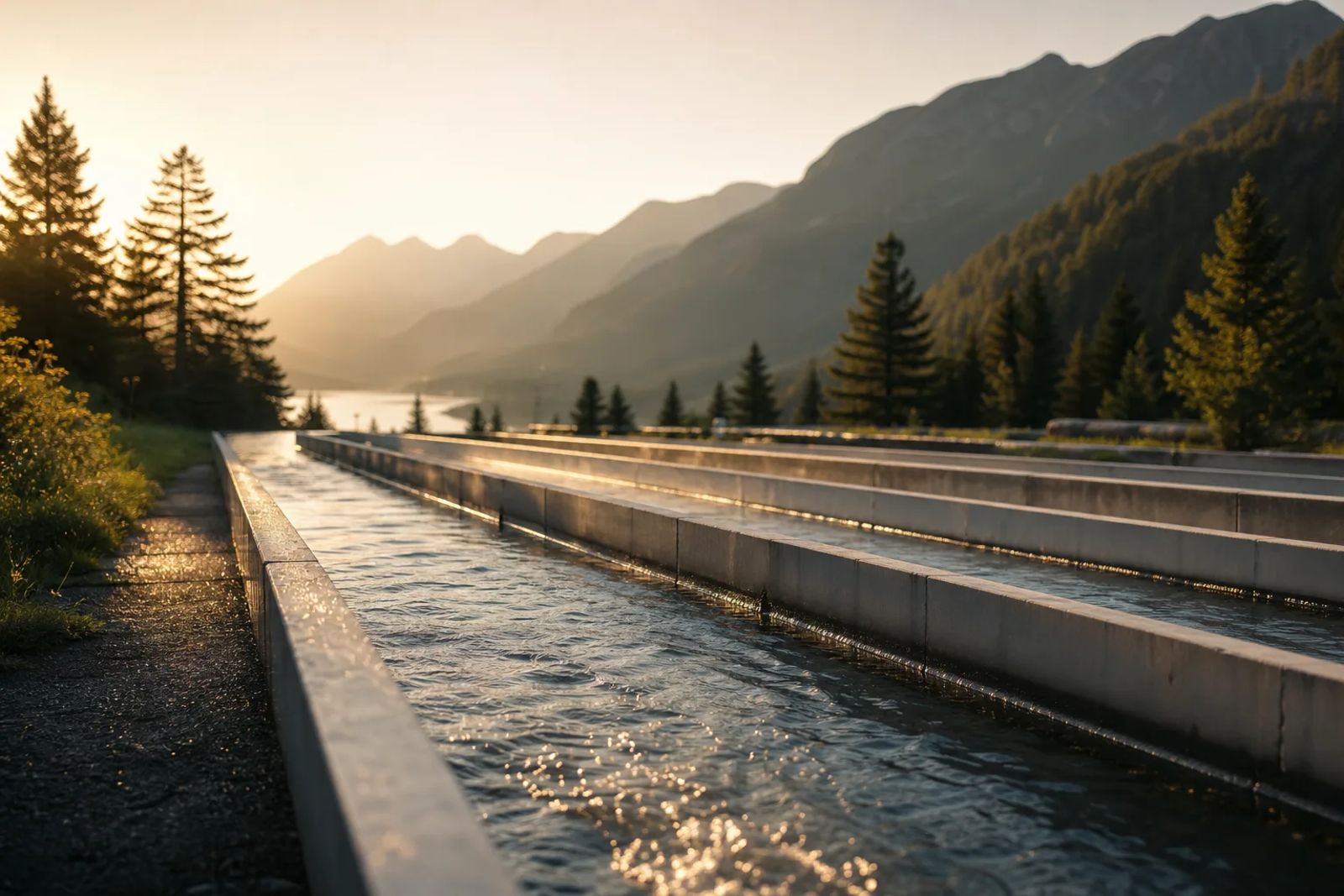
In Georgia's Rioni River, a survey of the 2018 spawning season found a new generation of stellate and Colchic sturgeon. In Armenia, artesian water in the Ararat Valley helped underpin the revival of fish farming. These are two distinct caviar stories: one centred on farming, the other combining documented farming and caviar processing with important surviving wild sturgeon habitat in Black Sea rivers.
Both countries have documented caviar businesses. Understanding them starts with separating the farm, the river and the roe.
Armenia at a glance
| Species farmed | Documented examples: Russian sturgeon (Acipenser gueldenstaedtii) and Siberian sturgeon (Acipenser baerii). Source 1. |
| Farming regions | Ararat and Armavir provinces. Source 1. |
| CITES operations | Four listed operations; processing and repackaging share one field. Source 3. |
| Trade regime | Decision 1281-N implements CITES, including sturgeon caviar marking requirements. Source 17. |
| PGI or PDO | Not publicly documented. |
| Wild stocks | The ministry identifies the documented farmed Russian and Siberian sturgeons as non-endemic. Source 1. |
| Country's role | Farmed fish and caviar origin, with registered processing or repackaging operations. Sources 1, 3. |
Armenia is landlocked, not a Caspian coastal state. Its farming industry has a different setting from the historic marine fisheries covered in the regional guide.
How Armenian farming developed
An expert account published in 2009 traces Soviet-era investment in Armenian aquaculture, followed by renewed activity after the Soviet Union's breakup. It identifies the Ararat Valley's artesian water and existing raceways, channels through which water flows, as the physical basis of that recovery.
Armenia's Ministry of Economy names Russian and Siberian sturgeon among commercially bred fish and identifies Ararat and Armavir as the principal fish-farming provinces. Its examples establish the presence of those species without cataloguing every species or cross held on Armenian farms.
Is Armenia a leading caviar producer?
Armenia's substantial sturgeon tonnage measures fish production, not harvested caviar. A World Bank report reproducing FAO figures places the country second in 2018 for aquaculture production of sturgeons and paddlefishes, at 3,910 tonnes.
The claim that Armenia is the world's third-largest producer therefore needs two essentials: which product, and which year?
EUMOFA's May 2021 caviar study addresses the distinction directly. It warns that Armenia's substantial sturgeon tonnage most likely reflects meat production. For caviar, it gives an industry estimate of 10 to 20 tonnes, rather than a verified national production series. Armenian caviar exports in CITES data varied between zero and three tonnes annually.
These older figures cannot settle a current world or Caucasus ranking. Fish tonnage, caviar production, exports and a farm's designed capacity measure different things. None can stand in for the others, as explained in reading production statistics.
Georgia at a glance
| Species farmed | Georgia's sixth CBD report names Siberian, Russian, sterlet, Amur and white sturgeons in aquaculture. Source 18. |
| Farming regions | Documented example: Khutsubani, Kobuleti municipality, Adjara; not a national census. Source 12. |
| CITES operations | Five listed operations; processing and repackaging share one field. Source 4. |
| Trade regime | CITES controls, national Red List protection and destination food-import requirements apply separately. Sources 4, 18. |
| PGI or PDO | Not publicly documented. |
| Wild stocks | Rioni populations survive; occurrence and spawning evidence vary by species. Sources 7, 8, 9. |
| Country's role | Reported sturgeon farming and caviar processing; important wild sturgeon conservation territory. Sources 9, 12. |
The Rioni, draining towards the Black Sea, is central to Georgia's wild-sturgeon story. This is not part of a single shared Caspian fishery. Historical records also name the Enguri, Supsa and Chorokhi rivers, although those records do not establish where sturgeon spawn today.
Which wild sturgeon remain?
The Rioni's conservation records contain some of the great names of caviar history. WWF's account discusses beluga (Huso huso), Russian sturgeon (Acipenser gueldenstaedtii), stellate sturgeon (Acipenser stellatus), ship sturgeon (Acipenser nudiventris), European sturgeon (Acipenser sturio) and the fish called Colchic sturgeon.
Recent confirmation varies across these historical and conservation records. The list does not represent six demonstrated breeding populations.
The 2022 IUCN assessment results classify beluga, Russian and stellate sturgeon as Critically Endangered. This global category measures extinction risk, rather than the number of fish remaining in the Rioni.
A 2022 genetic study examined 94 wild sturgeon samples from the Black Sea and Rioni, using mitochondrial DNA and nuclear markers. Its value lies in species and hybrid identification within that sample. It was neither a river census nor evidence of successful reproduction by every adult species recorded there.
The Colchic naming problem
“Colchic sturgeon” carries several scientific names in the regional literature: Acipenser colchicus and Acipenser persicus colchicus, while some conservation accounts place it under Persian sturgeon, Acipenser persicus. Reading these records requires care: different names do not automatically establish separate species or populations.
The evidence for a new generation is more specific. A university survey of the 2018 spawning season used drift nets for larvae and nets for young fish. The resulting 2019 thesis reported recruitment, the arrival of a new generation, by stellate and Colchic sturgeon in 2018, using the names given in that study.
Threats, fishing restrictions and conservation
For a spawning sturgeon, an open migration route and suitable riverbed matter enormously. Dams can block that route and alter the flows and habitats needed for spawning. Fishing nets can kill sturgeon even when other fish are the intended catch.
WWF identifies hydropower development and illegal fishing among the Rioni's central threats. Their wider effects are explored in habitat loss and bycatch.
Georgia's sixth national report to the Convention on Biological Diversity states that its sturgeons are nationally Red List species and that commercial catch was prohibited.
Fishing nets can kill sturgeon even when other fish are the intended catch.
Conservation work has targeted both habitat and the gaps in knowledge. IUCN SOS describes a 2022 to 2024 Fauna & Flora project focused on migration routes, habitat quality and population knowledge. In May 2026, Georgia's Parliament reported passing amendments intended to establish a 554-hectare Rioni reserve around spawning habitat. Effective management on the ground remains a separate question from that announcement.
Georgian farming and what each country is known for
Georgia also farms sturgeon. Georgian Fish and Caviar's company profile on the Trade with Georgia portal places its farm at Khutsubani on the Kintrishi River. It describes sturgeon breeding stock and caviar processing: a commercial operation distinct from the country's wild populations.
The profile also claims output across an 18-month cycle, but discusses sturgeon caviar alongside salmon and trout roe. Without a product-specific breakdown, that headline cannot establish the company's sturgeon-caviar output. Even such a breakdown would not establish Georgian national production or provide a sound basis for a regional ranking.
The clearest distinction between the countries is how production sits within the landscape, not a national flavour. Armenia has a substantial farmed-sturgeon sector. Georgia combines farming with unusually important surviving river habitat.
Registers, imports and origin labels
A CITES register entry tells you about a registered operation, not how much caviar a country produces. As of November 2026, CITES lists Armenian codes 0005, 0007, 0008 and 0018, and Georgian codes GE0001 to GE0005. Both pages combine processing and repackaging in one field, preventing separate totals. Neither is a census of farms, retailers or annual output.
For commercial imports, check three things separately: country listing, establishment approval and wildlife-trade documentation. Switzerland, the UAE, China, Japan, Russia and Australia also impose destination requirements in addition to CITES controls.
| Destination | Import requirements | Legal source |
|---|---|---|
| EU | Annex IX, as amended in October 2026, lists Armenia for farmed finfish and their products, including caviar; Georgia for wild catch only. Establishment approval is separate. | Regulation (EU) 2021/405, Annex IX; Regulation (EU) 2026/2228. |
| Great Britain | FSA guidance requires approval of both the exporting country and establishment under Great Britain's commercial fishery-product import rules. | FSA fishery-product import guidance; assimilated Regulation (EU) 2019/626. |
| Northern Ireland | Direct imports from either country need applicable EU country and establishment approvals. GB clearance does not replace them. | DAERA guidance on fishery-product imports. |
| United States | FDA guidance requires imported caviar to meet US food requirements. Separate USFWS wildlife controls also apply. | FDA food import guidance; USFWS requirements. |
Armenia's rules allow citizens to export personally up to 125 g of processed sturgeon caviar without a CITES permit. Postal consignments require permits. Check destination restrictions separately.
On a CITES origin label, AM identifies Armenia and GE identifies Georgia. Read the origin, not simply the repacker's address: an Armenian or Georgian repacker may handle roe produced elsewhere. Armenia's labelling procedure expressly separates the original production country from the repacker's details. The label supplies traceability, rather than independent verification of the contents.
Where to go next
- Wild Caviar Regions: The Caspian, Black Sea, Azov and Amur: explore the separate basins behind regional caviar history.
- Sturgeon Conservation Organisations: meet the groups conducting research, habitat protection and recovery work.
Sources
-
Ministry of Economy of the Republic of Armenia. Online fish-farming sector account, undated. Documents commercially bred species and the concentration of farms in Ararat and Armavir. Ministry page.
-
Global Seafood Alliance, Responsible Seafood Advocate. Aquaculture in Armenia, 2009. Historical and technical account of aquaculture development and Ararat Valley farming. Article.
-
CITES Secretariat. Armenia: Register of caviar exporters, undated live register. Search-retrieved listing; direct retrieval returned an access error. Country register.
-
CITES Secretariat. Georgia: Register of caviar exporters, undated live register. Search-retrieved listing; direct retrieval returned an access error. Country register.
-
World Bank. Market Growth Potential for Kazakhstan Fisheries and Aquaculture Products, 2023, Table E17, “Global sturgeons/paddlefishes aquaculture production, 2018”. Reproduces FAO production data. Report.
-
EUMOFA, European Commission. The Caviar Market: Production, Trade, and Consumption in and outside the EU, May 2021, section 1.3.2, Armenia. Report.
-
Beridze, T., and colleagues. Interspecific hybridization in natural sturgeon populations of the Eastern Black Sea: the consequence of drastic population decline? Conservation Genetics 23, 2022, pages 211 to 216. Research paper.
-
Edisherashvili, T., Ilia State University. Baseline survey of sturgeon in the Rioni River and developing essential knowledge, Master’s thesis, 2019, reporting 2018 fieldwork. Repository PDF.
-
WWF. Rioni River Sturgeons, undated factsheet. Species accounts, naming conventions and conservation threats. Factsheet.
-
IUCN SOS. Securing threatened sturgeons in the Rioni River, project record for 2022 to 2024, undated online edition. Project record.
-
Parliament of Georgia. Parliament Passed Amendments to the Law on the Establishment and Management of the Kolkheti Protected Areas in III Reading, 28 May 2026. Parliamentary announcement.
-
Trade with Georgia. Georgian Fish and Caviar, undated company-supplied profile. Location, breeding stock, processing and production claims are attributed to the business. Company profile.
-
European Commission. Commission Implementing Regulation (EU) 2026/2228 of 14 October 2026, amending Regulation (EU) 2021/405, including replacement Annex IX. Official text.
-
European Commission. Commission Implementing Regulation (EU) 2021/405, consolidated text dated 18 February 2026, Annex IX. Consolidated text.
-
Food Standards Agency. Fishery-product import guidance, online PDF edition retrieved November 2026. Food Standards Agency, Importing fishery products or bivalve molluscs, GOV.UK.
-
Department of Agriculture, Environment and Rural Affairs. Moving fish and fishery products, online guidance retrieved November 2026. Northern Ireland guidance.
-
Government of the Republic of Armenia. Decision 1281-N of 2009, English consolidated translation dated 29 August 2019, sturgeon-caviar marking provisions. Government translation.
-
Government of Georgia, Convention on Biological Diversity. Sixth National Report: Georgia, English edition, 2020. Sturgeon protection and prohibition of commercial catch. National report.
-
National Geographic Georgia, GIZ-supported biodiversity map. Colchian Sturgeon, undated online species account. Regional river records and alternative scientific naming. Species account.
Last checked: November 2026