
In the Detroit and Saint Clair rivers, egg mats revealed something worth celebrating: lake sturgeon had spawned on newly constructed reefs. Fish had found and used the rebuilt riverbed. Whether their offspring would survive was the next question.
That distinction runs through sturgeon recovery. Dams block breeding migrations, pollution damages developing fish, fishing gear catches unintended victims, and habitat destruction strips away spawning and nursery grounds. All are documented threats. Their importance varies between rivers, but each can break the chain between an adult fish and the next generation.
- Keep adults alive and restore successful reproduction. Recovery needs both.
- Judge a fish pass by measured movements and survival, not by its presence on a dam.
- Eggs on restored habitat confirm spawning. A self-sustaining population requires offspring to survive.
Where do these threats do the most harm?
The decisive threat is the one preventing a population from completing its life cycle. According to the Council of Europe, these pressures affect different habitats and life stages. Studies count different things: inaccessible habitat, contaminants in eggs, fish caught in nets and successful spawning. Those results cannot simply be added together.
Nor do the threats act alone. A sturgeon may reach its spawning grounds only to find the gravel buried in fine sediment. Another may survive years at sea, then become caught near a river mouth. The biological connections are explored in sturgeon life cycle and migration and why sturgeon face exceptional extinction risk.
Evidence from different rivers
| Threat | Mechanism | Example river | Source | Year |
|---|---|---|---|---|
| Dams | Block upstream spawning migration | Danube at the Iron Gates | ICPDR | 2021 |
| Dams | Cut access and alter downstream spawning conditions | Yangtze | NOAA review | 2021 |
| Pollution | Contaminants in eggs can disrupt development | Yangtze | Hu and colleagues | 2009 |
| Bycatch | Unintended capture through entanglement or trapping | US Atlantic rivers and coast | NOAA | Undated |
| Habitat removal | Dredging removes spawning riverbed | Detroit and Saint Clair | USGS | 2017 |
Dams: blocking the journey, changing the river
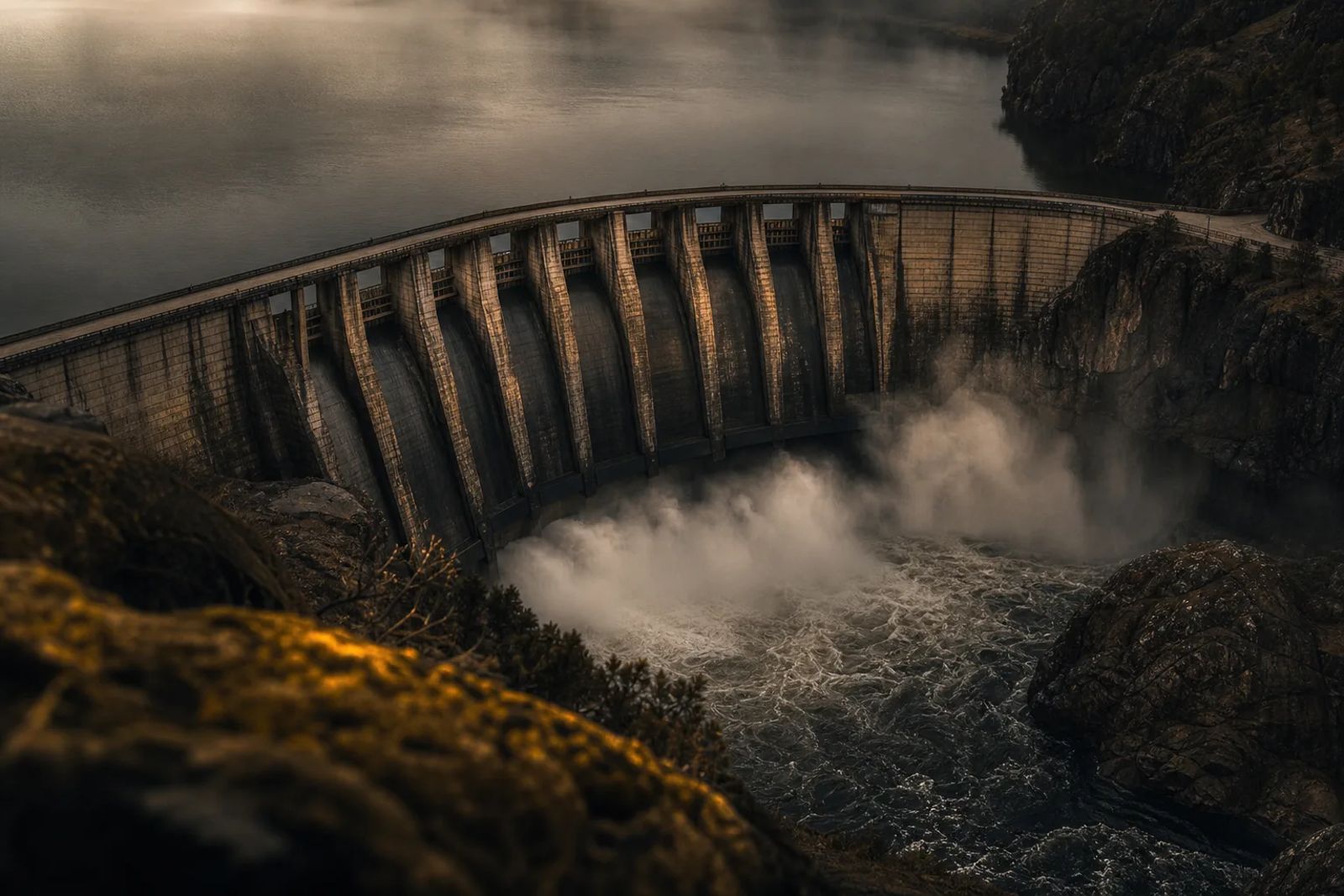
A dam does more than stop a fish swimming upstream. It can turn flowing habitat into a reservoir and change the water, sediment and temperature conditions below it. Many sturgeon migrate between feeding areas and freshwater spawning grounds; restoring that upstream journey solves only part of the problem. Juveniles and returning adults need safe routes downstream too.
On the Danube, Iron Gate I and Iron Gate II, between Romania and Serbia, cut migratory sturgeon off from the Middle Danube and important tributaries. The ICPDR's We Pass programme has investigated ways to restore passage. That work remains a distinction between possibility and performance: feasibility studies and proposed engineering solutions have not established successful sturgeon passage through these dams.
Below Russia's Volgograd dam, remaining spawning habitat has become especially precious. The dam blocked migrations from the Caspian into much of the Volga's former spawning system. Yet researchers genetically monitoring juveniles in 2017 and 2018 documented continuing natural reproduction downstream. Spawning had not ceased altogether; access to much of its former range had.
The Yangtze shows how obstruction and altered river conditions work together. NOAA's 2021 review identifies Gezhouba as the barrier to Chinese sturgeon migration. The Three Gorges reservoir and upstream reservoirs also change downstream flows, sediment and seasonal temperatures that influence spawning.
Can sturgeon use fish passes?
Some can. How many succeed depends on the species, the site and the passage itself. In a 2011 study at the Vianney-Legendre fishway on Canada's Richelieu River, researchers tagged 107 lake sturgeon and tracked their movements with electronic detectors. Of 88 fish that attempted passage, 32 completed it: a passage efficiency of 36.4%.
Turning basins caused particular difficulty. Thiem and colleagues also explain that the fish were confined within the entrance basin, so the experiment did not measure how readily free-ranging migrants would find the fishway.
A useful assessment follows the whole journey: finding the entrance, entering, completing passage and subsequently reproducing. Success at one stage cannot stand in for recovery across them all.
Pollution: damage can begin inside the egg
Pollution can reach a sturgeon before it hatches. Hu and colleagues' 2009 investigation examined triphenyltin, an organotin compound used in pesticides and antifouling products. It combined observations of Chinese sturgeon larvae and chemical measurements in eggs with controlled egg-injection experiments in Chinese and Siberian sturgeon. The experiments reproduced developmental abnormalities and supported maternal transfer of the contaminant as a cause of malformed offspring.
Different pollutants cause different problems. Industrial discharges, agricultural runoff and municipal wastewater introduce a mixture of pressures. Metals and persistent chemicals may damage fish directly; excess nutrients and organic matter can worsen oxygen conditions. The consequences depend on concentration, exposure time and life stage. Detecting a contaminant in tissue establishes exposure, rather than population decline by itself.
Oil has caused documented harm too. NOAA's Deepwater Horizon restoration programme identifies Gulf sturgeon as a species injured by the spill. The finding concerns that event; it does not establish the same mortality rate for oil exposure in the Caspian or elsewhere.
Start remedies at the source: control industrial effluent, reduce agricultural losses and sewage pollution, and prevent oil releases. Then monitor water and sediment alongside biological responses. Cleaner water is essential where pollution limits survival. It still cannot reconnect spawning grounds above an impassable dam.
Bycatch: the fish nobody meant to catch
A sturgeon need not be the target to die in fishing gear. Bycatch is the capture of a species a fishery is not targeting. NOAA identifies gillnets, pound nets and trawls as sources of Atlantic sturgeon bycatch. On Romanian coastal fishing grounds in the Black Sea, research documents overlap between sturgeon habitat and fisheries, including turbot fishing with bottom-set nets.
Entanglement, injury and prolonged confinement can all kill. NOAA notes that survival depends partly on water temperature and time spent in the gear. A fish released alive may still die afterwards. Preventing capture and requiring release are therefore different jobs.
Tested gear changes can reduce the risk. Hager and colleagues' 2021 study found that raised-footrope gillnets reduced subadult Atlantic sturgeon bycatch. Separately, NOAA's New Jersey Atlantic Sturgeon Bycatch Reduction Area guidance sets out low-profile gillnet requirements for specified monkfish operations and restrictions affecting spiny dogfish fishing.
These approaches differ and need to fit the fishery concerned. Avoiding high-risk places or seasons can also reduce encounters, supported by catch monitoring and fisher reporting. Deliberate capture and retention are a separate problem, explored in sturgeon poaching.
Lost habitat: when the riverbed disappears
Gravel alone does not make a spawning ground. Sturgeon eggs need suitable substrate and flowing, oxygenated water. Sand and gravel extraction can remove that substrate outright. Dredging and navigation works can change currents or spread fine sediment over it.
Young fish need more than a place to hatch. They need nursery areas where they can feed, survive and grow. Embankments, simplified channels and the loss of connected shallow margins or estuarine wetlands can shrink those opportunities. Effective restoration starts with the needs of the species and life stage concerned, rather than assuming any wetland will serve.
Rebuilding spawning substrate has produced encouraging results. USGS surveys in the Detroit and Saint Clair rivers used egg mats to compare spawning before and after reef construction. They found lake sturgeon eggs on the constructed reefs. Fish had discovered and used the habitat; tracking the offspring's later survival is the next step towards establishing the population benefit.
Which legal frameworks apply?
River protection extends well beyond fisheries law. In EU Danube states, the Water Framework Directive addresses river condition and river-basin management, while the Habitats Directive provides species and habitat conservation duties where applicable. River continuity and spawning habitat belong in project assessment and management. Neither directive automatically applies as domestic law in every non-EU Danube or Black Sea state.
Across the wider Danube and Black Sea region, the Bern Convention's sturgeon action framework and ICPDR's basin planning support coordinated habitat protection and migration restoration. Their recommendations and projects are distinct from enforceable national rules. The detailed basin programme is covered in Danube sturgeon conservation.
China's Yangtze River Protection Law, effective from 1 March 2021, addresses water pollution, habitat restoration and controls on sand mining. For Russia and the other Caspian states, the Tehran Convention provides a regional framework for preventing pollution and conserving biological resources.
In the United States, the Endangered Species Act protects listed sturgeon populations and underpins measures addressing fisheries interactions and habitat damage. Release and reporting requirements in US fisheries depend on the applicable rules and permits. Check current NOAA instructions for the fishery concerned, and confirm its specific rules with the management authority.
What would convincing recovery look like?
Recovery means completing the cycle: migrants reach usable spawning grounds, eggs survive, juveniles recruit into the population, and adults live to reproduce again. The strongest evidence connects conservation measures to those biological outcomes. Fish counters, cleaner water samples and occupied restoration sites mark useful progress, but each captures only part of the chain.
That is why sturgeon conservation requires combined action, rather than a choice between protecting fish and repairing rivers. Changes in temperature and water availability add another pressure, explored in climate change and sturgeon. They make tackling dams, pollution, bycatch and lost habitat no less necessary.
Sources
-
IUCN. Migratory monarch butterfly now Endangered: IUCN Red List. Official Red List update announcement, 21 July 2022, including the sturgeon reassessment. Official announcement.
-
Council of Europe, Bern Convention. Ralf Reinartz, Technical Guideline for Sturgeon Habitat Monitoring. TPVS(2024)16, 16 October 2024. Official document.
-
International Commission for the Protection of the Danube River. Danube River Basin Management Plan Update 2021. Final version, 2021. Management plan.
-
International Commission for the Protection of the Danube River. WE PASS: Facilitating Fish Migration and Conservation at the Iron Gates. Undated project webpage. Project account.
-
Sergeev, A. A., and colleagues, VNIRO and Caspian Fisheries Research Institute. Genetic monitoring of natural sturgeon spawning in the lower Volga for the period 2017-2018. Frontiers conference abstract, 2019. Research abstract.
-
NOAA Fisheries. 5-Year Review of Foreign Sturgeon. Review, 2021, Chinese sturgeon section. NOAA review.
-
Thiem, J. D., and colleagues. Behaviour and passage success of upriver-migrating lake sturgeon Acipenser fulvescens in a vertical slot fishway on the Richelieu River, Quebec, Canada. Endangered Species Research, volume 15, 2011. Open research paper.
-
Cooke and colleagues. Water resource development and sturgeon (Acipenseridae): state of the science and research gaps related to fish passage, entrainment, impingement and behavioural guidance. Review, 2020. Author-hosted paper.
-
Hu and colleagues. Malformations of the endangered Chinese sturgeon, Acipenser sinensis, and its causal agent. Proceedings of the National Academy of Sciences, 2009. Open research paper.
-
NOAA, Deepwater Horizon Natural Resource Damage Assessment Trustees. Open Ocean Project Leads to Better Understanding of Gulf Sturgeon Populations. Project update, April 2025. Restoration update.
-
NOAA Fisheries. Atlantic Sturgeon. NOAA species account and conservation guidance. Species account.
-
Frontiers in Marine Science. National fisheries restricted areas: an alternative tool for the sustainable management of Black Sea vulnerable and economically important fish populations. Original research article, 2025. Research paper.
-
Hager and colleagues. Raised-Footrope Gill-Net Modification Significantly Reduces Subadult Atlantic Sturgeon Bycatch. North American Journal of Fisheries Management, volume 41, 2021. Research paper.
-
NOAA Fisheries. New Jersey Atlantic Sturgeon Bycatch Reduction Area and restrictions for monkfish and spiny dogfish gillnet vessels. NOAA fisheries guidance. Official guidance.
-
US Geological Survey. Egg deposition by lithophilic-spawning fishes in the Detroit and Saint Clair Rivers, 2005-14. Scientific Investigations Report 2017-5003, 2017. Research report.
-
National People's Congress of China. The Yangtze River Protection Law of the People's Republic of China. Adopted 26 December 2020; effective 1 March 2021. Official English text.
-
Tehran Convention Secretariat. Tehran Convention, English explanatory publication, 2025, covering pollution prevention and biodiversity instruments. Secretariat publication.
-
NOAA Fisheries. Gulf Sturgeon: Science. Undated science account, including industrial, agricultural and municipal pollution. Official science account.
Last checked: November 2026