
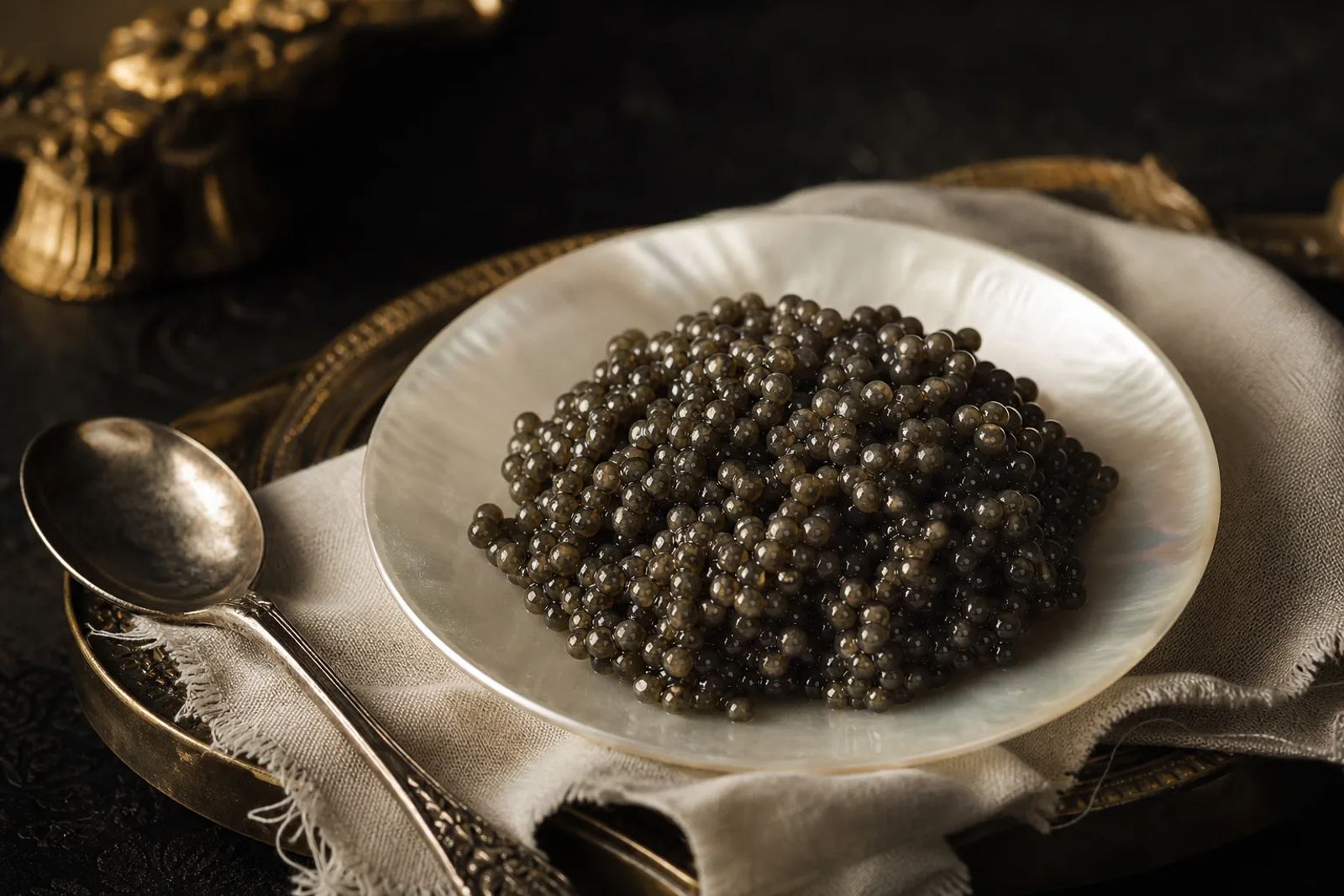
Beluga in the name does not make this pure beluga caviar. Beluga x Siberian brings together two species: beluga, listed by CITES as Huso huso, and Siberian sturgeon, Acipenser baerii. It is sturgeon caviar, but a clear description names both parents and calls the result a “hybrid”. Which parent is female matters too.
Beluga x Siberian: quick reference
| Field | What is documented |
|---|---|
| Parentage documented in farming | Male beluga, Huso huso, and female Siberian sturgeon, Acipenser baerii: lenbel. 3 |
| Reciprocal parentage claimed in commerce | Female beluga and male Siberian sturgeon, according to the seller. 4 |
| CITES hybrid codes | HUSxBAE for male beluga and female Siberian; BAExHUS for male Siberian and female beluga. 1 |
| Farming history | Lenbel described in a 2022 aquaculture study. 3 |
| Finished bead size and colour range | The cited lenbel study covers juvenile anatomy, not finished caviar. 3, 4 |
| Conservation | Both parent species listed as Critically Endangered in the 2022 IUCN assessment summary. 9 |
The distinction running through this table is simple: aquaculture research documents one direction of the cross; a seller describes the reverse.
Which parent comes first?
Read the parents, not just the product name. “Beluga x Siberian” alone does not tell you which fish supplied the eggs and which supplied the sperm.
Here, ordinary prose puts the female parent first and names both parents explicitly. CITES works the other way round. Resolution Conf. 12.7 (Rev. CoP17), Annex 2, places the male species code first, followed by x and the female code.
For a female Siberian sturgeon crossed with a male beluga, the CITES formula is HUSxBAE. Reverse the parents and it becomes BAExHUS. Annex 1 contains the universal labelling guidelines. The mechanics are explained in hybrid labelling.
Codex CXS 291-2010, section 7.1, requires a hybrid's common name to be supplemented with “hybrid”. Codex is an international food standard, not automatically national law. For scientific formulas, establish the naming convention before decoding the order of the parents.
What is actually documented?
Lenbel has a place in farming literature. In a 2022 paper, Novosadov and colleagues describe a female Siberian sturgeon crossed with a male beluga. Their subjects were cultured juveniles: the researchers examined body measurements and counts of anatomical features, rather than the taste or identity of finished caviar. The paper documents the cross, without supplying a complete commercial production history.
The reverse pairing appears in a Taste of Truffles product description: female beluga and male Siberian sturgeon. Its basis is the seller's statement, rather than a verified farm pedigree or CITES trade record.
For a particular batch, ask for three things together: the breeding record, harvest country and traceability documents. A farm's address, a brand's home country and the origin of its roe answer different questions. A repacking location cannot tell you where the hybrid was raised. The broader hybrid caviar guide explains why parentage matters.
Bead size, colour and flavour
What does this particular tin offer? Ask for the lot's measured bead size and the producer's description of texture, salting and maturation. Keep pedigree and pleasure as separate questions.
Judge the caviar in the tin, not an imagined average of its parents.
Taste of Truffles describes the eggs of its claimed female-beluga cross as grey-black, with a creamy character. That gives a picture of the seller's product, rather than an independent tasting or a flavour profile for every beluga and Siberian hybrid. It cannot establish how the reciprocal cross tastes.
Judge the caviar in the tin, not an imagined average of its parents. Beluga's documented egg diameter of 3.6 to 4.3 mm concerns mature eggs of Volga beluga. It is not a finished hybrid caviar measurement or a specification for this cross. Large-looking beads and a familiar flavour may shape the experience; neither establishes species identity.
Other documented beluga crosses
Beluga has also been crossed with sterlet and Russian sturgeon in peer-reviewed research. The codes below apply the CITES male-first rule to the stated parents; they are calculated from that rule, rather than copied from individual trade declarations.
| Cross | Male parent | Female parent | CITES code | Documented in trade |
|---|---|---|---|---|
| Bester | Sterlet, Acipenser ruthenus | Beluga, Huso huso | RUTxHUS | Not reliably established |
| Sterbel | Beluga, Huso huso | Sterlet, Acipenser ruthenus | HUSxRUT | Not reliably established |
| Russian sturgeon cross | Russian sturgeon, Acipenser gueldenstaedtii | Beluga, Huso huso | GUExHUS | Not reliably established |
| Reciprocal Russian cross | Beluga, Huso huso | Russian sturgeon, Acipenser gueldenstaedtii | HUSxGUE | Not reliably established |
Bester, the offspring of a female beluga and male sterlet, has its own bester caviar profile. The reciprocal sterbel was produced experimentally using beluga sperm in a study published in 2023. A cytological study published in 1991 examined reciprocal beluga and Russian sturgeon hybrids. These studies establish that the hybrids were produced, not that their caviar is available.
Kaluga is a different fish. “Kaluga Beluga” does not establish a Huso huso parent, and the familiar kaluga and Amur hybrid belongs to another pairing.
The parents and their conservation
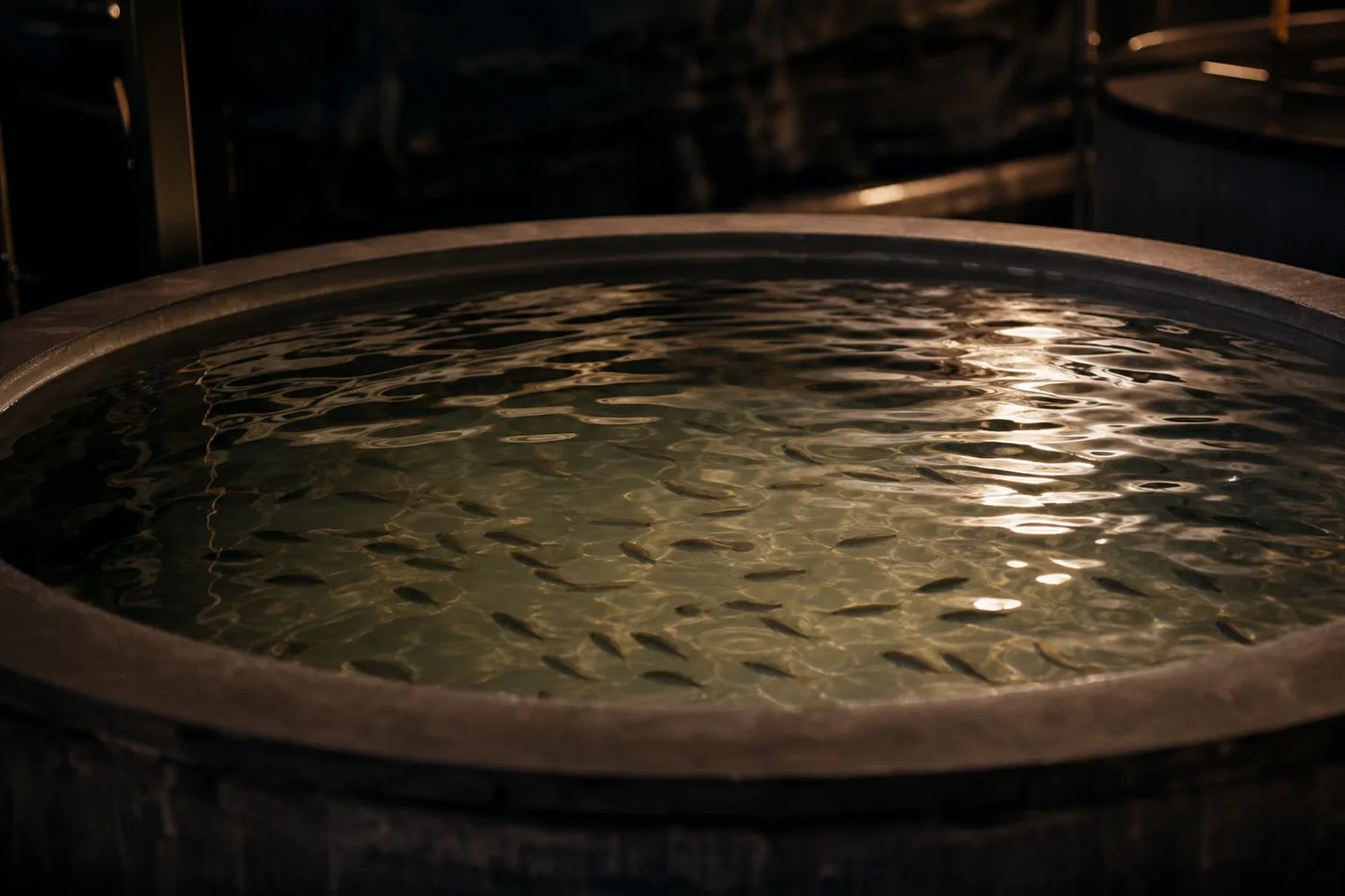
Both parent species are Critically Endangered in the 2022 IUCN assessment summary. That status describes the parent species, not a separate conservation category for their farmed hybrid. Producing a hybrid does not by itself demonstrate a benefit to wild populations.
Beluga's historical range spanned the Black, Azov, Caspian and Adriatic seas, according to FAO. A 2004 US assessment described its then-current range as limited to the Caspian and Black Sea basins. Siberian sturgeon is native to Siberian river systems and the Lake Baikal basin. The Siberian sturgeon profile gives its separate species account.
Even the scientific genus names are under debate. On 22 October 2025, the IUCN Sturgeon Specialist Group and World Sturgeon Conservation Society rejected revisions by Brownstein and Near and by Kottelat and Freyhof. They proposed instead to move Huso species into Acipenser. This article retains the CITES names and codes so that the legal terminology remains explicit and consistent.
What the label should tell you
“Beluga hybrid” and “Beluga” are different descriptions under Codex's naming standard. The hybrid parentage should be clear, not concealed behind a prominent species name.
That distinction matters under EU consumer law: Regulation (EU) No 1169/2011, Article 7, requires consumer information not to mislead about a food's identity or composition. Wildlife marking is separately governed by Regulation (EC) No 865/2006, Article 66. Customs classification does not decide whether a retail name is misleading.
Within the UK, Great Britain applies its assimilated version of Regulation 1169/2011, while EU food information law applies in Northern Ireland.
The US has separate guidance. Nonbinding FDA CPG Sec. 540.150 advises unqualified caviar for salted sturgeon roe, other fish names in substantially equal size and prominence, and a prominent declaration of artificial colour.
Alongside these naming requirements, a CITES label supplies traceability information, rather than independent verification of the contents.
For genetic verification, the method matters. A 2017 study tested nuclear DNA markers, including 47 beluga specimens and one beluga caviar sample. Nuclear markers can detect contributions that a maternal-line test alone misses. The research concerned beluga, sterlet and bester identification; it did not validate every commercial beluga and Siberian cross.
Does the US beluga rule cover hybrids?
A beluga parent does not automatically make a hybrid pure beluga under US law. Section 17.44(y) defines beluga products by reference to Huso huso. The explanatory text accompanying the 2005 special rule distinguishes hybrids from beluga protected under that listing.
Hybrids still face import controls. Under 50 CFR 23.43, CITES controls extend to wildlife hybrids according to their recent ancestry. Separately, 50 CFR 23.71 requires the male-first hybrid code on caviar labels. National requirements also apply in Switzerland, the UAE, China, Japan, Russia and Australia, alongside CITES controls.
For pure beluga, the rule contains conditional exemptions for qualifying products and case-by-case aquaculture provisions. It is not a simple permission for anything farmed. Consult the US beluga rule explained before relying on a product description. For a proposed hybrid shipment, obtain written confirmation from USFWS.
Sources
-
CITES. Resolutions of the Conference of the Parties in effect after the 20th meeting, current index, checked November 2026; and Conservation of and trade in sturgeons and paddlefish, Resolution Conf. 12.7 (Rev. CoP17), 2016, Annexes 1 and 2, official-document copy hosted by the US Government. Resolution index; resolution text.
-
FAO and WHO, Codex Alimentarius Commission. Standard for Sturgeon Caviar, CXS 291-2010, CXS 291-2010, section 7.1. Official text retrieved through the FAO document service.
-
Novosadov, A. G., and colleagues. Plastic and meristic signs of the hybrid “lenbel” (F₁ Acipenser baerii × Huso huso) under cultivation conditions, Fisheries, issue 4, 2022. Publisher-hosted paper.
-
Taste of Truffles. Royal Beluga Siberian Hybrid Caviar, undated commercial description.
-
FAO. Chebanov, M. S., and Galich, E. V. Sturgeon Hatchery Manual, Fisheries and Aquaculture Technical Paper 558, 2013 reprint, section 1.2.1. Manual.
-
Piyanova, S. V., Filippova, O. P., and Zuevskiy, S. E. Oogenesis of bester hybrids (female Huso huso × male Acipenser ruthenus) during the inter-spawning period while cultured in a recycling system, Journal of Applied Ichthyology 31, 2015, pages 64 to 70. Paper.
-
Study authors, indexed by the US National Library of Medicine. The successful production of “sterbel” hybrids using beluga (Huso huso) cryopreserved sperm, 2023, PMID 36764190. Study record.
-
Cytologia, Japan Science and Technology Information Aggregator, Electronic. Cytological Analysis of the Reciprocal Hybrids between Low- and High-Chromosome Acipenserids, the Great Sturgeon, Huso huso, and the Russian Sturgeon, Acipenser gueldenstaedtii, volume 56, issue 4, 1991. Publisher record.
-
North American Sturgeon and Paddlefish Society. Webb, M. IUCN Assessment 2022, 1 August 2022, comparative species-status table. Assessment summary.
-
World Sturgeon Conservation Society. Bronzi, P. IUCN SSG summary report, 13 November 2025, reporting the joint meeting of 22 October 2025. Report.
-
UK Government. Packaging and labelling, current guidance, retrieved November 2026, sections on food information and applicable legislation in Great Britain and Northern Ireland. Guidance.
-
European Commission. Commission Regulation (EC) No 865/2006, consolidated text dated 18 February 2025, Article 66. Consolidated regulation.
-
Scientific Reports. Nuclear DNA markers for identification of Beluga and Sterlet sturgeons and their interspecific Bester hybrid, 2017, methods and results. Full paper.
-
US Government, Electronic Code of Federal Regulations. 50 CFR 17.44, Species-specific rules, fishes, paragraph (y), current electronic text retrieved November 2026. Regulation.
-
US Fish and Wildlife Service. Beluga special-rule explanatory text, Federal Register 70, 4 March 2005, beginning at page 10493. Official publication.
-
US Government, Electronic Code of Federal Regulations. 50 CFR 23.71, How can I trade internationally in sturgeon caviar?, paragraph (b)(2)(i), on hybrid species codes. Regulation.
-
US Fish and Wildlife Service. 50 CFR 23.43, What are the requirements for a wildlife hybrid?, current text retrieved through Cornell Legal Information Institute, November 2026. Regulation.
Last checked: November 2026