
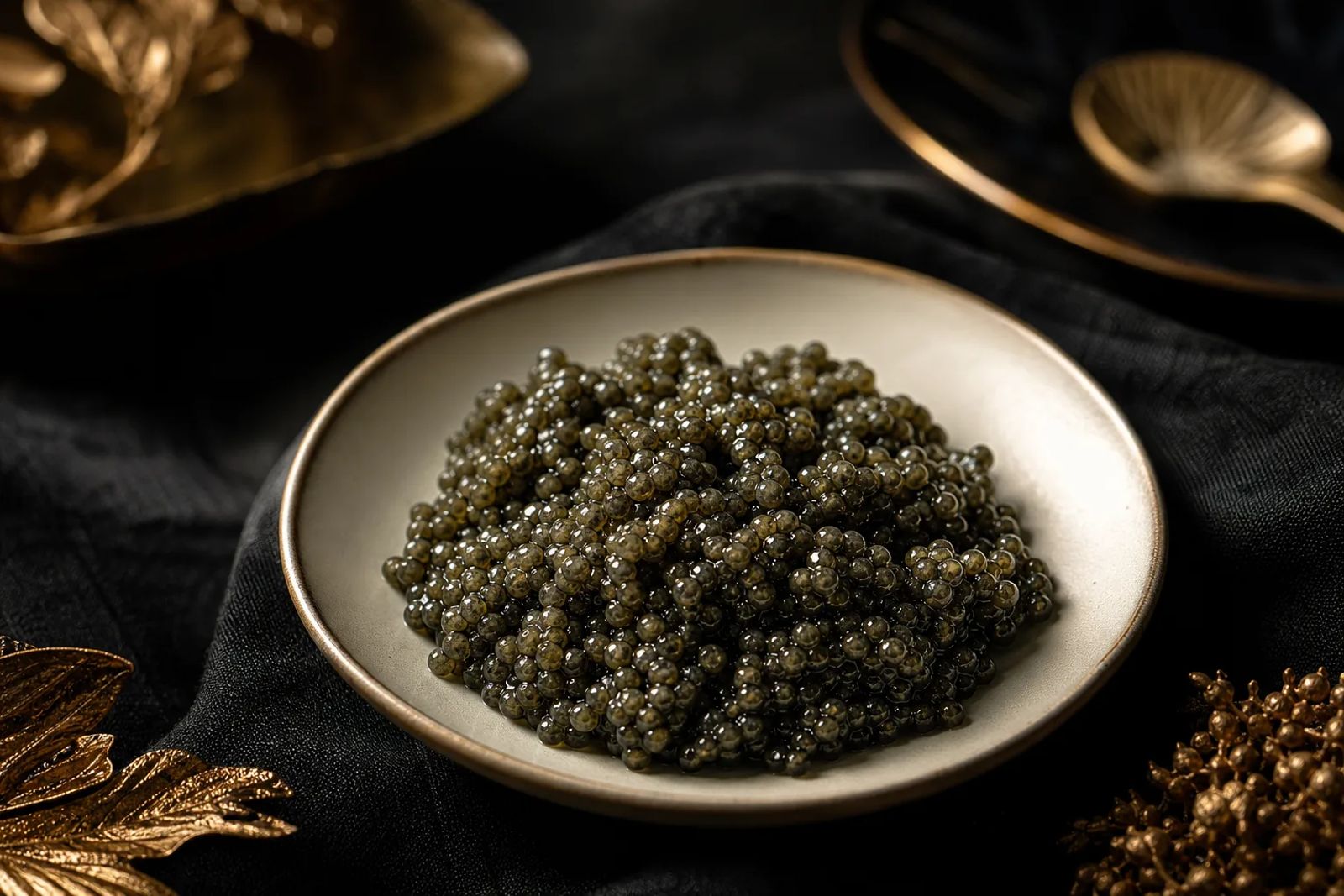
Bowfin roe, often called choupique roe in Louisiana, is salted fish eggs sold as an alternative to sturgeon caviar. Bowfin are neither sturgeons nor paddlefish, and US FDA guidance calls for the fish name alongside “caviar”. The name Amia calva also needs care: modern research recognises a second living bowfin species.
Species fact box
| Field | Reference facts |
|---|---|
| Names | Bowfin; choupique, grinnel and grindle are documented Louisiana names. |
| Scientific names | Amia calva and the separately recognised Amia ocellicauda; not interchangeable names. |
| Classification | Family Amiidae, order Amiiformes. 2 |
| CITES appendix and code | Neither bowfin species is listed; no sturgeon caviar species code applies. |
| IUCN status and assessment year | Amia calva: Least Concern, assessed 2011 before the split. |
| Native range | Eastern North America; the two species have different drainage distributions. |
| Roe appearance | Louisiana Sea Grant described the eggs as greyish black in 1999. |
| Harvest source | Documented Louisiana production comes from wild-caught fish. |
| Wild trade restrictions | State harvest and dealer rules apply; see below, checked November 2026. |
Which bowfin produces choupique roe?
Bowfins belong to Amiiformes, a different order from the Acipenseriformes that contains sturgeons and paddlefish. Their ancient lineage does not make them a kind of sturgeon: the distinction matters for names and wildlife trade rules. The Codex Standard for Sturgeon Caviar covers roe from the sturgeon family Acipenseridae, not bowfin.
Wright and colleagues’ 2022 study analysed 94 bowfin using restriction-site associated DNA sequencing, which compares many genetic markers across the genome. It supported at least two species; Brownstein and colleagues formally revived Amia ocellicauda later in 2022.
Brownstein and colleagues place Amia ocellicauda in the Mississippi, Great Lakes, western Gulf and Connecticut; Amia calva from the Pearl River east. Seafood Watch’s Louisiana assessment therefore says the fishery likely catches Amia ocellicauda: “choupique” alone cannot establish the scientific identity of a batch.
For the neighbouring fish, read paddlefish roe. The parent guide to paddlefish and bowfin roe explains why these products belong together as a reading topic, not as one biological group.
What bowfin roe is known for
Louisiana Sea Grant described bowfin eggs as greyish-black and similar to sturgeon roe in colour, size and taste in its February 1999 Lagniappe bulletin.
Do not use bead size or darkness to identify the species, or assume that dark roe has been dyed.
For choosing between different fish eggs, use caviar substitutes compared. The useful comparison is with a documented product, its ingredients and handling, rather than an imagined standard bowfin flavour.
The Louisiana fishery and state rules
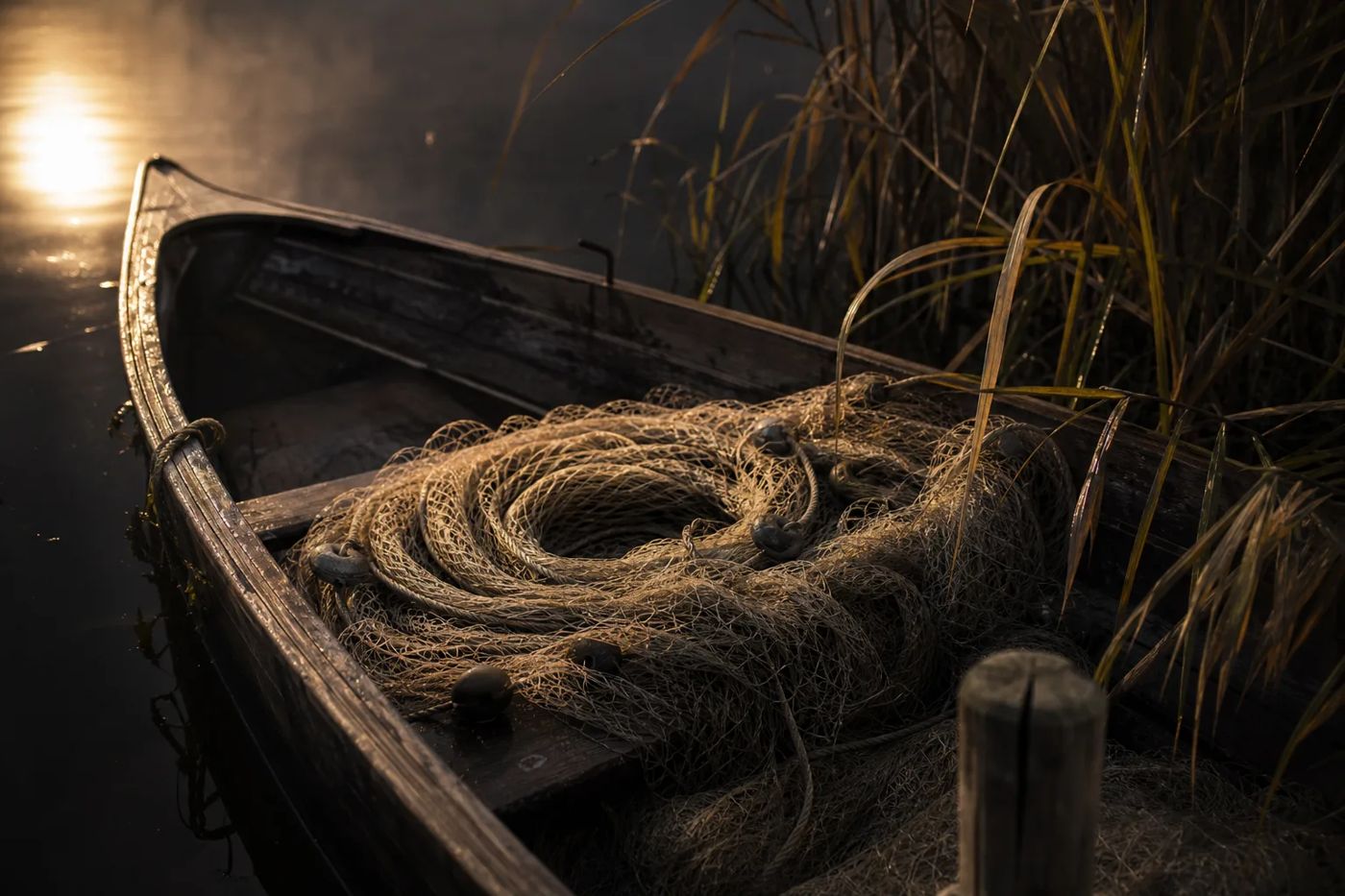
Louisiana Sea Grant records a roe fishery developing in the 1980s, chiefly using freshwater gill nets. Its history is distinct from sturgeon farming, and removing reproductive females makes harvest controls directly relevant to the roe trade.
Louisiana requires commercial fishing and applicable gear licences. Revised Statutes 56:326.5 set minimum total lengths, measured with the mouth closed, of 55.9 cm (22 inches) for commercial licence holders and 40.6 cm (16 inches) for recreational licence holders, and prohibit fishermen from possessing detached bowfin roe on water or land.
Louisiana law prohibits commercial bowfin netting from December through February, except in named parishes and waters, including the defined Atchafalaya Basin Floodway area south of US Highway 190. These exceptions are not permission to fish anywhere in the basin: match the actual location to the guide before harvesting.
Other states have their own rules. Illinois Administrative Code 17, section 830.13, requires commercial roe harvesters to keep bowfin roe whole, intact and inside the fish while on the water or adjacent bank; permits are tied to specified waters.

How bowfin roe must be labelled
In the United States, FDA Compliance Policy Guide 540.150 says unqualified “caviar” should describe salted sturgeon roe. Roe from another fish may be named “[fish name] caviar”, with every word in substantially the same size and prominence, so “bowfin caviar” is the straightforward form.
This is nonbinding agency guidance, not a federal standard of identity. It also calls for ingredient disclosure and a prominent declaration of artificial colour where an authorised colour additive is used; a regional nickname should not obscure which fish supplied the eggs.
In the EU’s 2026 Combined Nomenclature, prepared caviar substitutes fall under 1604 32 00, separate from caviar under 1604 31 00. That customs classification is not a retail naming instruction: Regulation (EU) No 1169/2011, Articles 7 and 17, separately requires non-misleading information and an appropriate food name.
Great Britain applies its assimilated version of Regulation 1169/2011, while EU food information law applies in Northern Ireland. A clear description such as “salted bowfin roe” identifies the food without confusing retail naming with tariff terminology; prepared bowfin roe is classified as a caviar substitute under UK tariff heading 1604.
Bowfin are not CITES-listed, so the CITES sturgeon caviar labelling system does not apply to their roe. That does not remove food import requirements or state wildlife rules; see caviar vs roe for the broader naming distinction.
Keeping ready-to-eat bowfin roe safe
Treat chilled, ready-to-eat bowfin roe as a perishable fish product, following the producer’s storage temperature, use-by date and instructions after opening. US FDA home guidance recommends refrigeration at 4°C (40°F) or below, with a colder label instruction taking precedence.
FDA advises keeping perishable seafood out of refrigeration for no more than two hours, or one hour above 32°C (90°F). Keep the portion being served cold, avoid contact with raw fish and use clean utensils; pleasant smell and appearance do not establish safety.
Bowfin roe contains fish, an allergen. Listeria can grow in chilled foods, so people who are pregnant or have a weakened immune system can ask a doctor or midwife for advice about eating chilled roe. Salt content depends on the product, so use the pack’s declaration rather than a generic caviar figure.
Sources
-
Wright, J. J., Bruce, S. A., Sinopoli, D. A., Palumbo, J. R. and Stewart, D. J. Phylogenomic analysis of the bowfin (Amia calva) reveals unrecognized species diversity in a living fossil lineage. Scientific Reports 12, article 16514, version of record, 3 October 2022. Full text.
-
Pinion and colleagues. The larval attachment organ of the bowfin Amia ocellicauda Richardson, 1836 (Amiiformes: Amiidae) and its phylogenetic significance. Journal of Fish Biology, 2023, DOI 10.1111/jfb.15528. Journal record.
-
Brownstein and colleagues. Hidden species diversity in an iconic living fossil vertebrate. Biology Letters, 2022. Article record.
-
Louisiana State Legislature. Louisiana Revised Statutes 56:326.5: Bowfin; size limitations; eggs. Online statutory text, amendment history through Act 241 of 2021. Statutory text.
-
Louisiana Cooperative Extension Service and Louisiana Sea Grant. Lagniappe, volume 23, number 2, 3 February 1999, bowfin discussion on page 13. Bulletin.
-
Monterey Bay Aquarium Seafood Watch. Environmental sustainability assessment of wild-caught Bowfin from Louisiana caught using set gillnets. Report 28230, Fisheries Standard version 3, 10 July 2023. Assessment.
-
CITES Secretariat. Appendices I, II and III. Online listing valid from 5 March 2026. Appendices index.
-
Louisiana Department of Wildlife and Fisheries. License and Permit Types and Fees. Updated 6 January 2026. Licence requirements.
-
Louisiana Department of Wildlife and Fisheries. Commercial Fishing/Reptile and Amphibian Collecting Licenses and Permits. Online guidance, undated. Gear licensing requirements.
-
Louisiana Department of Wildlife and Fisheries. 2026 Louisiana Commercial and For-Hire Fisheries Rules & Regulations. Updated 18 December 2025, freshwater finfish table, page 28. 2026 guide.
-
Illinois General Assembly, Joint Committee on Administrative Rules. Illinois Administrative Code, Title 17, section 830.13: Special regulations for the commercial harvest of roe-bearing species. Rule amended effective June 2026. Rule text.
-
US Food and Drug Administration. CPG Sec. 540.150: Caviar, Use of Term, Labeling. October 1989, current online guidance. Compliance Policy Guide.
-
US Department of Health and Human Services. CPG Sec. 540.150: Caviar, Use of Term, Labeling. Guidance repository record, 1989, including the guidance-status disclaimer. Repository record.
-
European Commission. Commission Implementing Regulation (EU) 2025/1926, Annex I, 2026 Combined Nomenclature, Chapter 16. Published 31 October 2025. Regulation.
-
UK Government. Packaging and labelling. Updated 4 September 2026, including the distinction between Great Britain and Northern Ireland. Government guidance.
-
US Food and Drug Administration. Selecting and Serving Fresh and Frozen Seafood Safely. Current online consumer guidance, retrieved November 2026. Seafood handling guidance.
-
US Food and Drug Administration. Refrigerator Thermometers: Cold Facts about Food Safety. Current online consumer guidance, retrieved November 2026. Refrigeration guidance.
Last checked: November 2026