
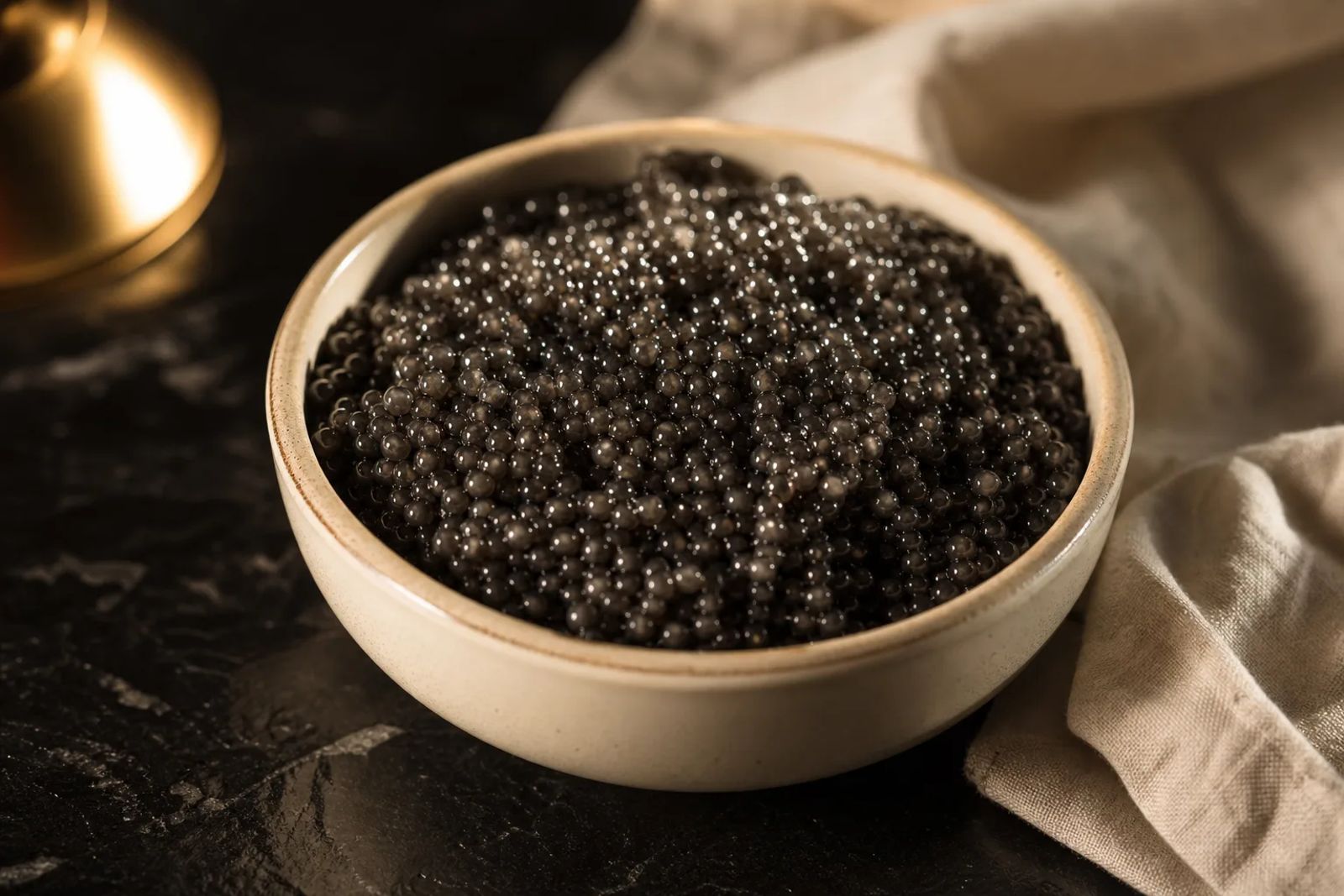
A fish with a broad, flattened snout swims with its mouth open, straining tiny plankton from the water. This is the American paddlefish, Polyodon spathula, also called spoonbill. Its salted eggs become paddlefish caviar, placed among grey-coloured roes in commercial descriptions. The fish is a relative of the sturgeons, rather than a sturgeon itself.
That distinction matters on the label. US wildlife-trade rules regulate paddlefish roe as caviar, while the Codex standard for sturgeon caviar excludes it. For US food labelling, FDA guidance supports the name “paddlefish caviar”, rather than simply “caviar”.
Paddlefish at a glance
| Field | Detail |
|---|---|
| Common and trade names | American paddlefish, paddlefish, spoonbill |
| Scientific name | Polyodon spathula, family Polyodontidae |
| Historical synonyms | Squalus spathula; Polyodon folium |
| CITES | Appendix II; listing year 1992; species code SPA |
| IUCN | Vulnerable; assessed in 2019 and published in 2022, according to IUCN |
| Native range | US river basins; formerly also the Great Lakes in Canada |
| Bead diameter | Awers describes medium-sized roe |
| Bead colour | Grey shades in commercial descriptions; colour cannot identify species |
| Main farming countries | Culture documented in China, Russia and the US |
| Wild trade | US harvest governed by state rules; international trade controlled by CITES |
| Status checked | November 2026 |
The fish behind paddlefish roe
Paddlefish and sturgeon share an order, not a family. The American paddlefish belongs to Polyodontidae, the paddlefish family; true sturgeons belong to Acipenseridae. Both sit within Acipenseriformes, the order used by CITES and US wildlife rules. This distinction explains why different documents can classify the roe differently without contradicting one another.
Its native distribution centres on the Mississippi basin, including the Missouri and Ohio river systems. But its range reaches further. USFWS also records Gulf Slope drainages from Mobile Bay, Alabama, to Galveston Bay, Texas. “Mississippi fish” captures its heartland, not its entire geography.
The broad snout is called a rostrum. Inside the mouth, filtering structures called gill rakers trap the plankton on which paddlefish feed. USFWS describes fish reaching about 2.1 metres in length and nearly 91 kg. Those are reported upper sizes, rather than typical dimensions or a verified record.
Maturity comes at different ages according to location and sex. Oklahoma’s wildlife authority gives spawning-age ranges of 4 to 9 years for males and 6 to 12 years for females. These figures describe that population account; they do not establish the age of a first commercial roe harvest on a farm.
American paddlefish have also been cultured in China. They remain the North American species, distinct from the Chinese paddlefish. The extinct Chinese paddlefish tells that other fish’s history and conservation story.
Grey beads and flavour notes
Captain Marden’s describes silvery-grey beads; Awers describes medium-sized grey roe. Together, these commercial descriptions place paddlefish among the grey-coloured roes. They offer a useful visual introduction, but colour alone cannot establish the species inside a jar.
The flavour descriptions are equally direct. The Caviar Co. calls its paddlefish roe strongly saline. Awers describes earthy and nutty notes. These are accounts of particular products, so use them as tasting pointers rather than a fixed flavour profile for every paddlefish roe.
The clearest comparison with sturgeon caviar begins with the fish itself. Paddlefish is a relative, not a sturgeon variety, however similar a spoonful may taste. Hackleback versus paddlefish untangles a comparison that often causes confusion, keeping the identities of the two fish clear.
Read a product description in the same order: species, origin, processing, then flavour. Ask for the scientific name and the records behind the roe before interpreting words such as “American” or comparisons with another caviar. Those details tell you more about its identity than either sales language or the appearance of a spoonful.

Caviar or not? How CITES, US law and Codex treat paddlefish
For wildlife trade, yes. Under the Codex sturgeon caviar standard, no. For US food naming, the fish’s name belongs alongside “caviar”. Each framework answers a different question: conservation controls, product standards or the information given to consumers.
| Framework | Treatment of paddlefish roe | Source and scope | Checked |
|---|---|---|---|
| CITES | Included in the Acipenseriformes caviar labelling system | Resolution Conf. 12.7 (Rev. CoP17), international wildlife trade | November 2026 |
| US wildlife law | Explicitly included in the definition of caviar | 50 CFR 23.71(a), international trade | November 2026 |
| US food naming | Name the fish alongside “caviar” | FDA CPG 540.150, nonbinding guidance | November 2026 |
| Codex | Excluded from the sturgeon caviar standard | CXS 291-2010, scope and definitions | November 2026 |
Under 50 CFR 23.71, processed paddlefish roe is expressly covered, although the section’s title refers to sturgeon caviar. Calling it “roe” instead does not release an exporter from wildlife controls. CITES recommends a 125 g personal effects limit; national implementation and exemptions vary.
Codex draws its boundary at the family level. CXS 291-2010 applies to granular sturgeon caviar from Acipenseridae. Paddlefish, belonging to Polyodontidae, falls outside it. As an international reference standard, Codex is not automatically binding national law, and this exclusion does not itself prohibit a qualified product name in another jurisdiction.
FDA’s CPG 540.150 distinguishes unqualified caviar from other salted fish eggs. For those other eggs, its policy calls for the fish’s common or usual name alongside “caviar”, with all words substantially equal in size and prominence. Applied to paddlefish, a non-sturgeon fish, that policy supports “paddlefish caviar”. The guide does not discuss paddlefish individually.
The guidance also calls for an ingredient list and, where artificial colour is used, a prominent declaration. Any colour additive must comply with applicable regulations. The guidance does not create a federal standard of identity for caviar. Caviar versus roe explores the broader distinction.
In the EU and UK, customs classification and consumer food naming are separate questions. CITES controls also apply in Switzerland, the UAE, China, Japan, Russia and Australia, alongside domestic import and food rules that vary by country.

Wild harvest, farming and conservation
US commercial roe can come from wild paddlefish fisheries. There is no single nationwide harvest rule: check state permissions and restrictions for the fishery concerned. Paddlefish fisheries explains seasons, harvest controls and conservation rules without treating one state’s arrangements as the national pattern.
The species’ American common name tells you which fish it is, not where its roe was harvested.
The conservation pressures are substantial. The New York Department of Environmental Conservation’s February 2025 assessment reports the global IUCN category as Vulnerable and identifies dams, disrupted migration, habitat damage and overharvest among the threats. That global assessment is distinct from state legal protection, which can vary within the fish’s native range.
Farming is also part of the story. The American Fisheries Society’s aquaculture literature documents propagation in the United States and its spread to Russia and China. Its China chapter, using information current to 2018, records culture across more than ten Chinese provinces, including Hubei and Sichuan. These records establish culture outside North America, but hatchery production does not by itself establish a commercial roe supply.
For a farmed-origin claim, request the producer, the actual country of harvest and supporting lot records. The species’ American common name tells you which fish it is, not where its roe was harvested.
Read the label, know the origin
Start with SPA. That is the paddlefish species code, not POS. Under the US international-trade rule, the original primary container, the container touching the roe, carries a non-reusable label recording species, source, country of origin, harvest year, processing plant and lot information. The source code describes documented origin; it is not a quality grade.
Repacked roe carries additional repackaging information, including the repackaging year and plant code. Keep the locations straight: the repackaging plant may be somewhere other than the country where the roe originated. A retailer’s address and a brand’s nationality describe different things again. Neither replaces the origin recorded in the traceability documents.
A CITES label provides traceability; it does not establish biological identity or food safety. Read in a practical sequence: species first, origin second, then the seller’s account of processing and flavour. Keep the label and supplier details so that any mismatch can be queried against the records.
For another American roe comparison, turn to paddlefish and bowfin roe. The guide introduces a different species alongside paddlefish; the comparison articles also help distinguish products that may look similar on a menu or supplier’s list. Keep the two essential questions separate: which species is it, and where did the roe originate?
Sources
-
US Fish & Wildlife Service. Paddlefish (Polyodon spathula). Undated species account, retrieved November 2026. Sections on size, range and reproduction. Species account.
-
US Fish & Wildlife Service. Freshwater Fishes of America: American Paddlefish. Undated public-information sheet. Natural-history section on filter feeding and gill rakers. Information sheet.
-
Oklahoma Department of Wildlife Conservation. Paddlefish. Undated field-guide entry, retrieved November 2026. Life-cycle section. Field-guide entry.
-
Fishes of Texas. Polyodon spathula. Undated taxon account, retrieved November 2026. Taxonomic hierarchy and synonymy. Taxon account.
-
New York State Department of Environmental Conservation. Species Status Assessment: Paddlefish. Updated February 2025 by Eli Lagacy. Status, threats and management discussion. Assessment.
-
CITES. Conservation of and trade in sturgeons and paddlefish. Resolution Conf. 12.7 (Rev. CoP17), 2016 revision, still current after CoP20. Resolution.
-
Czech Ministry of the Environment. Decree No. 210/2010 Coll., English translation, Annex 4. Species-code table for Acipenseriformes, 2010. Official translation.
-
US Government Publishing Office. Code of Federal Regulations, Title 50, Part 23. Annual edition, 2024, section 23.71. Official CFR text.
-
US Food and Drug Administration. CPG Sec. 540.150: Caviar, Use of Term, Labeling. Reissued October 1989, current FDA-hosted guidance retrieved November 2026. Compliance policy guide.
-
FAO and WHO, Codex Alimentarius Commission. Standard for Sturgeon Caviar, CXS 291-2010. Adopted 2010; last modified in 2026, according to the Codex register. Sections 1, 2.1 and 2.2. Standard.
-
Mims, S. D., Onders, R. J. and Shelton, W. L., American Fisheries Society. Propagation and Culture of Paddlefish, in Paddlefish Management, Propagation, and Conservation in the 21st Century. 2009. Retrieved chapter abstract. Chapter record.
-
Ji, H. and Li, Y., American Fisheries Society. Distribution and Aquaculture Status of North American Paddlefish in China, in Paddlefish: Ecological, Aquacultural, and Regulatory Challenges of Managing a Global Resource. 2019. Chapter abstract reporting conditions through 2018. Chapter record.
-
Captain Marden’s Seafoods. Caviar List. Commercial description of silvery grey paddlefish roe.
-
Awers. Commercial descriptions of grey paddlefish roe with earthy and nutty flavours.
-
The Caviar Co. Paddlefish. Commercial description of paddlefish roe with strong salinity.
Last checked: November 2026