
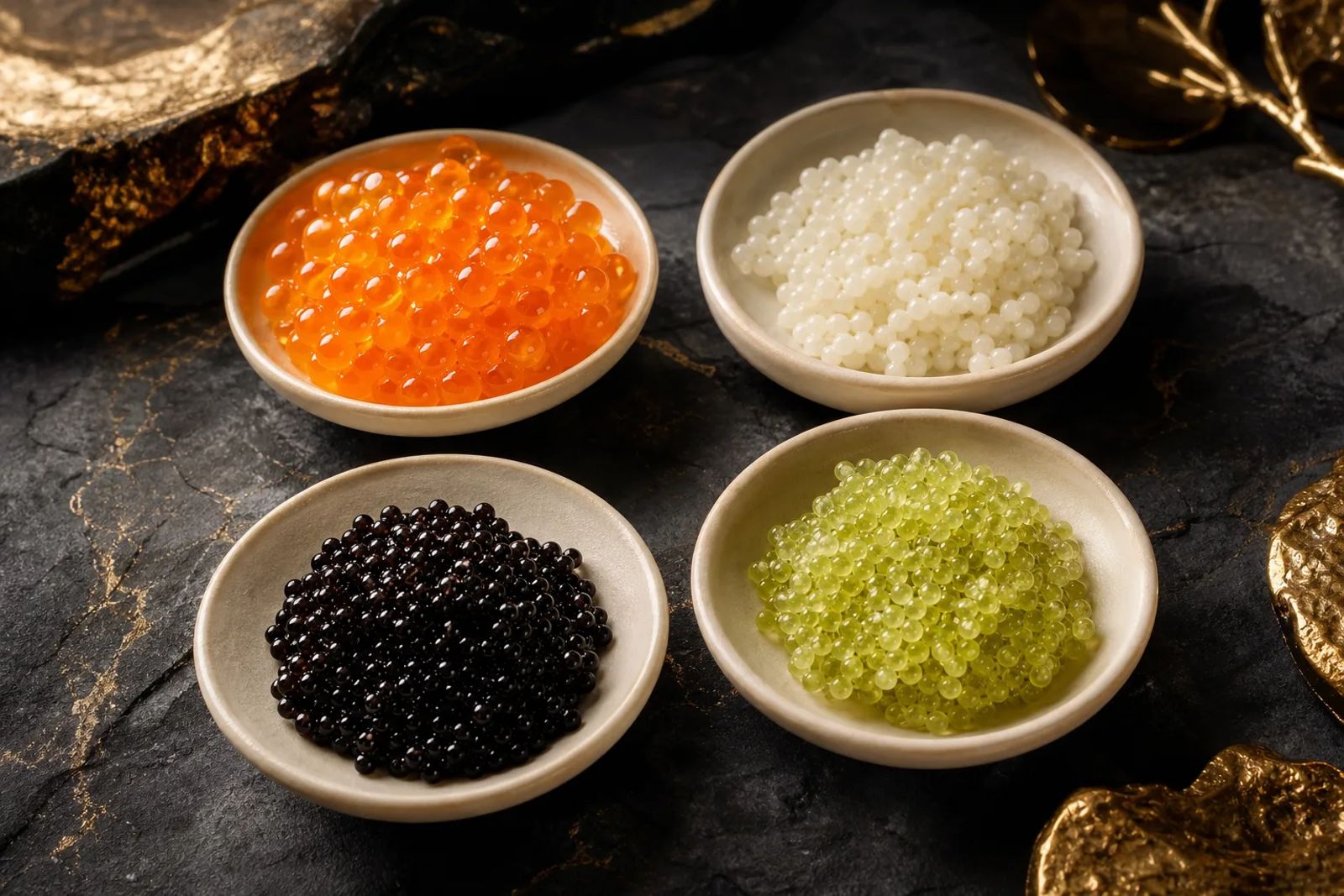
Milky white, pearly and opaque: researchers’ description of snail eggs captures just how far a caviar substitute can stray from sturgeon roe. Some pearls are fish eggs. Others are formed from fish flesh, seaweed gels or a chosen kitchen liquid. Finger-lime “caviar” grows inside a citrus fruit.
Start with what is in the bead. Then choose for the job: a cold garnish, a cooking ingredient or a dish that meets particular dietary needs.
- Fish roe and snail eggs are animal foods, not vegetarian alternatives.
- Alginate makes a gel; the full ingredient list determines whether the product is vegan.
- An unopened jar that keeps at room temperature may need refrigeration once opened.
What counts as a caviar substitute?
A culinary alternative, rather than a single legal category. “Caviar substitute” brings together foods with very different ingredients, textures and uses.
Codex CXS 291-2010 covers salted eggs of Acipenseridae, the true sturgeons. It is a reference standard, not automatically national law. US FDA guidance CPG 540.150 recommends reserving unqualified “caviar” for salted sturgeon roe, naming other fish in equally prominent type and declaring artificial colour prominently.
EU and UK customs distinguish caviar, 1604 31 00, from fish-egg substitutes, 1604 32 00. Those headings do not automatically classify snail eggs or plant pearls, and customs codes do not decide retail names. EU Regulation 1169/2011, Article 7, prohibits misleading information. Great Britain applies its assimilated version, while Northern Ireland generally follows EU food-labelling rules.
Caviar substitutes at a glance
Compare ingredients, not marketing names. A blank heat cell means no comparable cooking performance is given, rather than that the food cannot be heated. Storage and shelf life remain product-specific.
| Substitute | Made from | Animal or plant | Heat stable | Main allergen |
|---|---|---|---|---|
| Lumpfish, capelin and flying-fish roe | Salted or seasoned fish eggs | Animal | Fish | |
| Salmon, trout and whitefish roe | Fish eggs, usually salted | Animal | Fish | |
| Herring-based pearls | Fish flesh, starch and other ingredients | Animal | Warm use specified for one formulation | Fish; sometimes molluscs |
| Snail eggs | Land-snail eggs, usually in brine | Animal | Molluscs | |
| Seaweed or alginate pearls | Water, alginate and flavourings | Plant-based if all ingredients qualify | Depends on formulation | Check added ingredients |
| Kitchen-made spheres | Chosen liquid and gelling system | Depends on liquid and gel | Depends on recipe | Depends on recipe |
| Finger-lime vesicles | Citrus fruit pulp | Plant | No listed priority allergen inherent to citrus |
These ingredient, heat and allergen distinctions draw on the cited food specifications, experimental research and jurisdiction-specific allergen lists.
Fish roe and herring-based pearls
Roe means fish eggs. Lumpfish roe, masago from capelin, tobiko from flying fish, salmon roe, trout roe and whitefish roe are genuine animal eggs, even when presented as alternatives to sturgeon caviar. None suits a vegetarian or vegan diet. Switching fish species also leaves fish allergy a consideration.
California Caviar Company describes its whitefish roe as small and crisp, and suggests serving it with hot pasta or grilled fish. That gives a producer’s account of its product, rather than a comparative cooking trial; the cited sources offer no texture descriptions for the other named fish roes.html).
Herring pearls can be something quite different: fish flesh shaped into beads, rather than herring roe. One Arenkha specification describes smoked herring, starch and cuttlefish ink formed into creamy-textured pearls, then pasteurised. It lists fish and molluscs as allergens and suggests warm soups and pasta. It does not establish how the pearls withstand prolonged boiling.
Read the ingredients as closely as the fish name. Salt, seasonings, preservatives and added colour can distinguish two products made from the same roe, while the name alone cannot tell you whether either is pasteurised. Black or orange tells you little about the recipe. US FDA guidance recognises coloured fish roe and recommends a prominent declaration of artificial colour.
Snail eggs: pearly, white and distinctly animal
Snail caviar comes from land-snail eggs, not fish roe. Researchers describe spherical eggs that are milky white, pearly and not translucent. Processing can change their structure.
A review documents products that are washed, salted, flavoured and sometimes pasteurised. That range matters: there is no single finished texture or shelf life for the category. The particular preparation, rather than the name “snail caviar”, is what you need to understand.
These are animal eggs, neither vegetarian nor vegan. Read the snail-egg guide to explore them as a food in their own right, rather than expecting the experience of sturgeon caviar.
Plant pearls, kitchen spheres and citrus
Seaweed caviar is usually a manufactured gel bead, not an egg harvested from seaweed. Alginate, a seaweed-derived gelling material, forms a gel on contact with calcium. The liquid and other ingredients supply the flavour.
The distinction is useful in the kitchen. A plant-based recipe can suit vegans and vegetarians; a sphere made with fish stock, chicken broth or animal gelatine cannot. The gelling ingredient alone does not settle the question.
Heat can leave a pearl round while changing its bite. In a 2019 study, Kim and colleagues heated one calcium alginate bead formulation at 40 to 100°C (104 to 212°F) for 5 to 60 minutes. The beads largely kept their roundness, but higher temperatures made them firmer and smaller. The result describes that formulation, rather than the cooking performance of every commercial pearl.
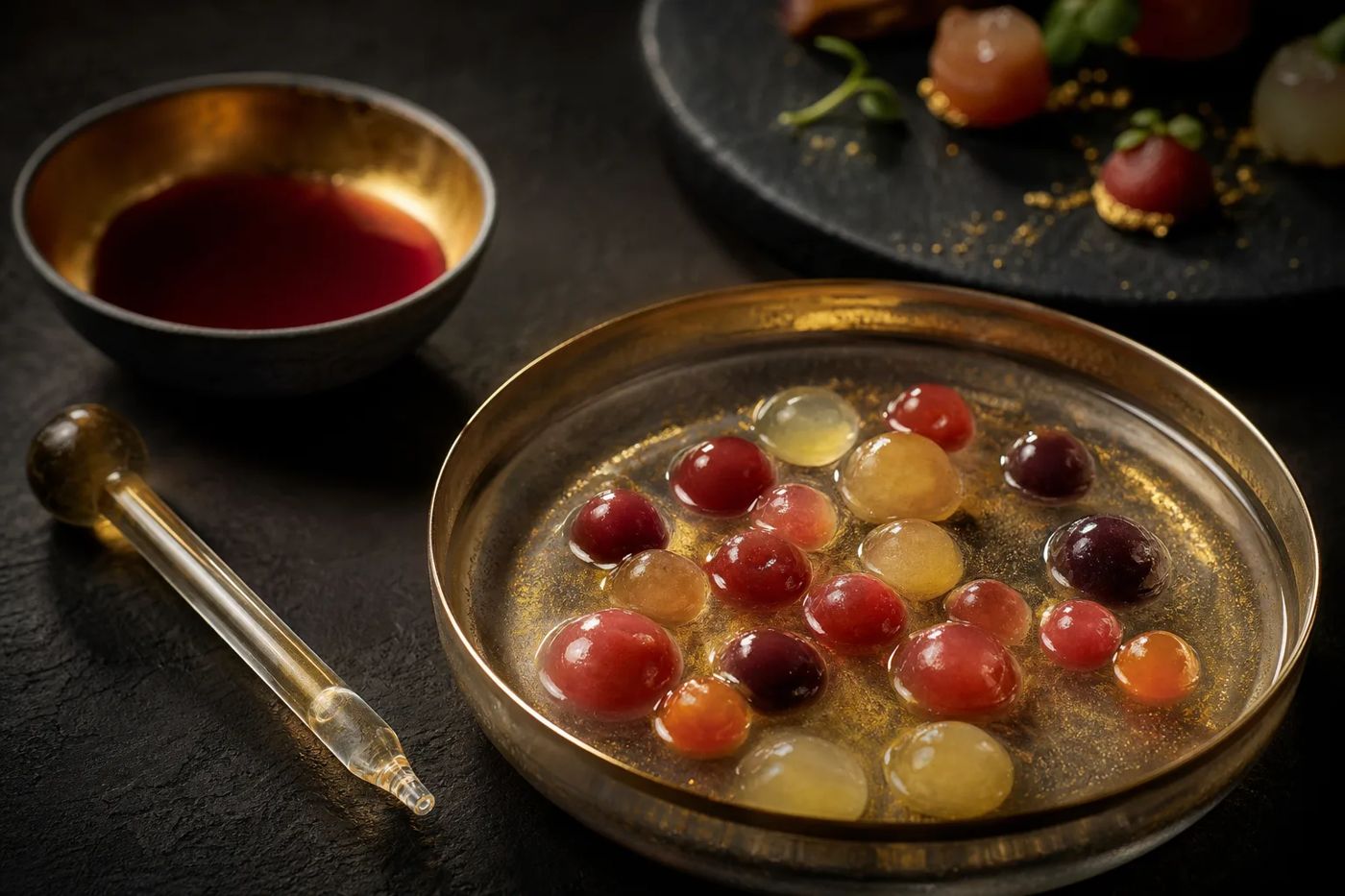
Kitchen spherification encloses a chosen liquid in a calcium-alginate structure. It can turn a savoury stock into a garnish or make fruit pearls; the liquid and gel determine dietary and allergen suitability. For commercial examples and ingredient checks, see seaweed and vegan alternatives.
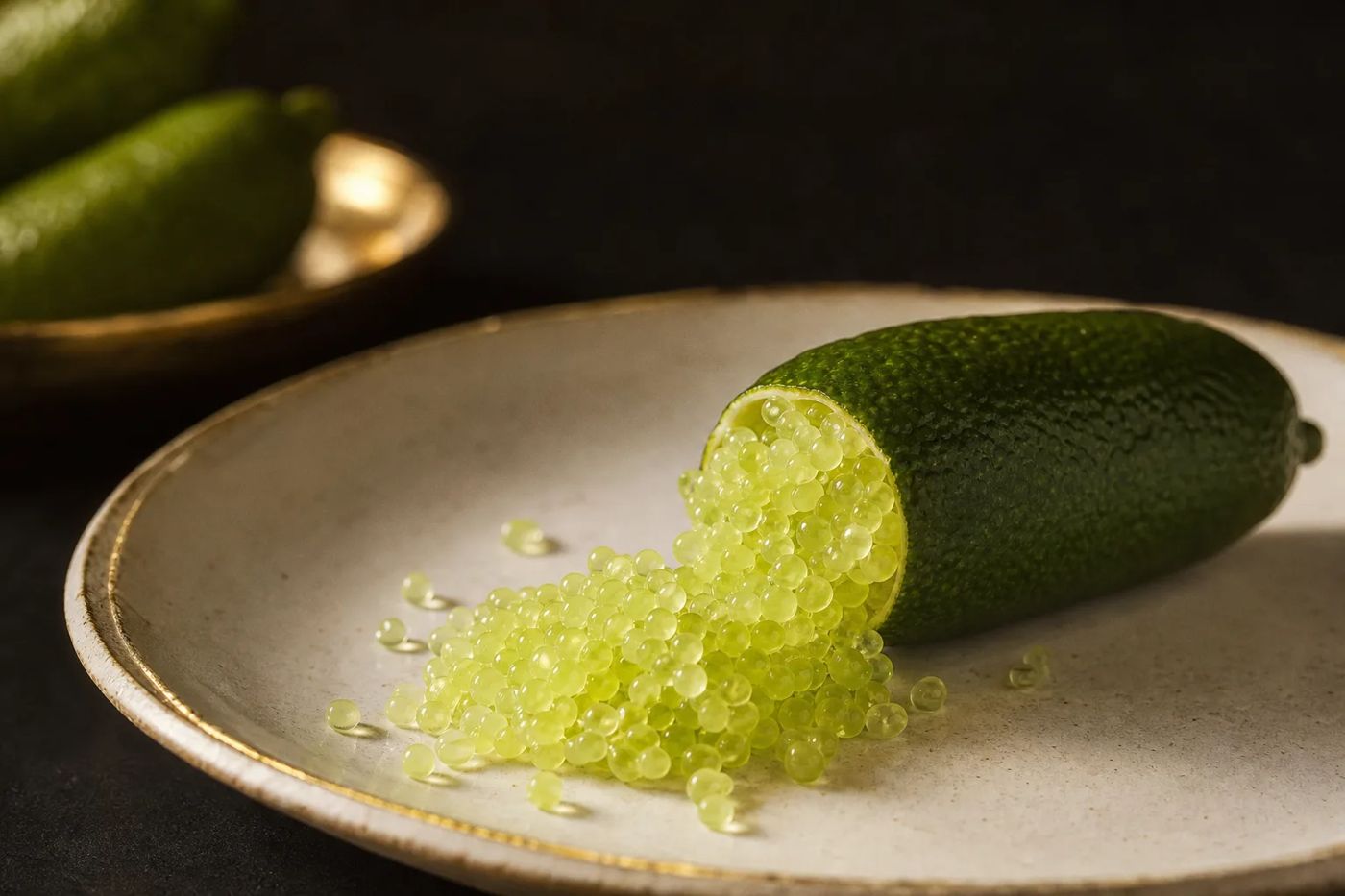
Finger-lime “caviar” needs no manufactured sphere. Its pearls are the fruit’s natural juice vesicles, delivering citrus juice rather than a fish-derived garnish. Choose them when a dish wants acidity, not an imitation of roe flavour.
Cultured products: development and authorisation
Cultured caviar belongs in a separate category from plant-only imitation. In January 2025, UMAMI Bioworks announced a blend of cultured sturgeon cells and plant ingredients. It is therefore not vegan.
The announcement marks product development, not permission to sell in every country. Consumer availability, authorised uses, storage requirements and cooking performance must each be established for the particular product.
Herring pearls can be something quite different: fish flesh shaped into beads, rather than herring roe.
The FDA maintains an inventory of completed consultations for foods made with cultured animal cells. A company’s sensory or sustainability claims remain company claims: they are neither independent findings nor evidence that a regulatory review has been completed.
Storage: read the instructions, not the category
Check three things before choosing a product: its unopened storage conditions, its use-by or best-before date, and its limit after opening. Chilled, frozen, pasteurised and shelf stable describe different things. Pasteurisation uses heat to reduce microorganisms; it does not necessarily make a food shelf stable.
Manufacturer Cavi-art describes its seaweed pearls as stable at room temperature, with an unopened shelf life of up to three years. Those claims belong to that manufacturer’s product, not to homemade spheres.
The herring-pearl specification, by contrast, requires refrigeration despite pasteurisation. Follow the current pack instructions: an older specification for one formulation cannot safely supply the rules for another.
For fish roe and snail eggs, obtain the stated chilled or frozen storage conditions and the after-opening limit before making your choice. Finger limes are perishable fruit. Published storage work concerns particular fruit and packaging, rather than a validated shelf life for extracted vesicles. Neither a pleasant smell nor an attractive appearance establishes safety.
Choose for diet, allergy or cooking
For a vegan or vegetarian dish, choose a clearly specified plant-only pearl or a citrus vesicle. Let the dish decide between savouriness and acidity. This is a choice about ingredients and culinary purpose, not a promise that either reproduces sturgeon caviar or carries a smaller environmental footprint.
For allergy, look beyond the word “vegan”. In the EU, Regulation (EU) No 1169/2011, Annex II, lists fish and molluscs separately as allergens subject to labelling rules. Great Britain applies the assimilated and amended version of that regulation; the EU regulation applies in Northern Ireland. Land snails are molluscs.
US rules differ. FALCPA and the FASTER Act identify nine major allergens, including fish and crustacean shellfish, but not molluscs. That omission does not mean snail eggs cannot cause allergy.
The UK’s Food Standards Agency also warns that vegan labelling does not guarantee freedom from animal-allergen cross-contact. For a diagnosed allergy, check the full ingredients and relevant precautionary warnings, and discuss uncertain substitutes with your doctor. Fish allergy and caviar explains the distinction further.
For cooking, choose a product with an explicit hot-use specification. Do not assume every pearl will survive a simmer. If you want a distinct bead on the finished dish, adding it after cooking gives more control. A manufacturer’s recommendation for warm soup does not establish suitability for frying or baking.
Where to go next
- Caviar Alternatives and Lookalikes: explore the individual foods and their fuller guides.
- Fish Allergy and Caviar: check the questions that matter when avoiding fish.
Sources
-
FAO and WHO, Codex Alimentarius Commission. Standard for Sturgeon Caviar, CXS 291-2010, online text checked November 2026. Sections 1 and 2.
Standard PDF -
US Food and Drug Administration. CPG Sec. 540.150: Caviar, Use of Term, Labeling, October 1989, current online guidance checked November 2026.
FDA guidance -
European Commission. Commission Implementing Regulation (EU) 2025/1926, 23 September 2025, Combined Nomenclature applicable from 2026, heading 1604.
EUR-Lex regulation -
UK Department for Business and Trade. Request for Input: Indicative Long List of US Products, 2025. Entries 16043100 and 16043200.
Government document -
European Parliament and Council. Regulation (EU) No 1169/2011 on the Provision of Food Information to Consumers, 2011, Article 7 and Annex II.
EUR-Lex text -
UK Government. Food Labelling: Giving Food Information to Consumers, current online guidance checked November 2026.
Government guidance -
Food Standards Agency. Allergen Guidance for Food Businesses, current online guidance checked November 2026.
FSA guidance -
US Food and Drug Administration. Food Allergies: What You Need to Know, current online edition checked November 2026.
FDA consumer guidance -
US Food and Drug Administration. Questions and Answers Regarding Food Allergens, Including the Food Allergen Labeling Requirements of the Federal Food, Drug, and Cosmetic Act, Edition 5, 2025. Question B.9.
FDA guidance PDF -
University of Florida, IFAS Extension. Technically Speaking, What Is Sturgeon Caviar?, FA194, online edition checked November 2026.
UF/IFAS publication -
California Caviar Company. Whitefish Roe, undated producer description, checked November 2026. Used only for its attributed texture and hot-use descriptions;
-
Arenkha product specification, hosted by Geyskens. Product Specification: Arenkha Selection MSC, revision 07, 4 July 2016.
Specification PDF -
Animals. Edible Snail Production in Europe, volume 12, article 2732, 2022. Sections on egg production and processing.
Open-access article -
Maćkowiak-Dryka, M., Szkucik, K. and Pyz-Łukasik, R. Snail Eggs as a Raw Material for the Production of a Caviar Substitute, Journal of Veterinary Research, volume 64, 2020, pages 543 to 547.
Research paper -
Journal of Veterinary Research. Occurrence of Selected Pathogenic Microorganisms in Raw and Processed Eggs of Snails of the Cornu Genus, online publication 2021.
Research paper -
Kim, S., Jeong, C. et al. Effects of Thermal Treatment on the Physical Properties of Edible Calcium Alginate Gel Beads: Response Surface Methodological Approach, Foods, volume 8, article 578, 2019.
Research paper -
Foods. Impact of Calcium Lactate Concentration and Holding Time on Caviar-like Chicken Broth Hydrogel Beads, 2025.
Research paper -
Northern Territory Department of Agriculture and Fisheries. Finger Limes, current online research overview checked November 2026.
Government crop information -
Noeparast, H., Panchal, S. K., Holford, P. and Donovan-Mak, M. Effects of Storage Temperature and Packaging Type on the Postharvest Quality of Finger Lime, Foods, volume 15, article 3476, 2026.
Research paper -
Cavi-art. Cavi-art: Kelp Caviar, undated manufacturer page, checked November 2026. Used only for attributed storage claims.
Manufacturer information -
UMAMI Bioworks. Cultivated Caviar, company announcement, 2025, checked November 2026. Used only to establish the announced formulation and development claim.
Company announcement -
US Food and Drug Administration. Inventory of Completed Pre-market Consultations for Human Food Made with Cultured Animal Cells, current online inventory overview checked November 2026.
FDA inventory overview -
Food Standards Agency. Consumer guidance on vegan labelling and food allergy, current online edition checked November 2026.
FSA guidance PDF -
University of Nebraska, Food Allergy Research and Resource Program. Molluscan Shellfish, current online resource checked November 2026.
University allergen resource
The piece was researched using official naming and allergen guidance, peer-reviewed food research and explicitly attributed manufacturer specifications, keeping experimental findings separate from commercial claims.
Last checked: November 2026