
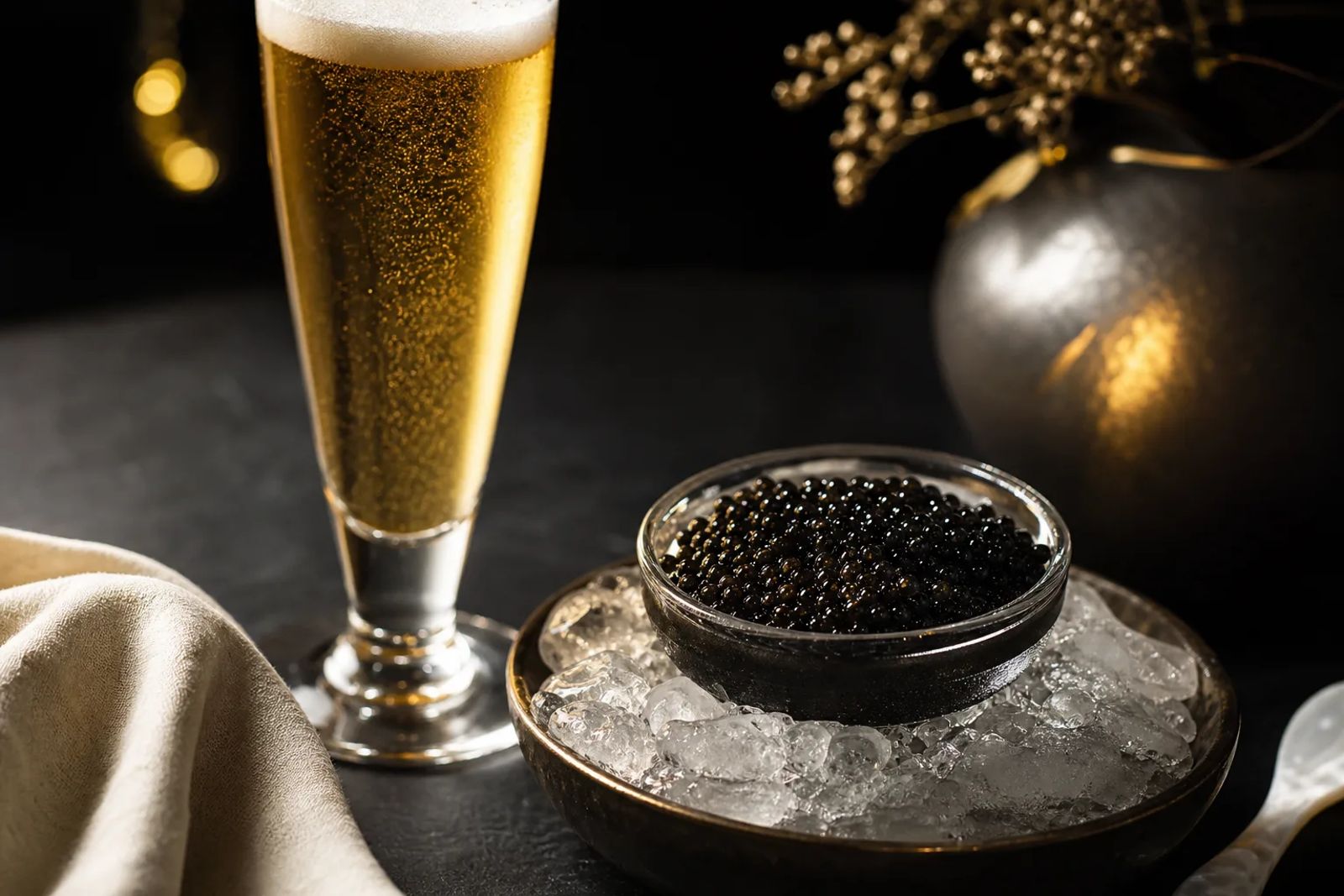
An olive filled with caviar turns a martini garnish into a savoury bite. Chef John Leonardi uses exactly that construction; STK Steakhouse beverage director Stephanie Castaneda prefers no olive at all. Their contrasting recommendations reveal how much the details matter. Beyond the martini, a dry, hoppy pilsner and a glass of fino or manzanilla offer further possibilities. The pleasure lies in choosing the right style, rather than treating beer, sherry or cocktails as a single flavour.
Choosing caviar with beer, sherry and cocktails
Choose the role you want the drink to play: refreshment between bites, a savoury echo of the roe, or a quiet accompaniment. A pilsner, fino or manzanilla, and a restrained martini are useful starting points, each supported by a different kind of recommendation.
The table distinguishes advice specifically about caviar from broader food pairings. These are informed starting points for tasting, rather than controlled comparisons establishing a favourite for everyone. For the wider picture, start with drinks with caviar.
| Drink style | Defining trait | Pairing advice | Source |
|---|---|---|---|
| Pilsner | Pale lager, bitter finish | Garrett Oliver recommends a dry, hoppy pilsner with caviar | Owen Ogletree's account of Oliver's advice |
| Fino | Dry, biologically aged wine | Recommended with salty fish and raw fish | Consejo Regulador fino guide |
| Manzanilla | Dry wine aged in Sanlúcar de Barrameda | Hannes Desmedt pairs it with a caviar dish, highlighting salinity | Consejo Regulador recipe collection |
| Dry martini | Spirit-forward, with dry vermouth | Stephanie Castaneda recommends a very cold vodka version | Food Republic interview |
Beer: start with a dry, hoppy pilsner
Hops need not be the enemy of caviar. Beer educator and brewer Garrett Oliver recommends a dry, hoppy pilsner, according to beer writer Owen Ogletree's account of his advice. The specificity matters: a pilsner is the recommendation, not any intensely hopped beer that happens to be available.
Ask for the style, not simply “lager”. The Beer Judge Certification Program's 2021 guidelines distinguish German Pils from Czech Premium Pale Lager, describing the latter as having more malt richness and body, with pronounced but rounded bitterness. These judging descriptions help you choose the character of the beer, rather than prescribe a caviar pairing.
At the table, that character matters. The Brewers Association's beer-and-food guide identifies carbonation, hop bitterness and flavour intensity as elements of a match. Applied to caviar, those principles suggest bubbles for textural contrast and bitterness for a finish quite unlike still wine.
Wheat beer, sour beer and stout call for more exploration. The same guide recommends wheat beer with lighter seafood and records seafood matches for darker styles. Those dishes are not interchangeable with plain caviar. Oliver's explanation of pairing stresses balance of intensity: a powerful stout can overwhelm delicate white fish.
For a useful home comparison, begin with pilsner and taste the caviar without a topping. Then, if wheat, sour or stout styles interest you, change only the beer. Keep the bite identical. It becomes much easier to tell whether the contrast is enjoyable or the drink is simply taking over.
Sherry: dry, distinctive and full of character
Fino and manzanilla are dry, not neutral. Both are biologically aged wines: during maturation, a layer of yeast called flor develops on the wine. The Consejo Regulador's style guides describe their pale colour and distinctive aromas. Their yeast-derived character is part of the attraction. These are not sweet dessert sherries.
Sweet or smoky drinks can have their own moment; consider saving them for another occasion if you find yourself tasting the cocktail long after the roe has disappeared.
Origin separates the two styles. In Spain, fino can be made under the Jerez-Xérès-Sherry designation. Manzanilla has its own protected designation, Manzanilla-Sanlúcar de Barrameda, and is aged in Sanlúcar. The council oversees both. That distinction concerns place and production; it does not mean every manzanilla must taste saltier than every fino.
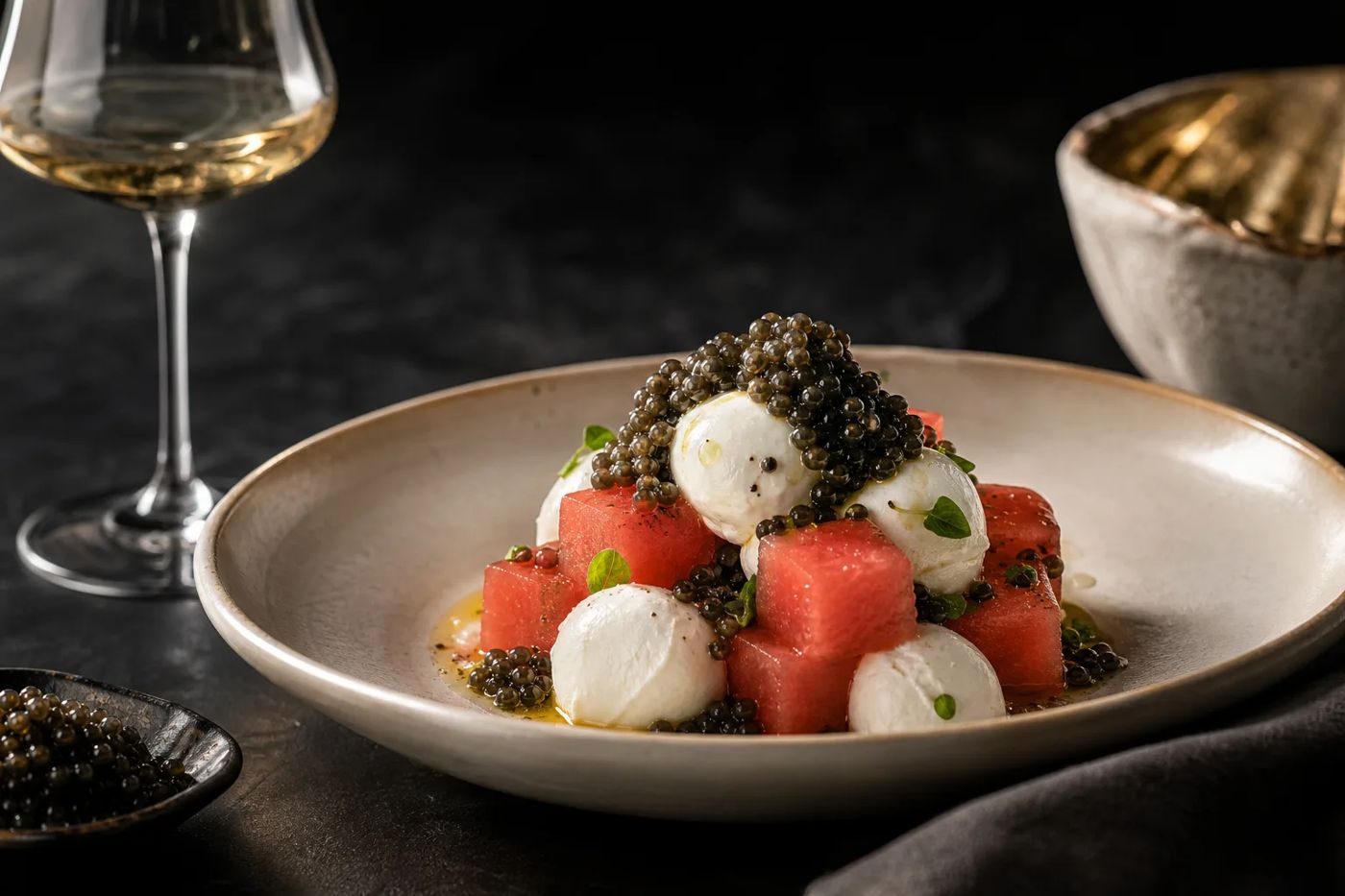
In the council's recipe collection, Hannes Desmedt pairs manzanilla with caviar, watermelon and mozzarella. Desmedt connects the wine's salinity with the caviar's marine character, alongside the fruit and cheese. The match is built around that composed dish, rather than caviar tasted plain.
For fino, the council explicitly recommends salty fish, including anchovies, and raw fish. Choosing it for caviar extends that broader advice; the council does not report a separate caviar trial.
Try manzanilla if its saline character appeals, or fino to explore another dry, flor-aged expression beside the roe.
Cocktails: the martini, plain or garnished
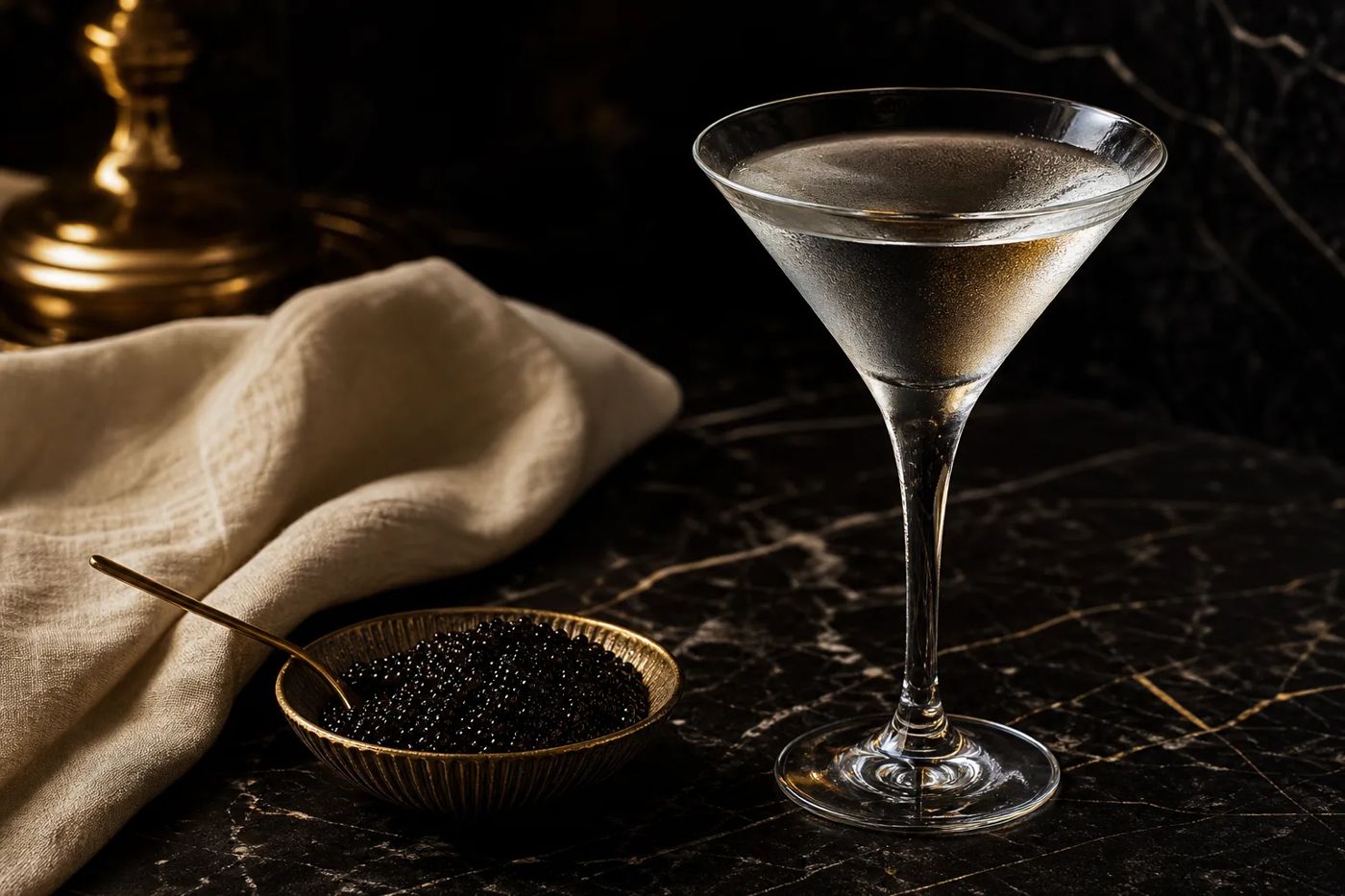
A dry martini makes a useful reference point because its structure is simple: spirit and dry vermouth, without fruit juice, syrup or cream. The International Bartenders Association's classic version is gin-based. For caviar, Castaneda told Food Republic in March 2026 that she prefers a very cold vodka martini, barely any vermouth and no olive. Her advice is a way to balance the drink and roe, not a compulsory recipe.
Decide whether you want vermouth's aromatic character alongside the caviar. A martini adds that ingredient and is therefore a different proposition from a glass of vodka. If you prefer to leave vermouth out, the guide to caviar and vodka covers the simpler pairing.
Then there is the garnish. In a recipe published on 11 February 2026, chef John Leonardi fills olives with caviar to garnish a martini. The olive brings its own flavour; it is not merely a holder for the eggs. This deliberately savoury construction offers a different experience from plain roe served beside a restrained drink.
Start with the caviar separate and taste the martini before adding a garnish. If a caviar-filled olive appeals, try it as a bite in its own right. Loose eggs need not go into the liquid just because a menu calls the drink a caviar martini.
Serving temperatures: cold, with room for flavour
Chill each drink to suit its style. For fino and manzanilla, the council recommends 5 to 7°C on its serving page and 6 to 8°C on its style pages. At the table, it recommends a generously sized white wine glass rather than a tiny copita that restricts expression. Keep the wine cool, but give its aromas room. A small glass is not essential to the pairing.
For classic pilsner, the Brewers Association guide gives 4.5 to 7°C (40 to 45°F). Its warning works in both directions: excessive chilling masks beer's flavour and aroma, while warmth can diminish refreshment.
Castaneda recommends a very cold martini and a chilled glass, without specifying a numerical temperature. These are recommendations for serving the drinks, separate from the requirements for storing caviar.
Sweetness and strong flavours change the aim
Keep the caviar in focus by choosing a drink that leaves room for it. Castaneda advises against sugary cocktails and strongly flavoured drinks such as espresso martinis or mezcal-based cocktails for that purpose. Sweet or smoky drinks can have their own moment; consider saving them for another occasion if you find yourself tasting the cocktail long after the roe has disappeared.
Salt does not automatically demand a bone-dry drink, either. WSET explains that salty food changes the perception of wine, including softening its apparent acidity and enhancing its fruit character. Judge the combined mouthful rather than following a slogan about salt. For grape-based alternatives beyond sherry, turn to caviar and white wine.
One bite, one small sip, then back to the roe. Does the caviar still stand out? Do you enjoy the finish? Keep the sips small and drink water between comparisons. When alcohol is not wanted, non-alcoholic pairings offers a separate route.
UK alcohol guidance: the NHS advises no more than 14 units weekly on a regular basis, spread over at least three days if drinking that amount; during pregnancy or when planning pregnancy, the safest approach is not to drink alcohol.
Sources
- Owen Ogletree, Brewtopia Events. Garrett Oliver's Beer & Food Comments. Ogletree's notes on Oliver's 2002 Craft Brewers Conference talk, checked November 2026. Reports his dry, hoppy pilsner suggestion.
- Beer Judge Certification Program. 2021 Beer Style Guidelines. 2021 edition, online text checked November 2026. Style definitions, particularly Czech Premium Pale Lager and German Pils.
- Brewers Association. American Craft Beer and Food: Perfect Companions. Undated digital edition hosted by the Cicerone Certification Program, checked November 2026. Pairing principles, seafood suggestions and serving guidance.
- Garrett Oliver, interviewed by Big Think. Garrett Oliver: How to Drink a Beer. 2008 interview and transcript. Explains matching flavour intensity and avoiding an overpowering beer with delicate fish.
- Consejo Regulador de los Vinos de Jerez y Manzanilla. Fino. Undated current style guide, checked November 2026. Definition, biological ageing and fish-pairing recommendations.
- Consejo Regulador de los Vinos de Jerez y Manzanilla. Manzanilla. Undated current style guide, checked November 2026. Style, origin and production characteristics.
- Consejo Regulador, recipe contributed by Hannes Desmedt. Royal Belgium caviar with fresh watermelon and mozarella. Undated recipe, checked November 2026. Documents the manzanilla pairing and Desmedt's explanation.
- International Bartenders Association. Dry Martini. Current online recipe, undated, checked November 2026. Gin and dry vermouth composition.
- Food Republic. The Best Cocktail To Pair With Caviar. 2026 interview with Stephanie Castaneda. Vodka martini recommendation, chilling instructions and advice on sweetness and strong flavours.
- Melissa Dowling, Beverage Information Group. What I'm Drinking Now: John Leonardi and the Caviar Martini. 11 February 2026. Chef-contributed recipe documenting caviar-filled olives as a garnish.
- Consejo Regulador de los Vinos de Jerez y Manzanilla. Conservation & Serving. Undated current guidance, checked November 2026. Serving temperatures and glassware.
- Wine & Spirit Education Trust. How to pair wine with your favourite takeaway meals. 2 June 2020. Explains salt's effects on perceived wine acidity and fruit character.
- NHS. The risks of drinking too much. Current online guidance checked November 2026. UK low-risk drinking and pregnancy advice.
This piece was researched through official drinks-education and regulatory-council material, attributed expert interviews and a published chef recipe, separating direct caviar recommendations from broader pairing principles.
Last checked: November 2026