
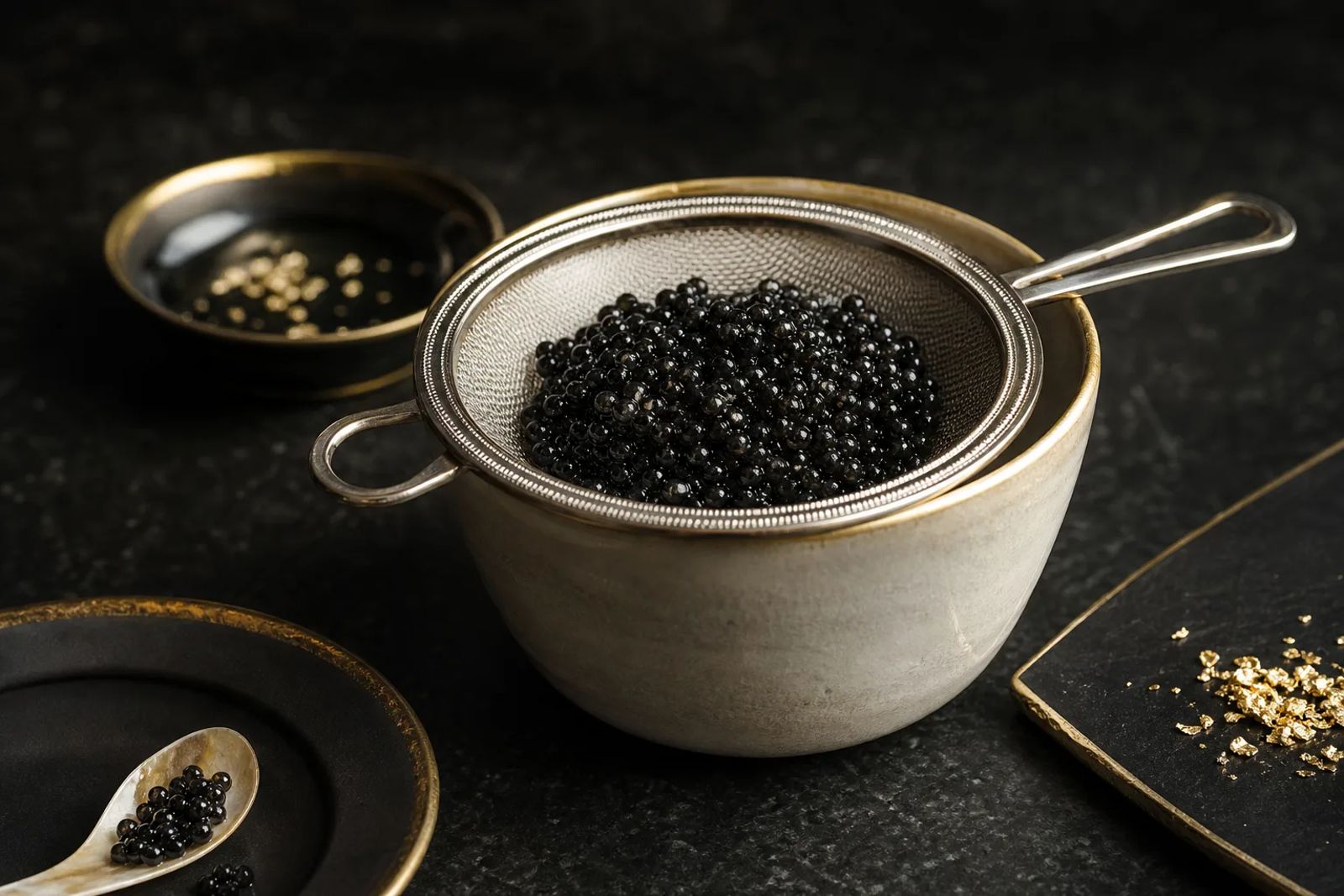
Caviar houses and producers can farm fish, prepare roe, repack caviar or sell another company's production under their own name. To understand a house, separate three things: who owns the business, where its caviar originated and which registered plant packed the particular tin.
The main kinds of caviar business
A historic house is usually understood through its trading history, selection and preparation, rather than through ownership of fish farms. Petrossian, for example, describes sourcing from partner farms and bringing caviar to its workshops; that is a different business model from raising the fish.
An integrated producer combines farming with processing and selling. A processor performs the first packing in the country of origin, while a repacker transfers caviar into new containers. Those last two terms have specific meanings in the CITES labelling system, rather than simply describing how a brand presents itself.
Distributors supply other businesses; retail and restaurant brands are the names customers encounter. According to CITES, processing plants, repackaging plants and traders perform distinct functions that can overlap within a business. The fuller distinctions belong in who does what.
A house's nationality is not the roe's origin
A Paris address tells you where an office, workshop or shop is located, not where the sturgeon lived. Petrossian's own account names partner farms in several countries, including France, Bulgaria, Italy and Poland. French identity and French roe are therefore separate statements, each requiring its own evidence.
On repacked caviar, the CITES country-of-origin field remains distinct from the repacking plant's details. The year can refer to repacking rather than harvest, so it should not automatically be read as the age of the roe. See origin versus repacking before interpreting a national flag or address as provenance.
A Paris address tells you where an office, workshop or shop is located, not where the sturgeon lived.
The same distinction applies to heritage. A house's establishment date does not date its farms, its current owners or the batch in front of you. Treat continuity of a trading name, continuity of ownership and continuity of production as three separate historical questions.
Where different houses fit
The examples below illustrate different roles, not a ranking or a complete directory. Company descriptions establish what each business says it does; they do not independently certify every product sold under its name. The house directory provides the route into the wider set of profiles.
| House | Headquarters country | Documented role | Own roe or sourced |
|---|---|---|---|
| Petrossian | France | Selection, maturation and retail | Sourced from partner farms |
| Caviar Giaveri | Italy | Farming and caviar production | Own farm production documented |
| Tsar Nicoulai | United States | Farming and caviar production | Own farm production documented |
| Kaluga Queen | China | Breeding, farming, processing and sales | Integrated production documented |
The table records company statements and corporate disclosures checked in November 2026. It describes documented operations, not an assurance about every product in each company's range.
Read “own farm production documented” as evidence that the company farms, not a promise that every item in its range comes from those farms. Establish the source of the particular caviar separately, especially when a producer also offers species beyond its documented farm stock.
What the label and register can establish
CITES Resolution Conf. 12.7 (Rev. CoP17), still listed in that revision after CoP20, sets out the international labelling system in Annex 1. It recommends national registration of processing and repackaging facilities. Binding obligations come from the implementing law in the relevant jurisdiction, not from treating the resolution as identical domestic law everywhere.
In the EU, Regulation (EC) No 865/2006, Article 66(6) and (7), provides for caviar marking and licensed processing and repackaging plants, including trade within the EU. In the US, 50 CFR 23.71 sets label requirements for imports, exports and re-exports. These are wildlife-trade rules, not company ownership registers.
Great Britain applies assimilated Regulation 865/2006; Northern Ireland applies EU caviar marking and licensing rules.
Match a plant code to the legal operator and address in the CITES register, rather than searching only for the brand. A retailer selling already packed tins may not itself be a processing or repackaging plant. Absence of its trading name is therefore not, by itself, evidence of unlawful trading.
A CITES label supplies traceability information, not laboratory proof of the contents or a quality award. For the matching process, use checking the CITES register; ask the relevant authority about an unexplained mismatch rather than guessing what a code means.
How to check a caviar house
Keep the enquiry focused on one product and one batch. A useful answer should connect the name on the front of the tin to the operator, the roe's origin and the packing records, rather than offer only a general account of the house.
- Identify the contracting company. Read the legal notice, invoice details or terms to find the registered entity, not just the brand. Record its registration number and distinguish the seller from any parent company, farm operator or overseas distributor named elsewhere.
- Request the actual label. Ask for a clear image of the non-reusable CITES label on the container that will be supplied. Read the species, source and origin fields alongside the plant and lot information; a decorative lid alone is not enough.
- Check the operation. Match the packing code and address against the register, then ask whether the named facility first packed the roe or repacked it. Do not assume the final packing plant also bred the fish or harvested the eggs.
- Check ownership separately. Search the appropriate company registry using the legal name and number. Compare dated filings with acquisition announcements, and distinguish directors from shareholders or controlling owners. Record what the evidence establishes instead of treating a familiar surname as proof.
- Ask for the missing connection. If the seller's name differs from the plant operator, request an explanation of that relationship and the farm origin. Assess whether the answer identifies this batch, rather than merely repeating a national identity or brand story.
Where a house buys caviar in larger containers and portions it into smaller ones, mother tins and repacked tins explains that packing stage. It is a question about the route into the final container, not a separate species, a farm identity or an automatic judgement about quality.
Ownership and what our profiles record
For UK companies, Companies House provides company details, filing histories and information on people with significant control. In France, DATA INPI provides business records, but access to beneficial ownership information is restricted. A public business record and a complete account of ultimate ownership are not necessarily the same thing.
Ownership changes need not erase a house's name or production history. Sterling announced its acquisition by Tsar Nicoulai on 18 December 2024; the Sacramento Bee reported that the transaction closed in October 2024 and identified Pacific Plaza Imports as the acquiring parent company. That is a dated transaction, not permission to assume an unchanged ownership structure indefinitely.
Each profile on this site separates the owner, named as a legal entity with a confirmation date, from headquarters and verified operating sites. It records the company's roles, whether it produces its own roe or sources it, documented species and origin countries, and publicly verifiable plant registration.
Those distinctions let readers compare evidence rather than reputations. An office address answers a location question; a corporate filing answers a business question; a batch record answers a provenance question. None should silently stand in for the others.
How to weigh a house's claims
Treat heritage dates, “since” statements and family histories as company claims unless supported by dated records. Useful evidence includes incorporation documents, archived catalogues, contemporary reporting and records of predecessor businesses. Ask what began on that date: the family enterprise, the brand, the present legal entity or caviar production.
For sustainability, ask which farm, which practice and which assessment the claim covers. A named certification should be checked for scope and validity, rather than extended from one certified site to an entire international range. CITES registration concerns wildlife-trade traceability; it does not certify every environmental claim.
For claims that fish survive egg collection, ask how the eggs were collected and request evidence on handling stress, longer term welfare and later reproduction, not just immediate survival. For purity claims, ask for the ingredient list and a precise definition. Neither claim should replace an explanation of what was actually done.
These checks are not a ranking of farming against sourcing. A specialist sourcing house and an integrated producer can both explain their work clearly; the useful distinction is between a documented account and an unsupported impression. Judge the answer against the specific question you asked.
Sources
- CITES. Resolutions of the Conference of the Parties in effect after the 20th meeting, current online index, checked November 2026.
- CITES. Conservation of and trade in sturgeons and paddlefish, Resolution Conf. 12.7 (Rev. CoP17), 2016 revision.
- CITES Standing Committee. Sturgeons and paddlefish, SC65 Doc. 47, 2014.
- European Commission. EU Wildlife Trade Reference Guide: Annex XIV, online edition, undated.
- US Government, Electronic Code of Federal Regulations. 50 CFR 23.71: How can I trade internationally in sturgeon caviar?, current online text checked November 2026.
- Department of Agriculture, Environment and Rural Affairs. Summary of personal food import restrictions, current online guidance checked November 2026.
- Companies House. Searching the Companies House register, current online guidance checked November 2026.
- INPI. Accès aux API: Entreprises, current online documentation, undated.
- INPI. Bénéficiaires effectifs, current online guidance, including access restrictions introduced in 2024.
- Petrossian. Foire aux questions, company account of partner farm countries and workshops; A Story Behind Every Tin: The Petrossian Legacy, company history, undated.
- Caviar Giaveri. Sturgeon farm, company statement, undated.
- Tsar Nicoulai. Company presentation and headquarters address, checked November 2026.
- Hangzhou Qiandaohu Xunlong Sci-tech Co., Ltd. Global Offering Prospectus, 22 June 2026.
- Sterling Caviar. Sterling Caviar Announces Acquisition by Tsar Nicoulai Caviar, company announcement, 18 December 2024.
- Sacramento Bee, Annika Merrilees. Sterling Caviar acquisition opens new chapter for storied Sacramento County business, 20 December 2024.
- CITES Animals Committee. Understanding the global caviar market, AC30 Inf. 33, 2018.
Last checked: November 2026