
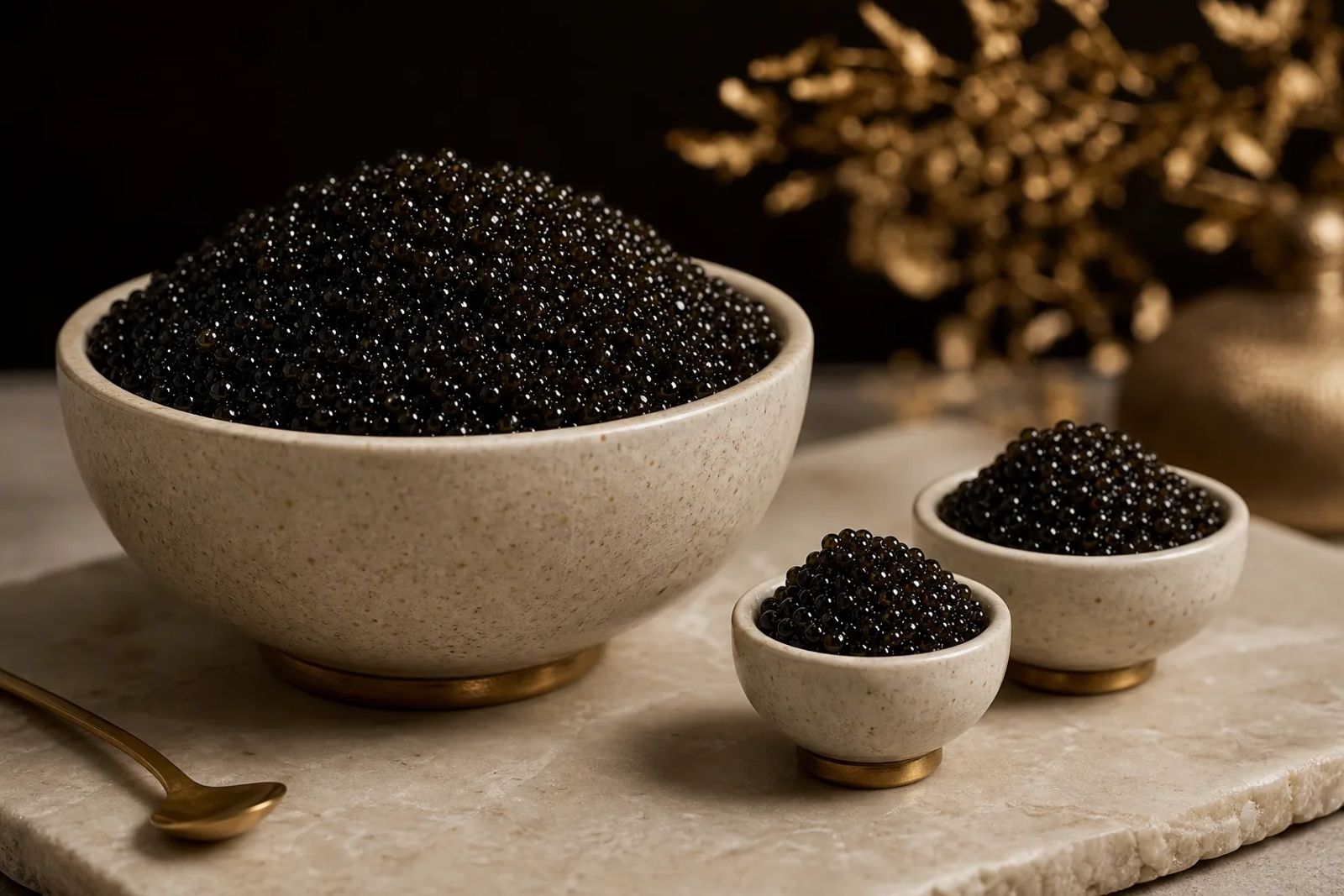
A mother tin is the original container filled with salted roe at the processing plant, commonly used for maturation before the caviar is divided into smaller packs. Repacking is a normal, permitted operation under controlled conditions; its CITES label identifies the repacking facility and year while retaining the country of origin.
What mother tins are
“Mother tin” and “original tin”, often shortened to OT, are trade expressions rather than quality grades. CITES uses a more exact distinction: the processing plant performs the first packaging into a primary container, meaning the receptacle directly touching the caviar; a repackaging plant transfers it into new primary containers.
Black River documents original containers holding up to 1.8 kg (about 63 oz), made from plastic, a reminder that “tin” is not always a literal description of the material.
Commercial examples show different capacities, not a compulsory standard size. Calendar Cheese describes importing mother tins of 1 to 1.8 kg (about 35 to 63 oz); Petrossian describes original tins of approximately 1.8 kg (about 63 oz). Black River documents original containers holding up to 1.8 kg (about 63 oz), made from plastic, a reminder that “tin” is not always a literal description of the material.
Size alone therefore cannot establish whether caviar has been repacked. Nor does a brand name identify the processing plant: the commercial roles are separated in farmers, processors and brands.
How caviar matures in the original container
The original container is also a holding vessel for maturation, not simply a transport pack. Petrossian describes maturation in original tins as part of its flavour development; Black River describes refrigerated curing, with periodic turning over two to three weeks. These are accounts of those businesses' practices, not a universal timetable.
Maturation and deterioration must not be treated as synonyms. A 2024 study of refrigerated Acipenser gueldenstaedtii caviar combined volatile analysis, lipidomics and microbial analysis to investigate flavour change during storage; it linked later changes with oxidation and microbial activity. The study associated later flavour deterioration with lipid oxidation and microbial activity during refrigerated storage.
The meaningful distinction is controlled development versus loss of condition, not simply large versus small. For the processes behind that development, see caviar maturation in the tin.
Why caviar is repacked
Repacking connects bulk production with the quantities used by restaurants and households. Calendar Cheese documents dividing its mother tins into packs of 10 to 250 g (about 0.35 to 9 oz); Browne Trading describes receiving original tins, grading the contents and packing smaller containers. Distribution and presentation can therefore be organised separately from the farm's initial packing.
It also allows a distributor or caviar house to present those portions under its own branding. That branding describes the commercial presentation, not necessarily who harvested or first packed the roe. The wider production sequence belongs in caviar processing, rather than being read backwards from the lid.
What transfer changes, and what it must preserve
Physically, repacking means opening a primary container and transferring caviar into another container, then closing and labelling it. The extra operation creates another point at which handling, cleanliness and temperature control matter. It does not, by itself, establish either damage or an improvement in quality.
Air exposure deserves particular attention because oxidation is one route to flavour deterioration. Mechanical handling can also damage fragile eggs: Codex committee material identifies physical damage as a packing defect. According to Codex committee guidance, handling should minimise physical damage and contamination, with exposure and product temperature monitored during processing.
Temperature control is a food-handling requirement, not an optional refinement. Codex CXS 291-2010 specifies product temperatures of +2 to +4°C (36 to 39°F) during packaging, storage and retail, with 0 to -4°C (32 to 25°F) for wholesale storage and transport. These are professional reference conditions, not serving temperatures; follow the product's validated instructions at home.
Lot separation is equally specific. Codex permits controlled repacking from larger to smaller containers but prohibits mixing caviar from different sturgeon species or lots. A lot is a traceable production grouping, not necessarily an entire farm's output; ordinary portioning must not be confused with pooling unrelated batches. Codex is an international food standard, not automatically binding national law.
How mother tins and repacked tins appear on labels
CITES Resolution Conf. 12.7 remains Rev. CoP17 in the resolutions index published after CoP20. Its Annex 1 distinguishes the original label, carrying the harvest year and processing plant, from the repacked label, carrying the repacking year and repackaging plant. The species, documented source and country of origin remain part of the identification.
The final field on a repacked label can identify the lot or the CITES export permit or re-export certificate. The repackaging plant code incorporates the repacking country's two-letter ISO code when that country differs from the country of origin. A later repacking year is therefore not evidence of a later harvest.
Teaching example, not a real label
Every value below is deliberately impossible or a placeholder. “S” stands for the documented source field, not an actual CITES source code; YYYY and ZZZZ stand for years.
Original: XXX/S/ZZ/YYYY/0000/000
Repacked: XXX/S/ZZ/ZZZZ/QQ-0000/000
| Field | Original container | Repacked container |
|---|---|---|
| XXX | Species placeholder | Same species placeholder |
| S | Source placeholder | Same documented source |
| ZZ | Country of origin | Same country of origin |
| YYYY or ZZZZ | Harvest year | Repacking year |
| 0000 or QQ-0000 | Processing plant | Repackaging plant, with different-country prefix |
| 000 | Lot identifier | Lot or permitted CITES document identifier |
The distinction is the facility's registered role, not a universal extra letter or the size of the tin. Repacking can happen within the origin country, so the absence of a foreign-country prefix does not prove original packing. For a full reading of the fields, use the CITES caviar code.
Where the rules apply
The CITES resolution supplies the international system; domestic legislation determines how it is enforced. Wildlife traceability labels also serve a different purpose from ordinary food information, such as ingredients, storage instructions and date marking. FDA CPG Sec. 540.150 recommends unqualified caviar for salted sturgeon roe, substantially equal type size and prominence for other fish names, and prominent declaration of permitted artificial colouring. The guidance is not itself binding law.
| Jurisdiction | Repacking requirement | Legal source | Checked |
|---|---|---|---|
| EU | Non-reusable labels apply to repacked containers, including domestic trade; licensed facilities keep traceability records. | Regulation (EC) No 865/2006, Article 66(6) and (7). | November 2026 |
| GB | Uses amended assimilated Regulation 865/2006 for marking; APHA handles CITES enquiries. | Article 66(6) and (7); GOV.UK guidance. | November 2026 |
| NI | EU wildlife-trade rules remain relevant; do not substitute GB amendments. | Regulation (EC) No 865/2006; APHA guidance. | November 2026 |
| US | Labels for international trade identify the most recent repacking facility and repacking year. | 50 CFR 23.71(b) and (c); USFWS guidance. | November 2026 |
Switzerland requires traceable, non-reusable caviar labels and registered commercial producers and repackers under CITES Control Ordinance Article 5. A business address should not be confused with the country of origin on a CITES label.
In China, official guidance on repacked foods identifies the repacker's name and address and the statement 分装, meaning repacked. These food-labelling particulars are separate from the CITES fields used in international trade. SAMR's newer food-identification measures were published in 2025 but do not take effect until 16 March 2027.
What a repacked label can and cannot tell you
A CITES label provides a route into records, not proof of the contents by itself. It does not chemically identify the roe, establish flavour quality or certify the cold chain. Checking the registration and matching the lot to commercial and CITES documents gives the code its evidential value.
Equally, an original label is not a complete handling history: it records initial packing, not every movement or temperature event afterwards. If the caviar remains in its original primary container without repacking, the CITES guidelines retain that label, including on re-export. A change of distributor alone does not require the caviar to be transferred.
For the separate distinction between harvest origin and the location of the later operation, read country of origin versus repacking. To turn this explanation into practical purchasing enquiries, continue with original tin or repacked, which covers what to ask the supplier.
Sources
-
CITES. Conservation of and trade in sturgeons and paddlefish, Resolution Conf. 12.7 (Rev. CoP17), 2016, Annex 1. Resolution text.
-
CITES. Resolutions of the Conference of the Parties in effect after the 20th meeting, post-CoP20 index, checked November 2026. Resolutions index.
-
FAO and WHO, Codex Alimentarius Commission. Standard for Sturgeon Caviar, CXS 291-2010, last modified in 2026 according to the Codex register. Standard.
-
European Commission. EU Wildlife Trade Reference Guide, online Annex XIV, “Labelling requirements”, updated October 2026. Explains Article 66 of Regulation (EC) No 865/2006 and the original and repacked label fields. Annex XIV.
-
UK legislation. Commission Regulation (EC) No 865/2006, Article 66, amended UK text, retrieved November 2026. Article 66.
-
APHA and Defra. Check if you need a CITES permit to import or export endangered species, current GOV.UK guidance, retrieved November 2026. Guidance.
-
United States Government. 50 CFR 23.71: How can I trade internationally in sturgeon caviar?, current electronic edition, retrieved November 2026. Regulation.
-
US Fish and Wildlife Service. Notice to Wildlife Import/Export Community: CITES labelling of sturgeon caviar, explanatory bulletin dated 13 March 2008. Bulletin.
-
CITES Standing Committee. SC78 Doc. 59, 2025, technical material examining caviar labels, plant codes and links to traceability records. Document.
-
Codex Committee on Fish and Fishery Products. FFP/34 CRD/5, 2015, proposed technical guidance on sturgeon caviar processing, particularly packing and maturation. Working group proposals submitted for committee consideration.
-
Food Chemistry: X. Multi-omics combined approach to analyze the mechanism of flavor evolution in sturgeon caviar (Acipenser gueldenstaedtii) during refrigeration storage, 2024. Research article.
-
Calendar Cheese Company. Caviar Wholesale, undated company account, retrieved November 2026. Account of mother tins and repacking.
-
Petrossian. Caviar production, undated company account, retrieved November 2026. Production account.
-
Black River Caviar. It's Harvest Time, 2023, and Our Story, undated retrieved version. Original containers; curing account.
-
Browne Trading Company. Packing Caviar at Browne Trading Co., company processing account, retrieved November 2026. Packing account.
-
Swiss federal authorities. Un label pour le caviar déclaré, 16 June 2008; CITES, Register of caviar exporters: Switzerland, current retrieved listing; Federal Food Safety and Veterinary Office, Informationen auf der Lebensmitteletikette, current guidance. Federal notice; register; food-label guidance.
-
China Ministry of Commerce, WTO affairs information service. 食品分装,需要注意哪些问题 [Food repacking: matters requiring attention], November 2024. State Administration for Market Regulation. 食品标识监督管理办法 [Measures for the supervision and administration of food identification], Order No 100, promulgated 14 March 2025, effective 16 March 2027. Repacking guidance; Order No 100.
Last checked: November 2026