

A fight in Tracy’s suite barely interrupts James Bond’s appetite. In On Her Majesty’s Secret Service (1969), George Lazenby’s Bond helps himself to caviar after fighting an attacker, identifies it as “Royal Beluga” and adds “north of the Caspian”. Violence gives way to food. His composure is the joke.
Caviar gives film and television a remarkably versatile prop. It can announce status, invite seduction or expose somebody’s pretensions. Bond’s connection goes beyond the familiar image of luxury: several films name beluga, and The World Is Not Enough makes a fictional caviar business part of the action itself.
How caviar in film and television tells a story
Watch who orders, who serves and who corrects somebody else. A food scene can establish a hierarchy before anyone has taken a mouthful. Film scholar Helene A. Shugart studies food’s symbolic and rhetorical work in cinema, an approach that helps explain how a bowl on a table can carry a story beyond the meal.
For Bond, knowing what to order belongs to a larger repertoire of knowing how to act. Jeremy Strong argues that culinary knowledge contributes to Bond’s character and his ability to identify signs. Brian A. Dixon examines food, drink and other appetites within the franchise’s representations of bodies and power.
An order, a refusal, a bid to impress: the meaning changes with the scene. In Bond, naming caviar can display confidence. In Titanic, refusing it becomes resistance to social instruction. In Frasier, the pleasure of eating it becomes entangled with the pleasure of impressing other people. These are readings of particular encounters, rather than a single meaning attached to every screen appearance.
James Bond and caviar
Thunderball (1965)
Sean Connery’s Bond orders beluga caviar and Dom Pérignon at the card table with Largo in Thunderball (1965). The script places the order within his pursuit of Domino.
The dialogue identifies beluga. It does not identify a commercial caviar brand or establish what was actually served during filming.
On Her Majesty’s Secret Service (1969)
Bond arranges caviar for two before the violent interruption in Tracy’s suite. The comedy lies in how little it disturbs him: food commands his attention again as soon as the fight is over.
His identification also mixes a species name with a commercial flourish. CITES lists beluga as Huso huso; Royal is a trade term, not a species or legal grade. “Royal Beluga” sounds authoritative, but only part of the phrase identifies the fish.
Never Say Never Again (1983)
At Shrublands, Connery’s Bond refuses to let a restrictive clinic dictate his appetite. Never Say Never Again (1983) gives him private supplies, with beluga caviar named among the provisions.
The joke is disobedience by way of food. While the institution prescribes self-denial, its patient intends to retain his pleasures.
A View to a Kill (1985)
Survival gives way to intimacy in A View to a Kill (1985). After the opening escape, Roger Moore’s Bond reaches a submarine disguised as an iceberg. The dialogue names beluga caviar alongside the drinks prepared for the journey.
Frasier and Niles have mistaken their own consuming obsession for everyone else’s priority.
The chase is over; familiar comforts are waiting.
The World Is Not Enough (1999)
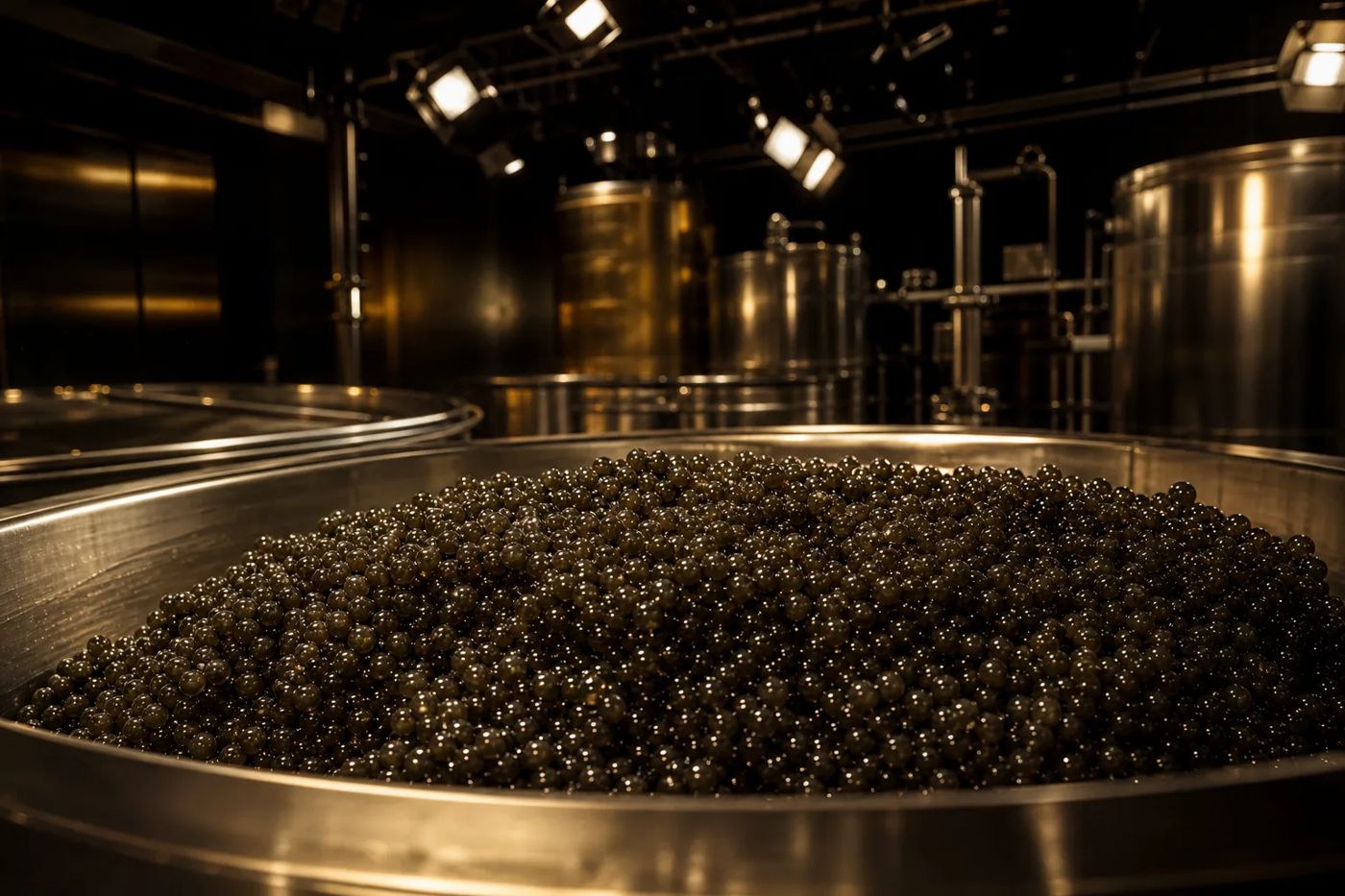
Caviar becomes part of the action in The World Is Not Enough (1999). Pierce Brosnan’s Bond follows a lead to Valentin Zukovsky’s caviar factory, where beluga is named in the dialogue and Zukovsky offers his fictional brand, “Zukovsky’s Finest”. The business provides a setting for interrogation and destruction, far from a quiet evening at the casino.
Eon’s production account describes the factory set built on Pinewood’s paddock tank, which was enlarged for the sequence. It documents the construction of a screen factory, rather than a real caviar operation. The damaged beluga dialogue belongs to this film, not to Zukovsky’s earlier appearance in GoldenEye (1995).
Casino Royale (2006)
A room-service order becomes a brisk change of priorities in Casino Royale (2006). In the Bahamas, Daniel Craig’s Bond requests beluga caviar and champagne, then specifies one person rather than two. He leaves Solange to follow a lead to Miami.
What begins as an apparent romantic provision ends with the mission taking precedence over company.
Fleming’s novels already use food to characterise Bond; that textual history belongs in caviar in literature. On screen, distinguish what the character says, what the camera shows and what production records establish. Naming a caviar does not, by itself, identify a supplier or establish paid placement.
Beyond Bond: class and appetite
Jack Dawson declines more than food in James Cameron’s Titanic (1997). The screenplay places him uneasily at first-class dining: a waiter asks how he takes his caviar, Cal answers for him with instructions involving lemon and champagne, and Jack refuses the caviar, rejecting the offered lesson along with the food.
Cal’s assumption is the revealing detail. He treats dining knowledge as authority and feels entitled to speak on another man’s behalf. The table welcomes a guest while reminding him who considers himself qualified to define belonging. The tension lies less in Jack’s taste than in the social instruction he is expected to accept.
The screenplay documents this written exchange, rather than a historical menu for the real ship. It names neither a caviar species nor a supplier. Cal’s instructions serve the relationship between the diners; they are not the scene’s recommendation for how viewers should eat caviar.
Vladimir Motyl’s Soviet film White Sun of the Desert has two dates worth keeping distinct: Mosfilm’s catalogue gives 1969; film catalogues record the general Soviet release on 30 March 1970.
Mosfilm also publishes an official extract titled “No customs, no smugglers”. The familiar account of Vereshchagin’s bowl of black caviar is not quoted here because it has not been checked against the film itself. The anecdote remains separate from a documented reading of the scene.
Caviar on television
Frasier’s “Roe to Perdition” (2003), season ten, episode eighteen, turns caviar into an entire comic plot. Frasier and Niles acquire a supply and become sought-after intermediaries for their social circle. The transcript names beluga. As their involvement escalates, their confidence in their own judgement becomes part of the joke.
Yet the pleasure is genuine. Roz initially dismisses caviar because of an earlier encounter, then changes her mind after tasting the brothers’ supply. The comedy leaves room for enjoyment alongside ambition: these characters are not merely pretending to like a food because other people admire it.
The climax makes their attachment physical. Faced with an apparent customs intervention aboard a boat, the brothers try to consume the caviar to remove the evidence. The officers are actually pursuing smuggled DVDs. Frasier and Niles have mistaken their own consuming obsession for everyone else’s priority.
Where Frasier turns caviar’s social appeal into physical farce, Dynasty puts that appeal to work in an episode title. Its 2020 episode “The Caviar, I Trust, Is Not Burned” is identified by its distributor as season three, episode nine. Food etiquette sounds almost like a threat, fitting an episode whose synopsis centres on confrontation. The title supplies a social signal, not documentation of a physical prop or a character eating caviar on screen.
Cookery television brings the attention back to the food. In America’s Test Kitchen, “Beef Wellington”, season twenty-three, episode 2305, Jack Bishop leads Bridget Lancaster through a tasting of domestic caviar and roe. PBS dates the episode to 7 January 2023. Here, differences are discussed directly rather than folded into a character’s display of sophistication.
The programme’s captions identify salmon roe, trout roe, paddlefish roe and a caviar called Osetra. Osetra is a trade name; the programme does not identify the species behind it. The comparative tasting is the point. Viewers hear the participants distinguish texture and flavour, instead of simply accepting a character’s reputation for knowing what belongs on an impressive dinner table.
What screen images cannot tell you
A gleaming spoon tells you little about its material. Silver-coloured cutlery might be stainless steel, plated metal or a prop; a still cannot establish that someone is eating caviar with silver. For the practical question, read why not use a silver spoon. Screen elegance and serving advice are separate things.
Character and performer need separating, too. Bond’s order tells us about Bond, not automatically about Connery, Lazenby, Moore, Brosnan or Craig. Their personal preferences require their own documentation, collected in famous caviar lovers. A convincing performance of appetite is still a performance, however naturally the order arrives.

A short screen timeline
| Year | Work | Caviar’s role |
|---|---|---|
| 1965 | Thunderball | Beluga accompanies Bond’s pursuit of Domino. |
| 1969 | On Her Majesty’s Secret Service | Food recognition follows a fight. |
| 1997 | Titanic | Dining etiquette exposes class authority. |
| 1999 | The World Is Not Enough | A fictional factory becomes an action setting. |
| 2003 | Frasier: “Roe to Perdition” | Social ambition ends in farce. |
| 2023 | America’s Test Kitchen: “Beef Wellington” | A tasting compares caviar and roe. |
Where to go next
- Caviar and the Arts: the wider guide to food, images and performance.
- Caviar in Music and Pop Culture: caviar references beyond scripted screen stories.
Sources
-
Helene A. Shugart, Sumptuous Texts: Consuming “Otherness” in the Food Film Genre, Critical Studies in Media Communication, volume 25, issue 1, 2008, pages 68 to 90. Publisher’s abstract checked. Publisher record.
-
Jeremy Strong, James Bond: international man of gastronomy, Journal of European Popular Culture, volume 4, issue 2, 2013, pages 155 to 172. Accepted manuscript and institutional record. University of West London repository.
-
Brian A. Dixon, Sex for dinner, death for breakfast: James Bond and the body, doctoral dissertation, University of Rhode Island, 2009. Institutional abstract checked. University repository.
-
James Bond Museum, Thunderball Script, undated online dialogue text for the 1965 film. This is not an authenticated screenplay edition. Text.
-
Springfield! Springfield!, On Her Majesty’s Secret Service (1969) Movie Script, undated dialogue transcription, not an authenticated published screenplay. Text.
-
Springfield! Springfield!, Never Say Never Again (1983) Movie Script, undated dialogue transcription. Text.
-
Simple Remix Transcripts, A View to a Kill (1985) Script, undated dialogue transcription. Record.
-
Springfield! Springfield!, World Is Not Enough, The (1999) Movie Script, undated dialogue transcription. Text.
-
Eon Productions, The World Is Not Enough: In Pictures, 27 January 2026, and Focus of the Week: Valentin Zukovsky, 8 April 2019. Found in the official James Bond website’s archive results. Production and character accounts are attributed to Eon.
-
Springfield! Springfield!, Casino Royale (2006) Movie Script, undated dialogue transcription. Text.
-
James Cameron, Titanic, screenplay for the 1997 film, online PDF reproduction, draft date not identified. First-class dining sequence, printed page 67. Screenplay.
-
Mosfilm, Белое солнце пустыни [White Sun of the Desert], undated studio catalogue entry, listing 1969 and a 2011 restoration. Studio record.
-
University of Illinois, Russian, East European, and Eurasian Center, Multimedia Library: Russian and Eurasian Feature Films, undated catalogue, version hosted in September 2020. Catalogue PDF.
-
Mosfilm, No customs, no smugglers. White Sun of the Desert, official film-extract page, published 9 September 2014. The page was checked; the footage was not reviewed. Official extract.
-
The Frasier Archives, Roe to Perdition, season 10, episode 18, 2003, undated fan transcription. Transcript.
-
Apple TV, Dynasty: The Caviar, I Trust, Is Not Burned, distributor’s episode record, release date 17 January 2020. Episode record.
-
PBS NC and America’s Test Kitchen, Beef Wellington, season 23, episode 2305, 7 January 2023. Episode record and programme captions. Episode and captions.
Research combined dialogue texts, a screenplay reproduction, programme captions, studio and distributor records, and academic publications.
Last checked: November 2026