
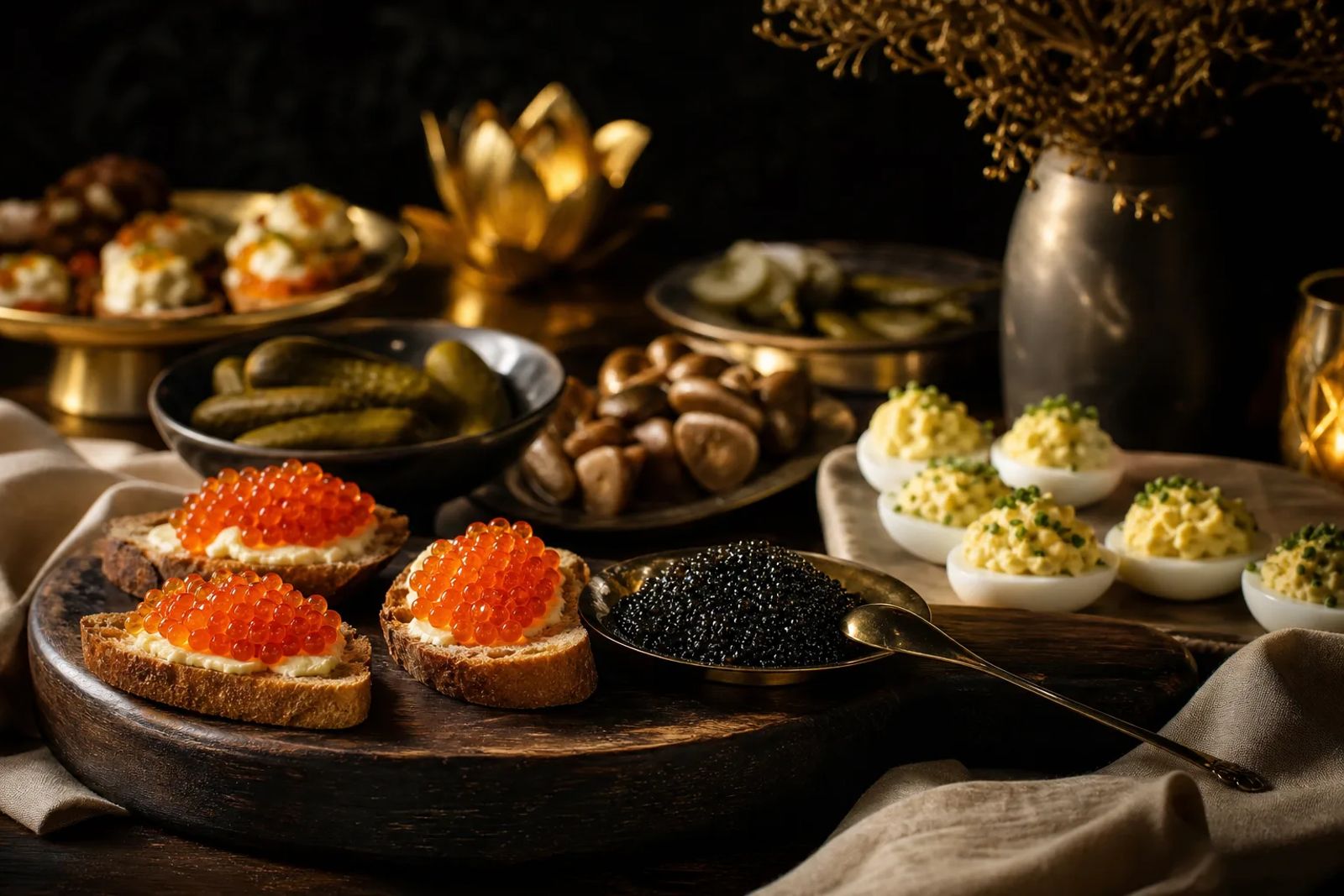
Bread underneath, butter in between, a visible layer of orange roe on top. The open sandwich captures caviar's festive role in a simple domestic image: something brought out to share, with anticipation as much a part of the occasion as formal service. Both red salmon roe and black sturgeon roe belong to Russian traditions of salted roe at the celebratory table.
What Russians mean by ikra
Ikra means more than caviar. The Russian word икра, transliterated ikra, means roe: fish eggs. In culinary speech, чёрная икра, chyornaya ikra, means black caviar, conventionally sturgeon roe; красная икра, krasnaya ikra, means red roe, conventionally salmon roe.
These familiar kitchen categories do not identify every detail of the fish or its origin. The word also reaches beyond fish altogether. Goldstein includes aubergine caviar among zakuski, while Molokhovets's cookbook distinguishes several kinds of fish roe. An English reader looking for caviar may therefore encounter a much broader culinary vocabulary.
Molokhovets's 1901 edition lists pressed, fresh and red roe among cold starters in its fasting-food section, specifying salt, pepper and herbs for the red roe. Black and red roe belonged to an established repertoire, rather than successive fashions in which one simply displaced the other. The cookbook records that repertoire, rather than the eating habits of the whole population.
The zakuski table: bread, eggs and vodka
Caviar takes its place among other pleasures on the zakuski table. These savoury starters or small dishes are usually shared, rather than arranged as one composed plate. In A Taste of Russia, food scholar Darra Goldstein sets caviar alongside smoked fish, salads, mushrooms and stuffed eggs. The appeal is in the choice and contrast between bites; roe need not command the whole spread.
Bread and butter are a documented domestic accompaniment, not a modern shortcut. In a published interview about her family's food traditions, American chef Bonnie Frumkin Morales recalls eating caviar on buttered white bread as a child. Her parents came from the Soviet Union, from what is now Belarus. The memory gives a vivid account of one Soviet diaspora household, with its own history and habits.
Pancakes offer another setting. Sharon Hudgins records butter, sour cream and jam among pancake toppings in Irkutsk in 1994, listing them as choices rather than a single combined preparation.
Vodka also has a place at the table. In a 2020 interview, Goldstein describes caviar, smoked fish and pickles as foods served with vodka within the zakuski spread. Enjoying roe does not require a drink: the guide to caviar and vodka explores the pairing on its own terms.
Blini and Maslenitsa
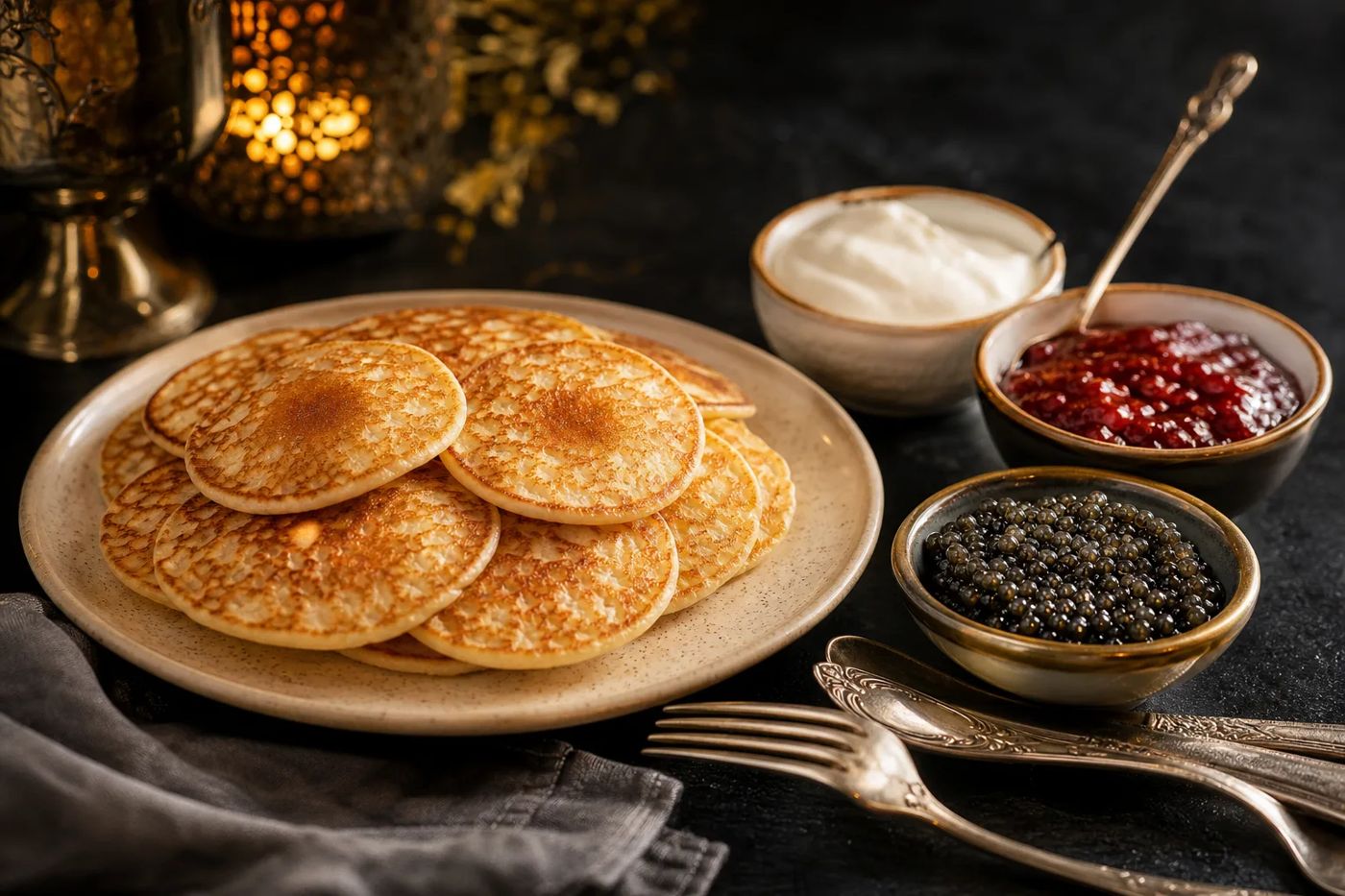
The pancake anchors Maslenitsa; the toppings provide the variety. Blini are central to the week immediately before Orthodox Great Lent. Its position follows the Orthodox Easter calendar, so its civil dates change each year. The Virginia Museum of Fine Arts' guide to Russian food culture lists caviar among pancake accompaniments, alongside sour cream, jam and smoked salmon.
A family memory can preserve a tradition more precisely than a national label.
On the streets of Irkutsk in March 1994, Hudgins observed Maslenitsa vendors serving pancakes with butter, sour cream or jam. Caviar is one possible accompaniment to the celebration, not its defining ingredient. What went on a pancake depended on the household, the setting and the food available.
The pairing also appears in accounts from outside Russia. Researcher Svetlana Pogodina's study of Russian periodicals in interwar Latvia identifies a 1940 Riga article describing red and black caviar among numerous fish accompaniments for pancakes. For the pancakes themselves, including the distinction between household forms and small restaurant versions, see blinis.
New Year and family celebrations
New Year is caviar's clearest modern festive association. TIME's retrospective on photographs of the Soviet caviar industry describes New Year's Eve and occasional birthdays as occasions for bringing it out. Reporting from Kurgan, published in December 2025, carries that association into a more recent setting: red roe as a New Year food, commonly served on sandwiches, in tartlets or with pancakes.
The buttered open sandwich makes the celebration visible. Bread, butter and orange roe give a familiar domestic form a festive role. Its significance lies as much in anticipation and sharing as in formal service: here, roe signals a celebration rather than an ordinary supper.
Other occasions need to be distinguished carefully. A name day honours the saint whose name a person bears; it is not another word for a birthday. The sources consulted do not establish roe's role at Russian weddings or name days.
How Soviet life shaped the red and black divide
Access to caviar depended on when and where people lived, and on their position. Historian Catriona Kelly describes food orders containing red roe and privileged New Year allocations. Institutions helped determine what reached the festive table, but these arrangements did not amount to a single, continuous national caviar ration.
Official gifting had separate channels. A contributor to the June 1996 Foreign Service Journal recalls being supplied with caviar for diplomatic partners. Such accounts help explain how a food promoted for celebration could also reveal differences in access. See Soviet caviar and the state monopoly for the wider history.
Both red salmon roe and black sturgeon roe have festive associations. The sources here leave open how differences in their household availability arose, and how widely either is eaten.
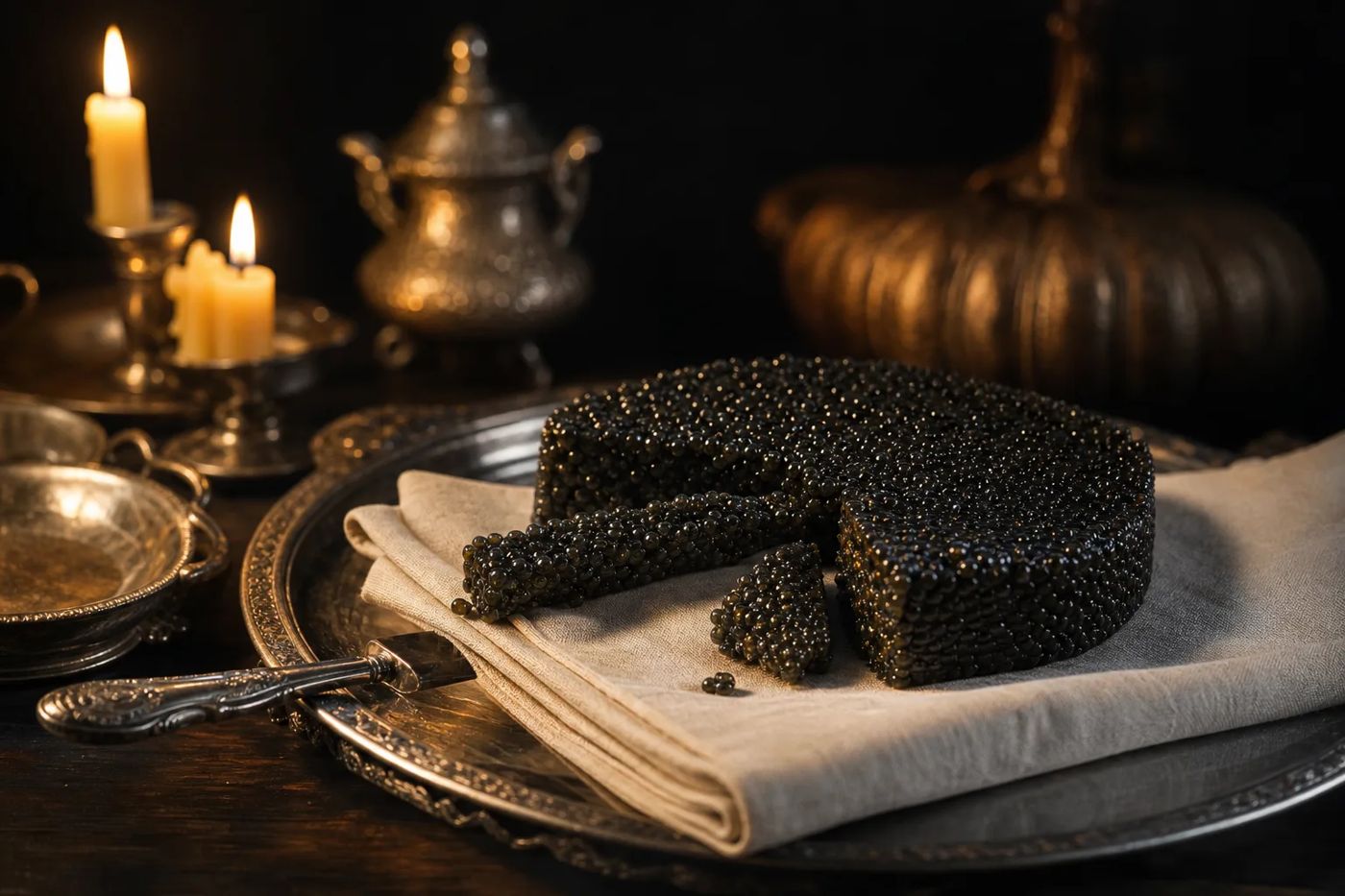
Russian caviar history also includes a preparation quite unlike loose grains: payusnaya ikra, or pressed caviar. Goldstein's historical account describes nineteenth-century service in which the firm preparation was sliced and presented in a napkin. This was an established way of eating roe, with its own texture and presentation, rather than a modern novelty. Explore it in pressed caviar: What It Is and How It Tastes).
After 1991: continuity and a different supply
After the Soviet Union's dissolution in 1991, familiar foods met new ingredients and returning customs. Hudgins's observations in Siberia in 1994 describe imported foods appearing and public religious celebrations reviving, alongside gaps in family knowledge of older holiday dishes. The table could hold continuity and rediscovery at once; the changes were more complex than a return to an unchanged past.
The supply of caviar has changed too. As of 2026, the Caspian states, Russia included, ban commercial sturgeon fishing; farmed caviar is sold in Russia. See Caspian fishing restrictions for the current position and caviar and sanctions for international travel and trade.
Traditions carried abroad
A family memory can preserve a tradition more precisely than a national label. Morales's American childhood account centres on the simple gesture of bread, butter and caviar, while locating her family's history in Soviet Belarus. Pogodina's Latvian material shows Russian-language writers using Maslenitsa food to express belonging between the wars.
These are particular memories and practices, not a frozen national menu. They also distinguish Russian food culture from the many peoples whose lives crossed the Soviet Union. A shared way of serving roe can coexist with Belarusian, Latvian or other identities.
At home or abroad, the clearest account names the family, community or source, rather than prescribing how all Russians eat caviar. In Morales's childhood memory, it is caviar on buttered white bread.
A short timeline
| Date | Documented development |
|---|---|
| 1901 | Molokhovets's edition lists pressed, fresh and red roe as cold starters. |
| 1940 | A Riga newspaper describes red and black caviar with Maslenitsa pancakes. |
| 1994 | Hudgins records Maslenitsa street food in Irkutsk. |
Where to go next
- Caviar Around the World: compare Russian customs with other roe-eating traditions.
- Classic Caviar Service: Russian and French Styles: distinguish formal service from household custom.
- Caviar in Moscow and St Petersburg: place cultural expectations in a present-day travel context.
Sources
-
Gramota.ru. Russian orthographic dictionary, online PDF, retrieved edition undated. Used for Russian spelling and stress, with plain English transliteration supplied editorially. Dictionary PDF.
-
Elena Molokhovets, reproduced by Molohovetc.ru. A Gift to Young Housewives, 1901 edition, section XXIV, “Постный стол”, digital transcription. Historical section. This is not Joyce Toomre's translation.
-
Darra Goldstein, reproduced by ckbk. A Taste of Russia, 1983, “The Zakuska Table”, online extract. Chapter extract.
-
KitchenAid Stories. “Rethinking the Culture of Caviar”, online feature, undated. Used specifically for Bonnie Frumkin Morales's attributed family recollections. Feature.
-
Sharon Hudgins, Anthropology of East Europe Review. “A Trinity of Siberian Easter-Season Meals”, volume 21, number 1, 2003, pages 17 to 23. Reports observations made in 1994. Journal PDF.
-
Suzy Chase, Cookery by the Book. “Beyond the North Wind: Darra Goldstein”, interview and transcript, 9 March 2020. Interview.
-
Virginia Museum of Fine Arts. A Taste of Russian Culture, online gallery guide, undated retrieved edition. Museum guide.
-
Svetlana Pogodina. “Russian Food as an Identity Marker: Russian Periodicals in Latvia in the 1920s and 1930s”, Acta Litteraria Comparativa, issue 9, 2022. Paper PDF.
-
TIME. “Good Eggs: A Rare Look Inside the Soviet Caviar Harvest”, 2017, archival photographic retrospective. Article.
-
Maria Shiryaeva, Oblast 45. “Красная икра в Кургане: где купить и как отличить натуральную от имитации”, 17 December 2025. Used for attributed contemporary reporting on festive foods, not its unsourced generalisations about national polling. Article.
-
Lingust. “Pronouns in Russian: Restaurant Reservations and Menus”, lesson 10, undated online edition. Used for the explanation of name days and their distinction from birthdays. Lesson.
-
Catriona Kelly, Yale University Press. St Petersburg: Shadows of the Past, 2014. Retrieved searchable extract describing food orders and New Year allocations, hosted by Scribd. Retrieved extract.
-
American Foreign Service Association. The Foreign Service Journal, June 1996 issue, recollection concerning Soviet diplomatic gifts. Issue PDF.
-
Darra Goldstein, Saveur. “Caviar Dreams”, online edition, 2000. Used for historical pressed-caviar service. Article.
-
Federal Agency for Fisheries, Russia. “Контрольная закупка «Осетр: аквакультурный или дикий»”, 12 January 2018. Used for the authority's account of fishing restrictions and distinction between aquaculture and illegal wild products. Agency article.
-
Upper Ob Territorial Administration, Federal Agency for Fisheries, Russia. “Сохранение запасов ценных видов рыб: прикаспийские страны договорились продлить запрет на коммерческий промысел осетровых”, published 27 November 2025, extending the ban through 2026. Official announcement.
This piece was researched through historical culinary texts, attributed family recollections, scholarship, museum interpretation, contemporary reporting and official fisheries announcements, keeping their different kinds of evidence separate.
Last checked: November 2026