

A deacon eats all the caviar at a funeral, and the story becomes a village's calling card. In Anton Chekhov's “In the Ravine”, appetite leaves a lasting mark. Elsewhere in literature, caviar helps a host conjure a feast, plays a part in a dinner arranged by colour or becomes Shakespeare's image for art that appeals to a limited audience. The bead on the plate is only the beginning.
"Caviar to the general": Shakespeare's phrase
Shakespeare's “caviary to the general” describes something too refined for popular taste. “The general” means the general public, not a military officer.
In the Folger Shakespeare Library edition, edited by Barbara A. Mowat and Paul Werstine, Hamlet says “’twas caviary to the general” in Act 2, scene 2, line 461. He is addressing the First Player, an actor newly arrived at the Danish court with his company.
Hamlet remembers a play that failed with the wider public, although he and people whose judgement he respected thought it excellent. Just before the caviar phrase, he says it “pleased not the million”. The neighbouring words make his meaning plain: this was drama for a select audience.
The familiar modern wording, “caviar to the general”, preserves that contrast between tastes. It describes something appreciated by a limited audience rather than by everyone, not a commander's special ration or a food everybody enjoys. The distinction lies in appreciation, not simply in who possesses the delicacy.
But Hamlet's confidence is part of the scene. His approval no more settles the play's quality than the audience's rejection establishes that it was bad. Beneath the elegant metaphor lies a sharper question: who gets to recognise merit, and who gets dismissed as incapable of recognising it?
Food language runs through the exchange. Hamlet has asked the players for a “taste of your quality”; he calls the remembered play “well digested” in its scenes. Hearing, judging and eating overlap. Caviar belongs to this account of how drama should be received, rather than to an imagined meal at court. The theatrical setting gives the image its force without turning it into menu history.
What the early editions actually print
The familiar phrase changes on the early printed page. The First Quarto of 1603 has “cauiary”, but directs the comparison “To the million”. The Second Quarto, dated 1604, prints “cauiary to the generall”. In the First Folio of 1623, “Cauiarie” is followed by “to the Generall”.
Each is a distinct printed witness, not an interchangeable copy of a modern text. When quoting, keep the spelling of the edition you name and give its act and scene. Line numbers vary: the Folger location above cannot simply be transferred to an Arden or another editor's text.
These changing forms also belong to a word history beyond the theatre. Follow the word's origins for that story. Hamlet's line does not establish that Shakespeare introduced either caviar or its name to England.
Russian literature: hospitality and appetite
In Nikolai Gogol's Dead Souls, a feast seems to materialise at an official's command. In Part I, Chapter VII, the police chief arranges a meal to celebrate Chichikov's apparent success. D. J. Hogarth's translation lists “sturgeon, caviare, salmon, herrings, cheese, smoked tongue” among the food suddenly covering the table.
Caviar is part of the gathering abundance, rather than a solitary treasure displayed for admiration. The busy table makes Chichikov's reception feel effortless and welcoming, even as the reader has reasons to distrust the business bringing everyone together. Food and official sociability reinforce each other. Crucially, the host can summon the feast through a subordinate: his power to provide matters as much as the display of status.
Chekhov gives appetite a different afterlife. In “In the Ravine”, section I, Constance Garnett's translation supplies the village's identifying remark: “That's the village where the deacon ate all the caviare at the funeral.” Outsiders remember the place through one person's act of eating.
Where Hamlet turns on the difficulty of appreciating something, Chekhov turns consumption into a story that people keep telling. The joke catches both the deacon's lack of restraint and the community's long memory. Caviar carries a character sketch here, rather than standing for a reaction shared by everyone who tastes it.
French literature: a meal arranged by colour
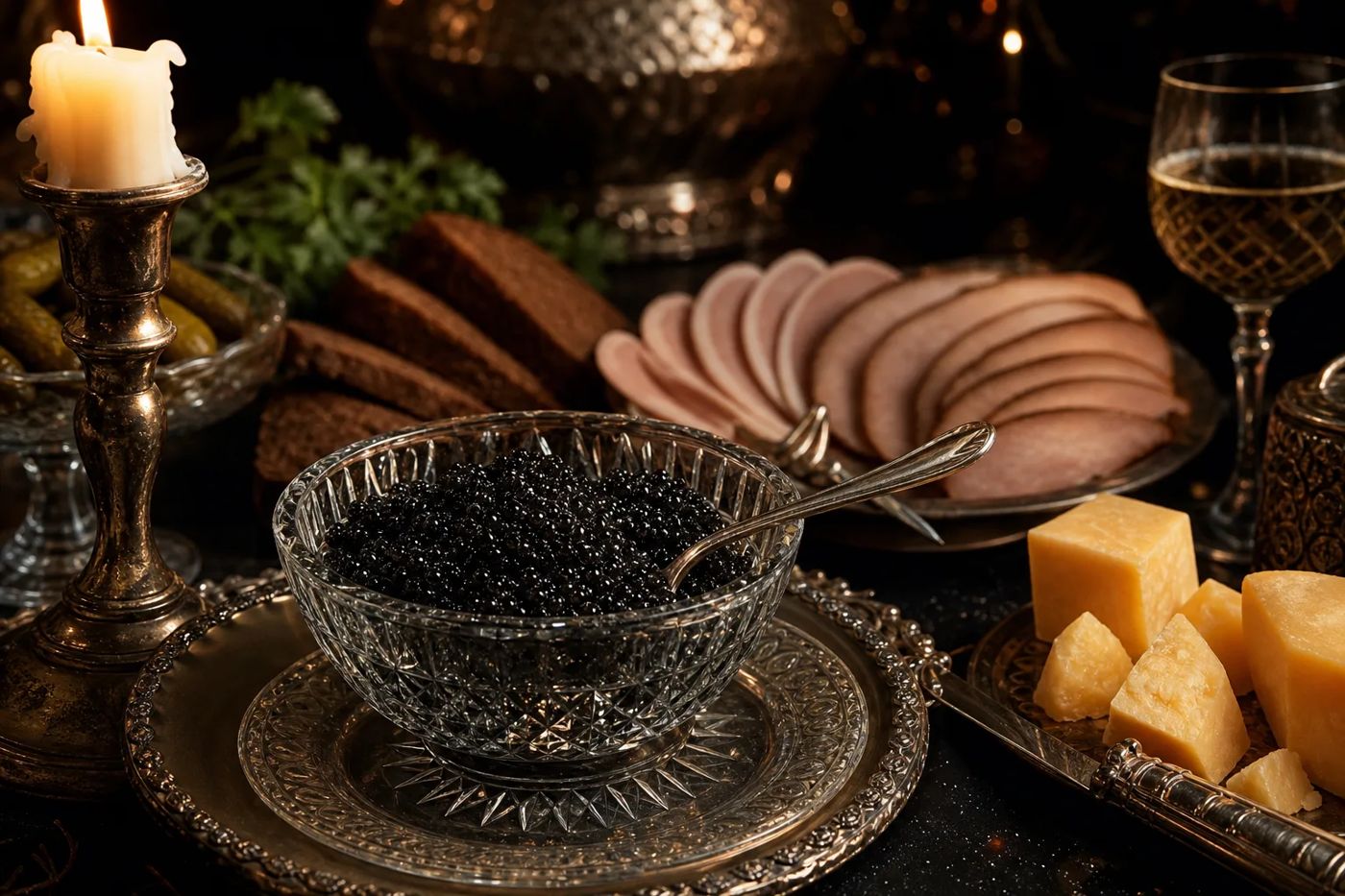
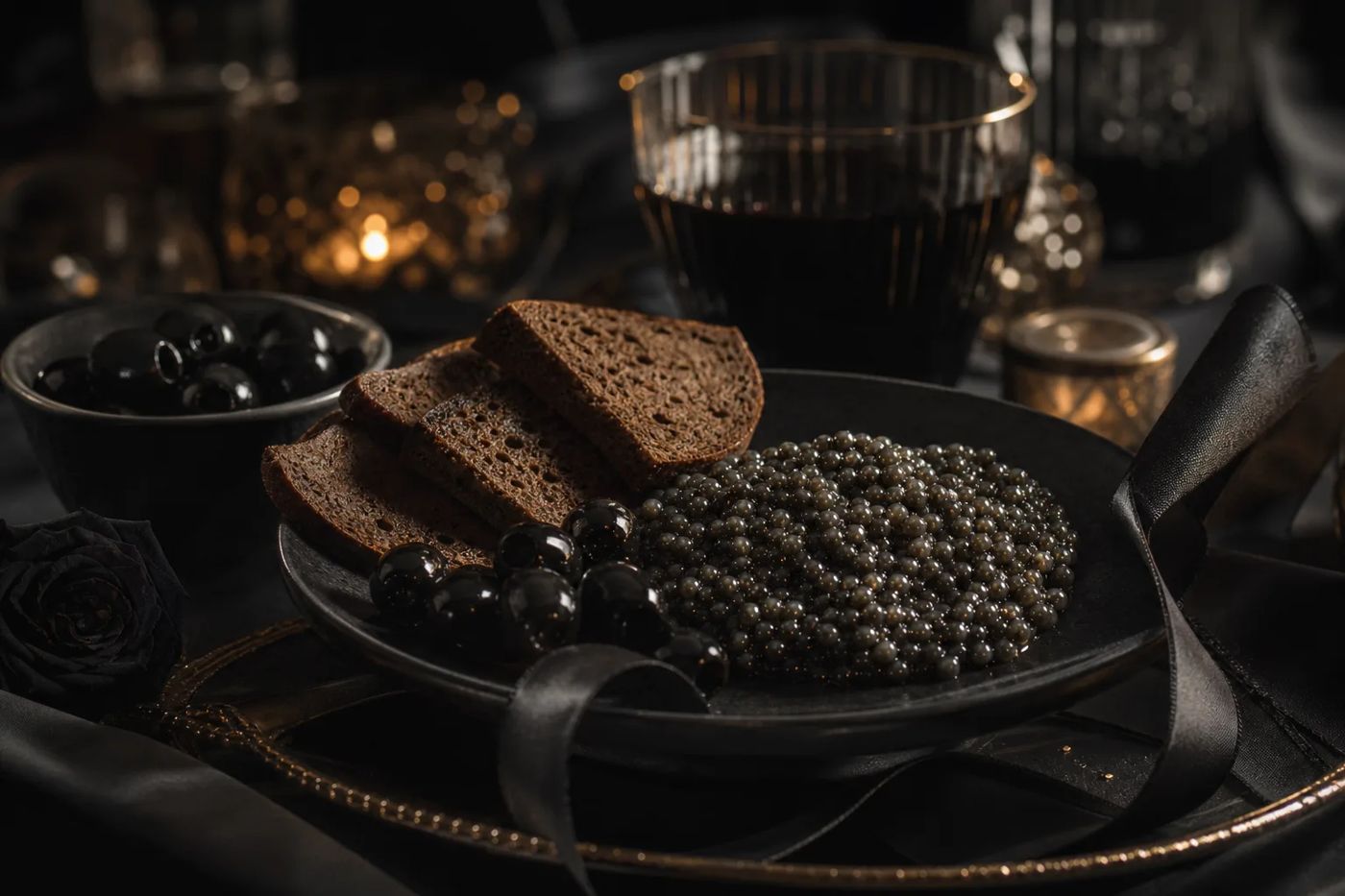
Darkness governs the menu in Joris-Karl Huysmans' À rebours. In Chapter I, Des Esseintes recalls a dinner with a funeral theme, complete with dark foods, dark glasses and mourning decorations. The French text places “du caviar” among Russian rye bread, ripe olives, mullet roe and other foods chosen for the occasion.
This is a private performance, not a customary French dinner. Read alongside the decorations and invitation, the food forms part of a carefully organised visual spectacle. Caviar's dark colour matters as much as its social associations. Abundance alone cannot explain a meal in which appearance so deliberately governs what is served.
The Shakespearean metaphor later returned in criticism of the novel itself. In a March 1923 review for The Dial, reproduced by Huysmans.org, Cuthbert Wright called À rebours “caviar to the multitude”. His adaptation describes a book of restricted appeal. It is a judgement about reception, not a claim about what its readers ate or a verdict shared by every reader.
Modern fiction: Bond at the dinner table
James Bond wants enough toast. That practical concern gives caviar its character in Ian Fleming's Casino Royale, first published in 1953.
Beneath the elegant metaphor lies a sharper question: who gets to recognise merit, and who gets dismissed as incapable of recognising it?
In Chapter 8, “Pink Lights and Champagne”, Bond and Vesper Lynd order dinner, and he insists on plentiful toast. In Chapter 9, “The Game Is Baccarat”, the caviar arrives with toast, chopped onion and grated egg white and yolk served separately. He wants the accompaniment to keep pace with the roe.
The detail makes his appetite particular and assured. Bond knows what he wants from the meal; he is doing more than naming an impressive food. The scene also keeps Bond and Vesper eating and talking before the gambling begins. These are details from Fleming's novel. Bond's screen meals belong in caviar in film.
How to read a literary serving
Start with what caviar does in the scene. It may be food on a table, an ingredient in a visual design or a metaphor for art. The surrounding action reveals its role more clearly than a ready label such as status or excess.
Then ask who eats, or who imagines eating. Chekhov's deacon is remembered for consuming. Hamlet borrows the language of eating to discuss spectators. Bond concerns himself with service. Those differences give each appearance its particular interest; caviar has no single fixed literary meaning.
The interpretations here are close readings of the scenes. Keep them distinct from judgements voiced within or about the works, including Hamlet's praise of the unsuccessful play and Cuthbert Wright's assessment of Huysmans' novel. A character's confidence, or a critic's memorable phrase, remains part of the evidence to consider.
Check the language, too. An English translation's “caviare” records that translator's wording; a French original's “caviar” belongs to the French text. Neither spelling alone identifies the fish, processing method or serving custom. Fiction shows what a work represents, rather than automatically documenting what an entire country ate.
For more examples of language rather than scenes, explore caviar sayings and caviar idioms. For the wider relationship between food and creative work, return to caviar and the arts.
A short publication timeline
These are publication dates, not the dates of the fictional meals. The three Hamlet entries identify different early printed texts. The later entries give each work's first publication year, rather than the date of the English translation quoted above.
| Year | Work or edition | Why it matters here |
|---|---|---|
| 1603 | Hamlet, First Quarto | Prints “cauiary” and addresses “the million”. |
| 1604 | Hamlet, Second Quarto | Prints “cauiary to the generall”. |
| 1623 | Hamlet, First Folio | Prints “Cauiarie”. |
| 1842 | Dead Souls, Part I | Caviar joins an official's abundant table. |
| 1900 | “In the Ravine” | A deacon's appetite identifies a village. |
| 1953 | Casino Royale | Bond insists on plentiful toast. |
Sources
-
Folger Shakespeare Library. William Shakespeare, Hamlet, edited by Barbara A. Mowat and Paul Werstine, online edition, undated. Act 2, scene 2, especially lines 455 to 465. Read the text.
-
Internet Shakespeare Editions, University of Victoria. William Shakespeare, Hamlet (Quarto 1, 1603), old-spelling transcription, textual editor Eric Rasmussen. Read the transcription.
-
Internet Shakespeare Editions, University of Victoria. William Shakespeare, Hamlet (Quarto 2, 1604), old-spelling transcription. Read the transcription. The relevant passage was also checked in the quarto facsimile. View the facsimile.
-
Internet Shakespeare Editions, University of Victoria. William Shakespeare, Hamlet (Folio 1, 1623), old-spelling transcription, editor David Bevington, textual editor Eric Rasmussen. Read the transcription.
-
Project Gutenberg. Nikolai Gogol, Dead Souls, translated by D. J. Hogarth, introduction by John Cournos, ebook 1081, undated digital edition. Part I, Chapter VII; introduction for the original publication year. Read the edition.
-
Wikisource; Princeton University, Shakespeare and Company Project. Anton Chekhov, The Witch and Other Stories, translated by Constance Garnett, 1918. “In the Ravine”, section I. View the digitised passage; view the edition record.
-
Cambridge University Press. The Cambridge Companion to Chekhov, edited by Vera Gottlieb and Paul Allain, 2000, chronology in the front matter. Read the front matter.
-
IAPSOP digital collection. Joris-Karl Huysmans, À rebours, illustrated by Auguste Lepère, 1903 edition. Chapter I, the funeral-themed dinner. View the digitised edition.
-
Huysmans.org. “Against the Grain”, review reproduced in an online transcription, published in The Dial, March 1923, by Cuthbert Wright. Read the review.
-
Hazi Desarat College digital library; Ian Fleming Publications. Ian Fleming, Casino Royale, 1953, Chapters 8 and 9, checked in the college-hosted digital transcription, whose print imprint is not identified. Read the transcription; view the author's official publication record.
The piece was researched through literary texts, early Shakespeare transcriptions, digitised editions, publication records and a reproduced critical review, with original close readings identified as such.
Last checked: November 2026