
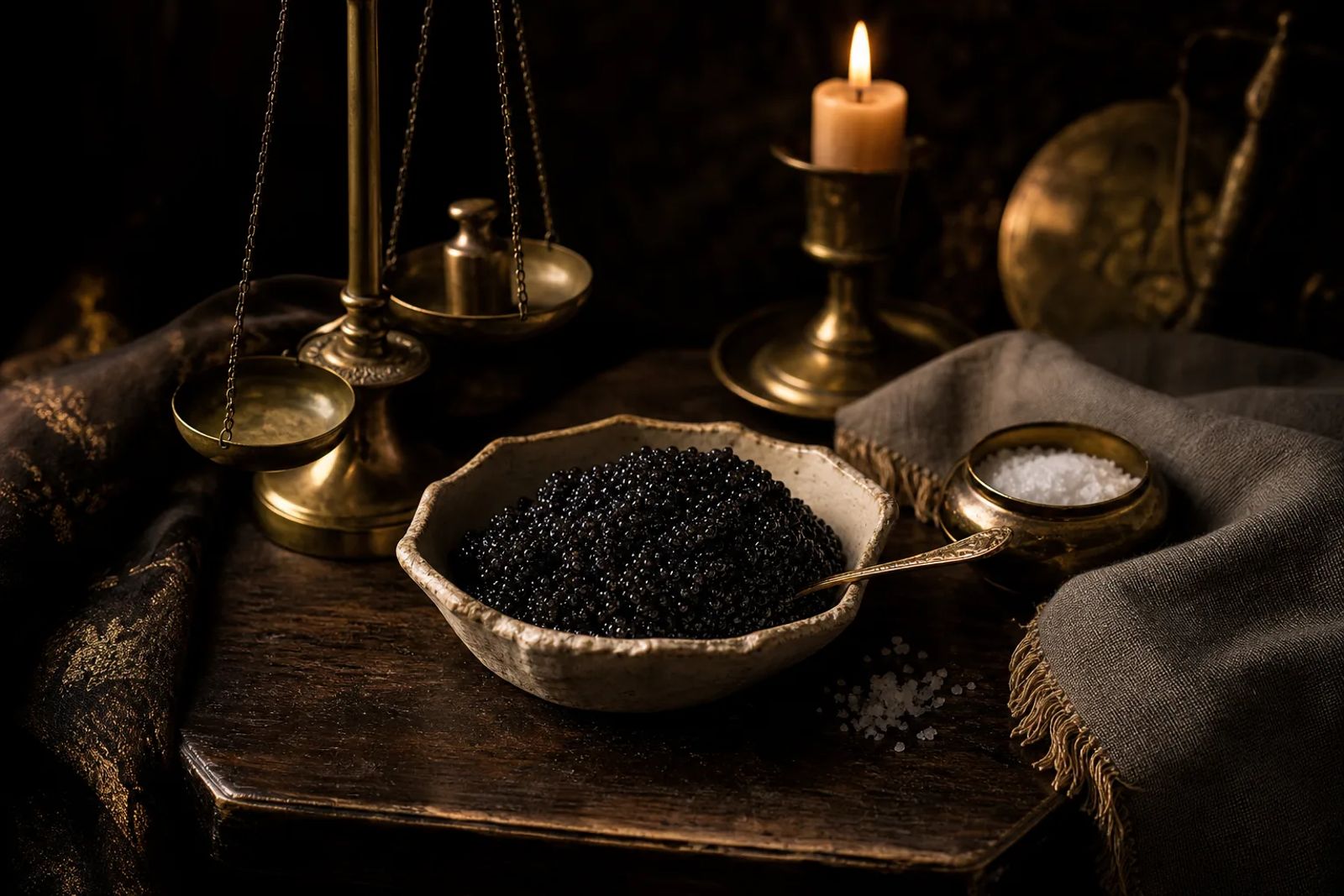
Caviar travelled to Constantinople and Italy through overlapping networks of river fisheries, Black Sea ports and Mediterranean merchants, while Caspian commerce connected Persia with Russia and markets farther west. Italy also had its own sturgeon fisheries, so Renaissance caviar was not simply an eastern import.
- Venetian accounts record a purchase of caviar from Tana in 1438.
- A sixteenth century Italian preparation used salt, heat and glazed vessels.
- A story crediting Leonardo da Vinci with presenting caviar at a court wedding remains an anecdote, not a documented introduction.
Byzantine caviar before the Ottomans
Byzantine writers knew more than one kind of preserved fish egg. Andrew Dalby’s historical glossary distinguishes salted mullet roe from khabiarion, caviar, and traces the latter through literary references including the Prodromic poems.
Twelfth-century references to caviar and caviar sellers place it within Byzantine urban food culture, not merely in later stories about imperial dining. They do not identify every fish species involved, and salted roe in an old text should not automatically be translated as sturgeon caviar.
Constantinople was both a destination and an exchange point. David Jacoby’s study of Byzantine caviar trading shows consignments arriving for local wholesalers and retailers, alongside others moving through the city to distant customers; this distinction matters because a recorded shipment through a port is not proof that its contents were eaten there.
Tana and the Black Sea merchant network
Tana, near the Don’s outlet into the Sea of Azov, was a particularly useful collecting point for fish products. Venetian and Genoese merchants operated there within a wider network that included Genoese Caffa in Crimea and Pera, across the Golden Horn from Constantinople.
This was not a trade in roe alone. Ievgen Khvalkov’s archival study of Tana places caviar alongside fish and salt within a much broader commerce; merchants also dealt in grain, textiles and enslaved people. Caviar travelled through commercial structures built for many goods, rather than along a separate, dedicated route.
A particularly clear transaction survives in the accounts of the Venetian merchant Giacomo Badoer: in 1438 he bought caviar from Tana. Khvalkov identifies the entries in the published account book, pages 416 and 417, making this a documented commercial connection rather than a general claim that Italians somehow discovered caviar in the East.
The point here is the connection between those producing areas, Constantinople’s middlemen and the Italian maritime cities.
Caviar in the Ottoman Empire
The Ottoman conquest of Constantinople did not mark the beginning of the city’s acquaintance with roe. Food historian Özge Samancı reports that purchases for Mehmed II’s kitchen in 1471 included caviar and other preserved fish products, drawing on palace accounting records.
That evidence establishes a place at the ruler’s table, not a uniform Ottoman diet. Samancı also stresses that fish purchases in the earlier palace records were neither consistently substantial nor continuously recorded, so a single kitchen list cannot describe what everyone in the empire ate.
Evidence outside the palace comes from grocery inventories. The Austrian Academy of Sciences’ GROCERIST database indexes havyar, translated as caviar, in Istanbul shop records; a study of these inventories identifies it in seven shops, six in Galata and one in Üsküdar. This later evidence widens the picture from court provisioning to urban retail.
Italian rivers and Renaissance cookery books
Italy was not just a customer for imported caviar. The Po and northern Adriatic supported sturgeon fisheries, including the Adriatic sturgeon, Acipenser naccarii; historical records also concern other sturgeons, so an old reference to storione does not establish that particular species. The Adriatic sturgeon guide separates the fish’s identity from the wider history of Italian roe.
Ferrara provides unusually tangible culinary evidence. Cristoforo di Messisbugo, an official responsible for organising the Este court’s dining, left Banchetti, compositioni di vivande, et apparecchio generale, published posthumously in Ferrara in 1549 by Giovanni de Buglhat and Antonio Hucher. Calling him simply a cook misses the administrative and ceremonial work of the scalco, the court officer overseeing service.
Edition details matter here. The Biblioteca e Museo della Cucina documents the Venetian edition of 1552 under the title Libro novo nel qual s’insegna a’ far d’ogni sorte di vivanda, issued at Giovanni della Chiesa’s expense, and reproduces its caviar recipe. The familiar Libro novo title should therefore not be casually assigned to the Ferrara first edition of 1549.
The Biblioteca e Museo della Cucina reproduces a preparation attributed to Messisbugo for sturgeon eggs to be eaten or preserved. The sources cited do not give its exact folio in the 1552 edition. It involves cleaning and salting the roe, leaving it overnight, heating it repeatedly in a warm oven until cooked and putting the keeping version into glazed stone jars under oil. This is evidence for a cooked Italian preparation, not a description of today’s chilled, lightly salted caviar.
Jewish Ferrara and the kosher question
Ferrara’s Jewish food history includes a local caviar tradition. MuseoFerrara documents the shop of Benvenuta Ascoli, known as Nuta, whose specialities included cooked caviar from the Po, and cites Aroldo Canella’s contemporary account in Rivista di Ferrara, July 1935, pages 320 to 322. No specialist scholarly corroboration is cited.
The museum describes her father Lodadio’s preparation as perhaps derived from Messisbugo’s. That is a valuable local tradition, but not proof of an unchanged recipe transmitted continuously from the sixteenth century; the documented family workshop and the proposed Renaissance connection deserve different levels of certainty.
Ievgen Khvalkov’s archival study of Tana places caviar alongside fish and salt within a much broader commerce; merchants also dealt in grain, textiles and enslaved people.
There was also a religious disagreement, not a simple exemption for anything sold by a Jewish maker. MuseoFerrara recounts the discussion of sturgeon in Isaac Lampronti’s Pahad Yitzhak and a permissive Ferrara custom concerning the fish called copese. Under Orthodox kosher rules sturgeon and its roe are not kosher; see the kosher question for the distinction between historical practice and present certification.
The Caspian routes through Persia and Russia
The Caspian belonged to another connected trading system, rather than being the direct source of every barrel sold in the Mediterranean. Salvatore Ciriacono’s study of early modern Eurasian commerce describes routes linking Persian ports, including the Rasht and Anzali area, with Astrakhan, and onward connections through Russia.
These were shared commercial corridors, especially important for Persian silk. Ciriacono also identifies Dutch shipping carrying silk and caviar towards Italy and the Mediterranean, showing that maritime routes around northern and western Europe could complement the older Black Sea connections.
The distinction is geographical as well as chronological. Medieval Tana’s Don fishery and the early modern commerce of Astrakhan and the Caspian should not be collapsed into one timeless Russian supply route. Nor does a cargo passing through Persia establish that its roe was harvested on the Persian shore.
Salt, barrels and the problem of distance
Preservation made this commerce possible. The sources describe salted roe, and both Khvalkov and Jacoby discuss caviar in transport containers, including barrels; Jacoby records a consignment of twenty-four small barrels sent from Pera towards Chios in 1455 and seized by pirates near Rhodes.
The packaging is part of the history, not incidental scenery. Barrels made roe a consignable cargo, while Messisbugo’s oven treatment and glazed vessels show another approach to keeping it. These historical descriptions are not safe modern preservation instructions, and their claims about keeping qualities should not be used as household storage guidance.
Invention stories tested against the records
Messisbugo did not invent caviar: Byzantine literary evidence and fifteenth-century trading records precede his books. His achievement here is documentary, giving a particular Italian preparation that can be identified and discussed rather than a universal origin story.
A story repeated in the Accademia Italiana della Cucina magazine in 2024 credits Leonardo da Vinci with presenting caviar to Beatrice d’Este at her wedding in 1491. The article introduces it as something that is said, not with a contemporary documentary reference; it belongs here as an anecdote, not proof that Leonardo introduced caviar to an Italian court.
A short documentary timeline
| Date | Evidence |
|---|---|
| Twelfth century | Prodromic poems refer to caviar and its sellers. |
| 1438 | Badoer’s accounts record caviar bought from Tana. |
| 1471 | Purchases for Mehmed II’s kitchen include caviar. |
| 1549 | Messisbugo’s Banchetti appears in Ferrara. |
| 1552 | A Venetian edition appears as Libro novo. |
| 1935 | Canella publishes his account of Nuta’s caviar workshop. |
Where to go next
- History of Caviar: the wider chronology beyond these trade routes.
- Where the Word Caviar Comes From: the separate history of the name and its transmission.
Sources
-
Andrew Dalby, Tastes of Byzantium: The Cuisine of a Legendary Empire, 2010 edition. Historical discussion and glossary entries for preserved roe and caviar. Digital text: https://djvu.online/file/LIhjFFJk90y4I.
-
David Jacoby, Hebrew University of Jerusalem, “Caviar Trading in Byzantium”, in Rustam Shukurov, editor, Mare et litora: Essays Presented to Sergei Karpov for His 60th Birthday, 2009, pages 349 to 364. Reproduction: https://ru.scribd.com/document/616385006/D-JAcoby-Caviar.
-
Ievgen Alexandrovitch Khvalkov, Central European University, Tana, a Venetian and Genoese Black Sea Trading Station in the 1430s: A Social and Economic History, MA thesis, May 2011. https://www.etd.ceu.edu/2011/khvalkov_ievgen.pdf.
-
Özge Samancı, “The Culinary Culture of the Ottoman Palace: Istanbul during the last period of the Empire”, undated online extract. Palace provisioning discussion and references to Arif Bilgin’s archival research. https://www.gastronomyconsultation.com/ProductDetails/87/Istanbul-and-Ottoman-Palace-Culinary-Culture-in-the-Last-Period-of-the-Empire.html.
-
Austrian Academy of Sciences, GROCERIST, “Havyar”, undated database record. https://grocerist.acdh.oeaw.ac.at/goods__38.html.
-
Taylor & Francis, “Grocers and available foods in Ottoman Istanbul during the eighteenth century”, online publication, 2026. https://www.tandfonline.com/doi/full/10.1080/2373518X.2026.2659434.
-
Pagani and colleagues, River Research and Applications, “The Record of the Last Sturgeons Caught in the Po River (North Italy) Tells a Cautionary Tale of Reasons of Their Silent Disappearance”, 2026. https://onlinelibrary.wiley.com/doi/full/10.1002/rra.70053.
-
Comune di Ferrara, Museo Didattico Virtuale degli Estensi, “Christoforo Messi Sbugo”, updated 12 December 2008. Includes the bibliographical description of the 1549 edition. https://museodidatticoestense.it/mdve/home/stanze/artisti/le-categorie/maestri-darti/christoforo-messi-sbugo.html.
-
Biblioteca e Museo della Cucina, “Messisbugo: Caviale, basilico, carciofi, erbazzone e panettone”, undated online article. Bibliographical descriptions of the 1549 and 1552 editions and reproduction of the caviar preparation. https://www.museodellacucina.com/messisbugo-caviale-basilico-carciofi-erbazzone-e-panettone/.
-
Bartolomeo Scappi, Opera, Venice, 1570, Getty Research Institute copy digitised through Internet Archive. https://archive.org/stream/operavenetiascap00scap/operavenetiascap00scap_djvu.txt. Catalogue description: https://commons.wikimedia.org/wiki/File:Opera_(IA_operavenetiascap00scap).pdf.
-
MuseoFerrara, “Benvenuta, Nuta, Ascoli (Ferrara, 1873-1941)”, undated institutional history. Includes references to Canella’s 1935 account and the Lampronti discussion. https://www.museoferrara.it/en/view/s/a62ce89230fc4014b5fadbed259c2d3b.
-
Ohr Somayach, “Caviar Kosher”, undated religious guidance. https://ohr.edu/ask_db/ask_main.php/183/Q4/.
-
Salvatore Ciriacono, Comparativ, “The Early Modern ‘Silk-Road’: The Role of European, Chinese, and Russian Trade Reassessed”, 2019. https://comparativ.net/v2/article/download/2944/2675/4762.
-
Accademia Italiana della Cucina, Civiltà della Tavola, number 374, October 2024, discussion of Italian sturgeon and caviar history. https://accademiaitalianadellacucina.it/sites/default/files/allegati/CDT_374_ott_2024_ITA.pdf.
This piece was researched through historical texts, scholarly studies, institutional collections and religious guidance, distinguishing contemporary records from later interpretations and anecdotes.
Last checked: November 2026