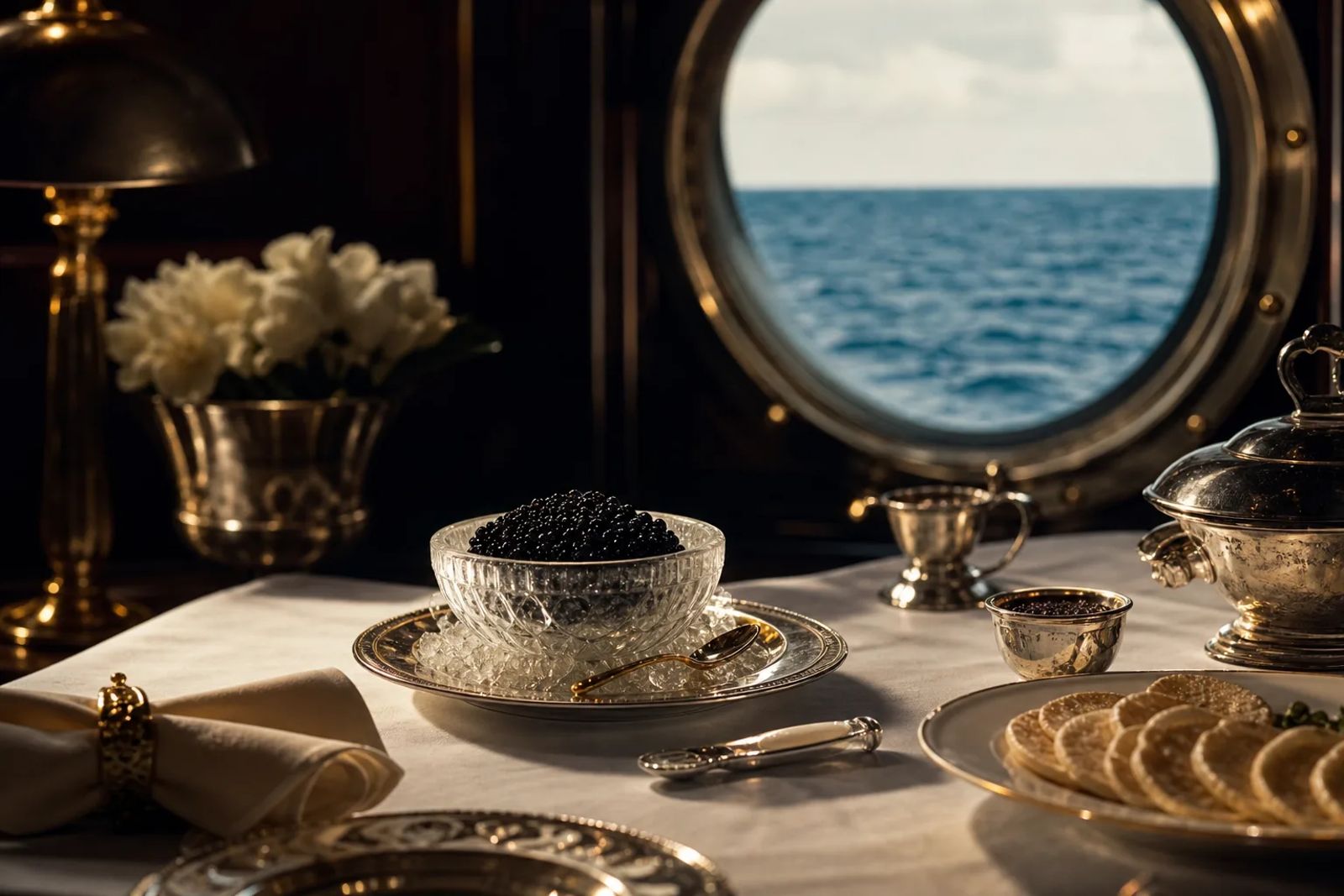
On 24 June 1939, the S. S. Brazil’s farewell-dinner menu offered a chilled luxury: beluga malossol caviar. Soup, seafood, meat dishes and desserts followed on the card. The surviving menu captures caviar’s place at the beginning of an elaborate shipboard meal. It also belongs to a wider travel story, from an 1883 account of the Orient Express, preserved in a later reproduction, to a contemporary report of Pan Am’s 1968 Moscow service.
Caviar on ocean liners: a place at the table
The Smithsonian Institution Archives preserves that American Republics Line menu in William and Lucile Mann’s South American travel scrapbook. Its English text names beluga malossol caviar. Beluga is the species CITES lists as Huso huso; malossol means lightly salted. These are the menu’s descriptions, rather than an independent identification of the roe.
Caviar also appears among the opening choices on Cunard White Star’s Queen Mary farewell-dinner menu of 4 June 1951, preserved in the Culinary Institute of America’s menu collection. Soups and fish courses follow. A cold buffet, salads, sweets and savouries complete the card: this was a substantial restaurant-style dinner, with caviar offered at the outset.
On 21 November 1958, another Queen Mary menu lists beluga malossol caviar alongside smoked salmon and oysters among the starters. The NYPL record and transcription survive online through the independent Menu Museum mirror.
Together, the menus establish repeated appearances across different decades, though not uninterrupted daily service on every crossing. Their surviving details give the story its texture: caviar beside oysters and smoked salmon, before soups and fish, within dinners that extended through sweets and savouries.
Chilled and plain: what service looked like
The Brazil menu calls its caviar glacé: chilled. The Queen Mary card of 1951 uses nature, meaning served plain, rather than as a prepared canapé or cooked dish. Two brief words give a direct glimpse of presentation.
The details stop there. Neither menu names a serving vessel, spoon material, garnish arrangement or portion weight. There is no basis for furnishing these tables with a particular bowl or spoon, however familiar those objects might seem today.
Nor does chilled service reveal how the caviar was stored. That requires a different kind of record: a provisioning ledger, refrigerator plan or steward’s manual. Modern storage advice cannot supply the missing historical detail.
Luxury trains: caviar across borders
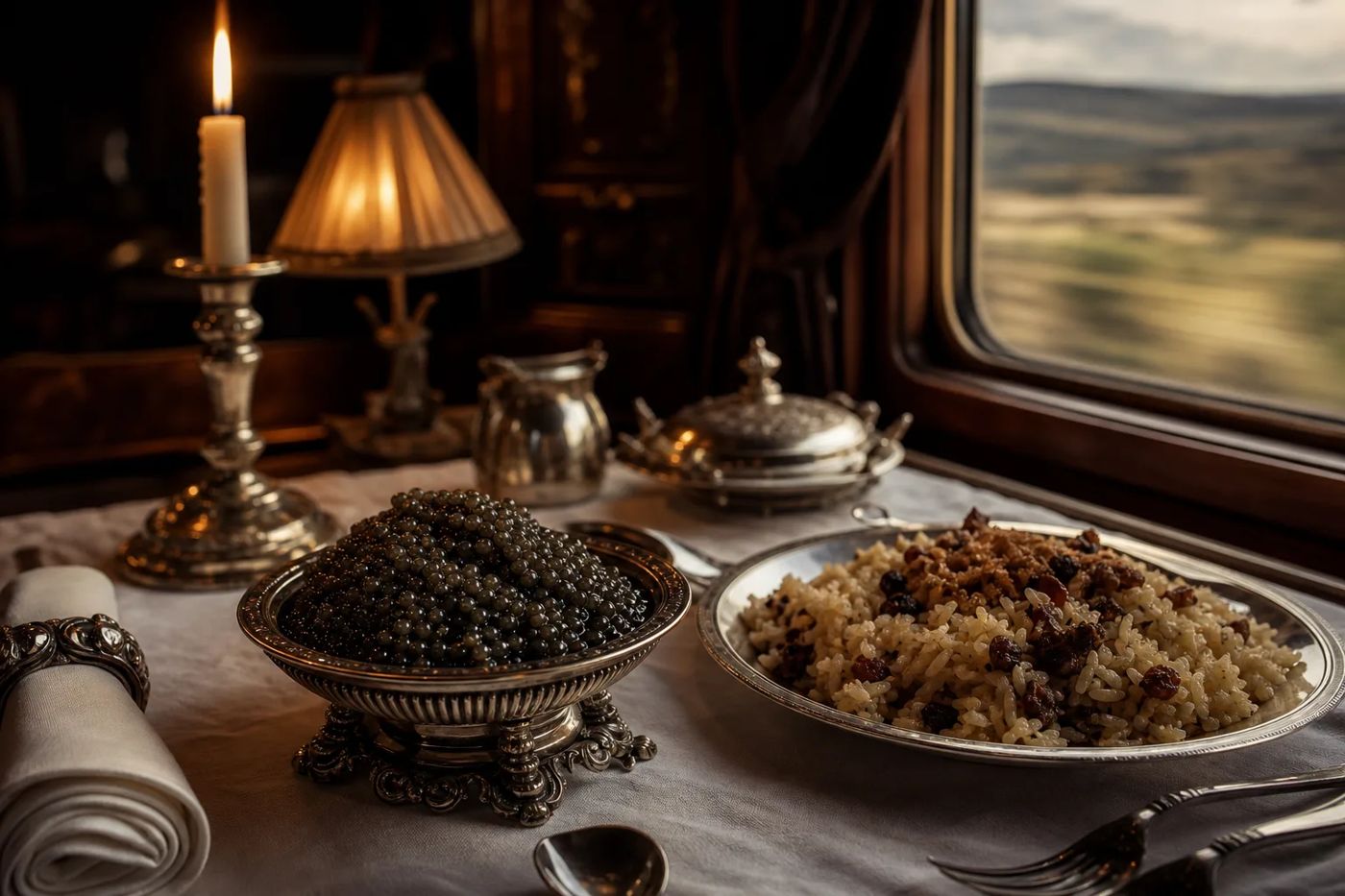
Fresh Romanian caviar, Danube sterlet and Turkish pilaf appear in an 1883 traveller’s account of the Orient Express. The meals changed with the countries crossed, making the dining car part of the journey rather than simply a place to eat.
The Bibliothèque nationale de France describes an 1883 traveller’s report of caviar aboard the train. Georges Boyer wrote about these meals in Le Figaro on 20 October 1883. RetroNews, a Bibliothèque nationale de France service, reproduces the passage without naming its author.
This is an account of caviar in the train’s early travel experience, not an inaugural menu or a printed bill of fare for a particular evening. “Romanian” gives the caviar a geographical description, but identifies no producer or merchant.
Fresh Romanian caviar, Danube sterlet and Turkish pilaf appear in an 1883 traveller’s account of the Orient Express.
The broader history of caviar follows the food beyond the dining car. Here, the interest lies in what the traveller recorded: caviar among meals whose character shifted as the train crossed borders.
Airlines: elaborate dining above the clouds
Seven-course Stratocruiser dinners, a lower cocktail lounge and roast beef carved aboard: the University of Miami Libraries’ Pan Am archive exhibition shows the scale of the airline’s dining ambitions. Its photographs identify galleys, food service and dining spaces, revealing the organisation behind the meal as well as the experience offered to passengers.
Caviar enters this record through a contemporary UPI report reproduced by the Pan Am Historical Foundation, which describes it aboard Pan Am’s 1968 Moscow service.
Air France’s own retrospective dates the debut of its first-class service to 1952. It also describes an earlier inspiration from cruises and sleeper trains. This points to continuity in the idea of travel dining, rather than establishing which airline first served caviar.
Who supplied the caviar?
Pan Am’s partnership with Maxim’s of Paris is documented in the Miami exhibition, along with commissary operations in several cities. It reveals a catering relationship, but does not identify the business supplying the roe. Menu planning, meal preparation, caviar production and importing are distinct activities.
The ship menus discussed here name no caviar supplier either. To attach a particular house to those voyages would take an invoice, contract, provisioning record or explicit contemporary acknowledgement.
The account of the Petrossian brothers tells their Paris history. It does not establish a transport contract. A famous name may fit the setting beautifully; the supply record still has to connect it to the ship, train or aircraft.
Three dates from surviving menus
| Date | Service and collection | What the menu records |
|---|---|---|
| 24 June 1939 | S. S. Brazil, American Republics Line; Smithsonian Institution Archives | Chilled beluga malossol caviar at the farewell dinner. |
| 4 June 1951 | Queen Mary, Cunard White Star; Culinary Institute of America | Plain caviar among the opening choices. |
| 21 November 1958 | Queen Mary; NYPL menu reproduced by The Menu Museum | Beluga malossol caviar among the starters. |
These dates fix an offer to a particular occasion, not the invention of caviar service. The 1883 railway report and later airline accounts supply a different kind of evidence from a printed menu.
Conservation: the missing supply records
CITES controls on international trade and restrictions on wild harvest changed the conditions under which travel operators sourced caviar. Tracing their effects on an individual carrier takes both regulatory and purchasing records.
There is no single switch-over year that can responsibly be assigned to ocean liners, luxury trains and airlines together. Nor can every restriction be described as a worldwide ban. The useful history lies in the details: which rules applied and what an operator’s purchasing records show.
What caviar said about status
Caviar’s position on the ship menus suggests distinction: an opening choice in an elaborate meal, rather than emergency sustenance for a long journey. A VARIG heritage website also associates it with first class. The theme is special service, without evidence that every accommodation class received it or every passenger ordered it.
A menu records what an operator wished to offer. Its descriptions of beluga and malossol cannot independently authenticate the contents, but its arrangement reveals caviar’s place in the ceremony of travel dining.
Where to go next
- Caviar in First Class, Private Jets and Superyachts: present-day service beyond the historical menus.
- Caviar in Restaurants, Hotels and Airlines: the catering and hospitality industry behind the plate.
Sources
-
Smithsonian Institution Archives. South American trip, 1939, William and Lucile Mann scrapbook, 1939. Includes the American Republics Line S. S. Brazil farewell-dinner programme and bilingual menu, 24 June 1939. Collection record and transcription.
-
The Culinary Institute of America, CIA Menu Collection. R.M.S. Queen Mary, Cunard White Star, farewell dinner menu, 4 June 1951, page 2. Menu record.
-
New York Public Library, What’s on the Menu? collection, reproduced by The Menu Museum. R.M.S. “Queen Mary”, 21 November 1958. Independent mirror of the NYPL menu images, catalogue information and transcription. Menu reproduction.
-
Bibliothèque nationale de France, RetroNews. 5 juin 1883 : premier voyage de l’Orient-Express, train de luxe légendaire, 21 June 2018. Reproduces Georges Boyer’s contemporary account and a May 1925 restaurant menu. Historical article and reproduced material.
-
University of Miami Libraries, Special Collections. Welcome Aboard, in Cleared to Land Exhibit, updated November 2021. Sections on dining, commissaries, Maxim’s and archival service photographs. Archive exhibition.
-
VARIG-branded heritage website. How was flying in the 1960s?, undated retrospective. The website describes caviar in first class during the 1960s. Heritage account.
-
BBC. Airline: The Story of Pan Am, 2011. Programme transcript reproduced by Subsaga; caviar recollection at approximately 17 minutes. Transcript reproduction.
-
Air France. La Première, corporate historical retrospective, Sections on the origins of its service and the 1950s. Corporate retrospective.
Last checked: November 2026