
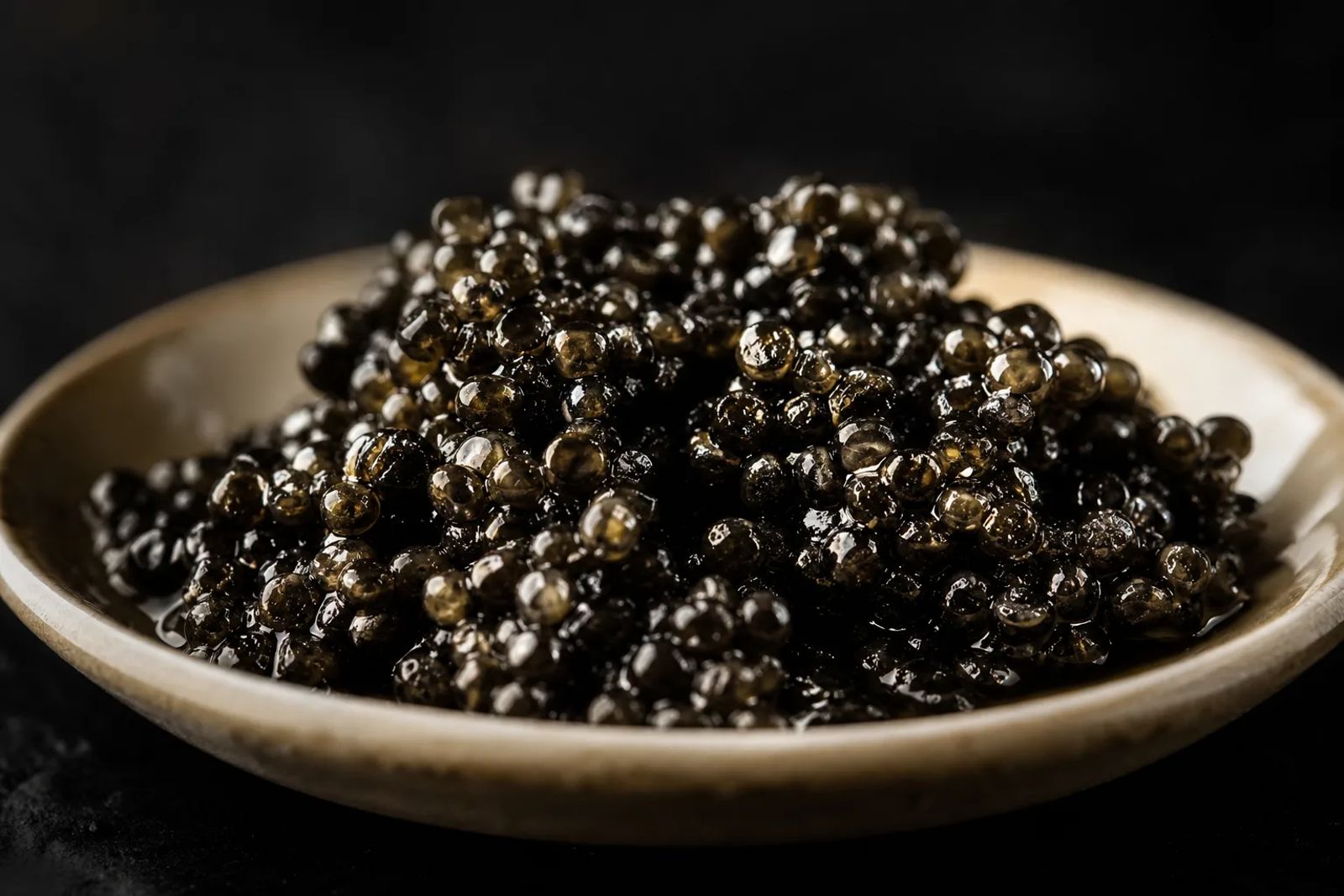
Caviar grains that tear as they separate are more than a disappointing spoonful: they are a defect specifically recognised by Codex. So are unacceptably hard coverings, broken eggs and fluid. These are useful, concrete observations, far more revealing than simply calling a tin “bad”.
Quality defects can begin with egg maturity or farm water, then develop through harvest handling, salting, packaging or storage. Soft beads, muddy flavour and excess liquid may signal a quality failure rather than a specific health hazard. Start with what you can see, smell and describe; investigation comes next.
In short
- Do not taste caviar from a swollen or leaking container, or continue eating it if it has mould or an abnormal sour smell.
- Codex lists defects including objectionable odours, broken eggs or fluid.
- Record the lot number and photograph the contents before contacting the seller.
Recognising caviar quality defects
Assess texture, aroma, flavour and appearance separately. A single judgement of “freshness” can conceal the detail that matters. For the broader framework, see caviar grading and quality. Use this table to describe a complaint, rather than diagnose its cause.
| Problem | Likely cause or contributor | Response |
|---|---|---|
| Soft, misshapen beads | Over-mature eggs are one documented cause | Record lost shape; contact seller |
| Broken beads and pooled liquid | Membrane damage; stage of damage uncertain | Photograph before disturbing |
| Clumps that tear apart | Adherence with fragile membranes | Do not force apart; report tearing |
| Tough, persistent skins | Raw-material and processing differences | Describe chewability |
| Earthy or muddy taint | Possible waterborne odour compounds | Ask about batch assessment |
| Rancid odour | Fat deterioration during storage | Stop eating; contact seller |
| Swelling, leakage or mould | Possible safety or packaging failure | Do not taste; see safety guidance below |
Texture: softness, stickiness and tough skins
A soft bead is not necessarily a damaged bead. Collapsed shapes, paste-like contents and broken membranes are more telling, as is whether the grains separate without tearing.
Egg development helps explain the difference. University of Florida fisheries researchers describe eggs softening as they approach ovulation. Over-mature eggs undergoing yolk resorption lose firmness and become irregular; immature eggs may lack their full size and colour.
Broken eggs call for a handling investigation as well as questions about ripeness. Record whether the damage runs throughout the contents or is concentrated where they have been disturbed. That pattern is useful information, although it cannot locate the original failure.
Sticky or clumped caviar needs a description of what happens during separation. Grains may lift together, separate cleanly or rupture as they part. Codex specifically recognises the last behaviour. Clumping alone leaves egg condition, processing and storage open as possible causes.
An unpleasantly chewy skin, meanwhile, is quite different from a firm bead. A Western Regional Aquaculture Center research programme found that feeding treatments could change skin thickness and breakability. Packing and position within a jar could also affect measured texture.
Excess liquid and surface oil deserve separate attention. Broken eggs can release both fluid and fat. A photograph can record a pool, but cannot establish its composition or cause; a wet appearance alone does not demonstrate oxidation.
What pasteurisation and freezing change
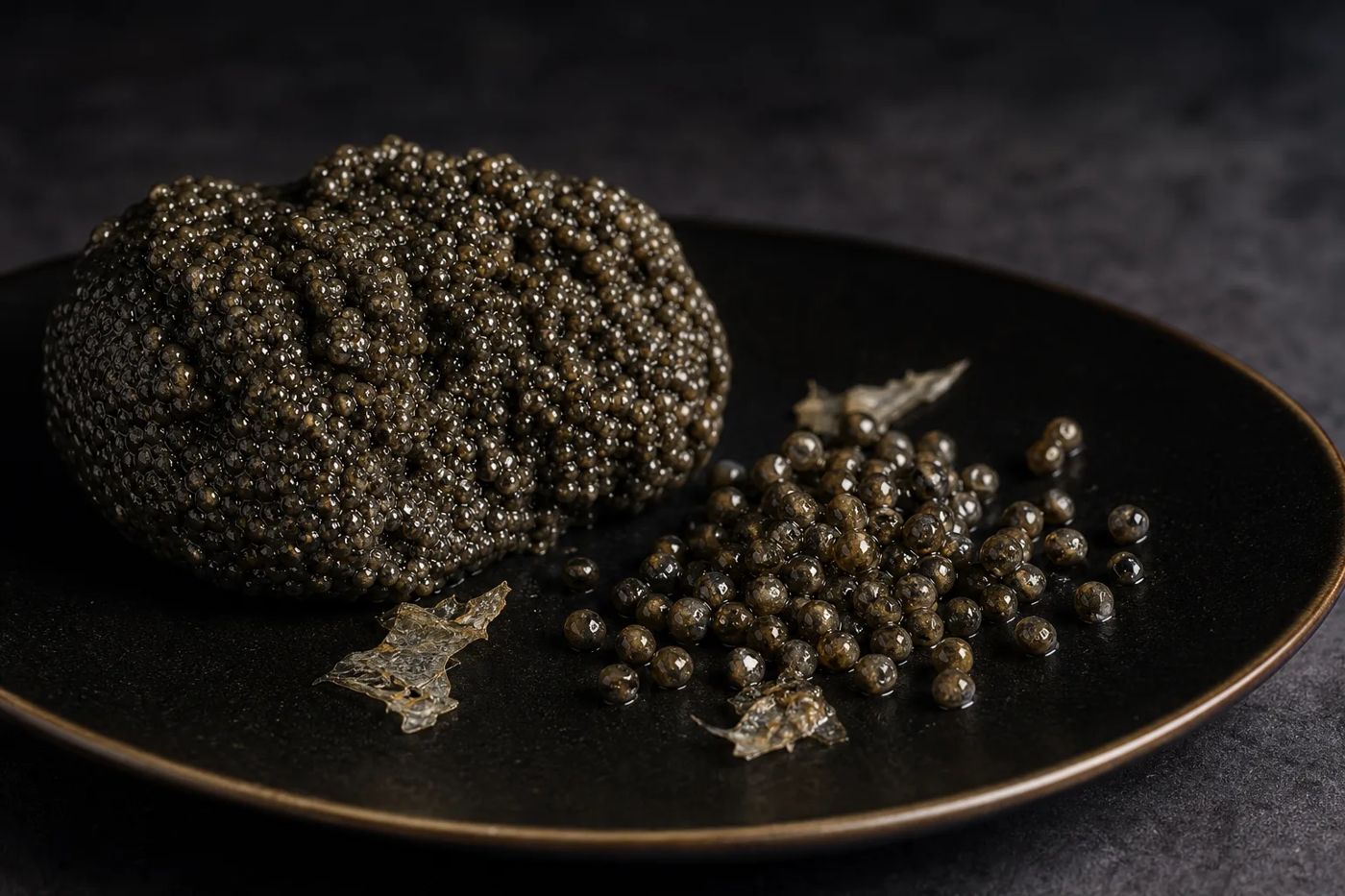
Pasteurisation is a heat treatment, not a quality defect. Research on sturgeon caviar shows that conventional heating can change texture, colour and flavour. The result depends on the treatment: “pasteurised” alone tells you neither how tough nor how soft the beads will be.
Freezing also depends on the process. If it damages egg membranes, separation and liquid retention can suffer. Yet specialised freezing and pre-freezing methods have been investigated successfully for sturgeon caviar. Evidence for those methods does not validate putting a chilled retail product into a domestic freezer.
Flavour and aroma: identifying the complaint
Earthy or muddy
An earthy, musty aroma can lead the investigation back to farm water. Geosmin and 2-methylisoborneol, usually shortened to MIB, are microbial odour compounds associated with these taints in aquaculture.
Researchers have detected both compounds in sturgeon-farm water. Instrumental analysis also linked earthy and musty taints in sampled white sturgeon fillets to geosmin and MIB. Those samples were fillets, not finished caviar, so the smell of a particular batch remains a clue rather than a chemical identification.
Purging farmed sturgeon examines clean-water holding and the evidence for removing these taints before harvest.
Rancid, sour or metallic
Rancidity is the deterioration of fats, not simply a strong fish aroma. In a refrigerated Russian sturgeon caviar study, researchers combined sensory assessment, volatile-compound analysis and other chemical methods. They found changes associated with lipid oxidation and the development of objectionable stored aromas.
Temperature and product condition shape that deterioration alongside elapsed time, so rancidity cannot reliably date a tin. For the chemistry, see lipids and oxidation; for everyday comparisons, see normal aroma versus quality problems.
Expert assessors in the Western Regional Aquaculture Center programme identified sourness and metallic flavours among undesirable characteristics. Sourness can accompany microbial spoilage; metallic notes can be associated with fat oxidation. Neither points to a single cause. An abnormal sour smell is a reason to stop eating.
Excessively salty or bland
Too much salt during processing can make caviar excessively salty. A mild flavour, meanwhile, may simply reflect the formulation. Ask for the declared salt content and product specification: blandness alone cannot establish dilution or mishandling.
Appearance: colour, dullness and foreign matter
Record uneven colour alongside shape and texture. Immature eggs may not yet have their full pigmentation, and processing can also change appearance. Lighter or darker beads do not, on their own, identify a particular failure.
Dullness needs the same context, especially the stated processing method. Foreign matter deserves separate attention. Distinguish apparent ovarian membrane or released fat from an unidentified particle, and report either. Do not pick out the apparent problem and carry on eating.

What Codex actually requires
Codex CXS 291-2010 gives granular sturgeon caviar an international reference standard. It is not automatically binding national law. The official text carries amendments through 2024, and the Codex register records a further modification in 2026.
Its defect provisions cover foreign matter, persistent objectionable odour or flavour, unacceptably hard coverings, membranes breaking during separation, broken eggs or fluid, and membrane remnants or secreted fat. They explicitly recognise decomposition, oxidation, feed taint and contamination as possible sources of objectionable flavour.
An earthy, musty aroma can lead the investigation back to farm water.
The standard specifies roughly equal-sized, characteristically coloured eggs and 3 to 5 g salt per 100 g of finished product. Freezing and frozen storage are permitted on the condition that they avoid quality deterioration. There is no unconditional ban.
How producers prevent defects
Quality control starts before the salt touches the eggs. Ripeness checks help producers select the intended stage of development. The University of Florida account describes sampling eggs and observing movement of the nucleus as one indicator of final maturation.
Water management and, where appropriate, clean-water purging tackle farm-related taints. In the sturgeon-water study, sludge from the drum filter held the highest concentrations of geosmin and MIB. The biofilters were not identified as a major source in those particular systems.
After harvest, the priorities are prompt hygienic processing, gentle handling, controlled salting and an uninterrupted cold chain. A visual grade alone cannot replace product-specific checks.
When quality becomes a safety question
A swollen or leaking container is a reason not to taste. Mould, an abnormal sour smell or another objectionable smell is a reason to stop eating. US FDA guidance advises against using mouldy, off-smelling or damaged products.
The reverse matters just as much: food can cause illness without looking, smelling or tasting spoiled, as the FDA's consumer storage guidance stresses. These warning signs call for stopping and reporting, not trying to identify an organism at home.
Use caviar spoilage warning signs for the disposal decision. Follow the producer's validated storage instructions throughout.
What to tell the seller
Contact the seller promptly. Send the product name, purchase details, lot number and photographs of both label and contents. Describe what happened before suggesting why: beads collapsing under light contact, liquid pooling around intact grains or an earthy aroma give the seller more to work with than “bad caviar”.
Include when the product arrived, when it was opened, how it was stored and any measured delivery or refrigerator temperature. Ask whether it was pasteurised or supplied under a validated frozen process. Request instructions for retaining, returning or disposing of it.
Before documenting the sample, do not rinse, re-salt, stir or otherwise alter it. The aim is to preserve evidence, not remedy the defect. Keep its original condition and batch information intact so the seller can investigate the batch.
Sources
-
FAO and WHO, Codex Alimentarius Commission. Standard for Sturgeon Caviar, CXS 291-2010. Adopted 2010; amendments listed in the retrieved official text: 2013, 2018 and 2024. PDF retrieved through FAO's official document proxy.
-
University of Florida, Institute of Food and Agricultural Sciences. Technically Speaking, What Is Sturgeon Caviar?. Publication FA194, retrieved web edition; revision date not established from the available text.
-
Western Regional Aquaculture Center, Barbara Rasco and collaborating researchers. Optimizing Quality and Shelf-Life of Sturgeon Caviar. Project termination report, 2006.
-
Al-Holy, M., Ruiter, J., Lin, M., Kang, D. H. and Rasco, B. Inactivation of Listeria innocua in nisin-treated salmon (Oncorhynchus keta) and sturgeon (Acipenser transmontanus) caviar heated by radio frequency. Journal of Food Protection, volume 67, issue 9, 2004, pages 1848 to 1854. Author-affiliated university record and abstract.
-
Da Silva and colleagues, Wiley. Distribution of Odorant Compounds in Recirculating Aquaculture Systems Used in Sturgeon Farming. Aquaculture Research, 2025, article 2377886.
-
US Department of Agriculture, Agricultural Research Service. Publication record for research on geosmin and MIB off-flavours in cultured largemouth bass and white sturgeon, 2005. Associated paper: Geosmin and 2-Methylisoborneol Cause Off-Flavors in Cultured Largemouth Bass and White Sturgeon Reared in Recirculating-Water Systems, North American Journal of Aquaculture, volume 67, issue 3, 2005, pages 177 to 180.
-
US National Library of Medicine, PubMed Central, repository host. Multi-omics combined approach to analyze the mechanism of flavor evolution in sturgeon caviar (Acipenser gueldenstaedtii) during refrigeration storage. Peer-reviewed study, 2024. Retrieved indexed passages; repository full-text access was intermittently blocked.
-
US Food and Drug Administration. Food Tampering, An Extra Ounce of Caution. Retrieved consumer-guidance web edition, November 2026.
-
US Food and Drug Administration. Are You Storing Food Safely?. Retrieved consumer-guidance web edition, November 2026.
This piece was researched against the official Codex text, university and government publications, and primary research, separating observed defects from unverified diagnoses.
Last checked: November 2026