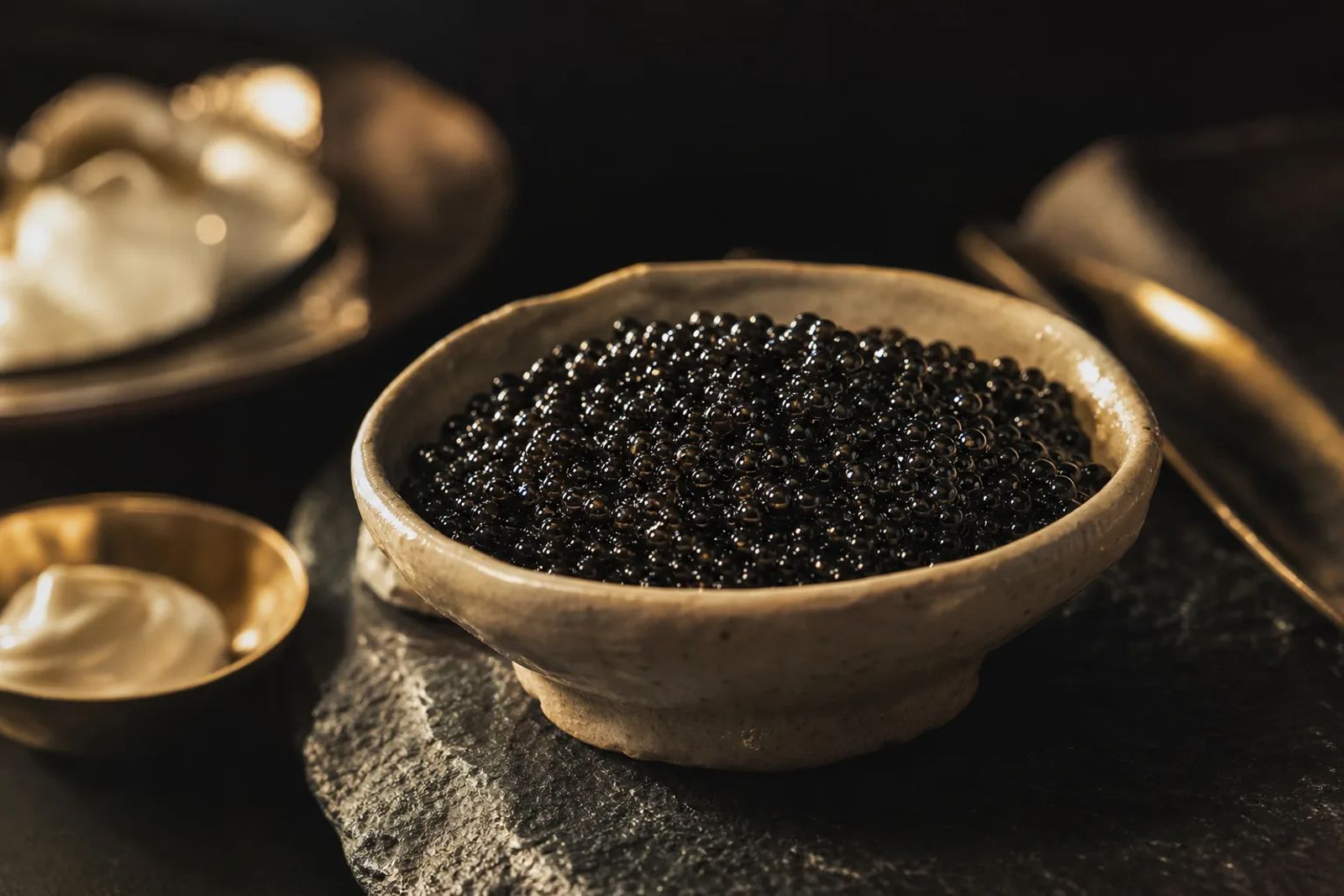
Vacuum-sealed, chilled to 4 °C (39 °F), and still changing: Russian sturgeon caviar followed over four weeks in a 2026 study developed volatile compounds as its membrane phospholipids oxidised. Cold storage slows the chemistry, but refrigeration is not proof that oxidation has stopped.
Caviar’s unsaturated fats can form compounds that change aroma, flavour and membrane integrity. Oxygen, light, temperature and time all influence those reactions. Establishing shelf life therefore means assessing quality alongside safety, within the legal responsibilities of the jurisdiction concerned.
Which lipids are present?
Caviar is not a uniform oil. It contains several lipid pools, each with a different role. Triacylglycerols, also called triglycerides, are storage fats. Phospholipids help form membranes and other cellular assemblies; phosphatidylcholine and phosphatidylethanolamine feature prominently in recent caviar studies.
In 2000, Wirth and colleagues analysed caviar from 22 wild fish and two farmed fish. Average fat contents ranged from 10.9 to 19.4 g per 100 g of wet product. The researchers separated triglycerides from phospholipids and measured their fatty acids, including EPA and DHA, two long-chain polyunsaturated fatty acids. Those figures describe the study’s samples rather than a specification for every tin.
For shelf-life work, both where the fat sits and how much is present matter. Oil extracted from whole eggs does not describe every membrane lipid separately. The nutritional story belongs in omega-3 in caviar; here, the question is how those lipids change during storage. For the wider framework, see caviar science.
Why caviar lipids oxidise
Oxidation can become a chain reaction. Polyunsaturated fatty acids contain multiple carbon-carbon double bonds, and hydrogen atoms between neighbouring double bonds are particularly vulnerable to removal. This allows a lipid radical to form and react with oxygen. The resulting peroxyl radical can attack another lipid, continuing the chain and producing lipid hydroperoxides.
These hydroperoxides are the primary oxidation products. As they break down, they generate secondary products, including aldehydes, ketones and alcohols. Some have a powerful effect on odour. Light offers another route, driving photosensitised oxidation through reactive singlet oxygen; enzymes such as lipoxygenase can also promote lipid oxidation.
Cooling slows these reactions without removing their reactants. Refrigeration and vacuum packing therefore need validation as controls, rather than being treated as guarantees that oxidation has stopped.
What oxidation markers reveal
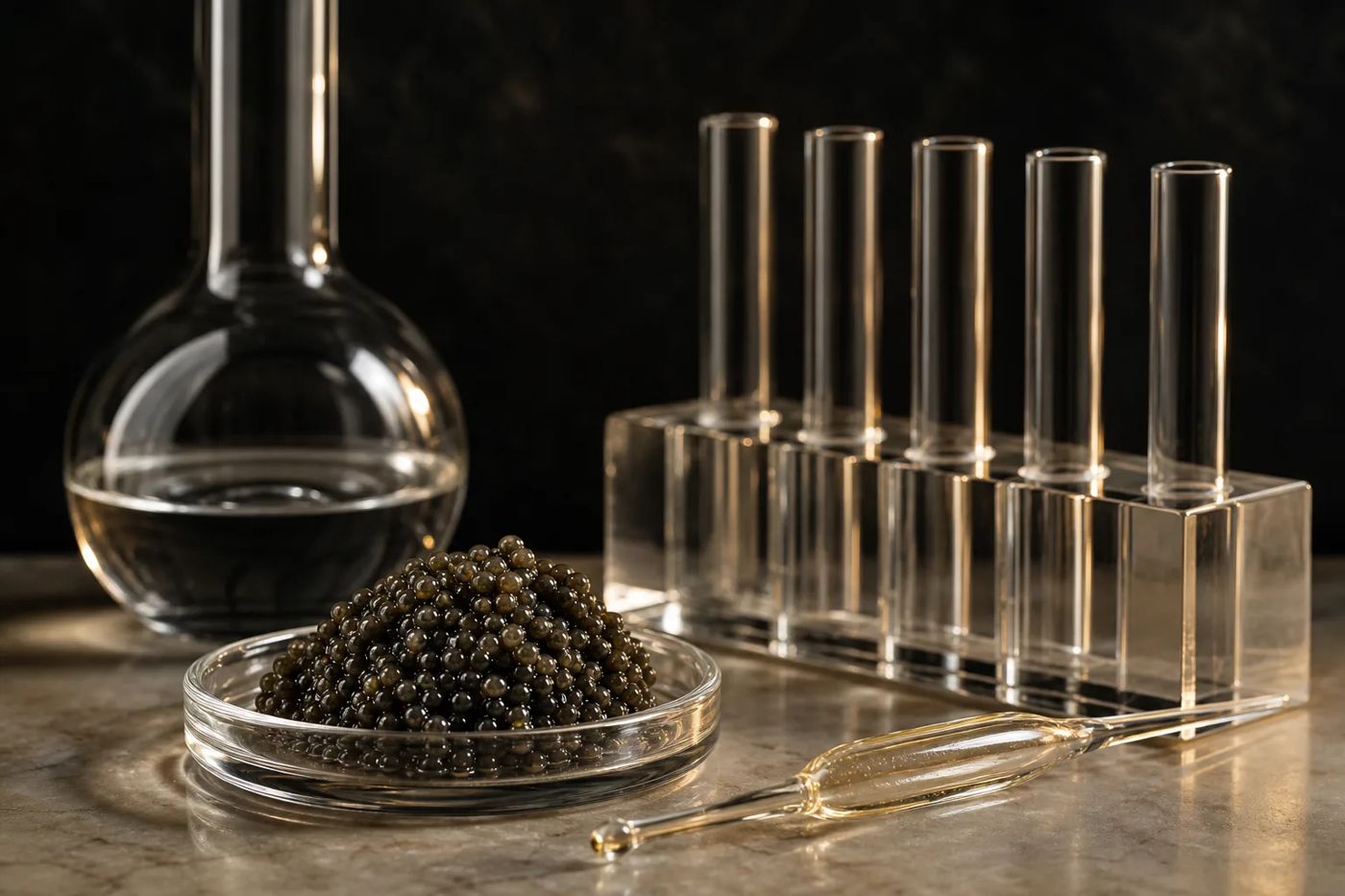
Three measurements answer three different questions: peroxide value tracks primary oxidation products, TBARS secondary products, and acid value lipid hydrolysis. They are complementary, not interchangeable.
Peroxide value, often abbreviated PV or POV, estimates the accumulation of primary peroxides in extracted lipids. Read the trend, not just the result. A low value can reflect hydroperoxides breaking down rather than an absence of oxidation.
TBARS, thiobarbituric acid reactive substances, measures secondary oxidation products, commonly reported as malondialdehyde equivalents. It does not capture every oxidised molecule. Extraction, reaction conditions and the reporting basis all affect the result, so the laboratory should state whether a value refers to whole caviar or extracted fat.
Acid value tracks free fatty acids released by lipid hydrolysis, the splitting of lipid molecules by water.
Maturation develops caviar towards a desired aroma, flavour and texture; an oxidation defect takes it away from an acceptable target.
Other methods reveal different parts of the picture. Gas chromatography coupled with mass spectrometry identifies volatile breakdown products. Lipidomics profiles individual lipids, while nuclear magnetic resonance can track changes in lipid structure.
Combine complementary measurements with trained sensory assessment. A changing volatile compound may explain a changing aroma; it does not, by itself, establish a universal rejection threshold or a food-safety limit.
Oxygen, light, temperature and packaging
Do not borrow a shelf life from another study. These three experiments used different products and storage conditions, and examined different aspects of lipid change. Their findings explain what happened to those samples, not how long another tin will last.
| Factor | Effect on lipids | Study and sample |
|---|---|---|
| Time under refrigeration | Membrane phospholipid oxidation accompanied volatile formation despite vacuum sealing. | Zhang et al., 2026: Russian sturgeon caviar, vacuum-sealed in 250 g cans at 4 °C (39 °F) for four weeks; three independent batch samples at each weekly time point. |
| Packaging oxygen transmission | Higher oxygen transmission was associated with greater secondary oxidation later in storage. | Salmon roe study, 2018: pasteurised ikura in two films with different oxygen transmission rates, stored for 60 days at 4 °C (39 °F); TBARS measured. Related roe evidence, rather than a sturgeon trial. |
| Time and lipid hydrolysis | Hydrolysis continued without evidence of intensive oxidation during the reported period. | Monitoring study, 2006: salted and unsalted farmed white sturgeon eggs at 4 °C (39 °F), examined chemically, by microscopy and by nuclear magnetic resonance. |
These experiments support validation for each product, not a single oxidation rate for chilled caviar. Distinguish mechanisms from experiments that actually changed a storage factor: none here isolates light exposure or compares storage temperatures, so they do not demonstrate those effects on caviar lipids.
For packaging specifications, assess residual oxygen, closure integrity, oxygen ingress and light protection together. Vacuum does not mean oxygen-free. Transparent packaging also needs assessment of its actual light exposure: container material alone cannot determine shelf life. The broader format comparison is covered in tins versus glass jars.
Maturation is not rancidity
Maturation develops caviar towards a desired aroma, flavour and texture; an oxidation defect takes it away from an acceptable target. More time in storage is not, by itself, maturation.
Codex CXS 291-2010 treats persistent, distinct objectionable odour or flavour indicating oxidation as a defect. It also lists broken eggs, fluid and secreted fat as defects, subject to its lot acceptance rules. Calling caviar “mature” does not excuse an oxidation-related aroma.
Follow aroma, taste and texture together, and distinguish lipid hydrolysis from oxidation rather than grouping every chemical change under one label. The practical distinction is acceptance against a defined target, supported by repeatable assessment.html).
Are antioxidant additives permitted?
Yes. Permission depends on the ingredient and the jurisdiction. An experimental treatment that suppresses TBARS is not itself a legal authorisation. Antimicrobial preservatives should not be confused with antioxidants.
- EU: Annex II of Regulation (EC) No 1333/2008 permits Group I additives, including ascorbic acid and tocopherols, in processed fish roe.
- Great Britain: The assimilated Annex II lists Group I additives for processed fish roe, subject to current GB conditions.
- Northern Ireland: EU additive rules generally apply, subject to the specific arrangements for qualifying retail goods moved from Great Britain.
- United States: Ascorbic acid is generally recognised as safe under 21 CFR 182.3013 when used according to good manufacturing practice. This is a general provision, rather than a caviar-specific approval.
Codex also accepts specified antioxidant classes through its reference to the General Standard for Food Additives. That international reference does not replace national authorisation or establish whether a particular commercial caviar contains an antioxidant.
How producers validate shelf life
A shelf life belongs to a defined product and process: roe supply, salting, any permitted additives, treatment, container, seal and distribution conditions. Food Standards Scotland’s 2025 guidance makes the responsibility clear. No standard method applies to all foods; the operator must demonstrate that the assigned life is appropriate.
For oxidation, follow representative production batches in their intended packaging, using predefined sampling points and acceptance criteria. Pair primary and secondary oxidation measurements with sensory assessment and relevant texture measurements. Record analytical methods and units so that changes can be interpreted consistently.
Microbiological safety is a separate obligation alongside this product-specific quality work. In the EU, Regulation (EC) No 2073/2005 requires operators to meet applicable food safety criteria for products placed on the market during their shelf life, under reasonably foreseeable distribution, storage and use. Process hygiene criteria apply at the stages specified in the regulation.
Where necessary, manufacturers must conduct shelf-life studies, particularly for ready-to-eat foods that can support Listeria monocytogenes growth. Great Britain applies its assimilated version of that regulation; Northern Ireland generally applies the EU version.
Annex II requires consideration of characteristics such as pH, water activity, salt, preservatives and packaging, with additional modelling, challenge testing or durability studies where necessary. Oxidation testing cannot replace this microbiological assessment.
Re-examine the evidence whenever formulation, packaging or process changes materially. During routine production, verification should establish that validated conditions still hold. One successful trial cannot be assumed to cover every subsequent batch.
Why the caviar shelf life date matters
Follow the date and storage instructions on the product, including any separate instructions after opening. A published storage experiment describes its own samples, not the contents or history of another producer’s tin. A duration from a research paper or a different brand is no substitute for those instructions.
A use by date concerns safety; a best before date generally concerns quality. Neither an acceptable smell nor a favourable oxidation result establishes microbiological safety. For practical date interpretation and handling, use how long caviar lasts, rather than calculating a new expiry date from lipid chemistry.
Sources
- Institute of Freshwater Ecology and Inland Fisheries, Wirth et al. Chemical and biochemical composition of caviar from different sturgeon species and origins. Nahrung, 44(4), 233 to 237, 2000. PubMed record.
- Zhang et al., Ocean University of China and collaborating institutions. The influence mechanism of phospholipids structure and composition changes caused by oxidation on the formation of flavor substances in sturgeon caviar. Food Chemistry, 460, 140585, 2024. PubMed record.
- Zhang et al., Ocean University of China and collaborating institutions. Mechanistic insights into the associations of membrane phospholipids oxidation and membrane protein contributions with flavor evolution in sturgeon caviar during storage. Food Chemistry, 528, 151096, 2026. Publisher record.
- Journal of Aquatic Food Product Technology. Quality Changes in Chum Salmon (Oncorhynchus keta) Caviar (ikura) Affected by Thermal Pasteurization, Storage Time, and Packaging Material. Volume 27(2), 2018. Published study.
- Journal of Agricultural and Food Chemistry. Monitoring the effects of storage in caviar from farmed Acipenser transmontanus using chemical, SEM, and NMR methods. 2006. PubMed record.
- Kato, Tohoku University. Mechanistic principles of lipid oxidation: from hydroperoxide formation to secondary oxidation reactions. Bioscience, Biotechnology, and Biochemistry, 90(7), 847 to 859, 2026. PubMed record.
- Food Chemistry: X. Multi-omics combined approach to analyze the mechanism of flavor evolution in sturgeon caviar (Acipenser gueldenstaedtii) during refrigeration storage. Volume 23, 101688, 2024. Published study.
- FAO and WHO, Codex Alimentarius Commission. Standard for Sturgeon Caviar, CXS 291-2010, amended in 2013, 2018 and 2024. Sections 4, 7.2, 8.2 and 9. Canonical PDF, via FAO's document service.
- European Parliament and Council. Regulation (EC) No 1333/2008 on food additives, Annex II, Parts C and E, category 09.3. Consolidated text dated 28 October 2024. EUR-Lex.
- Food Standards Agency, GOV.UK. Food additives authorisation guidance, published 2020, live guidance checked November 2026. Sections 1, 6 and 8.1. Official guidance.
- US Food and Drug Administration. 21 CFR 182.3013, Ascorbic acid, current electronic text checked November 2026. eCFR.
- European Commission. Regulation (EC) No 2073/2005 on microbiological criteria for foodstuffs, Article 3 and Annex II. EUR-Lex identifies the current consolidation as 1 July 2026. EUR-Lex.
- Food Standards Scotland. Shelf-life guidance 2025, public guidance summary and March 2025 guidance listing. Official guidance.
- Food Standards Agency, GOV.UK. Managing food safety, updated 21 August 2026. Sections on assimilated law, microbiological criteria and Northern Ireland arrangements. Official guidance.
This piece was researched using peer-reviewed studies, Codex documents, legislation and food-authority guidance, separating experimental findings from operational recommendations and legal requirements.
Last checked: November 2026