
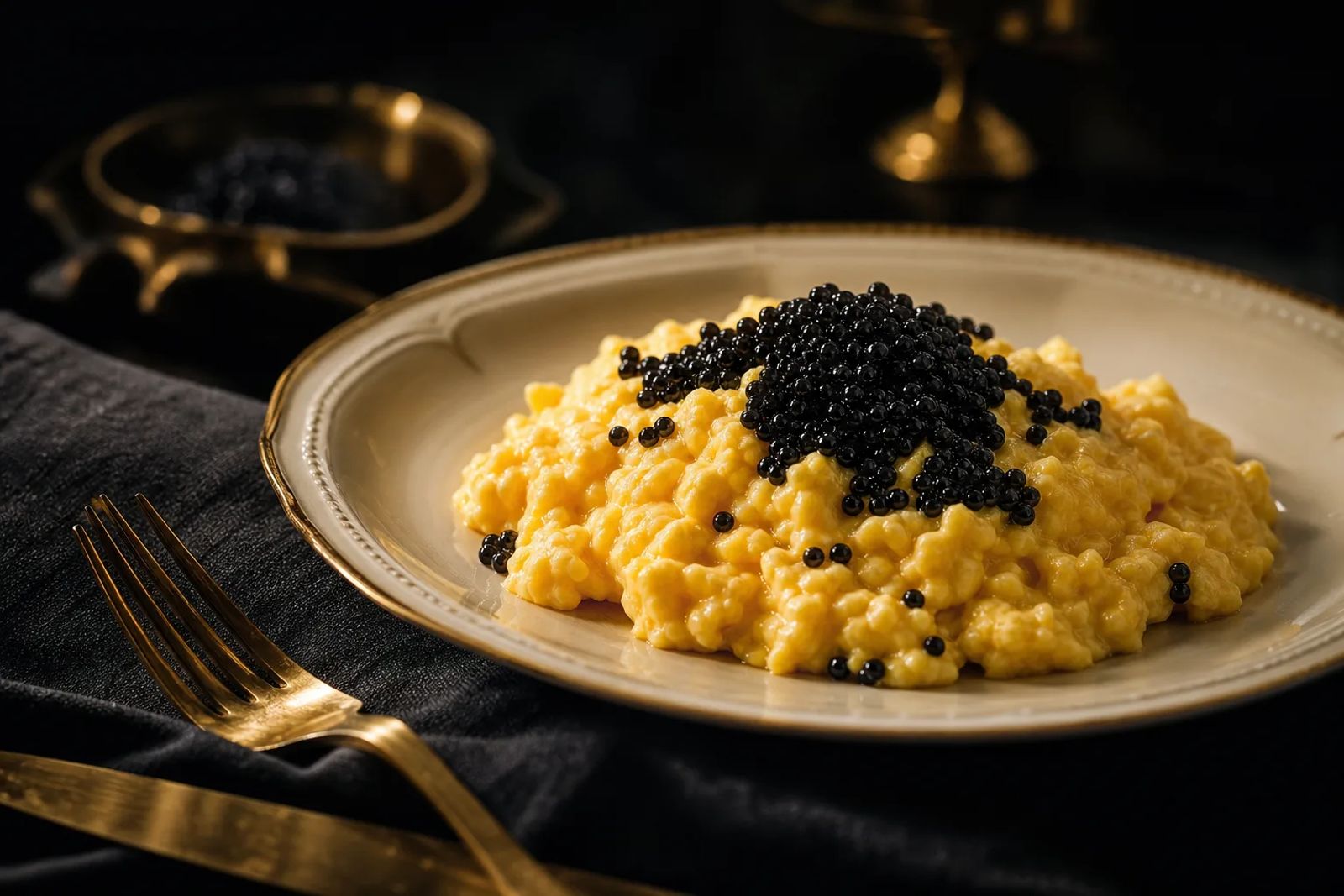
Soft scrambled eggs, then caviar: Belmond’s method leaves the roe until the end, where its distinct beads, salt and aroma can change each mouthful. The eggs are cooked. The caviar is the finishing touch.
Choose the dish first, follow a reliable recipe’s quantity and keep the caviar cold until the last moment. The best preparation often happens before the tin is opened.
What caviar brings to the plate
A spoonful of caviar can sharpen a dish without becoming its main ingredient. Great British Chefs describes its role in seafood dishes as intensifying flavour; the Culinary Institute of America teaches serving methods that preserve the individual eggs. Flavour and distinct beads are the point.
Add caviar at the end, off the heat. Codex processing guidance notes that prolonged heating of caviar proteins might affect taste and texture. Belmond’s scrambled egg method follows that sequence: prepare the base, then finish with caviar. Season the base lightly. Taste a complete mouthful, caviar included, before making the final adjustment, especially if the dish already contains smoked fish, salted butter, cheese or soy sauce.
Choosing caviar by species and style
For distinct beads against soft eggs or potato, look for firmness. The Culinary Institute of America describes farmed white sturgeon, Acipenser transmontanus, as firm textured, with a rich flavour. That makes it a useful candidate when the topping should remain distinct rather than disappear into the base.
Start with the species named on the product, then read the producer’s description of that particular caviar. Great British Chefs describes Siberian sturgeon caviar, Acipenser baerii, as delivering an immediate burst of flavour, and a Royal Oscietra as having a more lingering character. It does not state the latter’s species. Oscietra is a trade name, so check the species on the product.
Those descriptions help frame a choice between a stronger accent and a quieter accompaniment. They describe particular caviars, rather than a fixed ranking that applies to every tin.
Style matters too. Malossol means lightly salted, but two products need not taste equally salty. Compare salt declarations where available and ask whether the beads are firm or soft. For a visible topping, choose intact, firmer eggs. For a spread, a softer texture may suit the job.
When another roe is the right choice
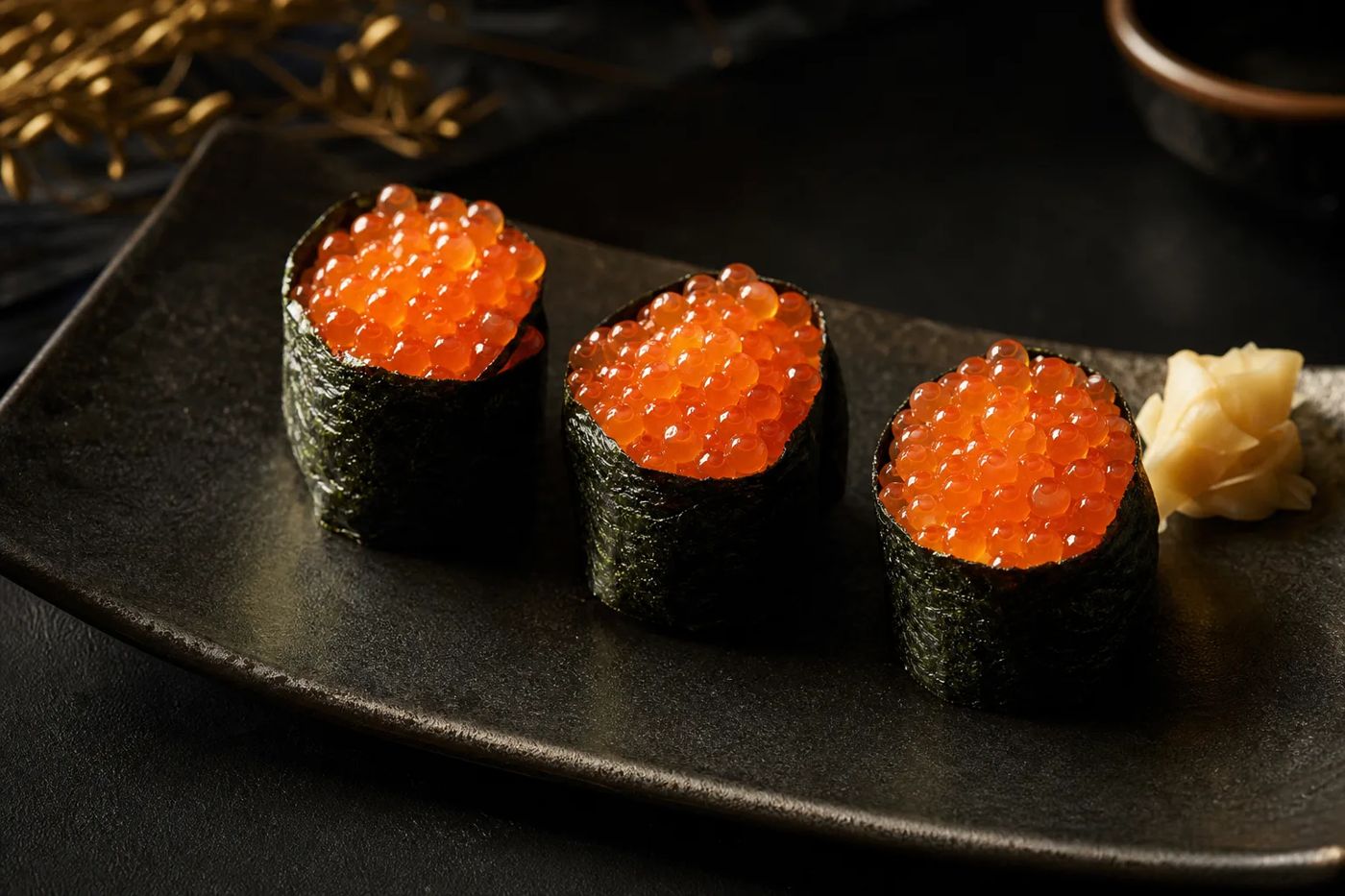
Salmon roe is often the more appropriate starting point for Japanese rice dishes. Japan’s Ministry of Agriculture, Forestry and Fisheries documents soy-marinated ikura served on rice and in hand-rolled sushi. This is a culinary tradition in its own right, not simply a way to replace sturgeon caviar.
Roe means fish eggs. Whether choosing trout roe, flying fish roe or another prepared roe, begin with a recipe that names it rather than swapping it for caviar spoon for spoon. Check the salt, any smoke or marinade, and the size of the topping.
Chef Eric Wolfinger’s chocolate and rye cheesecake with caviar shows where sweet meets savoury.
The guide to salmon roe vs sturgeon caviar explains the comparison. For dishes built around other fish eggs, go straight to roe recipes.
How much caviar does a recipe need?
Use the recipe’s stated weight. A small first course and a sushi topping ask different things of their roe, as these published examples show. The per-person figures are simple divisions of the published totals.
| Dish family | Roe in source | Published quantity | Recipe route |
|---|---|---|---|
| Eggs: Gourmet’s eggs en coque | Sturgeon caviar, preferably osetra | 50 g for 6 first-course servings; 50 ÷ 6 = about 8.3 g each | scrambled eggs |
| Eggs: Belmond’s soft scramble | Caviar, species unspecified | 50 g for 4; 50 ÷ 4 = 12.5 g each | egg recipes |
| Seafood | No cited recipe | No cited recipe | seafood |
| Pasta | No cited recipe | No cited recipe | pasta |
| Sushi: Kikkoman’s gunkan rolls | Salmon roe | 50 g for 2; 50 ÷ 2 = 25 g each | roe recipes |
| Sauces | No cited recipe | No cited recipe | sauces |
| Potatoes | No cited recipe | No cited recipe | potatoes |
| Snacks | No cited recipe | No cited recipe | snacks |
| Sweet dishes | No cited recipe | No cited recipe | sweet dishes |
| Canapés | No cited recipe | No cited recipe | canapés |
| Leftovers | No cited recipe | No cited recipe | leftover caviar |
The table cites no recipe for eight families: seafood, pasta, sauces, potatoes, snacks, sweet dishes, canapés and leftovers. Use the weight in the recipe you select; for leftovers, find a preparation suited to what remains.
Caviar may finish a small first course; roe may form a substantial part of a sushi topping. Keep those roles separate when planning portions. The sushi quantity is not a canapé allowance, and a main course does not automatically need more caviar than a starter.
Find your recipe family
Eggs: Soft scrambled eggs keep the preparation straightforward: make the base separately, then add the topping. Scrambled eggs with caviar is a useful first dish.
Seafood: Cured salmon, sea bass blinis and scallop ceviche all appear in Great British Chefs’ caviar repertoire. The seafood route in the recipe hub opens up both cooked bases and raw preparations.
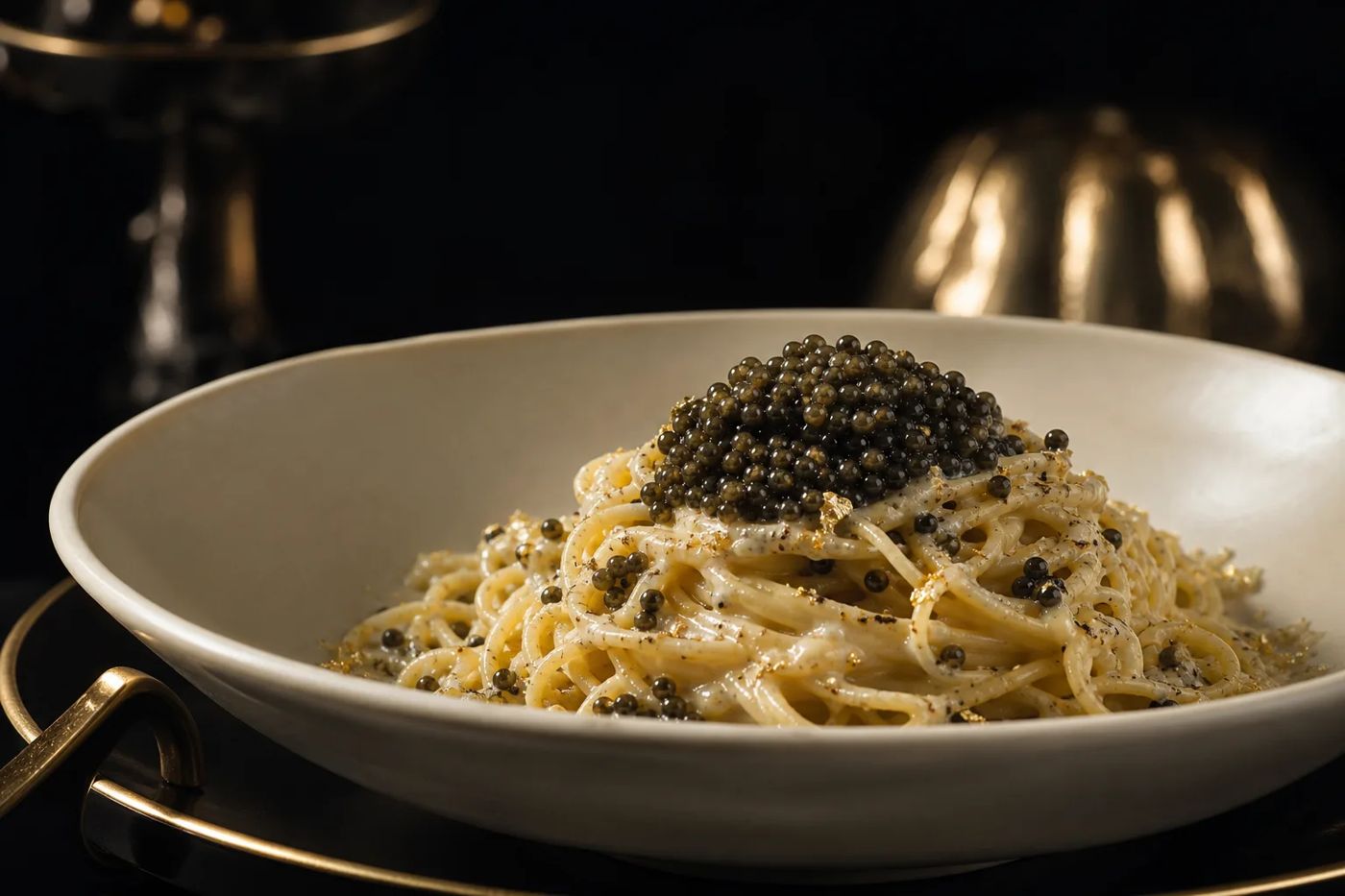
Pasta: A restrained butter or cream dressing gives caviar room, rather than making it compete with several assertive toppings. Keep that balance in mind when adapting pasta recipes.
Sauces: Chef Philip Tessier’s published fish dish with caviar cream illustrates the contrast: the sauce can carry the main flavour while caviar supplies the finishing texture. Explore that balance in the sauce family.
Potatoes: Crisp or soft is the first decision. Rösti, potato cups and other bases offer different contrasts with the beads; potato recipes make a useful next step after eggs.
Snacks: Grilled cheese brings caviar into less formal territory, a combination recorded by the American Culinary Federation. With snack recipes, prepare the base first and add the roe only when ready to eat.
Sushi: Rice bowls and hand rolls give ikura its established place at the table. Turn to roe recipes for those dishes rather than forcing sturgeon caviar into them.
Canapés: Blinis with cured fish offer a layered bite in miniature. The canapé recipes help keep the base, topping and final assembly manageable.
Sweet dishes: Chef Eric Wolfinger’s chocolate and rye cheesecake with caviar shows where sweet meets savoury. Start with a sweet recipe built for the combination, rather than assuming any dessert will work.
From cold tin to finished plate
Prepare the rest of the dish before opening the caviar.
The Culinary Institute of America recommends opening just before service, keeping the container over ice and using a non-reactive spoon: mother-of-pearl, horn, glass or clean food-safe plastic.
Lift gently; do not press the beads against the container. Use a clean spoon each time you return for more. Keep raw fish utensils away from the ready-to-eat roe, and never return a tasting spoon to the tin. Protect the final garnish from cross-contamination.
For storage, follow the product’s stated temperature and after-opening instructions. US FDA home guidance specifies a refrigerator at 4°C (40°F) or below; use a colder product instruction where given. Serving briefly on warm food does not change those storage instructions.
Check safety before choosing the dish
For pregnant or immunocompromised guests, check the intended eggs, fish and roe before settling on a recipe. Follow local advice for raw fish and chilled ready-to-eat roe.
Eggs and raw fish: US USDA FSIS advises people at higher risk to avoid raw fish and raw or lightly cooked eggs; FDA recommends pasteurised eggs for preparations served raw or undercooked. UK FSA catering guidance includes pasteurised egg for uncooked preparations. Ireland’s safefood advises fully cooked eggs for vulnerable groups; EU EFSA advises thorough cooking of eggs and seafood.
Chilled smoked or cured fish: The UK FSA advises people who are pregnant or have a weakened immune system to cook chilled ready-to-eat cold smoked or cured fish until steaming hot.
Time out of refrigeration: For seafood, the US FDA advises no more than two hours out of refrigeration, or one hour above 32°C (90°F). In Australia and New Zealand, FSANZ guidance for potentially hazardous food held between 5°C (41°F) and 60°C (140°F) counts the total time:
- Under two hours: use it or return it to the fridge.
- Two to four hours: use it immediately.
- Four hours or more: discard it.
Follow any stricter product instructions and keep preparation brief; these limits are not serving targets. A pleasant smell cannot establish safety.
Chilled ready-to-eat fish products can carry Listeria. Anyone needing pregnancy or medical advice should ask their midwife or doctor about the intended dish.
Plan for the opened tin
Decide before you start which dishes will use the caviar within the producer’s stated period. Weigh out the recipe’s quantity, promptly return the remainder to its specified storage conditions and plan a second simple preparation. Avoid repeatedly bringing the whole container to the table.
Mixing caviar into butter does not restart its shelf life or make mishandled roe safe. Leftover caviar covers ways to use it while keeping the original storage allowance in view. Choose the next dish while you still know exactly how the caviar has been kept.
Sources
- Great British Chefs. Caviar recipes. Web collection, undated, accessed 2026. Chef examples involving seafood and blinis. Source.
- Culinary Institute of America. Caviar. Teaching slides, publicly hosted 2025; revision not stated. Sections on farmed California white sturgeon, salting and serving utensils. Source.
- Belmond, Bre Graham. Recipe: Soft Scrambled Eggs and Caviar. Web edition, undated, accessed 2026. Ingredients, four servings and finishing sequence. Source.
- Great British Chefs. Making the grade: a guide to caviar. 23 November 2015. Attributed sensory descriptions only. Source.
- Japan Ministry of Agriculture, Forestry and Fisheries. Ikura no Shoyu-zuke (Soy Sauce-marinated Salmon Roe), Our Regional Cuisines. Web edition, undated, accessed 2026. Source.
- Gourmet, reproduced by Epicurious. Scrambled Eggs en Coque with Caviar. 21 September 2004. Ingredients and six first-course servings. Source.
- Kikkoman. Super temaki, section on making ikura gunkan sushi. Japanese web edition, undated, accessed 2026. Ingredients for two people and eight pieces. Source.
- Sterling Caviar. Recipes. Producer’s recipe collection, undated, accessed 2026. Producer's recipe collection, including Philip Tessier's pan roasted sturgeon with caviar cream;
- American Culinary Federation. The National Culinary Review. May 2015 edition. Caviar feature discussing eggs, salads and grilled cheese. Source.
- US Food and Drug Administration. What You Need to Know About Egg Safety. Web guidance, accessed 2026. Source.
- US Department of Agriculture, Food Safety and Inspection Service. Are there any foods persons at-risk should not eat? Updated 1 October 2024. Source.
- Food Standards Agency. Safe Catering: your guide to making food safely. Issue 7, April 2019, accessed 2026. Advice on pasteurised egg in uncooked and lightly cooked preparations. Source.
- safefood. How to cook eggs safely. Web guidance, undated, accessed 2026. Advice for vulnerable groups in Ireland. Source.
- European Food Safety Authority. Proper food handling. Safe2Eat web guidance, accessed 2026. Cooking, separation and refrigeration advice. Source.
- US Food and Drug Administration. Selecting and Serving Fresh and Frozen Seafood Safely. Web guidance, accessed 2026. Refrigeration, cross-contamination, serving limits and higher-risk consumers. Source.
- Food Standards Australia New Zealand. Food safety basics and 2-hour / 4-hour rule. Web guidance, accessed 2026. Consumer precautions and cumulative time accounting. Consumer guidance; time-control guidance.
- Food Standards Agency, GOV.UK. How to chill, freeze and defrost food safely. Web guidance, accessed 2026. Packaging instructions, chilled handling and the limits of refrigeration against Listeria. Source.
- US Food and Drug Administration. Fish and Fishery Products Hazards and Controls Guidance. June 2022 edition. Pathogen hazards and controls for ready-to-eat fishery products. Source.
This guide was researched from published chef recipes, culinary teaching material and national food-safety guidance; no recipe testing or first-hand tasting by the site is claimed.
Last checked: November 2026